

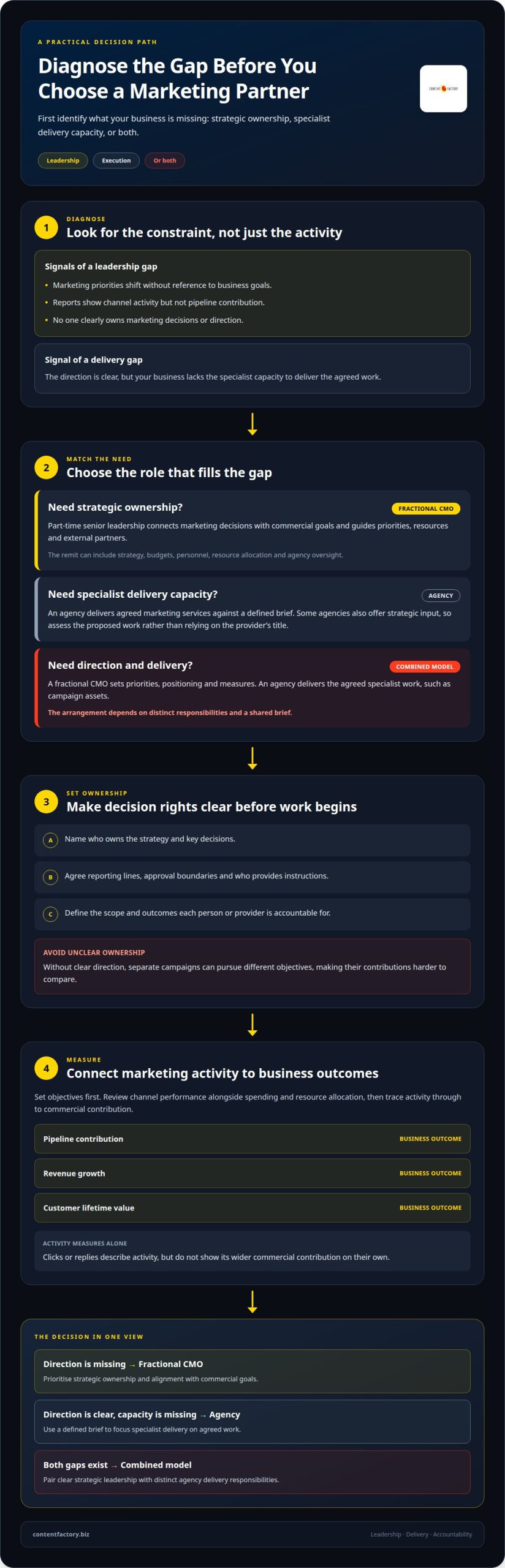
Hiring an agency may seem like the obvious way to solve a marketing problem, but the real issue may be a lack of strategic ownership. When hiring a fractional CMO vs an agency, choose a fractional CMO when you need senior leadership to connect marketing decisions with commercial goals. Choose an agency when your direction is clear but you lack specialist delivery capacity. If both gaps exist, a combined model may fit.
Both options bring expertise, but their roles differ. A fractional CMO provides part-time leadership, guiding priorities, resources and external partners. An agency delivers agreed marketing services and may also offer strategic input. Define what your business needs before choosing a model.
This guide shows you how to assess that need. You’ll learn how the options differ in strategic alignment, implementation, accountability and scope. It also explains how consultants, internal teams, fractional leaders and agencies can work together without unclear ownership. By the end, you’ll have a practical way to identify your gap and choose an arrangement that supports your business goals.
Key Takeaways
- Start by diagnosing the gap: your business may need strategic leadership, more execution capacity, or both.
- Assess marketing against pipeline contribution, revenue growth and customer lifetime value, not channel activity alone.
- Clarify decision rights, reporting lines and outcome ownership before engaging a fractional marketing leader.
- Pair strategic direction with agency delivery when your business needs both a coherent growth plan and specialist execution.
- Compare engagement scope as well as fees: leadership, implementation and channel services cover different needs.
Fractional CMO alignment of marketing with business goals
A fractional CMO connects marketing priorities to commercial objectives, then establishes a structure for decision-making and measurement. This strategic leadership can help when marketing activity lacks a clear link to the business plan.
ROI and Business-Growth Accountability
Assess marketing ROI against business outcomes, not channel activity alone. A fractional CMO can connect channel performance to pipeline contribution, revenue growth and customer lifetime value. These measures show more than clicks or reply rates, which describe activity but not its wider commercial contribution. Set objectives first, then review results alongside spending and resource allocation.
Businesses turning over £300k to £2m may find it difficult to justify a marketing team or multi-channel agency retainer. The key question is whether the business needs senior direction, more delivery capacity, or both. A fractional CMO can review the existing structure, identify gaps and align available resources with the company’s growth goals.
- Link each marketing priority to a commercial objective.
- Track pipeline contribution, revenue growth and customer lifetime value.
- Review channel performance against those outcomes.
For example, an outreach campaign may generate replies without attracting qualified prospects. Trace results from channel activity to sales conversations and pipeline contribution. This gives leadership a clearer basis for adjusting the plan or reallocating resources, rather than treating a strong channel metric as proof of business growth.
When a Fractional CMO Is Needed
A business may need fractional marketing leadership when no one owns the connection between commercial goals and marketing decisions. This can happen when internal resources are limited, priorities compete or activity across channels lacks a shared direction. Unlike a specialist focused on delivery, a fractional CMO can oversee strategy, budgets, personnel and resource allocation.
Look for practical signals: marketing priorities shift without reference to business goals; reports show activity but not pipeline contribution; or teams lack clear decision ownership. If strategy is clear but delivery capacity is the constraint, an agency may fit better. A defined brief lets specialists focus on agreed work, such as content marketing agency services. Choose leadership when direction is missing, and execution support when priorities are already clear.
Fractional CMO vs Agency: What’s the Right Fit?
For a Singapore business, choose a fractional CMO when strategic ownership is missing, and an agency when delivery capacity is the gap. To vet either option, compare its proposed scope, relevant experience, decision rights and reporting against your commercial objectives.
Strategic Leadership and Tactical Execution
Strategic leadership sets the direction: which audiences to prioritise, what the business needs to achieve and how marketing should contribute. Tactical execution turns that direction into defined channel work, such as producing campaign assets. A fractional CMO typically leads strategic decisions; an agency usually delivers an agreed brief. Some agencies also advise on strategy, so assess the proposed work rather than relying on the provider’s title.
Fractional CMO Accountability
A fractional CMO can connect marketing decisions to company priorities and coordinate internal teams with external agencies. Define which decisions the leader owns, who reports to them and which outcomes they are accountable for. In an agency engagement, the business generally retains responsibility for overall direction and resource allocation. Clear authority helps prevent delayed approvals and conflicting instructions.
In Singapore, vet candidates by asking how they would:
- Translate a commercial objective into a marketing plan.
- Set decision rights, reporting lines and approval boundaries.
- Assess delivery against agreed business outcomes.
Agency Execution With Strategic Leadership
A combined model suits a business that needs both strategic direction and specialist execution. The fractional CMO can define priorities, positioning and measures; the agency can deliver agreed campaign work. For example, the CMO sets the audience and business objective, while the agency develops campaign assets and reports on delivery. This arrangement works when responsibilities are distinct and everyone shares the same brief.
Agency Risks Without a Strategy
Without a strategy, an agency may deliver activity that does not support a consistent business objective. One campaign might prioritise reach while another pursues lead volume, leaving the team unable to compare their contributions. A written direction, audience and outcome give the agency a usable brief. They also make later reviews more meaningful than checking channel activity alone.
When hiring a fractional CMO vs an agency, match the engagement to the gap: leadership, execution or both. If ownership and scope remain unclear, discussing your marketing structure can help you identify a practical next step.
Fractional CMO implementation responsibilities
A fractional CMO turns business goals into defined marketing decisions and assigns ownership. The role can cover strategy, budgets, personnel, resource allocation and agency oversight. Implementation may mean directing work rather than personally producing every campaign. Agree the remit at the outset to distinguish strategic leadership from tactical delivery.
A useful first step is an independent examination of the customer journey, messaging, marketing, sales, systems, team and ownership. One approach completes this review over 30 days, then uses its findings to define priorities. For example, if sales feedback shows prospects misunderstand the offer, the CMO can align messaging and channel activity around that issue.
From there, responsibilities should connect to a specific business goal. A fractional CMO might:
- Translate a revenue objective into marketing priorities and defined measures.
- Set budget and resource allocation across internal staff and external agencies.
- Clarify decision rights, reporting lines and accountability for outcomes.
- Review performance and adjust the plan when evidence shows a gap.
Consider a business that needs to raise pipeline coverage from 0.6x to 1.2x within 60 days. The fractional CMO can first identify which audience, channel or hand-off constrains qualified opportunities. They can then coordinate sales and marketing around the defined target, monitor progress and redirect resources when activity fails to contribute.
That work goes beyond supplying a tactical plan. A fractional CMO can oversee the whole marketing function, connect it to sales and operations, and mentor an internal team. For a scale-up preparing for Series B funding, the role may include developing a credible go-to-market strategy, clarifying ownership and aligning execution with the company’s growth priorities.
Before agreeing a retainer or engagement scope, define the practical boundaries:
- Which decisions can the CMO make independently?
- Who reports to the CMO, and which agencies do they lead?
- Are they advising on execution or accountable for delivery?
- Which business outcomes do they own, and how are they reviewed?
Clear answers distinguish leadership from implementation capacity. If an internal team can deliver the work, the CMO may focus on direction and mentoring. If specialist execution is missing, the CMO can identify the gap and coordinate external support, keeping responsibilities tied to agreed business goals.
Combining consultants, fractional CMOs, and agencies
A combined model works when each role has a defined purpose and everyone shares a growth vision. A consultant can diagnose a specific problem, a fractional CMO can set priorities, the internal team can contribute customer knowledge, and a marketing agency can deliver specialist work. The model breaks down when several people own strategy but no one controls decisions or follow-through.
Start with the business objective, then assign each contributor a clear boundary. For example, a Singapore B2B company seeking stronger lead generation could use a consultant to assess its current approach. The fractional CMO then translates that diagnosis into priorities and measures. Internal sales staff contribute buyer insights, while the agency executes agreed channel activity.
Keep strategic ownership distinct from outsourcing. The fractional CMO should maintain the overall plan, approve changes in priorities and coordinate external partners. The agency should deliver its agreed scope. Internal staff should provide product knowledge, sales feedback and approvals. This gives each contributor a clear function without blurring accountability.
Use a monthly coordination meeting to make the model work. The fractional CMO can bring the internal team, consultant and agency together to review progress against agreed objectives. For example, the group can examine lead quality, identify a gap between enquiries and sales conversations, and assign a follow-up action. Record the decision, owner and next review date.
- Vision: agree the commercial objective and priority audience.
- Clarity: document who sets direction, approves work and delivers it.
- Outsourcing: assign agencies only defined execution tasks.
- Coordination: review performance and unresolved blockers monthly.
A consultant may add value through a focused diagnostic or specialist recommendation. The fractional CMO turns useful findings into ongoing priorities and ensures agency work supports them. If your internal team already owns strategy and coordination, another leadership role may create overlap. In that case, a clearly scoped agency engagement may be more direct.
Before combining providers, write a one-page operating brief. State the objective, each party’s responsibilities, approval route, reporting measures and meeting cadence. For instance, specify that the fractional CMO owns the marketing plan, the agency delivers the agreed campaign, and internal sales staff report on lead quality. Review the arrangement monthly and revise the scope when priorities change.
The takeaway is simple: combine roles to fill distinct gaps, not to accumulate advice. A consultant diagnoses, a fractional CMO leads, internal staff contribute business context, and an agency executes. A shared vision, written ownership and monthly coordination turn this combination into a workable structure.
What marketing services are included in fractional CMO fees versus agency fees?
Scope matters more than the engagement label. A fractional CMO fee generally covers senior leadership and coordination; an agency fee usually covers delivery of agreed marketing services. The division depends on the written scope, so distinguish decision-making from production before comparing proposals.
Fractional CMO scope centres on leadership
A fractional CMO typically sets priorities, guides marketing strategy and oversees resource allocation. The role may include managing internal marketing personnel, briefing agencies and assessing work against business objectives. For example, the CMO might decide which audience or channel deserves focus, then assign delivery to internal staff or specialist providers.
Leadership does not automatically include hands-on production. Some fractional CMOs implement work, but many direct or coordinate others. Define whether the engagement includes writing campaign materials, managing channel activity or only setting direction. This helps you avoid paying for strategic oversight while expecting production outside the agreed scope.
Agency scope centres on specialist delivery
A marketing agency may provide paid advertising, SEO, content creation, social media, design or video production. An engagement might cover one channel, such as paid advertising, or combine several services under an agreed brief. Agencies can also offer strategic input, but the delivery scope and strategy work should be stated separately.
Check each proposal for deliverables, the approval process, reporting and exclusions. For example, an agency might create content and report its performance, while your business retains responsibility for overall marketing priorities. Ad management may also be charged as a percentage of advertising spend, in addition to a retainer. Treat this as a separate scope item when reviewing the commercial terms.
Compare the work, not just the fee label
Use a simple scope check before deciding:
- List strategy, planning and leadership responsibilities separately from production.
- Identify which channels and deliverables the agency will handle.
- Record who approves work, allocates budgets and reviews performance.
- Clarify whether reporting covers channel activity, business outcomes or both.
A business with a clear plan but limited production capacity may prioritise agency delivery. A business with several providers but no coherent direction may need leadership first. A combined engagement can work when the fractional CMO owns priorities and an agency delivers defined channel work.
Compare proposals by mapping each responsibility to an owner and an output. This exposes gaps, duplicate work and unclear accountability before engagement begins. If you need help defining the right marketing scope, Contact Us to discuss your requirements.
ContentFactory
ContentFactory helps clarify whether your marketing needs stronger direction, focused execution or a better-defined combination. Its High-Intent SEO and Content Marketing Advisory can help you assess priorities, align activity with business goals and define what specialist support should deliver. Not every marketing gap requires a choice between an executive hire and an agency.
Start with the problem behind the decision. If priorities keep changing, the immediate need may be strategic clarity. If objectives and measures are settled but agreed work lacks capacity, implementation support may be the gap. If both issues exist, separate leadership decisions from delivery work before deciding how to resource each.
Advisory can help you assess the role of SEO and content marketing within your wider marketing direction. Consider the audiences you need to reach, the value your content should communicate and how planned activity connects with commercial priorities. This gives you a clearer basis for assigning internal responsibilities or scoping external support.
Before selecting a model, define:
- The business objective marketing needs to support.
- The strategic decisions that need an accountable owner.
- The activities your internal team can deliver.
- The specialist work that requires external execution.
- The measures you will use to assess progress.
These decisions make proposals easier to compare. A strategy-led requirement is not the same as a production brief; equally, a clear plan does not solve a capacity shortage by itself. Defining the gap first helps you avoid overlapping support or assigning outcomes without clear ownership.
ContentFactory’s High-Intent SEO and Content Marketing Advisory is a relevant next step when your questions centre on SEO, content priorities and their role in marketing strategy. It can help structure the decision, so you can determine whether you need strategic input, specialist execution or both.
If you’d like to discuss your marketing priorities, book a 30-minute discovery call with ContentFactory.
Turn the decision into a clear next step
Before committing, write down the next marketing decision your business needs to make. Identify who will own it, what expertise is missing and how the work should support commercial priorities. This turns the broad question of hiring a fractional CMO vs an agency into a practical scope, rather than a choice based on job titles.
Then test the proposed model against the work itself. If you need help shaping SEO and content priorities, ContentFactory’s High-Intent SEO and Content Marketing Advisory can clarify their role in your marketing direction. If delivery is already clear, keep the scope focused on the capability your team needs to add.
You don’t need to settle every resourcing question before discussing the problem. Bring your business objective, current marketing structure and main execution gap to a conversation with ContentFactory. The aim is to identify a workable next step, whether that means clearer priorities, defined advisory support or a more focused delivery brief.
Contact Us to discuss your marketing needs with ContentFactory. A clearer decision starts with the right question, and you can take that step with confidence.
Frequently Asked Questions
Can a consultant replace an agency?
Yes, if the consultant’s agreed scope includes the work your business needs delivered. Many consultants focus on diagnosis and recommendations rather than producing campaigns, content or design. Define the required outputs and who will complete them. For example, a consultant may create a channel plan for your internal team to execute. If production capacity is missing, advisory alone will not fill the gap.
Final Word: Which Is Better for Your Business?
Neither option is universally better; the right choice depends on the gap you need to close. If marketing decisions lack ownership, prioritise leadership. If your direction is settled but work is not getting done, prioritise delivery capacity. As a final test, name the next business outcome, assign its owner and identify the expertise needed. This turns preference into a practical resourcing decision.
How much does a fractional CMO cost in the UK?
For a Singapore business, assess fractional CMO fees in S$ and compare the scope each proposal includes. Costs depend on seniority, time commitment, responsibilities and whether the engagement covers implementation or strategic oversight. A lighter advisory role differs from one managing internal staff and external agencies. Compare the required involvement and outputs, not just the retainer amount, so the proposed arrangement matches your business needs.
Is it ever smart to combine these options?
Yes. Combining a fractional CMO with an agency can make sense when your business needs strategic ownership and specialist delivery. For example, the CMO can set audience priorities and review results, while the agency produces campaign assets. The arrangement works best when responsibilities, approvals and reporting are explicit. Otherwise, each party may assume the other owns a decision, leaving important work stalled.
What if I don’t want to manage multiple partners?
Keep the operating model simple by assigning one internal person to coordinate decisions, approvals and information. You can also narrow outsourced work to a clearly defined scope instead of splitting delivery across several specialists. For example, appoint one lead partner for a campaign and keep other contributors in an advisory role. Reduce hand-offs without leaving budget approval or business decisions unowned.
What does a fractional CMO do compared with a marketing agency?
A fractional CMO provides part-time executive leadership, while a marketing agency typically delivers agreed specialist services. For example, the CMO may set priorities and manage internal resources; an agency may produce content, manage paid advertising or support social media. Some agencies also offer strategy, and some fractional CMOs implement work. Compare responsibilities and outputs, not just titles.
When should a Singapore business hire a fractional CMO instead of an agency?
Consider a fractional CMO when your Singapore business needs someone to connect marketing decisions with leadership priorities. This may apply if internal teams receive conflicting requests, budgets lack clear ownership, or channel plans are not tied to commercial objectives. If you already have a clear plan but need specialist delivery, an agency may be the more direct fit. Decide based on the gap, not company size alone.
When is hiring a marketing agency better than hiring a fractional CMO?
A marketing agency is often the better fit when your business has a defined brief, clear approval routes and insufficient delivery capacity. For example, if your team knows which audience it needs to reach but lacks paid advertising or design expertise, an agency can take on that work. Set the deliverables, review process and success measures before the engagement begins, so the scope stays tied to the business need.

Article by
Mayuresh Godse
Mayuresh Godse is a Singapore Certified Management Consultant and Business Strategist specializing in Sustainability, ESG, AI-driven Digital Transformation, and business growth. Based in Singapore, he writes about Sustainability, Digital Innovation, Business Strategy, and Content Marketing for global audiences.
Disclaimer
This article is provided by ContentFactory for general information only and is not legal, tax, accounting or financial advice. Regulations and government scheme criteria change; grant eligibility and quantum are set by the relevant Singapore agencies and assessed case by case, with no outcome guaranteed. Verify current requirements before acting.