

A grant audit can expose a gap between what your team says it delivered and what the records can prove. Knowing how to prepare for a grant audit in Singapore starts with a clear evidence trail, not a last-minute search through inboxes and shared folders.
You may already know the approved project scope and have records of its costs. The challenge is bringing documents held across teams and systems together, then checking that they support a consistent account of the work. Review the Letter of Offer, organise relevant project records such as invoices, contracts, payment evidence and deliverable reports, and reconcile claimed costs against the approved project period and scope.
This guide explains how to build a practical, traceable audit file, spot inconsistencies before responding to an agency request and identify when grant compliance support can help. It also shows how to separate documented facts from explanations your team still needs to verify. The aim is a coherent response grounded in project records, not assumptions made under time pressure.
Key Takeaways
- Start with the grant terms, approved scope and agency request, not a generic checklist.
- Build your evidence file in a clear sequence: collect relevant records, label them, cross-reference them to the request and review them before responding.
- Compare the approved work, reported project activity and supporting records to identify gaps or discrepancies that need clarification.
- Answer each agency question directly. Link documented facts to evidence and clearly flag anything still being checked.
- Use internal review for straightforward record organisation. ContentFactory’s grant compliance support can help when the evidence or project narrative needs a structured review.
How to Prepare for a Grant Audit in Singapore: Start with the Grant Terms
Begin with the grant offer, the approved project scope and any audit notice or agency instructions you have received. These documents establish what was approved and what information is being requested. Requirements can differ by grant scheme, project and request, so use the documents that apply to your case rather than relying on a generic checklist.
Separate requirements stated in the grant documents from internal steps your team uses to organise its response. This distinction helps prevent a useful preparation practice from being mistaken for an agency requirement.
For a practical overview of audit preparation, watch this video from SG Business Grants:
Grant audit readiness means having organised, traceable supporting evidence that connects the approved project, the work completed and the information requested.
Identify the grant, approved scope and audit request
Gather the grant offer, approved application, any approved variations and relevant correspondence with the agency. Read them together, then note the project scope, approved period and conditions stated in those documents. This gives your team a shared reference point before it explains what was delivered.
Next, review the audit notice or agency instructions. Identify exactly what information is requested, how the response should be submitted and any stated response timeframe. Keep the request with the source documents so each response item can be traced to the instruction that prompted it.
Build a requirement-by-requirement preparation list
Confirmed requirements: list only the documents, explanations or actions explicitly requested in the grant terms or agency instructions. Turn each one into a checklist item, using the agency’s wording where practical.
Internal preparation practices: assign an owner to each item and record where its supporting document is held. Your team can use a simple tracker with the request, owner, source record and review status. The tracker helps coordinate the work, but it is an internal tool, not an assumed agency requirement.
If instructions appear unclear or conflict with another document, flag the issue rather than filling the gap with an assumption. Use the agency channel stated in the notice to seek clarification, and keep a record of the response. This is a key part of how to prepare for a grant audit in Singapore: establish what applies to your project before assembling evidence or drafting explanations.
Create a Traceable Evidence File for Your Singapore Grant Audit
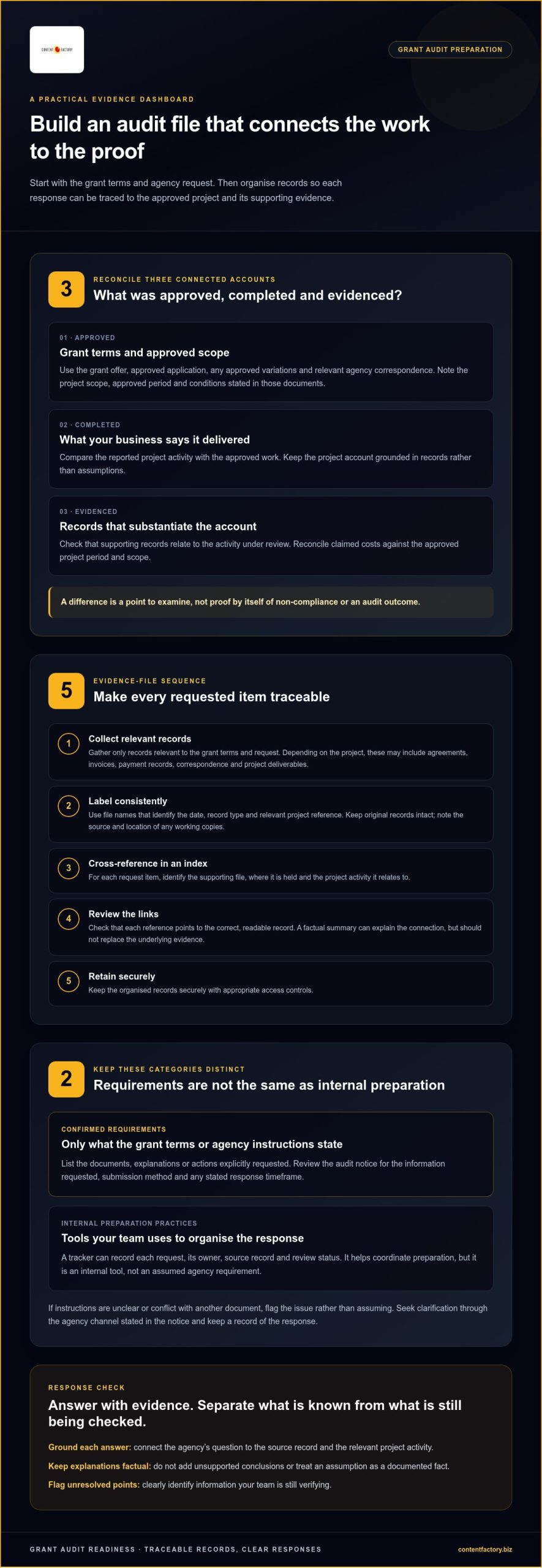
A useful evidence file does more than store documents. It connects each requested item to the grant’s approved scope, the activity it relates to and the source record that supports it. Build the file in sequence: collect relevant records, label them consistently, cross-reference them, review the links and retain the file securely.
Keep the file focused on the specific grant and audit request. Agreements, invoices, payment records, correspondence and project deliverables may be relevant, but include only categories that apply to the grant terms and requested information. For wider context on Singapore’s grants governance, see Strengthening Grants Governance in Singapore.
Collect records that relate to the approved project
Gather records that substantiate the project activity and the items under review. Keep original records intact. If you create working copies, note their source and where the original is held. This keeps the underlying record distinct from any copy assembled for the audit file.
Use a consistent folder structure based on the approved scope or the agency’s request items, rather than collecting everything from every team. This keeps unrelated material out and gives each document a clear purpose.
Make each record easy to trace
Create a simple index with a line for each request item. Identify the supporting file, its location and the project activity it relates to. Use file names that include the date, record type and relevant project reference, so a record can be recognised without opening several files.
Traceability connects each response item to its source evidence. A short factual summary can explain the connection, but it should not replace the underlying record or add unsupported conclusions. Review the index against the files before submission, then retain the organised records securely with appropriate access controls.
- Collect: include records relevant to the grant terms and request.
- Label: use consistent names that identify each record.
- Cross-reference: connect request items, project activity and evidence in an index.
- Review: check that links point to the correct, readable records.
- Retain: preserve originals and store the working file securely.
If coordinating and reviewing the evidence file is difficult, ContentFactory’s post-approval audit and compliance support can help structure the document review and preparation. Discuss your grant audit preparation with the team.
Reconcile Project Activity, Expenditure and Supporting Records
Before drafting an audit response, compare three things: what the grant documents approved, what your business says it completed and what the records substantiate. The aim is to identify whether these accounts align, not to assume that every difference means non-compliance or determines an audit outcome.
Work through the project scope one activity or deliverable at a time. For each, note the relevant evidence and any difference that needs checking. Apply the grant terms and agency instructions for your project rather than treating a general reconciliation method as a universal test.
Check records against the approved project
Start with the project description and deliverables in the approved documents. Compare them with the completed work and any changes recorded in correspondence or approved variations. If the internal project summary uses different wording, establish whether it describes the same activity before using it in a response.
Then connect relevant expenditure records to the activity they support, where applicable. For example, check whether an invoice and its payment record relate to the project activity described in the supporting documents. Review project dates and any changes against the grant terms and agency instructions. Do not assume that a cost or change is acceptable simply because it appears in the business records.
Resolve gaps before drafting explanations
Record each missing, inconsistent or unclear item, then assign someone to investigate it. The owner can check the source document, confirm the facts with the relevant colleague and correct the internal summary if it contains an error. Keep original records intact so the summary remains distinct from its evidence.
Use a short working checklist to guide the review:
- Scope: Does the reported activity correspond to the approved work or a documented change?
- Deliverables: Can the completed work be linked to relevant supporting records?
- Expenditure: Where applicable, can the recorded cost be connected to the project activity?
- Gaps: Is any point unresolved, and who is checking it?
- Explanation: Is it supported by evidence, or is it still an assumption?
A mismatch is a prompt to investigate, not a conclusion. It may reflect an unclear description, a missing record or a genuine difference between the approved scope and the work reported. Keep those possibilities distinct. Never backdate or alter source records, and do not present an unverified explanation as established fact.
Reconcile the records before drafting your response. Resolve factual questions where possible, and describe any matter that remains unclear accurately, following the agency’s instructions.
Respond to a Singapore Grant Audit Clearly and Carefully
A clear response follows the agency’s request, answers each point and shows where the supporting evidence can be found. Keep the submission tied to the grant documents and records. A lengthy explanation cannot replace a direct answer with a traceable reference.
Structure the response around the agency’s questions
Use the same sequence and wording as the questions in the agency communication. For each item, provide a concise answer and identify the relevant evidence by its file name or index reference. If an explanation is needed, connect it to documented facts rather than adding claims the records cannot support.
Before submission, ask a responsible internal reviewer to check that every request has an answer, each reference points to the correct record, and the response is consistent with the grant documents and the rest of the submission. A focused review can also catch unclear wording or statements that go beyond the available evidence.
Handle uncertainty and follow-up requests responsibly
Separate confirmed facts from explanations, assumptions and matters still being checked. If a record or condition is unclear, verify it against the grant documents and agency instructions. Do not guess or present an unresolved point as settled. If the agency’s instructions remain unclear, use the channel stated in its communication to seek clarification.
Follow the deadline and submission channel specified in your agency communication. Keep a record of what you submitted, when and through which channel, along with any follow-up questions and responses. This creates a reliable account of the exchange and helps your team respond consistently if further information is requested.
Keep legal, tax or accounting matters separate from grant-document preparation. This guide covers general preparation practices, not legal, tax or accounting advice.
Careful response preparation relies on evidence, clear references and a distinction between verified facts and unresolved points. ContentFactory’s post-approval audit and compliance support provides structured help with reviewing grant documents and preparing for post-approval compliance.
Contact Us to discuss support with your grant audit preparation.
When Grant Audit Support Can Help Your Team Prepare
Your internal team may be able to prepare the response if it can locate the requested records, connect them to the approved project terms and explain any gaps using documented facts. Base the decision to seek support on the work involved, not on assumptions about the audit outcome.
Decide whether internal preparation is sufficient
Start by checking whether each request has a clear owner and a traceable source record. If staff can assemble the evidence, reconcile it with the grant documents and review the response consistently, internal preparation may be practical.
ContentFactory provides post-approval grant audit and compliance support for teams whose records sit across departments, whose responsibilities are unclear, or who need a structured review of the connection between the approved scope and project evidence. The support is for organising and assessing grant documentation. It does not include audit representation or an audit or assurance opinion.
Prepare for a focused advisory discussion
Make an advisory discussion more useful by bringing the grant documents, agency request, evidence index and a short list of unresolved questions. Identify the response points or records that need review, and note the submission date stated in the agency communication. This keeps the discussion focused on practical preparation priorities.
For broader information about grant consulting in Singapore, see the Singapore grant consulting guide. ContentFactory also provides post-approval grant audit and compliance support, including structured review of grant documentation and preparation for compliance requirements.
If your team needs help organising its evidence or reviewing its compliance preparation, Contact Us to discuss the support you need.
Keep your grant audit response grounded in evidence
A practical approach to how to prepare for a grant audit in Singapore starts with the grant terms and the agency’s request. Organise supporting records so each response point can be traced to evidence, then compare the approved scope with the work reported and the documents available. Investigate gaps before submitting, and distinguish confirmed facts from explanations or items still being checked.
If your team needs help reviewing grant documents and preparing for post-approval compliance, ContentFactory provides post-approval grant audit and compliance support. Mayuresh Godse is a Singapore Certified Management Consultant with 25+ years of consulting experience.
Start with the records you have, note what needs follow-up and bring your response file into a clear, consistent order. Contact Us to discuss your preparation needs.
Frequently Asked Questions
What documents should I prepare for a grant audit in Singapore?
Start with the grant offer, approved application, any documented variations and the agency’s audit request. Then gather records relevant to the request and grant terms. These may include agreements, invoices, payment records, correspondence and project deliverables. The applicable documents depend on the scheme, project and agency instructions. Keep original records intact, and note where working copies came from so each item can be traced to its source.
How do I organise documents for a Singapore grant audit?
Group records by the approved project scope or by the items requested in the agency communication. Use consistent file names that identify the date, record type and project reference. Create an index linking each request to its evidence and the relevant project activity. Before submission, check that each reference opens the correct, readable record, and retain the organised file securely in line with the applicable grant terms.
What happens if my grant audit records are incomplete?
Identify exactly what is missing, unclear or inconsistent, then assign an owner to investigate each gap. Check whether the record is held by another team or whether another source document can substantiate the relevant fact. Do not alter or backdate original records, or present an assumption as confirmed. Follow the agency’s instructions for explaining unresolved items, and seek clarification through the stated channel if needed.
Can I prepare for a grant audit without an external consultant?
Yes. Your internal team can organise the response if it can locate the requested records, connect them to the approved project terms and review the file for consistency. ContentFactory’s preparation support is useful when responsibilities are unclear, documents are scattered or the relationship between project activity and evidence needs a structured review. Base the decision on your team’s workload and preparation needs, not assumptions about the audit outcome.
How should I respond to a grant audit request?
Answer each request directly and, where possible, follow the agency’s sequence and wording. Reference the supporting record for each answer, and distinguish documented facts from explanations or points still being checked. Have a responsible internal reviewer check completeness and consistency before submission. Use the deadline and submission channel stated in your agency communication, and keep a record of what you send and any follow-up.
Does a document gap mean my business has failed a grant audit?
No. A missing or inconsistent record is a reason to investigate, not by itself a conclusion about compliance or the audit outcome. Check the grant terms, request and available evidence to establish what the gap relates to. Record what you verify and be clear about anything unresolved. The agency assesses the matter under the applicable grant documents and its instructions.
Can a grant consultant guarantee a successful audit outcome?
No. A consultant cannot guarantee an audit outcome or influence an agency’s decision. Grant compliance support can help your team review documentation, organise supporting evidence and prepare a coherent response based on the available records. ContentFactory provides post-approval grant audit and compliance support as preparation, not audit representation or an assurance opinion. The agency makes its assessment under the applicable grant terms and instructions.
Grant quantum, support levels and eligibility criteria are set by the relevant Singapore government agencies and are subject to change. Eligibility is assessed case by case.
Book a Strategic Consultation, a 30-minute discovery call.

Article by
Mayuresh Godse
Mayuresh Godse is a Singapore Certified Management Consultant and Business Strategist specializing in Sustainability, ESG, AI-driven Digital Transformation, and business growth. Based in Singapore, he writes about Sustainability, Digital Innovation, Business Strategy, and Content Marketing for global audiences.
Disclaimer
This article is provided by ContentFactory for general information only and is not legal, tax, accounting or financial advice. Regulations and government scheme criteria change; grant eligibility and quantum are set by the relevant Singapore agencies and assessed case by case, with no outcome guaranteed. Verify current requirements before acting.