

A technology project may be necessary, yet the right funding route and its obligations can be unclear. Government grants for business technology adoption may support eligible projects, but scheme fit depends on current criteria and the details of the work. Start with the business need, not a preferred grant or supplier.
Before committing budget or staff time, define the problem, the proposed change and the outcomes you will track. Then compare the project with current grant requirements. A technology idea alone does not establish eligibility, and funding is never guaranteed.
This guide explains how to assess project fit, prepare a clear application and plan for the responsibilities that may follow approval.
Key Takeaways
- Define the business problem, proposed technology and intended outcomes before assessing whether a grant may fit.
- Compare the project with the current purpose and criteria of relevant routes, such as the EDG or CTC Grant.
- Check agency guidance on eligibility, application timing and expenditure rules before committing to project costs.
- Prepare a consistent scope, business rationale and supporting evidence, then plan for record-keeping if the application is approved.
- Use financial modelling to test the project’s assumptions and delivery capacity, whether or not you pursue grant support.
Government grants for business technology adoption start with a defined business need
You may know your business needs a new technology capability but still be unsure which funding route fits, what evidence an application requires or what obligations follow approval. Scheme fit depends on the current criteria and your project details. Start with the business case, not a preferred grant or vendor.
A technology adoption project should identify a constraint, explain the proposed change and describe the outcomes you will track. Buying a tool or licence on its own does not explain why the investment is needed or how it will affect the business.
A grant may contribute to eligible project costs, but it does not guarantee that funding will be awarded. Treat government grants for business technology adoption as a route to assess, not as an assumption in your budget.
Separate the operational problem from the technology solution
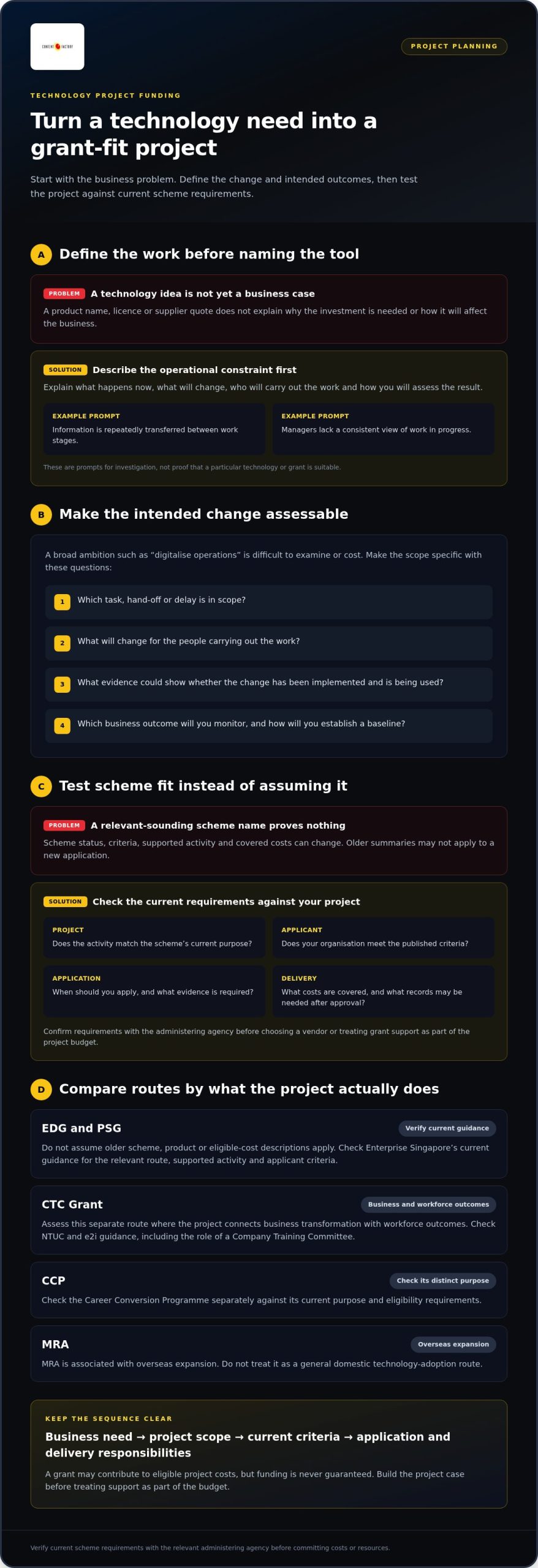
Before naming a system, describe the recurring constraint. For example, a team may repeatedly transfer the same information between work stages, or managers may lack a consistent view of work in progress. These are prompts for investigation, not proof that a particular technology or grant is suitable.
Write down how the process works now and what you intend to change. Then identify outcomes you can assess without promising an unverified return:
- Which task, hand-off or delay is in scope?
- What will change for the people carrying out the work?
- What evidence could show whether the change has been implemented and is being used?
- Which business outcome will you monitor, and how will you establish a baseline?
This turns a broad ambition such as “digitalise operations” into a project that can be examined, costed and compared with grant requirements.
Treat grant fit as a decision to test, not an assumption
A scheme name that sounds relevant does not establish eligibility. Compare your proposed activity and applicant profile with the administering agency’s current criteria. Check the application sequence, covered costs and supporting documents before committing resources.
Before proceeding, record what needs to be verified:
- The project’s scope and intended outcomes.
- Your organisation’s fit with the applicant criteria.
- When to apply and which costs or activities the rules cover.
- The evidence, records and post-approval responsibilities involved.
For wider context on scheme selection and preparation, the Singapore grant application guide can help frame your questions. Use current agency instructions to confirm requirements before making commitments.
Compare Singapore grant routes against the technology project you plan to deliver
Once your project has a clear scope, compare possible routes by purpose, applicant criteria, application requirements and responsibilities after approval. Scheme names and older guidance can be misleading, so use the administering agency’s current information rather than relying on an outdated summary.
For government grants for business technology adoption, the practical question is whether the current activity category fits the work. Check whether your organisation meets the stated criteria, what must be submitted and how the project must be documented if supported. Then compare those requirements with your team’s capacity to deliver the project and maintain the necessary records.
Assess EDG and PSG guidance against current routes
EDG and PSG information may appear in older articles, product listings and advice. Do not assume that a past description of a scheme, product or eligible cost applies to a new application. Check Enterprise Singapore’s current guidance for the relevant route, supported activity and applicant criteria before selecting a vendor or building a budget around grant support.
Make the comparison specific to your project. Note which activities are in scope, what the agency requires and which assumptions still need confirmation. If a scheme’s current status or requirements are unclear, resolve that before treating support as part of the project plan.
Check whether CTC, CCP or MRA fits the actual project
The NTUC Company Training Committee (CTC) Grant is a separate route to assess where a project connects business transformation with workforce outcomes. Check NTUC and e2i guidance for current requirements and the role of a Company Training Committee. Do not assume it is interchangeable with another scheme simply because technology is part of the project.
The Career Conversion Programme (CCP) also needs a separate check against its current purpose and eligibility requirements. MRA is associated with overseas expansion, so do not treat it as a general domestic technology-adoption route.
- Project: Match the activity to the scheme’s current purpose.
- Applicant: Confirm the organisation meets the published criteria.
- Delivery: Understand the application timing, required evidence and post-approval record-keeping.
If you are assessing these requirements against a defined scope, strategic grant advisory and financial modelling can help structure the review. For support with your project questions, use Contact Us.
Build a grant-ready technology project before choosing an application route
A fundable idea needs more than a product name and a quotation. Before applying for a grant, set out what the project will change, who will deliver it and how you will assess the result. This gives you a basis for testing scheme fit without treating funding as a given.
Project documentation should match the work you propose and the scheme you select. A business case explains the operational need and expected value. A product pitch describes features. Keep the focus on the business case.
Use this sequence to prepare:
- Define the problem. Describe the recurring operational constraint and who experiences it.
- Scope the project. State which activities are included, what is excluded and what the project will deliver.
- Test scheme fit. Compare the scope and applicant profile with the current agency criteria.
- Prepare evidence. Gather information that supports the need, proposed work and financial assumptions.
- Verify submission rules. Check current application instructions, timing and expenditure requirements before making commitments.
Define project scope, ownership and expected outcomes
Write a short project brief that identifies the business need, boundaries, implementation activities and an internal decision owner. Clarify which process or team the change covers, what work will be undertaken and who is accountable for decisions. Avoid an open-ended brief that treats every possible improvement as part of one application.
Describe intended outcomes in terms you can observe, such as a changed workflow or a defined capability being put into use. Record assumptions and dependencies, including staff availability, access to information, integration needs and decisions that must happen first. These details help you assess feasibility before applying.
Prepare evidence and model the project responsibly
Build an evidence file around the project rather than assembling generic paperwork. Depending on the scheme and application, relevant material may include a project description, cost assumptions, supporting quotations, organisational information and a rationale for the proposed change. This is a preparation guide, not a universal checklist. Confirm the exact document requirements with the administering agency.
Financial modelling should make assumptions visible. Separate confirmed costs from estimates, explain the basis for each assumption and show how expected operational value relates to the project’s objectives. Do not present projected savings or returns as guaranteed results. Decision-makers should be able to see what the model depends on and what you will monitor after implementation.
Application timing and expenditure rules vary. Do not assume that costs committed or incurred before a particular application milestone will qualify. Check the relevant agency’s current instructions before signing contracts, placing orders or starting work. For more preparation context, use this strategic grant application guide, then verify the live requirements for your chosen route.
Evaluate grant support alongside project risk, effort, and compliance
Grant support can affect a project’s cash-flow profile, but it does not remove delivery risk or administrative work. Compare two realistic options: proceed under a grant route if your project fits, or proceed without grant support if the business case still holds. The decision depends on project fit, internal capacity and the agency’s current requirements, not the headline support level alone.
Test whether the project remains commercially sensible if the application is unsuccessful, delayed or supported at a different level than expected. If it only works financially with grant support, revisit the assumptions before committing. Do not enlarge the scope or choose technology your business does not need just to pursue a grant. The project must solve a genuine operating need first.
Weigh project fit against application and delivery effort
Set out what your organisation can resource: internal ownership, staff time, implementation coordination and the work required to prepare an accurate application. Then compare this with the scheme’s verified criteria and submission requirements. A project may appear to fit by name but still be difficult to deliver if the people, information or decision-making capacity are not available.
Keep these questions together in a decision note:
- Would the project still be worth doing if no grant support were awarded?
- Can the business deliver the proposed scope with its available people and resources?
- What application work and supporting evidence are required under current agency guidance?
- Could the business manage the project if timing, support levels or disbursement differ from its assumptions?
Approval, support levels, timing and disbursement are subject to agency decisions and current rules. Build your decision around a scenario your business can manage, rather than treating any funding outcome as certain.
Plan for compliance and post-approval administration
Approval is not the end of the work. Your organisation may need to follow scheme-specific conditions, keep records and provide information to support claims or reviews. Before proceeding, check the relevant agency’s current instructions on reporting, claims, audit and disbursement. Requirements can differ by scheme and project, so do not assume the application documents are all you will need.
Set up a record-keeping process that connects project activities, decisions and financial records to the approved scope. Assign responsibility for maintaining those records, and keep a clear version of the scope used for the application. If the work changes, check the applicable agency process before treating revised activities or expenditure as part of the supported project.
This gives you a practical comparison: expected business value, delivery capacity, application effort and ongoing compliance. If those factors point in different directions, resolve the gaps before committing. ContentFactory provides post-approval grant compliance support to help businesses plan for the administration that follows approval. For advice on assessing your project and responsibilities, Contact Us.
Choose a grant route only after confirming fit, then prepare the next step
You do not need to begin with an application form. Begin with a decision your business can defend: does the project meet a current scheme’s criteria, can your organisation deliver it, and will the investment make sense on its own merits? This keeps grant support in perspective. A grant may support a suitable project, but it should not dictate what your business buys or promise a funding outcome.
Turn your assessment into a short action plan. Assign an owner to each task and record any unresolved questions. This gives decision-makers a clear view of what is known, what still needs checking and who is accountable for the next step.
Use a practical decision checklist before proceeding
Validate the route before finalising commitments. Confirm the scheme’s current status, administering agency, applicant criteria and fit with your defined project. Then check the application sequence and eligible expenditure rules using current official guidance. Do not rely on an old summary or assume that a past route, product or cost treatment still applies.
- Finalise the project scope and business rationale.
- Verify applicant criteria and current scheme requirements.
- Check application timing and expenditure rules with the administering agency.
- Prepare supporting evidence and assign owners for application and delivery records.
- Plan how you will monitor the work and retain relevant records if support is approved.
Keep a written record of the guidance you relied on and the date you checked it. If a requirement is unclear, use the relevant agency’s published instructions or enquiry channels before committing to expenditure. Treat the checklist as a decision aid, not a substitute for the scheme’s own rules.
Get project-specific grant advice without assuming an outcome
Project-specific advice can help connect your scope, assumptions and supporting documents to the route you are assessing. ContentFactory provides strategic grant advisory, financial modelling, application documentation and post-approval compliance support. This is preparation and compliance support, not agency representation or influence over an approval decision.
Financial modelling can make the project’s assumptions visible: what the proposed work depends on, how costs are organised and how expected business value relates to intended outcomes. That helps your team assess whether the project remains sensible if the application is unsuccessful or the final support differs from expectations.
For a project-specific assessment of scheme fit and preparation needs, explore Singapore grant consulting. If you are ready to discuss your project, use Book a Strategic Consultation for a 30-minute discovery call.
Turn your technology case into a clear next step
Test a grant route before funding assumptions become project commitments. Keep your decision grounded in current agency criteria and a business case that still makes sense for your organisation. That lets you assess government grants for business technology adoption without making the grant the reason for the investment.
ContentFactory can help structure the grant assessment and prepare the supporting work. Mayuresh Godse is a Singapore Certified Management Consultant with more than 25 years of consulting experience. ContentFactory supports grant advisory, financial modelling, application documentation and post-approval compliance, without promising eligibility or approval.
Use a 30-minute discovery call to discuss your project’s scope, assumptions and preparation needs. The grant quantum, support levels and eligibility criteria are set by the relevant Singapore government agencies and are subject to change. Eligibility is assessed case by case.
Frequently Asked Questions
Can a Singapore SME apply for a government grant to adopt business technology?
A Singapore SME may apply if it meets the relevant scheme’s current requirements. Eligibility depends on the applicant criteria and the proposed activity. Check the administering agency’s guidance before treating possible grant support as part of your budget.
Which Singapore grant is best for business technology adoption?
There is no single best route for every business. Identify the project’s main purpose, then compare it with current scheme criteria. A project focused on technology adoption may warrant checking relevant digital initiative guidance, while work tied to workforce outcomes may require a separate CTC Grant assessment. Choose based on fit and delivery capacity, not a scheme’s name alone.
Does the Enterprise Development Grant support digital initiatives?
EDG has supported eligible digital initiatives, but historical scheme information does not confirm that a new project qualifies. Check Enterprise Singapore’s current guidance for the route available to your proposed activity, the applicable criteria and the application process. Separate past support information from the rules that apply to a new application before making project decisions.
Can I buy technology before applying for a grant?
Check the relevant agency’s rules before placing an order, signing a contract or starting work. Application sequence and expenditure treatment can differ by scheme, and an early purchase may not be treated as an eligible project cost. Until you have clarity, avoid relying on possible grant support to justify a commitment.
What documents are needed for a technology grant application?
The exact document list depends on the scheme and project. You may need information that identifies the applicant, describes the proposed work and supports its business rationale and cost assumptions. Keep the scope consistent across the application and supporting materials. Compare your file against the administering agency’s current checklist before submission.
What happens after a business technology grant is approved?
Read the approval terms closely and use them to guide delivery. They set out the project scope and applicable conditions. Assign an internal owner to track milestones, decisions and supporting records, and follow the agency’s instructions for claims and disbursement. If the approved work needs to change, follow the relevant agency process before proceeding.
Can a business apply for more than one Singapore grant?
A business can assess more than one scheme for separate activities, but do not assume the same project cost can be claimed under multiple routes. Check each scheme’s current rules on overlapping support and disclose related applications or funding where required. Keep activities and cost items distinct in your records, and resolve uncertainties with the administering agency before relying on a proposed combination.
Book a Strategic Consultation for a 30-minute discovery call.

Article by
Mayuresh Godse
Mayuresh Godse is a Singapore Certified Management Consultant and Business Strategist specializing in Sustainability, ESG, AI-driven Digital Transformation, and business growth. Based in Singapore, he writes about Sustainability, Digital Innovation, Business Strategy, and Content Marketing for global audiences.
Disclaimer
This article is provided by ContentFactory for general information only and is not legal, tax, accounting or financial advice. Regulations and government scheme criteria change; grant eligibility and quantum are set by the relevant Singapore agencies and assessed case by case, with no outcome guaranteed. Verify current requirements before acting.