

If Enterprise Singapore has rejected your application, your first question may be whether you can appeal. Published Enterprise Singapore guidance does not set out a formal EDG appeal process. It advises companies to consider the reasons for rejection before deciding whether to reapply. Treat the decision as a prompt to review the application record, not proof that an appeal route is available.
The scheme’s status matters too. EDG closed to new applications on 29 September 2026. From 30 September, new applications for similar business grant support must be made under the EDGE Grant. Your next step depends on the rejection notice, the application timing and current official instructions, not an assumption that the former EDG route remains open.
This guide explains how to read the notice, identify any stated next steps and check current Enterprise Singapore guidance. It also shows how to review the submitted application and decide whether to seek permitted clarification, prepare a new submission under the applicable scheme or stop. The aim is to make a reasoned decision, not repeat an application with the same gaps.
Key Takeaways
- Read the rejection notice carefully. Identify the decision, stated reasons and any instructions before choosing a response.
- Check current Enterprise Singapore guidance before assuming a review, clarification, appeal or resubmission route is available.
- When appealing a rejected EDG grant application, assess the options: seek clarification through a permitted channel, prepare a revised submission if allowed, or stop.
- Keep the notice, submitted application, project description and supporting records together. Use them to identify gaps and plan your next step.
- Structured grant advisory can help organise the application record and assess practical next steps. It does not represent you to Enterprise Singapore.
What an EDG rejection notice tells you to check first
A rejection is a decision, not proof that an appeal route exists. Before responding, separate what Enterprise Singapore has stated from what you may be inferring. Published Enterprise Singapore guidance does not set out a formal EDG appeal process. It advises rejected applicants to consider the reasons before deciding whether to reapply.
The rejection notice records the decision and any next steps it states. Check it for the decision, reasons, requested actions, official instructions and contact details. Record dates and references exactly as written. Do not assume they create a deadline or process unless the notice or current official guidance says so.
How to read the reasons given for an EDG rejection
Group each stated reason under the relevant part of the application. A comment about the project description belongs with the scope. A request for a supporting record belongs with that document. Compare the notice with the exact version submitted, not a draft or a later amendment. This helps you distinguish missing information, unclear documentation and concerns about the case as submitted.
Keep the agency’s stated reasons separate from your interpretation. If the notice is brief, record its exact wording and list any unresolved questions. Do not treat your interpretation as an agency criterion. Check current Enterprise Singapore guidance for instructions that apply to your application rather than inferring requirements from a phrase or omission.
What the notice does not automatically mean
A rejection alone does not establish a right to appeal or permission to resubmit. Nor does it amount to a judgement on your business beyond the application decision. Your next step depends on the notice and current official guidance. Before appealing a rejected EDG grant application, establish whether an official route is available rather than assuming there is one.
Keep the notice with the application as submitted and its supporting records. Preserve the project description, forms, relevant documents and correspondence in the versions sent. A structured EDG application review guide can help you organise that record. The agency’s notice and current instructions should guide your decision.
For a practical first review, mark each sentence in the notice as a decision, a stated reason, a requested action or an instruction. Put unclear points on a separate list. Then check whether current official guidance answers them. This keeps assumptions out of the application record and gives you a focused basis for choosing what to do next.
How to verify your options after an EDG application rejection
Do not choose a response based on the word “rejected” alone. Read the notice, then compare it with current Enterprise Singapore (EnterpriseSG) instructions. Published agency guidance does not set out a formal EDG appeal process. It advises companies to consider the reasons for rejection before deciding whether to reapply.
Follow only a route that current agency instructions support. An enquiry, clarification, review and fresh application are different actions. A question to the agency does not automatically become an appeal or trigger reconsideration.
Check whether the agency provides a review or appeal route
Use this sequence before taking action:
- Start with the notice. Check whether it names an action, channel or timeframe. If it does not, do not assume there is a deadline or invent a procedure.
- Check current EnterpriseSG guidance. Look for instructions that specifically apply to rejected applications. General EDG application advice and third-party summaries may not address your situation.
- Use the stated application channel. If official guidance directs you to the Business Grants Portal or another channel, follow those instructions. Do not send sensitive application details through a route the agency has not identified for this purpose.
- Keep a record of what you checked. Save the relevant notice or guidance and note when you reviewed it. This gives your team a reference if instructions change.
Application timing matters. EDG closed to new applications on 29 September 2026. From 30 September 2026, new applications for similar business grant support must be made under the EDGE Grant. If you are considering a new submission after an EDG rejection, check EnterpriseSG’s current EDGE guidance rather than assuming the former EDG route remains open.
Clarify the decision before selecting a response
If official instructions permit an enquiry, keep it narrow and tie each question to the notice. For example, ask which submitted document a stated information gap refers to, or whether a specific next step applies to your application. Do not ask for an informal explanation to be treated as a formal appeal. A reply does not guarantee reconsideration.
Keep the enquiry factual. Identify the application reference, quote the relevant wording and ask a clear question. Separate confirmed instructions from your interpretation, and save any response with the application records. This helps you decide whether clarification resolved an ambiguity or whether the notice leaves no supported route to pursue.
A structured strategic grant application guide can help you organise the material and questions before acting. ContentFactory provides grant advisory to help review application records and assess practical next steps. Contact ContentFactory about grant advisory. Advisory supports preparation; it does not represent you to EnterpriseSG or influence the agency’s decision.
Appealing a rejected EDG grant application: assess the case before acting
Appealing a rejected EDG grant application is not automatically the right response. The rejection itself does not establish that a formal appeal is available. Review the application record before deciding what to do. Do not assume you can submit the same case again or argue for a different outcome.
Start with the reasons in the notice. For each one, ask whether existing evidence can address it, whether the point is unclear or whether the submitted application does not support a credible response. Keep your assessment tied to the project and records as submitted. Do not fill gaps with assumptions, unsupported claims or arguments about government policy.
Your practical options are to seek clarification through an officially permitted channel, consider a revised or new application only if current Enterprise Singapore instructions allow it, or stop. These are distinct choices. A clarification request is not an appeal, and preparing revised documents does not mean a resubmission route is open.
When a clarification may be the practical next step
Clarification may help when the notice leaves a specific point unresolved and official instructions allow an enquiry. Refer to the exact passage and ask a focused question, such as which submitted record the stated information gap concerns. Keep the tone factual. Do not demand that the agency reverse the decision or assume that a reply will trigger reconsideration.
Before sending anything, confirm that the channel is intended for this type of enquiry. Keep a copy of your question and any response with the application records. If the reply clarifies the point but identifies no further route, use that information to assess whether another permitted step exists. Do not treat clarification as an appeal by another name.
When to consider a revised application or pause
Consider a revised or fresh application only after checking current official guidance for the applicable scheme and route. Then test whether you can address each stated concern accurately. For example, if the notice identifies a mismatch between the project description and a supporting document, check whether reliable records support a correction and a clear explanation. Do not make a claim simply because it would make the case sound stronger.
Pausing is sensible when key information is missing, the project scope cannot be described consistently or you cannot support a response with evidence. Separate facts from assumptions and record what remains unresolved. That review may show that further action is not practical now, or that you need more information before assessing the available options.
Use this decision test: seek clarification only if it is permitted and a specific ambiguity remains; prepare a revised submission only if official guidance allows it and the evidence supports the changes; otherwise, stop rather than repeat unsupported claims. A careful review can organise your next step, but it cannot guarantee or determine Enterprise Singapore’s decision.
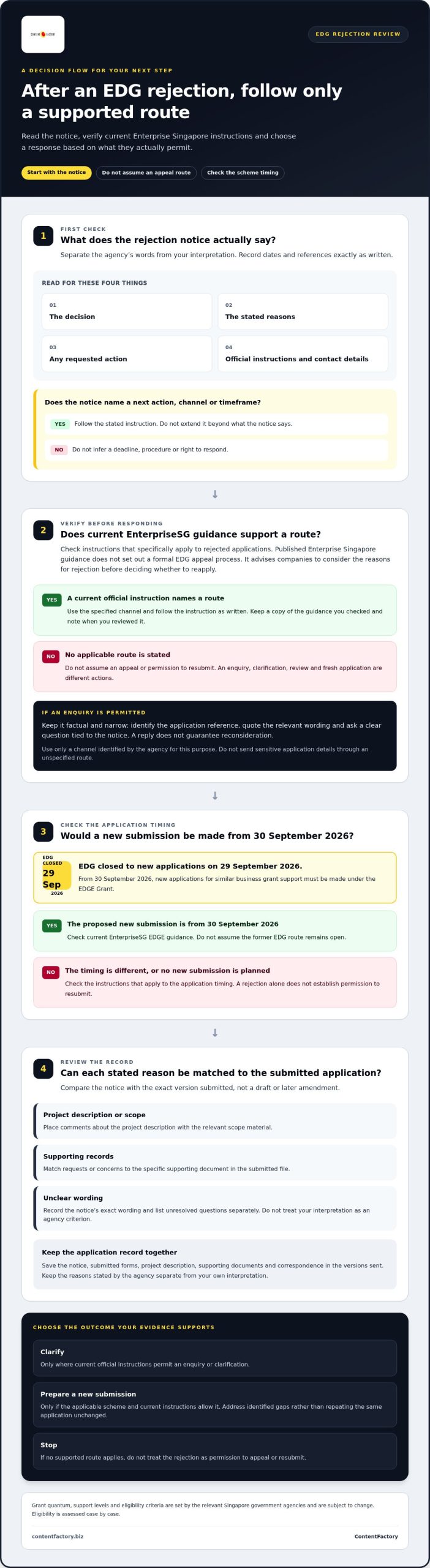
Use this EDG rejection review checklist to prepare your next step
Before making an enquiry or preparing a revised submission, put the application record in one place. A clear file helps you distinguish what the notice says from what you remember. It also shows whether each concern can be answered with evidence and gives you a practical basis for deciding whether to seek permitted clarification, take another step allowed by current guidance or pause.
Organise the application record
Collect the rejection notice, submitted forms, project description, attachments and relevant correspondence. Keep the versions that were actually submitted. Drafts may provide context, but they are not evidence of what the agency received.
For each reason in the notice, record the agency’s wording and link it to the relevant application section or document. Do not rewrite a brief reason as a broader criterion or add an explanation the notice does not provide.
- Decision notice: Save the complete communication, including any stated instruction, channel or timeframe.
- Submitted application: Keep the forms and attachments as filed, with dates or version details where available.
- Project description: Compare the stated scope, objectives and expected deliverables with the supporting records.
- Supporting evidence: Identify which existing records relate to each stated concern and whether they support the point clearly.
- Financial information: Check relevant figures and documents for consistency with the application and project description.
- Correspondence: File official messages about the application alongside the notice.
For each stated concern, mark whether the submitted file contains relevant evidence, whether reliable records can support a response or whether a genuine gap remains. Do not treat an unsupported estimate, unapproved draft or new assertion as proof. If you cannot identify evidence, record that plainly rather than filling the gap with assumptions.
Prepare a focused response or decision note
Use a short note to support your decision. For each issue, record the agency’s wording, the related document, what it establishes and what remains unclear. If official instructions permit an enquiry, turn the unresolved point into a focused question. If you are assessing a new submission, check current guidance first and describe only changes you can support accurately.
Compare the project description with its supporting documents and financial information. Check that names, scope, deliverables and figures align across the record. Flag any mismatch before taking action. Do not alter a record simply to make the file appear consistent.
This checklist can support a sound decision about appealing a rejected EDG grant application, but it cannot establish that an appeal or resubmission route is available. The Enterprise Singapore grant application guide can provide broader context for reviewing the application record. For structured support to organise evidence and assess practical next steps, Contact Us.
Get structured support for your EDG rejection next steps
A rejection can leave you with a file full of documents and no clear view of what to do next. Grant advisory can help you review the application as submitted, organise evidence against the reasons given and assess practical next steps under current official instructions. The purpose is to support clear decision-making, not to create an appeal route or promise a different outcome.
What a grant adviser can help you review
A structured review starts with the application record, not assumptions about what the agency may have meant. An adviser can compare the notice with the submitted project description, supporting documents and financial information. The review can flag gaps, inconsistencies or statements that the available records do not substantiate.
For example, if the project description and a supporting quotation appear to describe different scopes, a review can identify the mismatch and clarify what the documents show. If a financial figure cannot be reconciled with the submitted information, it should be marked as unresolved, not replaced with an unsupported explanation. This distinction helps you assess what can be addressed accurately.
ContentFactory provides grant advisory, application documentation support and financial modelling. This work can help organise the record and assess practical options. It is not representation before Enterprise Singapore. Advisory cannot guarantee approval, influence the agency’s decision or replace the official instructions that apply to your application. A review does not assure that a clarification, appeal or resubmission will be accepted.
Where financial modelling is relevant, the focus is on presenting assumptions and figures coherently in relation to the project and its supporting records. A model cannot make an unsupported claim reliable. The evidence and application must remain consistent.
Mayuresh Godse, ContentFactory’s Singapore Certified Management Consultant, brings 25+ years of consulting experience. That experience informs a practical review of your documents and options. It does not provide privileged agency access or influence over EnterpriseSG.
Choose a next step grounded in the official decision
Keep the sequence straightforward: review the notice, verify current official options, then decide whether to make an enquiry through a permitted channel, prepare a new submission if allowed or stop. When appealing a rejected EDG grant application, separate what the agency has stated from what you hope a further step might achieve.
A useful review should leave you with a clear record of the stated concerns, the evidence that relates to them, any unresolved gaps and the next action supported by official guidance. If that action is unclear, pause and verify it before submitting more material. ContentFactory can help you review the application record and practical options. Contact Us to book a 30-minute discovery call.
Make your next grant decision with a clear record
Your next step does not need to be a rushed appeal or another application. Give your team a clear decision point: identify what the official notice supports, record what remains uncertain and assign responsibility for checking any permitted action. This creates a sound basis for deciding whether to proceed, pause or close the matter.
Keep the decision grounded in evidence. If you are appealing a rejected EDG grant application, do not treat the effort spent on the original submission as a reason to continue. Focus on whether an official route exists and whether reliable records support your response. If either point remains unresolved, verify it before committing resources.
ContentFactory can help you review the application record, organise documentation and assess practical next steps. To discuss your situation, Contact Us.
A well-reasoned decision is useful whether it leads to a permitted next step or a clear decision to stop. Base your actions on verified instructions and a sound record.
Frequently Asked Questions
Can you appeal a rejected EDG grant application?
It advises companies to consider the rejection reasons before deciding whether to reapply. Before appealing a rejected EDG grant application, check the notice and current official instructions for a route that applies to your case. An enquiry or request for clarification is not automatically a formal appeal and does not guarantee reconsideration.
How long do I have to appeal an EDG rejection?
The guidance does not state a general EDG appeal deadline. Check your rejection notice for any timeframe or required action, then verify it against current Enterprise Singapore instructions. Do not rely on a deadline quoted in an unofficial article or assume you have a set number of days. If the notice is unclear, check the official application channel before deciding whether or how to respond.
Can I reapply for EDG after my application is rejected?
Enterprise Singapore advises rejected applicants to consider the reasons before deciding whether to reapply. From 30 September 2026, new applications for similar business grant support must be made under the EDGE Grant. Check current EnterpriseSG guidance for the applicable scheme and process. Do not assume that you can submit another EDG application through the former route.
Does a rejected EDG application affect future applications?
A rejection does not, by itself, establish that a future application is automatically prevented or explain how a later application will be assessed. Treat the outcome as applying to the application that received the decision. Before making a new submission under an available scheme, check its current instructions and assess whether your project information and supporting records address the issues previously identified.
Can an EDG consultant guarantee that my appeal will succeed?
No. A consultant cannot guarantee an appeal outcome or influence Enterprise Singapore’s decision. Grant advisory can help you review documentation, assess financial information and organise a response based on the available evidence. This support can make your decision-making clearer, but it does not create an appeal route or guarantee that an agency will accept a request, reconsider a decision or support a later application.
What documents should I keep after an EDG rejection?
Keep the complete rejection notice, the application as submitted, its project description and every attachment included with it. Retain relevant correspondence and copies of supporting and financial records in the versions used for the application. Preserve original files rather than replacing them with edited copies. This lets you check what the agency received and distinguish the original application record from material prepared afterwards.
Can I change my EDG project after receiving a rejection?
A rejection does not confirm that you can amend the project or submit a changed proposal under EDG. EDG is closed to new applications, so check EnterpriseSG’s current guidance for the scheme that applies to any new submission. If changes are permitted, describe the revised scope accurately and ensure the supporting documents and financial information match it. Do not present a changed project as though it were the original submission.
Grant quantum, support levels and eligibility criteria are set by the relevant Singapore government agencies and are subject to change. Eligibility is assessed case by case.
Book a Strategic Consultation (30-minute discovery call).

Article by
Mayuresh Godse
Mayuresh Godse is a Singapore Certified Management Consultant and Business Strategist specializing in Sustainability, ESG, AI-driven Digital Transformation, and business growth. Based in Singapore, he writes about Sustainability, Digital Innovation, Business Strategy, and Content Marketing for global audiences.
Disclaimer
This article is provided by ContentFactory for general information only and is not legal, tax, accounting or financial advice. Regulations and government scheme criteria change; grant eligibility and quantum are set by the relevant Singapore agencies and assessed case by case, with no outcome guaranteed. Verify current requirements before acting.