

A sustainability report should connect material issues to traceable data, clear targets and consistent metrics. To understand how to write a sustainability report, start by selecting a suitable framework, assess which environmental, social and governance topics matter most, then analyse the supporting data and set measurable goals. The report should show what your organisation is doing and how it tracks progress, not rely on broad claims.
That may sound straightforward, but the work often spans teams, data sources and competing priorities. A disciplined process helps you focus the report on relevant issues and explain your methods clearly. For companies using SGX Practice Note 7.6 as a reference, key components include governance, the reporting framework, material ESG factors, targets, related policies and performance, and climate-related disclosures consistent with ISSB requirements.
This guide explains how to write a sustainability report: choose a framework, involve stakeholders in a materiality assessment, collect and analyse sustainability data, and set goals with useful metrics. It also shows how to organise the report so readers can understand its scope, evidence and progress.
Key Takeaways
- Choose a reporting framework that fits your organisation’s needs, reporting obligations and intended audience.
- Use stakeholder input to identify and prioritise the sustainability issues most relevant to your business.
- Document data sources and calculation methods so reported figures are traceable and easier to review.
- Set targets from a clear baseline and connect each one to a defined metric and reporting period.
- Build a report that explains its scope, governance and progress in a clear, consistent way.
How should companies report on sustainability information?
Build sustainability reporting around stakeholder input, material issues, evidence and accountable decisions. For organisations in Singapore, start by identifying applicable reporting requirements and setting up a process that links disclosures to reliable information.
Engage Stakeholders in the Reporting Process
Map the stakeholders who influence or are affected by your organisation’s activities. Include employees, customers, suppliers, investors and relevant external groups. Use surveys to gather broad input, interviews for detailed perspectives, focus groups to explore differing views, and consultations to discuss specific decisions.
Record who participated, which issues they raised and how their views shaped reporting priorities. Use different engagement methods where appropriate. Employee interviews, for example, may surface workplace concerns that a supplier consultation would not. Keep the questions and response records with your reporting files.
Assess Materiality with Stakeholder Input
Use stakeholder feedback to identify and prioritise sustainability topics. A materiality assessment determines which ESG issues matter most to your organisation and its stakeholders. Consider how each issue relates to business strategy, operational impacts and concerns raised through engagement.
Validate the priorities with management and document why topics were included or excluded. Don’t select topics solely because peers disclose them. An issue affecting your operations or business relationships may deserve attention even if it receives little public discussion.
Check Applicable Reporting Requirements
Identify requirements that apply to your organisation, including its listing status and reporting circumstances. SGX Practice Note 7.6 identifies report components such as governance, the reporting framework, material ESG factors, targets, related policies and performance, and climate-related disclosures consistent with ISSB requirements.
Listed companies should align their reporting timetable with the requirements applicable to their issuer and reporting year. The Corporate Sustainability Reporting Directive (CSRD) is Directive (EU) 2022/2464, according to the European Union. Treat overseas requirements as relevant only where they apply to your organisation; do not assume they govern every Singapore business.
Define Report Contents and Production Plans
Set out the report’s scope, governance, framework, material topics, policies, targets and performance. Explain the reporting boundary and how it relates to your organisation’s operations and influence. Readers should be able to see what the report covers, what evidence supports its disclosures and what progress has been made.
Plan production by assigning data owners, review points and time to validate figures and draft disclosures. Costs and timelines depend on the reporting scope, data readiness, stakeholder engagement and frameworks used. Define these factors before setting a budget and schedule. Establish review responsibilities early so collection and approval fit the plan.
Choosing a sustainability reporting framework
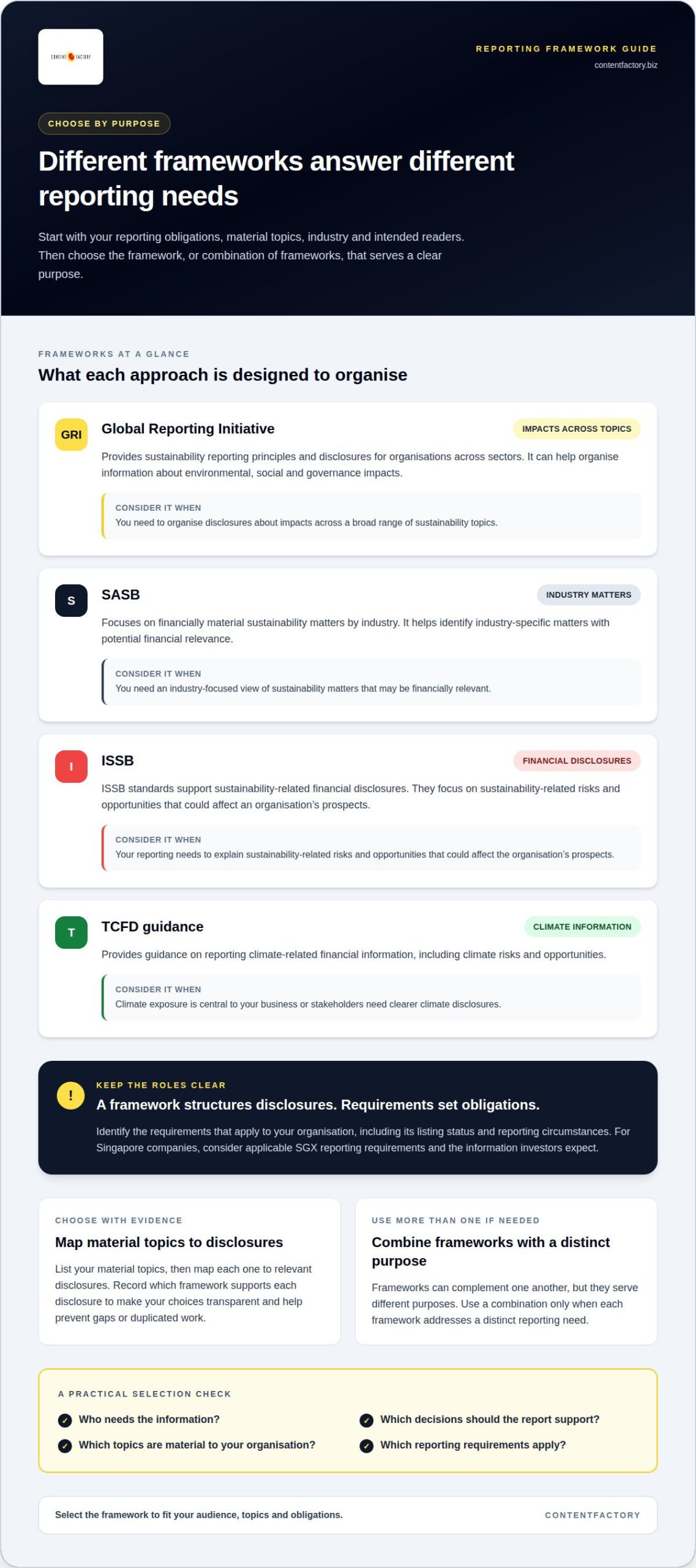
Commonly used approaches include GRI, ISSB, SASB and the Integrated Reporting Framework. Choose according to your reporting obligations, material topics, industry and intended readers. You can combine frameworks when each serves a distinct purpose.
- Start with your reporting purpose. Identify who needs the information and which decisions the report should support. GRI provides sustainability reporting principles and disclosures for organisations across sectors. SASB focuses on financially material sustainability matters by industry. ISSB standards support sustainability-related financial disclosures. Choose a framework that fits your audience and business priorities, rather than following other companies’ choices.
For Singapore companies, consider applicable SGX reporting requirements and the information investors expect. An issuer may need to align disclosures with local requirements while using a framework to organise broader reporting. When deciding how to write a sustainability report, distinguish the framework’s role from your obligations: the framework structures disclosures, while applicable requirements determine what your organisation must address.
- Compare the topics each framework covers. GRI can help organise disclosures about impacts across environmental, social and governance topics. SASB helps identify industry-specific matters with potential financial relevance. ISSB focuses on sustainability-related risks and opportunities that could affect an organisation’s prospects. These approaches can complement one another, but they serve different purposes.
List your material topics, then map each to relevant disclosures. For example, reporting on greenhouse gases may require emissions data and an explanation of reduction plans. Record which framework supports each disclosure. This makes your choices transparent and helps prevent gaps or duplicated work across reporting requirements.
- Use climate guidance where it adds value. The Task Force on Climate-related Financial Disclosures (TCFD) provides guidance on reporting climate-related financial information, including risks and opportunities. Consider it when climate exposure is central to your business or stakeholders need clearer climate disclosures. Check how its recommendations fit the frameworks and requirements you have selected.
For example, a company facing climate-related supply chain risks could explain its exposure, governance and response. Avoid treating climate disclosures as a standalone exercise. Connect them to the organisation’s strategy and the risks or opportunities identified through its reporting process.
- Decide whether integrated reporting belongs in your approach. The Integrated Reporting Framework can connect governance, strategy, performance and future prospects in a single account of value creation. Use it when readers need to understand how sustainability relates to the organisation’s broader direction. It can complement detailed disclosures rather than replace them.
Write down the framework combination and the reason for each choice. Then map reporting obligations, material topics and available data against that combination. For teams deciding how to write a sustainability report across frameworks, ESG sustainability reporting support can help connect disclosure needs with a practical reporting approach. If the options feel difficult to reconcile, discuss your reporting framework needs with a specialist before drafting.
Collecting and analysing sustainability data
Build a repeatable data process that links every reported metric to its source and calculation method. Clear ownership and records help you accurately analyse environmental performance, governance controls and business opportunities.
Collect Sustainability Data
Identify the data needed for each disclosure, then assign an owner and source. Electricity bills, fuel records, water invoices and workforce records can support different environmental and social metrics. Check that each source covers the reporting boundary and period you defined. Don’t combine figures from different periods without explaining the difference.
- Set up a consistent collection process. Create a register listing each metric, its data owner and source, the collection method and reporting period. For example, note whether electricity data comes from invoices or meter readings. Use consistent units and definitions across departments, sites and activities. This makes comparisons more meaningful and helps teams spot missing entries before drafting disclosures.
- Keep the source file with each figure. Save invoices, meter records, calculation sheets and relevant internal records alongside the data. Name files clearly and record when information was received. If a supplier provides activity data, retain the original response and note how it relates to your reporting boundary. Don’t rely on a spreadsheet cell without a traceable source.
Analyse and Document ESG Data
Check each dataset for completeness, consistency and unusual changes before using it. Where prior records are available, compare them with current figures and investigate differences with the data owner. Document the source, calculation method, assumptions and any limitations. This creates a transparent record to support accurate reporting and later review.
- Connect metrics to decisions and controls. Analyse what each result shows about environmental impacts, operational exposure or governance. For emissions accounting, retain activity data and the method used to calculate reported figures. Separate measured values from estimates, and explain material assumptions in plain language. This helps readers understand the evidence behind performance claims.
- Use automation selectively and maintain oversight. Automated collection can bring together information from different systems and sources. Map each automated input to its original record, metric definition and responsible owner. Check that transfers preserve units, periods and calculation logic. Automation can reduce manual handling, but teams still need to review exceptions and source quality.
- Prepare a controlled dataset for reporting. Keep a central register of approved figures, supporting evidence and changes made during review. Record who checked each metric and how corrections were resolved. Traceable, high-quality data aligned with governance standards supports audit readiness. Before drafting, confirm that every disclosure can be traced from the reported figure back to its source.
Identifying material sustainability issues through stakeholder-informed assessment
A materiality assessment turns stakeholder concerns and business impacts into reporting priorities. Use it to focus disclosures on issues that affect people, the environment or your organisation’s performance.
Identify Material Sustainability Issues
- Build an initial list of topics. Review your activities, value chain, existing policies and stakeholder feedback. Consider environmental, social and governance issues such as energy use, workplace safety, labour practices and business conduct. Base the list on your organisation’s actual operations, not a generic industry checklist.
- Gather evidence for each topic. Combine stakeholder views with operational records, risk reviews and existing objectives. Employees may, for example, flag safety concerns, while suppliers may identify resource constraints. Record who raised each issue and the evidence behind it. A materiality assessment should show how input shaped priorities, not just list consultation activities.
- Prioritise and validate the topics. Assess each issue by the scale and likelihood of its impacts, its relevance to business decisions and stakeholder concern. Discuss the resulting priorities with management and document why topics were included or excluded. EUR-Lex explains that a management report should analyse environmental and social aspects needed to understand an undertaking’s development, performance or position.
Conduct a Double Materiality Assessment
- Assess impacts from the organisation outward. Consider how your activities and business relationships affect people and the environment. Examine actual and potential impacts, including those linked to suppliers or customers. For example, assess whether purchasing practices influence labour conditions or operations affect local resource use. Stakeholder input can reveal impacts that internal records alone may miss.
- Assess sustainability matters from the outside inward. Identify how environmental and social developments could affect your organisation’s prospects, operations or financial position. Resource constraints may disrupt supply, for example, while changing climate conditions may affect facilities. Consider the relevant time horizon and explain the evidence for each assessment. Don’t dismiss a topic as immaterial just because its financial effect is not immediate.
- Bring both perspectives together. A topic may be material because of its impact on people or the environment, its effect on the organisation, or both. Record the rationale, evidence, stakeholder views and management validation for each priority. Use the results to refine reporting topics and link sustainability disclosures to business strategy. Revisit the assessment when operations, relationships or stakeholder concerns change.
Setting SMART sustainability goals and metrics
Turn material topics into objectives your organisation can measure and act on. Choose relevant metrics, set targets using baseline data, and assign responsibility for monitoring progress.
Select Relevant ESG Metrics
Choose metrics that directly track material topics and business priorities. Common examples include greenhouse gas emissions, water use, diversity and supply chain transparency. Select measures that clearly show performance, rather than collecting data simply because it is available.
For each metric, define its unit, boundary, data source and reporting period. If you track water use, specify which operations the figure covers. Consistent definitions help readers interpret results and allow your teams to compare performance over time.
- Establish a baseline. Record the starting point for each selected metric using the best available, traceable data. A baseline puts your target in context and helps distinguish measured progress from intention. If operational changes affect comparability, document them instead of presenting the figures as directly equivalent.
Set Sustainability Goals and Objectives
Make each goal Specific, Measurable, Achievable, Relevant and Time-bound. For example, a water-use objective should identify the operations covered, the intended reduction, the baseline and the deadline. This makes the commitment clear and gives the responsible team a defined outcome to work towards.
Align objectives with business strategy and material topics. Consider industry, national or sector benchmarks when deciding how ambitious to be. Avoid targets without a baseline, those that depend on undefined actions, or those outside your organisation’s operational influence.
- Assign ownership and actions. Link each objective to the team responsible for implementing it and the activities needed to make progress. An emissions target, for instance, may require operational teams to track relevant energy use and report changes. Define how stakeholder engagement informs decisions and who approves target updates.
Monitor Metrics and Progress
Set a consistent review schedule for each metric, based on how often its underlying data changes. Compare current results with the baseline and target, then investigate unexpected changes with the data owner. Record the explanation, corrective action and any effect on reported progress.
Keep evidence for each result, including source records and calculation methods. Explain both progress and missed objectives in the report. A clear account of obstacles and next steps is more useful than presenting a target without performance context.
- Review targets as conditions change. Reassess objectives when material topics, operations or available evidence shift. Keep the original baseline and explain any revised target, scope or method so readers can follow the change. For help translating reporting priorities into a practical measurement approach, Contact Us.
ContentFactory: ESG Readiness & Materiality Assessments
ContentFactory helps organisations turn sustainability reporting priorities into a clear, workable process. Its ESG Readiness & Materiality Assessments help identify reporting gaps and prioritise issues relevant to your business and stakeholders.
Use this support when your team needs to clarify material topics, organise sustainability information or choose an approach across reporting frameworks. ContentFactory also provides Multi-Framework Sustainability Reporting and GHG Emissions Calculation and Carbon Accounting, linking disclosures to the underlying emissions data.
You remain responsible for your organisation’s decisions and reported information. For support with your reporting needs, contact ContentFactory.
Make your report a tool for ongoing decisions
Your first sustainability report sets a starting point, not a finish line. Bring reporting responsibilities into regular management discussions so teams can respond to emerging issues and keep disclosures connected to business decisions. When planning how to write a sustainability report, focus on what happens after publication: maintain clear ownership, improve data quality and review whether priorities still reflect your organisation’s impacts and risks.
ContentFactory offers ESG Readiness & Materiality Assessments, GHG Emissions Calculation and Carbon Accounting, and Multi-Framework Sustainability Reporting. These services support assessment, emissions data and reporting, while your organisation remains responsible for its disclosures. To discuss your reporting needs, book a 30-minute discovery call: Book a Strategic Consultation.
Frequently Asked Questions
What are the 3 main principles of sustainability reporting?
The three main principles are transparency, accountability and comparability. Transparency means explaining the information and methods behind disclosures. Accountability makes clear who oversees commitments and performance. Comparability helps readers understand changes across reporting periods or assess similar information across organisations. For example, explain a change in calculation method rather than presenting figures from two years as directly comparable without context.
What is corporate ESG reporting?
Corporate ESG reporting is an organisation’s structured account of its environmental, social and governance impacts, risks, policies and performance. It gives stakeholders information to assess how the organisation manages relevant issues. A report might, for example, describe oversight of workplace safety, emissions measurement and supplier standards. Strong reporting links disclosures to evidence and decisions rather than relying on general statements of commitment.
What are the steps to prepare a sustainability report?
Start by identifying applicable reporting requirements and selecting a suitable framework. Determine material topics, engage stakeholders, assign owners to required information and collect supporting evidence. Analyse the information, set measurable objectives, draft disclosures and check them for accuracy and consistency. Before publication, make sure the report clearly explains its scope, methods and progress. Keep a record of decisions so future reporting can build on this work.
How do companies identify material sustainability topics and engage stakeholders?
Companies identify material topics by combining stakeholder perspectives with evidence about business activities and impacts. Use methods such as employee interviews or supplier consultations to surface different concerns, then record how each issue was assessed. Validate priorities with management and retain the reasons for including or excluding topics. This creates a traceable decision process and distinguishes material issues from subjects included only because they attract attention.
Which ESG metrics and targets should a sustainability report disclose?
Disclose metrics that reflect your organisation’s material topics and help readers understand performance. Common examples include greenhouse gas emissions, water use, diversity and supply chain transparency. For each target, explain the baseline, boundary, measurement method and intended timeframe. A target without a defined scope is difficult to assess. Report progress and explain any changes in methodology or coverage that affect comparisons.
How can a company collect, verify and assure sustainability data?
Assign an owner to each metric and retain records supporting its reported value, such as invoices, meter records or supplier information. Document calculation methods, assumptions, reporting boundaries and review steps. Internal checks can identify missing or inconsistent information; independent external assurance can increase stakeholder confidence in disclosures. Assurance is separate from data preparation, so define the review’s scope and retain evidence supporting each disclosure.
What are common sustainability reporting mistakes, risks and greenwashing concerns?
Common mistakes include unsupported claims, unclear reporting boundaries, inconsistent methods and targets without a measurable baseline. These weaknesses make disclosures harder to interpret and can undermine confidence. The SME Sustainability Hub defines greenwashing as advertising and public messaging that make a business appear more climate-friendly and environmentally sustainable than it really is. Match every public claim to evidence, state limitations plainly and avoid implying more progress than the data supports.

Article by
Mayuresh Godse
Mayuresh Godse is a Singapore Certified Management Consultant and Business Strategist specializing in Sustainability, ESG, AI-driven Digital Transformation, and business growth. Based in Singapore, he writes about Sustainability, Digital Innovation, Business Strategy, and Content Marketing for global audiences.
Disclaimer
This article is provided by ContentFactory for general information only and is not legal, tax, accounting or financial advice. Regulations and government scheme criteria change; grant eligibility and quantum are set by the relevant Singapore agencies and assessed case by case, with no outcome guaranteed. Verify current requirements before acting.