

The era of “comply or explain” is dead, replaced by a climate-first regime that treats carbon data with the same rigor as your balance sheet. For many directors, the shift toward mandatory climate reporting Singapore feels like a looming regulatory hurdle designed to drain resources. It’s easy to feel overwhelmed by the technical nuances of ISSB-aligned disclosures or the specific thresholds for Large Non-Listed Companies. You’re likely worried about the spiraling costs of traditional advisors and the lack of internal expertise to handle complex Scope 3 data.
We agree that compliance shouldn’t be a black hole for your budget. This guide is designed to help you master these new regulations and turn mandatory disclosures into a strategic asset that attracts institutional capital. We’ll provide a decisive breakdown of the revised reporting timelines, an actionable roadmap for carbon accounting, and a clear path to securing Enterprise Development Grants (EDG) to offset your transition costs. It’s time to stop reacting to regulations and start leading through them with a grounded, execution-focused strategy.
Key Takeaways
- Navigate the complex ACRA and SGX implementation timelines to ensure your business meets the specific deadlines for listed issuers and Large Non-Listed Companies.
- Bridge the gap between theory and execution by aligning your mandatory climate reporting Singapore framework with the latest ISSB-based IFRS S1 and S2 standards.
- Prepare for the ripple effect of Scope 3 reporting, where large firms demand granular emissions data from their SME suppliers to satisfy their own regulatory requirements.
- Execute a structured 5-step roadmap for carbon accounting and ESG readiness that prioritizes operational efficiency over abstract consulting frameworks.
- Discover how to utilize Singapore government support, such as the Enterprise Development Grant (EDG), to fund your transition toward institutional-grade sustainability reporting.
Decoding the ACRA and SGX Climate Reporting Timelines
For years, sustainability reporting in the Lion City was largely a “comply or explain” exercise, a soft-touch approach that allowed firms to bypass disclosures if they provided a valid reason. Those days are over. The Accounting and Corporate Regulatory Authority (ACRA) and SGX RegCo have pivoted to a mandatory model where climate-related financial risks are treated with the same legal weight as your profit and loss statement. This shift isn’t just about environmental stewardship; it’s a core component of Singapore’s climate action plan to ensure the nation’s financial ecosystem remains resilient against global decarbonization pressures.
At its core, mandatory climate reporting Singapore requires companies to disclose how climate change impacts their financial position, their strategy for mitigating risks, and their roadmap for seizing green opportunities. It’s not about high-level sentiment; it’s about institutional-grade data. The requirements differ significantly based on your company’s listing status and size, creating a tiered implementation that leaves no room for “wait and see” strategies.
The Reporting Roadmap for Listed Issuers
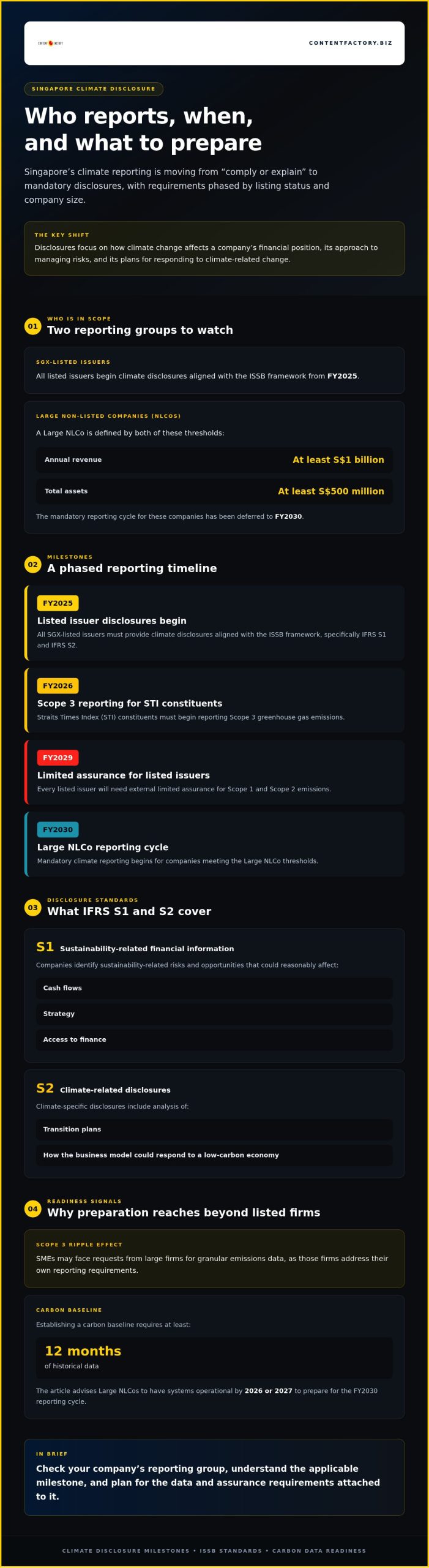
The pressure is most immediate for those on the Singapore Exchange. Starting from FY2025, all SGX-listed issuers must provide climate disclosures aligned with the International Sustainability Standards Board (ISSB) framework, specifically IFRS S1 and S2. This is a massive leap from the older TCFD-aligned models. You’re no longer just reporting on intent; you’re reporting on impact. For Straits Times Index (STI) constituents, the stakes are even higher, as they must begin reporting Scope 3 greenhouse gas (GHG) emissions by FY2026. By FY2029, every listed issuer will also need to obtain external limited assurance for their Scope 1 and 2 emissions, making carbon accounting a non-negotiable audit requirement.
The Reporting Roadmap for Large Non-Listed Companies (NLCos)
If you’re a private entity, don’t assume you’re exempt. ACRA has defined a “Large NLCo” as any company with annual revenue of at least S$1 billion and total assets of at least S$500 million. While the mandatory reporting cycle for these giants has been deferred to FY2030, treating this as a four-year holiday is a strategic failure. Establishing a carbon baseline requires at least 12 months of historical data, meaning your systems must be operational by 2026 or 2027 to avoid a chaotic scramble when the deadline hits. You don’t want to be building your accounting infrastructure while simultaneously trying to satisfy regulators; you want to be refining an already efficient system that proves your long-term financial viability.
The Shift to ISSB Standards: Understanding IFRS S1 and S2
The move toward the International Sustainability Standards Board (ISSB) framework signifies a fundamental shift in how mandatory climate reporting Singapore is executed. We’re moving away from the era of marketing-led ESG “storytelling” and entering an era of institutional-grade financial disclosure. While previous reports often focused on vague corporate social responsibility (CSR) initiatives, the new IFRS S1 and S2 standards demand data that’s investor-ready and audit-proof. It’s no longer about appearing “green”; it’s about proving your business is resilient.
IFRS S1 sets the general requirements for disclosing sustainability-related financial information. It forces companies to identify risks and opportunities that could reasonably affect their cash flows, strategy, or access to finance. IFRS S2 is more surgical, focusing specifically on climate-related disclosures. It requires a detailed analysis of your transition plans and how your business model will survive a low-carbon economy. As highlighted in the official ACRA and SGX Climate Reporting Timelines, these standards are now the benchmark for regulatory compliance in Singapore.
Carbon Accounting and the GHG Protocol
To satisfy IFRS S2, you can’t rely on estimates or “back-of-the-envelope” math. The Greenhouse Gas (GHG) Protocol has become the non-negotiable global standard for emissions calculation. You must account for Scope 1 emissions, which are direct emissions from sources your company owns or controls, and Scope 2 emissions, which cover indirect emissions from purchased electricity or cooling. GHG emissions calculation is the non-negotiable quantitative foundation upon which all IFRS S2 climate disclosures are built. If you aren’t sure where your data gaps lie, starting with a professional ESG Readiness & Materiality Assessment is the most pragmatic first step.
Materiality Assessments: Identifying Financial Risk
Compliance isn’t about checking every possible ESG box; it’s about financial materiality. You need to distinguish between physical risks, like the impact of rising sea levels on local infrastructure, and transition risks, such as sudden shifts in carbon pricing or technological disruption. A materiality assessment for ESG that satisfies ACRA auditors must be sector-specific. It should move beyond generic climate concerns to pinpoint exactly how environmental variables will impact your specific balance sheet and operational integrity. This rigorous approach ensures that mandatory climate reporting Singapore remains a tool for financial transparency rather than just a compliance burden.
Why Non-Mandated SMEs Must Pay Attention: The Scope 3 Pressure
Many local business owners look at the S$1 billion revenue threshold for mandatory climate reporting Singapore and assume they have a free pass. That’s a dangerous misconception. While you might not be reporting directly to ACRA yet, your largest clients certainly are. Under the ISSB framework, these mandated entities must eventually account for Scope 3 emissions; the carbon footprint generated by their entire value chain. In plain English: your emissions are now their line item.
This creates an immediate “competitive lock-out” risk. Multinational corporations (MNCs) and SGX-listed firms are currently auditing their vendors to purge carbon-intensive liabilities from their books. If you can’t provide a credible GHG emissions calculation, you won’t just lose your “preferred supplier” status; you’ll likely be barred from the tender process entirely. For SMEs eyeing regional growth, this data is also becoming a market entry requirement for ASEAN expansion, where cross-border trade increasingly hinges on sustainability credentials. A structured approach to supply chain ESG compliance for SMEs is now the most direct path to protecting your existing client relationships and winning new enterprise contracts.
ESG Readiness as a Competitive Advantage
Compliance shouldn’t be viewed as a cost center. It’s a tool to win. Companies that demonstrate high ESG readiness are already securing “Green Loans” with preferential interest rates from local banks. Beyond financing, a clear digital roadmap for data collection streamlines your operations. It identifies energy waste and logistical inefficiencies that were previously invisible. You aren’t just checking a box for a client; you’re building a leaner, more resilient business model that thrives on precision rather than guesswork. A structured ESG readiness assessment Singapore SMEs can act on immediately is the most direct way to identify these hidden operational gains and build a defensible market position.
Addressing the “Too Small to Care” Objection
The myth that climate reporting is exclusive to “Big 4” clients is costing growth firms their edge. You don’t need a hundred-page theoretical report to satisfy an auditor or an investor. You need actionable data. Proactive reporting helps you attract top-tier talent and impact investors who prioritize long-term viability over short-term gains. ContentFactory specializes in right-sizing these frameworks. We strip away the consulting fluff to provide hands-on implementation support that fits the operational reality of a Singaporean SME. Don’t wait for a mandate to force your hand; use the current window to outmaneuver your slower competitors.
5 Steps to Building a Compliant Climate Disclosure Framework
Regulatory bodies provide the rules, but they don’t provide the map. Transitioning to mandatory climate reporting Singapore standards requires more than a compliance checklist; it demands a structural rethink of your data architecture. This isn’t a theoretical exercise. It’s a pragmatic five-phase journey from fragmented activity data to an audit-ready disclosure that proves your firm’s long-term viability. We don’t believe in the bloated, slow-moving consulting models of the past. Instead, we focus on a nimble execution that delivers results quickly.
- Phase 1: ESG Readiness and Gap Analysis. We don’t start by reinventing the wheel. We identify your existing data points and highlight the specific voids where your current reporting falls short of ISSB requirements.
- Phase 2: GHG Emissions Calculation. This is the quantitative core. You establish a baseline by measuring direct and indirect emissions across your operations using the GHG Protocol.
- Phase 3: Materiality and Risk Assessment. We filter out the noise. We focus on the climate risks that actually impact your cash flow, from supply chain disruptions to carbon tax hikes. A structured materiality assessment for ESG ensures you report only the metrics that drive genuine financial value and regulatory compliance.
- Phase 4: Data Governance and Tech Adoption. You move away from fragile Excel sheets. We help you implement systems that ensure data is captured accurately and consistently.
- Phase 5: Assurance and Reporting. The final step is a verified disclosure that stands up to external scrutiny and satisfies ACRA auditors. Beyond compliance, communicating these findings through engaging, professional presentation is vital; learn more about The Ethical Agency to explore dedicated sustainability report design for impact-driven organizations.
Step-by-Step Carbon Footprint Calculation
Your carbon footprint is the sum of every operational decision you make. You start by mapping your energy consumption, fuel usage, and logistics. To convert raw activity data into a standardized CO2e figure, you must apply specific emission factors that reflect the carbon intensity of your energy use and fuel consumption. Once you have this baseline, you can set decarbonization targets that are grounded in reality rather than just marketing ambition. This grounded approach ensures your transition plan is both defensible and achievable.
Integrating Technology for Reporting Longevity
Manual data entry is the single greatest risk to your reporting integrity. One misplaced decimal in a spreadsheet can trigger a red flag during an assurance audit. You need a digital roadmap that integrates automated data collection from the start. Selecting the right carbon accounting software for the Singapore market ensures your data is auditable and scalable as your business grows. If you’re ready to stop guessing and start measuring, it’s time to build your Digital Roadmap and Implementation Plan with a partner who understands the operational floor.
Beyond the Big 4: Pragmatic ESG Advisory for Singapore’s Growth Firms
Most mid-market firms assume that high-level compliance requires a global consultancy with a global price tag. They often end up with a 200-page theoretical whitepaper that looks impressive in a boardroom but offers zero utility on the operational floor. Transitioning to mandatory climate reporting Singapore shouldn’t be a drain on your capital; it should be a catalyst for your growth. We reject the detached, slow-moving consulting models of the past in favor of assertive pragmatism. We don’t just tell you what the regulations are. We build the systems that satisfy them.
While local expertise is essential, the principles of organizational transformation remain universal. For instance, Redefine Brands Group helps businesses achieve sustainable growth by ensuring that their strategic brand development aligns with these new regulatory and environmental realities.
Choosing a boutique partner means you get a strategic mentor who understands the unique pressures of the local market. Our approach is led by a Singapore Certified Management Consultant (SCMC), ensuring that every assessment meets the rigorous quality standards required by Enterprise Singapore. We provide the intellectual weight of a top-tier firm combined with the hands-on grit of an entrepreneur. This ensures that your sustainability journey is integrated into your business strategy, not just bolted on as a compliance afterthought.
Maximizing the Enterprise Development Grant (EDG) for ESG
The financial barrier to institutional-grade carbon accounting is lower than you think. Enterprise Singapore’s Enterprise Development Grant (EDG) is a powerful lever for local firms, potentially offsetting up to 50-70% of the costs associated with sustainability advisory and carbon accounting implementation. We specialize in grant structuring, ensuring your project is framed to meet the specific eligibility criteria for sustainability-related upgrades. 2026 is the critical window to act. As the FY2027 reporting deadline for Large NLCos approaches, the demand for certified consultants will spike, making this the optimal time to secure funding and build your baseline data.
Your Actionable Roadmap to 2027 Compliance
The time for “wait and see” has expired. Boards and management teams must move from awareness to execution this quarter. Waiting until 2027 to establish your carbon baseline is a recipe for regulatory panic and audit failure. You need to initiate an ESG readiness assessment Singapore growth firms can leverage now to identify your data gaps and start capturing the metrics that will define your market position in a low-carbon economy. If you’re ready to turn compliance into a competitive edge, book a consultation with ContentFactory for a pragmatic ESG roadmap and secure your business’s future in the Singaporean market.
Future-Proofing Your Operations for the Low-Carbon Economy
The transition to mandatory climate reporting Singapore isn’t just a regulatory hurdle; it’s a fundamental pivot toward financial transparency. We’ve established that carbon accounting is no longer a peripheral ESG project but a core audit requirement that impacts your access to capital and MNC contracts. Whether you’re navigating IFRS S2 standards or managing Scope 3 pressure from your value chain, the goal is clear: replace fragmented data with institutional-grade insights.
Success in this new regime requires execution, not just theory. You need a partner who brings the authority of an SCMC-certified advisor and a proven track record in carbon accounting and EDG grant structuring. Stop reacting to deadlines and start leading your sector with a roadmap built for growth. Secure your ESG transition with ContentFactory’s grant-supported advisory and ensure your business remains resilient in a rapidly decarbonizing market. You’ve got the roadmap; now it’s time to execute.
Frequently Asked Questions
Is climate reporting mandatory for all companies in Singapore?
No, mandatory reporting currently focuses on SGX-listed entities and specific Large Non-Listed Companies (NLCos). While most SMEs aren’t legally required to file with ACRA yet, they face increasing commercial pressure to provide emissions data to their mandated MNC clients. Ignoring this trend is a strategic risk, as mandatory climate reporting Singapore standards are rapidly becoming a prerequisite for doing business in the region.
What is the difference between TCFD and ISSB reporting standards?
TCFD provided a voluntary framework for climate-related financial disclosures, whereas ISSB (IFRS S1 and S2) is the new global standard designed to be a mandatory baseline. Singapore is transitioning from TCFD-aligned reporting to the more rigorous ISSB standards. This shift moves the needle from qualitative “narrative” reporting to “institutional-grade” financial disclosure that auditors can verify.
How much does it cost to implement carbon accounting for an SME?
Implementation costs are not fixed; they scale with the complexity of your supply chain and the number of emission sources you track. Instead of viewing this as a sunk cost, growth-focused firms treat it as an investment in operational resilience and data integrity. Utilizing government grants can significantly lower the barrier to entry, making professional carbon accounting accessible for mid-sized enterprises.
Can we use the Enterprise Development Grant (EDG) for climate reporting?
Yes, the EDG specifically supports sustainability projects that help local firms improve their ESG readiness and carbon accounting capabilities. This grant can offset a substantial portion of the costs for advisory services and implementation, typically up to 50% or 70% for qualifying SMEs. It’s a pragmatic way for firms to build a compliant framework without bearing the full financial burden of the transition.
What happens if our company fails to meet the ACRA reporting deadline?
Failing to meet ACRA deadlines can result in statutory penalties and fines under the Companies Act. However, the commercial consequences are often more severe than the legal ones. You risk losing your “preferred supplier” status with MNCs and listed firms that cannot include you in their own mandated disclosures without verified data, effectively locking you out of major supply chains. SMEs that have already addressed supply chain ESG compliance for SMEs will be far better positioned to retain these critical enterprise relationships when deadlines hit.
How do we calculate Scope 3 emissions if our suppliers don’t have data?
If supplier-specific data is missing, you use secondary data sources like industry-average emission factors or spend-based modeling. This allows you to create a defensible estimate of your value chain’s impact. The key is to demonstrate a clear, consistent methodology and a plan for improving data granularity as your suppliers build their own reporting capabilities over time.
Does our climate report need to be audited by a third party?
Yes, external limited assurance will become mandatory on a phased timeline according to the revised roadmap. Listed companies must obtain assurance for Scope 1 and 2 emissions starting from FY2029, while Large NLCos follow in FY2032. We recommend building “audit-ready” systems now so the final third-party verification becomes a routine check rather than a costly operational crisis.
What are the criteria for a “Large Non-Listed Company” under ACRA rules?
ACRA defines a Large Non-Listed Company as a private entity with annual revenue of at least S$1 billion and total assets of at least S$500 million. These companies are required to begin ISSB-aligned climate reporting from FY2030. Even if you don’t meet these specific thresholds today, tracking your growth against these criteria is essential for long-term strategic planning and investor relations.

Article by
Mayuresh Godse
Mayuresh Godse is a Singapore Certified Management Consultant and Business Strategist specializing in Sustainability, ESG, AI-driven Digital Transformation, and business growth. Based in Singapore, he writes about Sustainability, Digital Innovation, Business Strategy, and Content Marketing for global audiences.
Disclaimer
This article is provided by ContentFactory for general information only and is not legal, tax, accounting or financial advice. Regulations and government scheme criteria change; grant eligibility and quantum are set by the relevant Singapore agencies and assessed case by case, with no outcome guaranteed. Verify current requirements before acting.