

If your marketing dashboard is glowing green but your bank balance remains stagnant, is your current method for measuring ROI on digital marketing actually capturing commercial reality? Most B2B leaders feel the persistent frustration of pouring capital into digital channels only to receive reports filled with impressions and clicks that fail to translate into closed deals. It’s a systemic challenge to bridge the gap between superficial marketing activity and hard revenue. Effective measurement is non-negotiable.
You already know that traditional reporting often obscures the truth about your acquisition costs. This guide provides the exact strategic frameworks required for measuring ROI on digital marketing with surgical precision, ensuring you can justify every dollar of your expansion budget to the board. We’ll examine the integration of CRM data, the shift from lead quantity to high-intent quality, and the precise formulas that turn vague digital spend into a predictable engine for revenue. By the end of this guide, you will have a clear roadmap for measuring ROI on digital marketing that aligns marketing spend with tangible commercial growth. Mastering the art of measuring ROI on digital marketing is the only way to ensure long-term resilience.
Key Takeaways
- Eliminate the distraction of vanity metrics by shifting your reporting focus toward net profit and commercial resilience.
- Master precise formulas for measuring ROI on digital marketing to isolate the performance of specific channels from your baseline organic growth.
- Move beyond obsolete last-click attribution models by prioritising high-intent lead generation over high-volume, low-value traffic.
- Build a robust measurement framework by integrating digital advertising platforms with your CRM to ensure data consistency across the entire sales cycle.
- Leverage ROI transparency to secure strategic growth grants and inform large-scale initiatives like ASEAN market entry and ESG integration.
Defining Digital Marketing ROI for the B2B Mid-Market
Return on investment in the B2B sector is frequently misunderstood as a simple calculation of revenue generated against ad spend. For the mid-market enterprise, true ROI is the net profit produced by digital activities relative to the total cost of investment. This distinction is critical. If your marketing efforts aren’t directly impacting the bottom line after all operational expenses are accounted for, they aren’t performing. Measuring ROI on digital marketing requires a shift from tracking activity to evaluating fiscal outcomes.
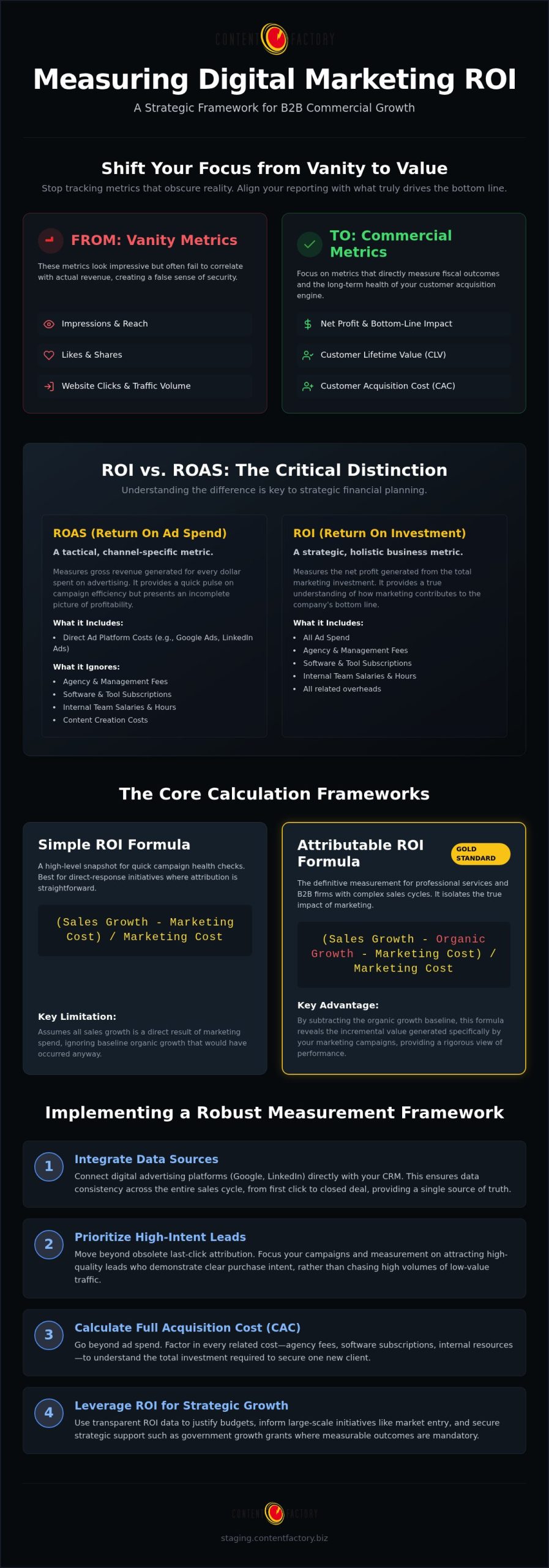
Vanity metrics like likes, shares, and impressions are the silent killers of B2B profitability. While these figures might look impressive in a monthly report, they rarely correlate with revenue in a high-value sales environment. Relying on them creates a false sense of security while masking inefficient spend. Instead, sophisticated firms align their metrics with long-term Customer Lifetime Value (CLV). This approach ensures that marketing isn’t just buying clicks; it’s acquiring assets that yield dividends over years, not just days. B2B Digital Marketing ROI acts as the essential bridge between marketing spend and commercial scalability.
The Difference Between ROI and ROAS
Professional services firms often confuse Return on Ad Spend (ROAS) with true ROI. ROAS is a tactical metric that measures gross revenue per dollar spent on a specific ad platform. It ignores agency fees, software subscriptions, and internal resource hours. To move toward a strategic investment analysis, you must calculate the Return on Marketing Investment (ROMI) by factoring in every overhead cost. This transition allows leadership to see the actual cost of acquisition, providing a realistic view of how digital channels contribute to the firm’s resilience.
Why Singaporean SMEs Must Quantify Digital Impact
For Singaporean SMEs, the ability to quantify impact is a prerequisite for board approval and government support. Measuring ROI on digital marketing provides the empirical evidence needed to justify budgets for high-intent SEO and performance marketing. This data is also vital when applying for the Enterprise Development Grant (EDG), where measurable outcomes are a key requirement for approval. Beyond funding, ROI insights drive business process reengineering by highlighting operational bottlenecks. Integrating these findings with broader initiatives, such as an ESG readiness assessment Singapore, ensures your growth strategy is both profitable and sustainable.
The Core Formulas: Calculating Simple vs. Attributable ROI
Precision in measuring ROI on digital marketing requires more than a cursory glance at your monthly ad spend. For B2B firms, the challenge lies in isolating the specific impact of digital channels within a multi-faceted sales environment. Without a rigorous mathematical approach, marketing reports often become exercises in confirmation bias rather than tools for strategic decision-making. To achieve fiscal clarity, leadership must distinguish between baseline performance and the incremental value generated by active campaigns.
Integrating Customer Acquisition Cost (CAC) into your profitability equations is a non-negotiable step for the mid-market. CAC goes beyond ad spend to include the total investment required to secure a new client, including agency fees and technology overheads. When these figures are weighed against the lifetime value of a client, the resulting data provides a definitive view of your firm’s commercial efficiency and scalability.
The Simple ROI Calculation Framework
The Simple ROI formula serves as an essential baseline for quick campaign health checks or direct-response initiatives. It’s calculated as: (Sales Growth – Marketing Cost) / Marketing Cost. While this provides a high-level snapshot of performance, it’s often insufficient for professional services firms with complex, multi-touch buyer journeys. Its primary limitation is the assumption that every dollar of sales growth is a direct result of marketing spend, which is rarely the case in established B2B ecosystems.
Campaign-Attributable ROI for Professional Services
For management consultants and industrial firms, Campaign-Attributable ROI is the gold standard of measurement. The formula is more rigorous: (Sales Growth – Organic Growth – Marketing Cost) / Marketing Cost. This method forces a confrontation with the “organic baseline,” which represents the revenue your firm would have generated through existing reputation and referrals without any new digital intervention. By subtracting this baseline, you ensure that your marketing team is only taking credit for the growth they actually manufactured.
Isolating this data allows you to identify which high-intent channels are driving genuine expansion versus those that are simply capturing leads that were already in your orbit. If your current reporting lacks this level of granularity, it’s time to consult with a strategic advisor to audit your attribution models. Measuring ROI on digital marketing through this lens prevents the overestimation of impact and ensures your growth budget is allocated to the most resilient channels. This disciplined approach transforms marketing from a cost centre into a predictable engine for commercial growth. For firms operating in manufacturing and engineering sectors, a dedicated approach to lead generation for industrial companies applies these same attribution principles to the unique challenges of long sales cycles and complex buying committees.
The B2B Attribution Challenge: Quality Over Quantity
Measuring ROI on digital marketing requires a departure from the simplistic last-click models common in B2C e-commerce. In a high-value B2B environment, the journey from initial awareness to a signed contract often spans several months and involves multiple stakeholders. Attributing a million-dollar deal solely to the final link clicked is not just inaccurate; it’s a strategic liability that misallocates future growth capital. You must map the entire digital journey to understand how initial SEO discovery feeds the CRM conversion pipeline.
Success is defined by intent, not volume. Ten high-intent leads generated through targeted technical content are exponentially more valuable than 1,000 low-intent clicks from a generic display campaign. This focus on commercial relevance is the cornerstone of effective B2B performance marketing Singapore. By prioritising quality over quantity, firms ensure that their digital spend acts as a high-yield investment rather than a recurring overhead expense.
Multi-Touch Attribution Models for Mid-Market Firms
Mid-market firms must select an attribution model that mirrors their specific sales cycle. First-touch models are useful for identifying which awareness-level content initiates the relationship, while time-decay models provide a more realistic view of the interactions that drive the final decision. Linear models offer a balanced perspective by assigning equal credit to every touchpoint. Strategic content marketing plays a vital role here, acting as a mechanism to warm prospects before they are handed over to sales. A well-executed B2B content marketing strategy ensures that every piece of content is mapped to a specific stage of the buyer journey, maximising its contribution to the attribution model. Partnering with a specialised B2B lead generation agency Singapore can help shorten the attribution window by deploying high-intent tactics that move prospects through the funnel with greater velocity.
Measuring Lead Quality and SQL Conversion Rates
The ultimate metric for measuring ROI on digital marketing is the lead-to-revenue ratio. This requires a clear distinction between Marketing Qualified Leads (MQL) and Sales Qualified Leads (SQL). An MQL might be a prospect who downloaded a whitepaper, whereas an SQL is a decision-maker who has requested a feasibility study or a quote. Tracking the conversion rate between these stages reveals the true efficiency of your digital engine. Professional services firms often find that high-intent SEO leads yield 3x higher ROI than generic display ads because they capture prospects at the exact moment of commercial need. This data-driven approach ensures that your marketing spend is consistently aligned with your firm’s commercial maturity and growth objectives.
Step-by-Step: Implementing a Measurement Framework
Execution is where strategic vision meets operational reality. Measuring ROI on digital marketing isn’t a passive activity; it requires a structured technical roadmap to ensure data integrity across every touchpoint. If you don’t establish a rigorous framework from the outset, your reporting will inevitably suffer from fragmentation and inaccuracy.
Phase 1 begins with establishing a data-clean baseline. You must verify your current performance metrics before launching new initiatives to avoid skewed results. Phase 2 involves the deep integration of your digital advertising platforms with a robust CRM like Salesforce or HubSpot. This connection allows you to track a prospect from the initial ad click to the final contract signature, providing a clear view of the revenue pipeline. In Phase 3, you’ll configure ‘Key Events’ in Google Analytics 4 (GA4), focusing on high-value commercial actions such as feasibility study requests or consultation bookings. Finally, Phase 4 requires a monthly audit of lead-to-close data to refine your spend allocation and shift budget toward high-yield channels.
Setting Up the Technical Infrastructure
A resilient framework relies on technical precision. Implementing server-side tracking is now a necessity to combat data loss from ad-blockers and privacy-focused browser updates, ensuring your data remains accurate as third-party cookies phase out. Your team must also maintain absolute UTM parameter discipline across all B2B content marketing efforts to provide granular attribution data. This technical rigour establishes a single source of truth, eliminating the chronic discrepancies between marketing dashboards and sales CRMs.
Defining Your ROI Benchmarks for 2026
Benchmarks must be grounded in the commercial reality of the Singaporean professional services sector. While performance varies by industry, a 5:1 ROI ratio is the industry standard for sustainable growth. This means every dollar invested should yield five dollars in revenue. However, you must adjust these expectations based on your strategic phase. During a market entry phase, your ROI might be lower as you invest heavily in brand equity. Conversely, in a market consolidation phase, you should expect higher efficiency and improved margins. Measuring ROI on digital marketing through these contextual lenses ensures your growth targets remain both ambitious and fiscally responsible.
Driving Commercial Growth Through Strategic ROI Management
Measuring ROI on digital marketing is not merely a reporting requirement; it is a critical instrument for broader commercial steering. When you possess a granular understanding of your acquisition costs and conversion efficiencies, you gain the confidence to pursue aggressive market entry strategy and ASEAN expansion. This data serves as the foundation for financial modelling, allowing leadership to project the feasibility of new territories with empirical certainty rather than speculative optimism. It transforms marketing from a black box into a transparent, audit-ready asset.
Integration with your firm’s sustainability objectives is the next evolution of performance tracking. Just as you seek transparency in your supply chain through an ESG readiness assessment Singapore, you must demand the same level of accountability in your marketing spend. Measuring ROI on digital marketing provides the empirical clarity needed to transition from speculative spending to strategic investment. This alignment builds brand resilience by ensuring that every dollar spent contributes to a sustainable growth trajectory. Strategic grant advisory further enhances this by leveraging support like the Enterprise Development Grant (EDG) to offset the costs of digital transformation, effectively de-risking your investment in high-intent lead generation.
From Data to Decision: The Strategic Roadmap
A robust measurement framework allows you to pivot from low-performing, broad-reach channels to high-intent SEO with surgical precision. This shift mirrors the rigour found in carbon accounting services SG, where every data point must be verified and actionable. By treating digital ROI as a core business metric, you build a scalable lead generation engine that eventually pays for itself through measurable commercial returns. It ensures your marketing strategy remains agile, allowing you to redeploy capital to the channels that demonstrate the highest commercial resilience.
Partnering for Performance-Led Growth
A boutique consultancy provides a level of depth that generic digital agencies cannot match. While a standard agency might focus on ad placements, a partner led by a Singapore Certified Management Consultant audits your marketing spend through the lens of business process reengineering. This ensures that your digital strategy isn’t operating in a vacuum but is fully integrated with your commercial operations. ContentFactory acts as the execution engine for this high-intent growth strategy, moving beyond mere reporting to deliver tangible business outcomes. The next logical step is a comprehensive audit of your current digital ROI to identify where capital is being wasted and where it can be redeployed for maximum impact.
Mastering Commercial Accountability in the B2B Landscape
Achieving commercial scalability in 2026 requires a departure from superficial reporting. Success isn’t defined by traffic volume but by the precision of your attribution and the quality of your lead pipeline. By isolating your organic baseline and integrating CRM data, measuring ROI on digital marketing becomes a transparent, strategic asset rather than a monthly guessing game. This shift ensures every dollar is tied to a tangible commercial outcome.
This results-led framework transforms your marketing spend into a predictable engine for expansion. ContentFactory provides the pragmatic expertise needed to bridge the gap between digital activity and commercial profit. Our leadership, composed of Singapore Certified Management Consultants, specialises in Enterprise Development Grant (EDG) advisory to ensure your transformation is both efficient and fiscally supported. We focus on execution that drives resilience and long-term value.
It’s time to stop justifying spend and start demonstrating impact. With a robust measurement framework in place, your growth budget becomes a high-yield investment in your firm’s future. Build the clarity you need to lead with confidence.
Frequently Asked Questions
What is a good ROI for B2B digital marketing in Singapore?
A 5:1 return ratio is widely considered the benchmark for sustainable growth in the Singaporean professional services sector. This means every dollar invested should generate five dollars in revenue. However, your targets must reflect your current strategic phase. Firms in a market entry phase often accept lower initial returns to build brand equity, while established players should focus on higher efficiency and improved margins through precise measurement.
How do I calculate ROI if my sales cycle takes 6 to 12 months?
Measuring ROI on digital marketing during long sales cycles requires tracking intermediate commercial milestones rather than just final closures. You should assign a weighted value to Sales Qualified Leads (SQLs) based on historical conversion rates. This approach allows you to quantify the value of your pipeline in real time. Integrating your CRM with digital platforms ensures that attribution remains accurate even when a deal takes twelve months to finalise.
Can I use the Enterprise Development Grant (EDG) for digital marketing?
The Enterprise Development Grant (EDG) can support digital transformation projects that involve strategic marketing advisory or business process reengineering. It isn’t a subsidy for ad spend alone. To qualify, your project must demonstrate a significant impact on operational efficiency or market expansion. Working with a Singapore Certified Management Consultant is essential to ensure your proposal meets the rigorous requirements set by Enterprise Singapore for 2026.
What is the difference between ROI and ROAS in B2B lead generation?
Return on Ad Spend (ROAS) is a narrow tactical metric that only accounts for direct advertising costs. In contrast, ROI provides a comprehensive view by including agency fees, software overheads, and internal resource hours. For B2B lead generation, relying solely on ROAS is dangerous because it ignores the high operational costs associated with nurturing complex relationships. True ROI reveals the actual profitability of your acquisition strategy.
How do I track the ROI of organic SEO vs. paid advertising?
Isolating organic performance requires you to establish a baseline of revenue generated without active advertising. You can then use UTM parameters and CRM tracking to attribute specific deals to paid campaigns. By subtracting your organic baseline from your total sales growth, measuring ROI on digital marketing becomes more accurate. This level of granularity prevents marketing teams from overestimating their impact on existing revenue streams and ensures budget is allocated effectively.
What are the most common mistakes when measuring marketing ROI?
The most frequent error is prioritising vanity metrics like impressions or clicks over net profit. Many firms also fail to account for the organic baseline, leading to inflated ROI figures that don’t reflect reality. Another critical mistake is maintaining disconnected data silos between marketing dashboards and sales CRMs. Without a single source of truth, you cannot accurately track a prospect’s journey from initial discovery to final commercial conversion.
Is it possible to measure the ROI of brand awareness campaigns?
While brand awareness is often viewed as intangible, you can measure its impact through brand search volume lift and assisted conversion data in GA4. These metrics show how awareness-level content influences future high-intent searches. Over time, successful brand campaigns should lower your overall Customer Acquisition Cost (CAC) by increasing trust and shortening the sales cycle. Tracking these trends provides a pragmatic way to justify spend on top-of-funnel activity.
How often should my firm audit its digital marketing ROI?
Your firm should conduct tactical audits on a monthly basis to refine ad spend and channel allocation. Strategic audits, however, should occur quarterly to align marketing performance with broader business objectives like ASEAN expansion or ESG integration. These deeper reviews allow leadership to assess the long-term resilience of the lead generation engine. Regular auditing ensures that your digital strategy remains agile and consistently contributes to commercial growth.

Article by
Mayuresh Godse
Mayuresh Godse is a Singapore Certified Management Consultant and Business Strategist specializing in Sustainability, ESG, AI-driven Digital Transformation, and business growth. Based in Singapore, he writes about Sustainability, Digital Innovation, Business Strategy, and Content Marketing for global audiences.
Disclaimer
This article is provided by ContentFactory for general information only and is not legal, tax, accounting or financial advice. Regulations and government scheme criteria change; grant eligibility and quantum are set by the relevant Singapore agencies and assessed case by case, with no outcome guaranteed. Verify current requirements before acting.
One thing worth checking on the tool side: if the disclaimer is switched on globally, the grant caveat already written into your Global Writing Instructions will appear as well, so grant articles will carry the same point twice. Remove the required-disclaimer section from the instructions file if you enable this one.