

The value of an ESG project depends on what your business counts as a return. Measuring the ROI of ESG initiatives means comparing project benefits with costs, then assessing environmental and social outcomes alongside financial results. Set a baseline before work begins so you can distinguish measured changes from assumptions.
It is reasonable to expect a sustainability project to affect business performance. Some returns are direct, such as lower energy or waste costs. Others may come through revenue, reduced risk or stronger resilience over time. The challenge is to connect each outcome to the initiative without claiming more than the evidence supports.
This guide explains how to set useful baselines, identify value drivers and assess savings, revenue, risk reduction and longer-term returns for Singapore businesses. It also covers benefits that may not appear immediately in financial results, and how to build a clearer case for continuing or adjusting an initiative.
Key Takeaways
- Set a clear baseline before starting an ESG initiative so you can compare later results with the starting position.
- Assess returns across savings, revenue, risk reduction and environmental or social outcomes, not just immediate cash gains.
- Use a consistent ROI calculation, and make the investment costs and benefits behind it transparent.
- Track measurable indicators such as energy use, waste, employee retention or supply-chain disruption to connect initiatives with business value.
- Consider payback periods and longer-term resilience when judging projects whose benefits may take time to emerge.
How can companies measure the ROI of their sustainability initiatives and strategy?
Compare the value an initiative creates or protects with the investment it requires, then track financial, environmental and social outcomes. Measuring the ROI of ESG initiatives starts with measures tied to operational decisions and reliable evidence.
Financial, Reputational, and Market Returns
ESG returns can include financial gains, stakeholder confidence and market opportunities. Assess each category separately, then identify where the outcomes connect. An energy-efficiency project may reduce utility use, while responsible sourcing may strengthen customer relationships or reduce exposure to supply-chain disruption. Track carbon and resource changes alongside operating results, rather than treating sustainability metrics as a substitute for financial performance.
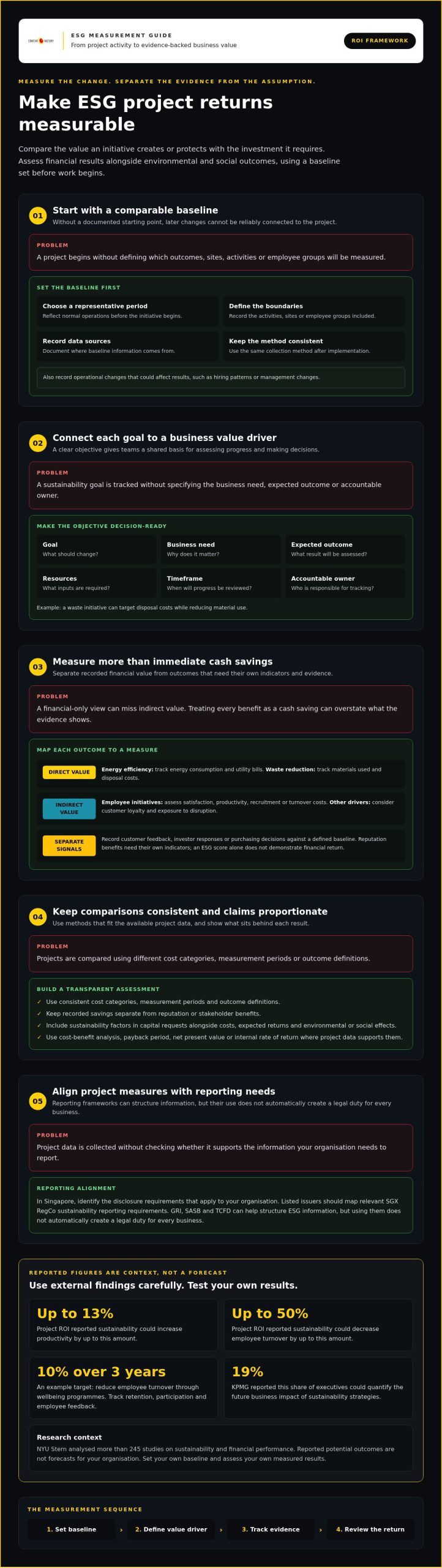
To assess reputation and market value, record customer feedback, investor responses or purchasing decisions against a defined baseline. Compare financial results with environmental and social outcomes. An ESG score alone cannot demonstrate a financial return.
Direct and Indirect Financial Value
Direct value appears in records such as lower energy bills, less material waste or avoided operating costs. Indirect value may affect performance through employee retention, customer loyalty or reduced exposure to disruption. Keep these categories separate: a recorded saving can be included in a cash-flow calculation, while reputation benefits need their own indicators and evidence.
To compare projects or business units, use consistent cost categories, measurement periods and outcome definitions. For example, compare an equipment upgrade’s bill savings with a workforce initiative’s retention data. Do not treat different outcomes as interchangeable simply because both support sustainability.
Integrating ESG into Financial Decisions
Include sustainability factors in capital requests and project proposals alongside costs, expected returns and environmental or social effects. Finance teams can distinguish benefits that belong in cash-flow forecasts from those that need separate performance measures. This gives decision-makers a consistent basis for prioritising projects, reviewing assumptions and allocating capital.
In Singapore, identify the disclosure requirements that apply to your organisation. Listed issuers should map relevant SGX RegCo sustainability reporting requirements. GRI, SASB and TCFD can help structure ESG information, but using them does not automatically create a legal duty for every business. Align project measures with the information your organisation needs to report.
Turning ESG Outcomes into Financial Metrics
Translate each outcome into an operational driver, a financial effect and a measurement method. For energy efficiency, track consumption and utility bills. For waste reduction, track materials used and disposal costs. Assess employee initiatives through measures such as satisfaction, productivity, recruitment or turnover costs. Consistent data collection makes comparisons more credible.
Use cost-benefit analysis, payback period, net present value or internal rate of return where project data supports them. NYU Stern analysed more than 245 studies on sustainability and financial performance. KPMG reported that 19% of executives could quantify sustainability strategies’ future business impact. Clear tracking helps you assess what your own evidence supports. ContentFactory’s Singapore ESG services include carbon accounting and sustainability reporting.
Establishing baselines and identifying value drivers
A useful sustainability ROI assessment starts with a baseline: a documented view of performance before an initiative begins. Set one for each outcome you plan to assess, such as emissions, energy use, employee retention, customer sentiment or supply-chain disruption. Without a comparable starting point, you cannot reliably connect later changes to the project.
Choose a baseline period that reflects normal operations, and record its boundaries and data sources. For an emissions project, specify which activities and sites are included. For a staff wellbeing programme, define the employee group and retention measure. Use the same collection method after implementation, and document operational changes that could affect the results.
Link each sustainability goal to a business value driver. A practical objective identifies the goal, business need, expected outcome, resources, timeframe and accountable owner. For example, a waste initiative might target disposal costs while reducing material use. This gives finance and sustainability teams a shared basis for assessing progress and making decisions.
Talent, productivity and organisational value
Employee initiatives can affect satisfaction, productivity, recruitment costs, turnover and innovation. Project ROI reported that sustainability could increase productivity by up to 13% and decrease employee turnover by up to 50%. Treat these as reported potential outcomes, not forecasts for your organisation. Track your own baseline and results to assess whether the initiative creates measurable organisational value.
A practical target could be reducing employee turnover by 10% over three years through wellbeing programmes. Measure retention alongside programme participation and employee feedback. Compare the same workforce groups over time, and record other changes that may influence outcomes, such as hiring patterns or management changes.
Tracking reputation, talent and customer relationships
Reputation and customer relationships can influence purchasing decisions without appearing as immediate savings. Track customer feedback, repeat business or Net Promoter Score over time, then compare changes with the initiative’s timing and reach. An Accenture study of 140 US companies found that firms leading in diversity hiring, employment and inclusion achieved 28% higher revenue on average. This is external US evidence, not a Singapore benchmark or a forecast for local businesses.
Rather than assume external findings predict local behaviour, use employee surveys and retention data to understand your own workforce. Diverse management teams have also been associated with 19% higher innovation revenue. Treat this as external context, then assess whether workforce composition and innovation measures relate to your organisation’s own results.
Communicating ESG value to stakeholders
Give employees, customers, investors and community members a concise account of the baseline, actions, results and remaining gaps. Distinguish measured financial outcomes from reputation indicators, and explain how emissions or social metrics were collected. To organise these priorities, discuss an ESG measurement approach.
Sustainability ROI definition and conceptual equation
Sustainability ROI assesses the value an initiative creates or protects against the resources invested. It combines financial analysis with environmental and social measures, giving decision-makers a broader view of project performance.
Defining Sustainability ROI
Use this conceptual equation: ESG project ROI = net project benefits ÷ project costs × 100. Define which benefits and costs belong in the calculation before applying it. Net benefits represent value attributable to the initiative after relevant costs are considered.
The resulting percentage can help compare financial returns, but it cannot capture every outcome. A supplier project, for example, could improve sourcing practices and reduce exposure to disruption. Report those results separately from cash benefits. This keeps the calculation transparent and makes governance outcomes visible without assigning them an invented monetary value.
Operational Savings from Environmental Sustainability
Environmental initiatives can lower operating costs when they reduce resource use, waste or unnecessary process steps. Assess each project using records that reflect the activities it affects. For example, evaluate a packaging change through material purchases, product damage and disposal activity.
Consider financial and environmental results together. Using less material may reduce purchasing needs, but changes in damage or handling could offset some savings. Track these effects, state the project boundaries and identify the evidence used. This helps you determine whether operational improvements deliver savings without overlooking other consequences.
The Business Case for Sustainability Investment
A business case links an investment to a defined need, expected outcome, required resources and timeframe. Customer and supplier expectations can help identify that need. For example, assess whether sustainability criteria affect purchasing decisions, tender participation or supplier relationships. Distinguish observed evidence from assumptions about future revenue.
Include supply-chain continuity and governance where they are relevant to the project. A supplier initiative could improve environmental performance while addressing operational dependencies. Assess each outcome on its own terms, then explain how it supports resilience or customer relationships. This gives leaders a grounded basis for prioritising investment without assuming every benefit appears as immediate cash.
Challenges in Measuring Sustainability ROI
Measurement becomes harder when teams use different project boundaries, incomplete records or inconsistent definitions. Siloed information can also make it difficult to connect operational data with finance records. Agree shared metric definitions and assign responsibility for collecting source evidence before reviewing project results.
Separate recorded outcomes from estimates, especially for customer loyalty, reputation and supply-chain resilience. Keep the assumptions and calculation methods with each result, and apply them consistently across reporting periods. If a method or boundary changes, explain why and how it affects comparisons. These practices make the analysis clearer and help decision-makers judge what the evidence supports.
Quantifying savings, revenue and risk reduction
Quantify ESG outcomes by linking operational changes to financial records and relevant sustainability metrics. For each project, track savings, revenue, resource use and risk exposure against its defined baseline.
Cost Savings from Efficiency Improvements
Efficiency improvements create savings when operations use fewer resources or avoid unnecessary work. For an energy project, compare consumption and utility bills before and after installation, while recording operating hours and output. This helps distinguish genuine efficiency gains from changes in production volume.
Include project costs and ongoing maintenance when assessing the result. Track waste and material use as well as energy: a process change may reduce both input requirements and disposal needs. Keep each metric distinct, then calculate the financial effect using the relevant bills or purchasing records. Deloitte reported that 59% of companies saw a positive top-line impact from operational ESG investment, but your own figures should drive project decisions.
Operational Cost Savings
Operational cost savings include recurring changes across business operations, not just one-off reductions. Compare resource purchases, waste handling and equipment use over consistent periods. For water, record consumption alongside production levels. For materials, compare quantities used per unit of output. These measures show whether improvements reflect better performance or simply lower activity.
Assess energy-efficiency projects through payback period, cost savings and carbon footprint reductions. Separate direct reductions from costs avoided, such as preventing material loss through better handling. Document the method and data source for each calculation. If production changes during the review period, adjust the comparison or explain the difference rather than attributing every cost movement to the ESG initiative.
Revenue and Risk Reduction
Revenue effects need a clear link to customer demand, market access or margin improvement. Compare sales associated with a product or service affected by the initiative, and record the period and relevant customer segment. Project ROI reported that sustainability could increase sales revenue by up to 20%; treat this as reported potential, not a forecast for your business.
To assess risk reduction, first identify the exposure, such as supply disruption or resource dependency. Track relevant incidents, downtime, replacement costs or supplier concentration before and after the project. Estimate avoided loss only when the assumptions, including likelihood and potential impact, are documented. Report these measures separately from realised savings. This gives decision-makers a defensible view of value without presenting prevented costs as cash already earned.
Risk management and long-term returns
Some ESG investments support resilience and competitiveness before producing visible financial returns. A project that reduces reliance on scarce resources, strengthens supplier continuity or improves climate preparedness may protect future operations. Assess these effects over a suitable planning horizon rather than judging every initiative by its first reporting period. Value depends on the exposure addressed, the actions taken and the evidence tracked over time.
Climate risk is one example. Map how physical disruption or changing market conditions could affect facilities, operations and supply chains, then identify which controls the initiative improves. For each material exposure, record the business function affected, the response action and an indicator of progress. Leaders can use this information in planning and capital decisions, without claiming that controls have eliminated the risk.
Regulatory readiness is another potential value driver. Track relevant disclosure requirements, assigned owners, data coverage and reporting gaps as they change. Stronger processes can help an organisation respond more consistently, but assess readiness through specific milestones rather than assumed savings. Separate resources spent on compliance preparation from costs avoided, and document the basis for any estimate of avoided disruption or rework.
Long-term performance also needs a clear measurement window. Use the results as context, not as a forecast. Set interim measures for operational resilience, resource exposure and progress against objectives, then review them alongside financial performance at planned intervals.
Investor expectations add another reason to make the evidence decision-ready. It also reports that 73% of executives surveyed by Deloitte in 2023 were very concerned about climate change. These findings indicate stakeholder attention, but your organisation still needs to show how its own exposures, decisions and outcomes connect.
For each initiative, keep a concise record of the risk addressed, baseline, actions, costs, results and remaining exposure. Compare actual outcomes with the original assumptions, and revise future capital decisions when the evidence changes. A climate-related project, for example, may improve preparedness without producing immediate savings. Report the resilience outcome separately from realised cash benefits to make long-term value visible without overstating certainty.
If your business needs to structure ESG risk measures and connect them to reporting and investment decisions, Contact Us.
ContentFactory: ESG Readiness & Materiality Assessments
ContentFactory helps businesses identify material ESG priorities and build a clearer basis for assessing initiative value. Its ESG Readiness & Materiality Assessments can help your business prioritise issues, align measures with objectives and clarify which data supports decisions. For emissions-related initiatives, GHG Emissions Calculation and Carbon Accounting can establish the information needed to track carbon outcomes. Multi-Framework Sustainability Reporting can organise ESG performance for relevant reporting needs.
Turn to these services when your metrics are fragmented, material priorities are unclear or sustainability outcomes are difficult to connect with business decisions. Explore ESG services in Singapore to see how readiness, carbon accounting and reporting can support a more structured approach. To discuss your requirements, contact ContentFactory.
Make your next ESG investment measurable
The next step is to make your measurement approach a repeatable business practice. Choose an initiative with a clear owner, accessible evidence and a decision that depends on its results. Define success before work begins, then use the findings to refine future priorities and investment decisions.
Measuring the ROI of ESG initiatives is most useful when finance and sustainability teams share definitions, data ownership and review points. Keep financial outcomes distinct from environmental and social measures, and document assumptions behind indirect benefits. This discipline helps leaders act on credible evidence rather than broad claims.
ContentFactory can help your organisation shape its ESG priorities, emissions data and reporting approach into a clearer measurement framework. If you’re ready to define the next practical step for your business, Contact Us. Start with the decision you need to make, and build the evidence around it.
Frequently Asked Questions
And the size of the prize?
Potential value depends on the initiative, its costs and the business outcomes it affects. An energy project may reduce operating expenditure, while a supplier programme may protect continuity or support customer requirements. Estimate the value for your business using evidence tied to these outcomes, then separate realised savings from possible future benefits. The result is a project-specific case, not a universal return figure.
From ESG Reporting to Business Value: Why Sustainability ROI Matters?
Sustainability ROI helps turn ESG information into decisions about priorities, resources and performance. Reporting can show emissions or workforce outcomes; linking those measures to operations helps leaders decide what to do next. For example, if a facility’s energy use rises despite lower production, investigate the process before setting a new investment priority. The aim is useful management insight, not reporting for its own sake.
What Is Sustainability ROI?
Sustainability ROI assesses the value an initiative creates or protects relative to its investment, taking economic, environmental and social outcomes into account. It can include financial measures and separate indicators for results that cannot responsibly be expressed as cash. For instance, a supplier programme might show operating savings alongside improved supply continuity. Keeping these outcomes distinct gives decision-makers a fuller view than a single percentage.
Why is it crucial for companies to understand the ROI of sustainability?
Understanding ROI helps your business decide which initiatives to fund, which need redesign and which to stop. It also provides a basis for explaining trade-offs to finance teams and other decision-makers. If a project reduces emissions but increases operating costs, leaders can assess the environmental outcome against the financial effect. Without this comparison, sustainability activity can remain disconnected from investment choices and operational priorities.
How is ROI for ESG initiatives defined and calculated?
Calculate ESG project ROI as net project benefits divided by project costs, multiplied by 100. Define the benefits and costs before calculating: include relevant implementation and operating costs, then identify which benefits are directly attributable to the initiative. Keep environmental and social results alongside the percentage rather than forcing them into a cash figure. State the measurement period and assumptions so reviewers can interpret the result consistently.
What financial and nonfinancial KPIs measure ESG initiative outcomes?
Choose indicators that match the project’s intended results. Financial KPIs can include operating cost savings, revenue changes, payback period or margin effects. Non-financial indicators may include emissions intensity, resource consumption, employee satisfaction, supplier continuity or community engagement. A packaging project, for example, could track material cost per unit, waste volume and product damage. Define each measure clearly so teams collect comparable information.
How can companies attribute cost savings and revenue growth to ESG initiatives?
Compare results before and after implementation, accounting for changes in production, prices, customer mix and other operational factors. Where possible, compare the affected site or product with a similar area outside the initiative. Document data sources and assumptions, then distinguish observed changes from estimates. This gives a more credible view of the initiative’s contribution than attributing every improvement during the period to ESG activity.
What are typical costs and payback periods for ESG investments?
There is no single typical cost or payback period because projects differ in scope, technology, operating conditions and implementation requirements. An equipment upgrade may have a different cost profile from supplier engagement or employee programmes. Estimate each project based on the resources required, ongoing operating costs and expected benefits. Assess payback from the timing of cash effects, and evaluate longer-term environmental or social outcomes separately.

Article by
Mayuresh Godse
Mayuresh Godse is a Singapore Certified Management Consultant and Business Strategist specializing in Sustainability, ESG, AI-driven Digital Transformation, and business growth. Based in Singapore, he writes about Sustainability, Digital Innovation, Business Strategy, and Content Marketing for global audiences.
Disclaimer
This article is provided by ContentFactory for general information only and is not legal, tax, accounting or financial advice. Regulations and government scheme criteria change; grant eligibility and quantum are set by the relevant Singapore agencies and assessed case by case, with no outcome guaranteed. Verify current requirements before acting.