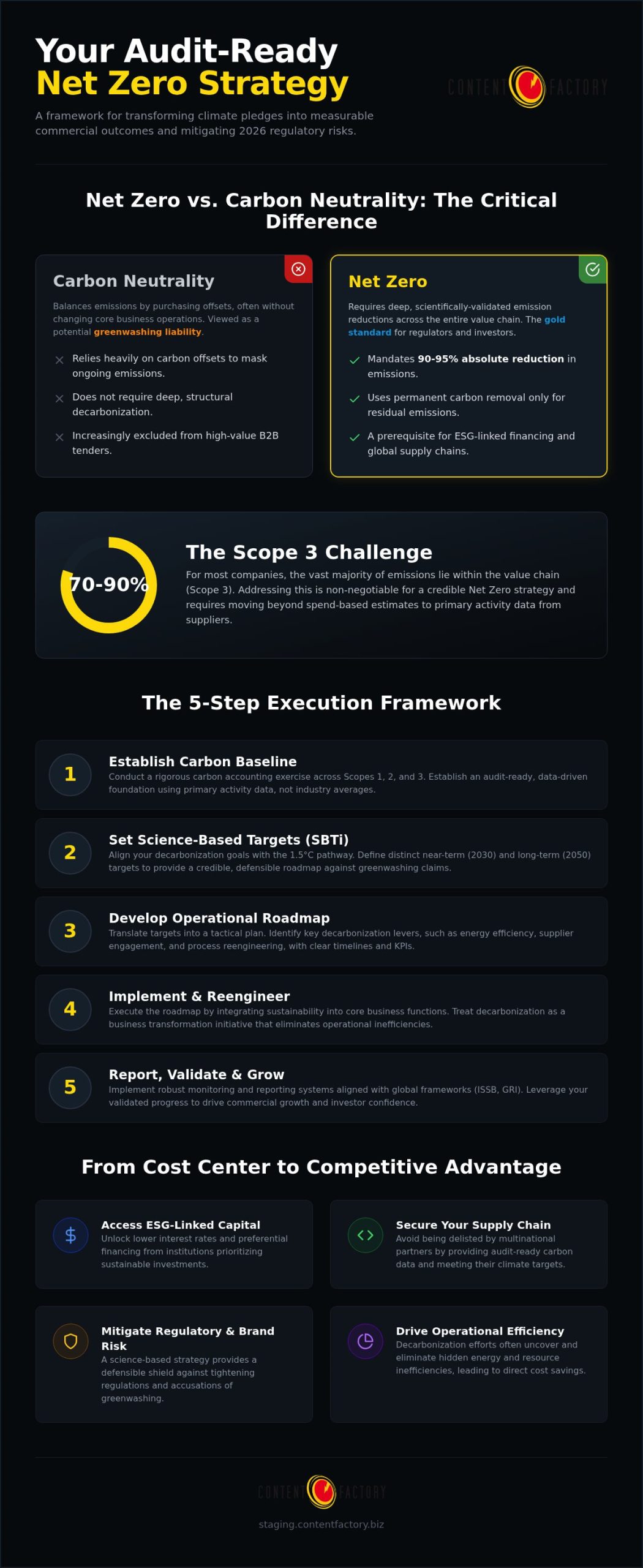
Most net zero pledges are currently little more than expensive liabilities waiting to be exposed by a 2026 audit. While the intent to decarbonize is high, many firms find themselves paralyzed by the technical complexity of Scope 3 data collection and the conflicting demands of frameworks like SBTi, GRI, and ISSB. If you feel like your sustainability report is a house of cards, you aren’t alone. Engaging with professional net zero strategy consulting shouldn’t just be about ticking a compliance box. It’s about reengineering your business processes for a low-carbon economy and long-term viability.
You likely recognize that “business as usual” is no longer a viable strategy for growth or investor confidence. We’re here to help you bridge the gap between high-level vision and operational execution. This guide provides a clear, 5-step implementation framework to build an audit-ready roadmap that drives measurable ROI. We’ll examine how to align your operations with global reporting standards and transform decarbonization from a cost center into a driver of commercial resilience and competitive advantage.
Key Takeaways
====
====
- Understand the critical distinction between superficial carbon offsets and deep-reduction net zero to mitigate regulatory and greenwashing risks in 2026.
====
====
- Leverage specialized net zero strategy consulting to establish a scientifically valid, audit-ready carbon baseline across Scopes 1, 2, and 3.
====
====
- Reframe decarbonization as a business process reengineering opportunity that identifies and eliminates hidden operational inefficiencies.
====
====
- Implement a pragmatic five-step framework to transition from abstract climate pledges to tangible, results-led commercial outcomes.
====
====
- Discover how strategic grant advisory can fund your sustainability transformation while ensuring your roadmap remains aligned with global reporting standards.
====
====
====
====
====
====
Table of Contents
====
====
====
====
====
What is a Net Zero Strategy and Why is it Critical in 2026?
====
====
Net zero represents a state where greenhouse gas emissions are reduced to the absolute minimum through structural operational changes. It’s no longer a voluntary pledge for the distant future. In 2026, it’s a rigorous business requirement. Companies must achieve deep decarbonization across their entire value chain before addressing any residual emissions. This transition requires more than a simple accounting exercise; it demands comprehensive net zero strategy consulting to integrate sustainability into the core business model. Firms that fail to define a clear path toward absolute zero find themselves excluded from capital markets and high-value procurement contracts.
====
====
The Difference Between Net Zero and Carbon Neutrality
====
====
Many executives conflate carbon neutrality with net zero, yet the technical requirements differ significantly. Carbon neutrality allows a firm to balance its emissions by purchasing offsets, often without changing its underlying processes. Net zero is far more demanding. It requires a 90 to 95 percent absolute reduction in emissions across Scopes 1, 2, and 3 before any remaining footprint is neutralized through permanent carbon removal. High-level B2B tenders in 2026 now explicitly exclude firms that rely solely on offsets. If your strategy doesn’t prioritize deep reduction, you’re essentially preparing for a commercial dead end. Investors and regulators now view offset-heavy plans as a “greenwashing” liability rather than a legitimate climate strategy.
====
====
Commercial Drivers: Why Mid-Market Firms Must Act Now
====
====
The shift from voluntary to mandatory disclosure has reached a tipping point. Mid-market firms face a “Supplier Squeeze” as multinational corporations audit their value chains to meet their own climate targets. If you can’t provide audit-ready carbon data, you risk being delisted from global supply chains. Beyond compliance, the financial incentives are shifting. ESG-linked financing now offers lower interest rates for firms with validated decarbonization roadmaps. In ASEAN markets, a robust net zero strategy is transitioning from a “nice-to-have” differentiator to a fundamental license to operate. Investing in net zero strategy consulting ensures your firm remains a preferred partner in these tightened procurement cycles. This reality forces a choice: evolve through business process reengineering or lose relevance in an increasingly decarbonized economy.
====
====
The Three Pillars of a Robust Net Zero Roadmap
====
====
A fragmented approach to decarbonization often results in missed targets and reputational damage. To ensure long-term commercial resilience, a comprehensive strategy must rest on three foundational pillars: rigorous accounting, science-aligned targets, and a tactical operational roadmap. Without this triad, your climate commitments remain purely theoretical. Professional net zero strategy consulting bridges this gap by turning high-level pledges into actionable, audit-ready workflows that withstand regulatory scrutiny.
====
====
Carbon Accounting: Establishing the Baseline
====
====
Accurate data is the prerequisite for any credible climate claim. Utilizing professional carbon accounting services SG allows firms to move beyond high-level estimates toward granular, audit-ready emissions tracking. This process involves categorizing emissions into Scope 1 (direct from owned sources), Scope 2 (indirect from purchased energy), and Scope 3 (the entire value chain). In 2026, the market demands primary activity data rather than industry averages. Relying on generic spend-based metrics is no longer sufficient for institutional investors or multinational procurement teams who require precision to validate your progress. Before committing to a solution, firms should also evaluate the cost of carbon accounting in Singapore to ensure their investment is structured for both compliance and long-term financial efficiency.
====
====
Target Setting: The Science-Based Approach
====
====
Credibility in decarbonization is defined by alignment with the Science Based Targets initiative (SBTi). This framework ensures your goals are compatible with the 1.5°C pathway established by the Paris Agreement. A robust roadmap distinguishes between near-term targets for 2030 and long-term net zero commitments for 2050. Setting these science-based benchmarks provides a defensible shield against greenwashing accusations. It demonstrates that your reductions are mathematically consistent with global climate requirements rather than arbitrary corporate milestones. This alignment is critical for maintaining access to ESG-linked capital and favorable insurance premiums.
====
====
Scope 3: Solving the Value Chain Challenge
====
====
For most mid-market enterprises, Scope 3 emissions represent between 70% and 90% of their total carbon footprint. This is often the most difficult area to manage because it requires data from external suppliers and partners. Seeking specialized scope 3 emissions reporting help is essential for mapping these indirect impacts. Success depends on moving from passive data collection to active supplier capability building. By integrating sustainability criteria into your procurement processes, you transform your value chain from a source of carbon risk into a driver of operational efficiency. A rigorous supply chain ESG risk assessment is an essential complement to this process, enabling you to identify, prioritize, and mitigate the most material risks embedded within your Tier 2 and Tier 3 supplier networks. If you’re ready to transition from reporting to execution, you can speak with our strategic advisors to begin your materiality assessment.
====
====
Evaluating the ROI: Net Zero as a Strategic Advantage
====
====
Many CFOs still view decarbonization as a purely defensive cost, a perception that represents a fundamental misunderstanding of the 2026 economic landscape. Strategic net zero strategy consulting transforms sustainability from a compliance burden into a mechanism for tangible value creation. It isn’t just about saving the planet; it’s about optimizing the balance sheet and ensuring your firm remains a viable partner for global enterprises. When you treat net zero as a business process reengineering opportunity, you move beyond theoretical goals toward measurable commercial resilience.
====
====
Operational Efficiency and Cost Reduction
====
====
True decarbonization requires a deep audit of resource flows, where firms often uncover significant waste in energy use, water consumption, and raw material handling. Eliminating these inefficiencies directly reduces OpEx and increases your bottom line. A net zero roadmap serves as a critical hedge against energy price volatility and the inevitable rise of carbon taxes. Leadership teams should apply a standard Internal Rate of Return (IRR) framework to green projects, comparing the upfront capital expenditure against the long-term reduction in utility costs and waste disposal fees. Key areas for efficiency gains include:
====
====
- Energy Intensity: Reducing the kilowatt-hours required per unit of production through equipment upgrades and smart monitoring.
====
====
====
- Asset Valuation: Avoiding “brown discounts” where high-carbon facilities lose market value compared to sustainable alternatives.
====
====
====
Market Access and Brand Resilience
====
====
The 5-Step Execution Framework for Net Zero Strategy
====
====
Success in decarbonization depends on a structured transition from abstract commitments to operational reality. High-level pledges often fail because they lack a tactical roadmap for deployment. By utilizing professional net zero strategy consulting, firms can implement a rigorous execution engine that balances environmental impact with commercial viability. This five-step framework ensures every strategic move is data-driven, audit-ready, and aligned with global standards.
====
====
Step 1 & 2: Assessment and Baselining
====
====
Effective transformation begins with identifying where your business is most exposed to climate risk. Conducting an ESG readiness assessment Singapore allows leadership teams to pinpoint high-impact areas and prioritize materiality. Once these focus areas are defined, you must establish your starting point. A carbon baseline is the verified starting point against which all future emissions reductions are measured and reported. In 2026, maintaining this data in manual spreadsheets is no longer sufficient. Digital accounting tools are now essential to ensure your emissions inventory remains audit-ready for institutional investors and regulatory bodies.
====
====
Step 3 & 4: Planning and Implementation
====
====
With a baseline established, the focus shifts to setting milestones and deploying decarbonization levers. Science-based targets must include interim 2030 goals to ensure immediate action rather than back-loading reductions toward 2050. To prioritize these actions, we utilize the Marginal Abatement Cost Curve (MACC). This financial model ranks potential interventions, such as energy retrofits or product redesigns, based on their cost-effectiveness per ton of CO2 avoided. This ensures you execute the most impactful, low-cost reductions first. Implementation often involves a mix of operational efficiency and energy procurement shifts, including Power Purchase Agreements (PPAs) that lock in renewable energy rates and hedge against future utility volatility.
====
====
Step 5: Reporting and Transparency
====
====
The final step is establishing a rigorous monitoring and disclosure cycle. Alignment with global frameworks like GRI, TCFD, and ISSB is critical for maintaining stakeholder trust and market access. Annual progress reports shouldn’t just celebrate successes; they must provide a transparent view of challenges and iterations. Third-party verification of your net zero claims is the gold standard for 2026, serving as a definitive shield against greenwashing accusations and ensuring your roadmap remains scientifically valid and commercially defensible.
====
====
====
====
Integrating Net Zero with Commercial Growth: The ContentFactory Approach
====
====
ContentFactory operates as an execution engine rather than a mere advisory firm. We understand that for Singapore’s mid-market sector, decarbonization must be balanced with the immediate pressures of operational overhead and market competitiveness. Our approach to net zero strategy consulting moves beyond high-level climate theory to deliver a synchronized system where ESG data fuels commercial growth. We act as a dedicated extension of your leadership team, ensuring that every sustainability milestone is scientifically valid, audit-ready, and strategically positioned to win new business.
====
====
Leveraging Grants for Sustainability Projects
====
====
One of the primary barriers to decarbonization is the perceived upfront cost. We mitigate this through Strategic Grant Advisory, specifically helping firms navigate the complexities of the Enterprise Development Grant (EDG). As a boutique consultancy led by Singapore Certified Management Consultants, we possess the localized expertise required to align your ESG initiatives with government support frameworks. These grants can significantly offset the costs of carbon accounting and business process reengineering, turning a potential liability into a funded transformation. By securing these resources, you can accelerate your roadmap without straining your primary operating capital.
====
====
ESG as a Growth Engine
====
Scale your business with an audit-ready net zero strategy
====
====
By choosing a partner that understands both the intricacies of Scope 1 to 3 accounting and the mechanics of market entry, you ensure your sustainability journey is grounded in economic reality. We provide the pragmatic guidance necessary to transform your firm into a leader within the regional ecosystem, proving that decarbonization is the ultimate driver of long-term profitability in 2026.
====
====
====
====
The transition to a low-carbon economy is no longer a peripheral concern; it’s a structural shift in how global business is conducted. We’ve explored how a robust roadmap relies on rigorous accounting, science-based targets, and tactical execution. By treating decarbonization as a business process reengineering opportunity, you secure long-term market access and operational efficiency. Mid-market firms currently have a unique advantage by leveraging localized support and strategic funding to lead this transition.
====
====
Engaging in professional net zero strategy consulting ensures your climate claims remain defensible and your emissions data is audit-ready. Our team provides high-level oversight through Singapore Certified Management Consultants, offering deep expertise in full Scope 1-3 carbon accounting. We also facilitate your journey through Strategic Grant Advisory to secure EDG funding, effectively lowering the financial barrier to your sustainability transformation.
====
====
====
====
Building a resilient, decarbonized future is an ambitious journey, but with the right execution engine, it’s entirely achievable. Your commercial legacy depends on the strategic actions you take today.
====
====
Frequently Asked Questions
====
====
What is the first step in developing a net zero strategy for an SME?
====
The first step is conducting a materiality assessment to identify which emissions sources are most significant to your operations. This ensures you don’t waste resources on low-impact areas. By prioritizing high-impact categories, you establish a focused foundation for your carbon accounting. This initial phase aligns your climate goals with your core business functions, making the subsequent roadmap both scientifically valid and commercially relevant.
====
====
How much does net zero strategy consulting typically cost for a mid-market firm?
====
Consulting fees depend on the complexity of your supply chain and the current state of your data maturity. While costs vary across the industry, mid-market firms should view this as a strategic investment in market access rather than a simple expense. A well-executed engagement identifies operational efficiencies that often offset the initial consulting outlay. Professional firms provide tiered structures based on the depth of Scope 3 analysis required for your specific sector.
====
====
Can we achieve net zero without addressing Scope 3 emissions?
====
Achieving true net zero is impossible without addressing Scope 3 emissions, which typically comprise the vast majority of a firm’s footprint. Ignoring the value chain leaves you exposed to significant regulatory and commercial risks. Most global reporting standards now mandate the inclusion of indirect emissions. If you don’t account for Scope 3, your strategy won’t meet the audit-ready criteria required by institutional investors or multinational procurement teams in 2026.
====
====
What is the difference between SBTi and other net zero frameworks?
====
The Science Based Targets initiative (SBTi) is the gold standard because it mandates absolute emissions reductions aligned with the 1.5°C pathway. Other frameworks may focus more on disclosure or allow for heavier reliance on carbon offsets. Utilizing net zero strategy consulting helps you navigate these differences to ensure your targets are defensible. SBTi validation provides the highest level of credibility, protecting your firm against greenwashing accusations in a tightening regulatory environment.
====
====
How long does it take to develop a credible decarbonization roadmap?
====
Developing a credible decarbonization roadmap usually requires three to six months. This timeframe allows for thorough data collection across all scopes and the modeling of various reduction levers. If your data is already digitized, the process is faster. However, engaging suppliers for Scope 3 information often extends the timeline. Rushing this phase leads to baseline errors that can undermine your reporting accuracy and stakeholder trust later.
====
====
Is the Enterprise Development Grant (EDG) available for carbon accounting projects?
====
The Enterprise Development Grant supports carbon accounting and sustainability projects in Singapore under the sustainability pillar. To qualify, you must work with a certified management consultant who understands the specific reporting requirements of the grant framework. This funding helps mid-market firms offset the costs of building internal ESG capabilities. It’s a pragmatic way to fund your transition while ensuring your roadmap meets international standards for audit readiness.
====
====
What happens if our company misses its interim net zero targets?
====
Missing interim targets can result in immediate commercial consequences, including exclusion from high-value B2B supply chains and higher interest rates on ESG-linked financing. Regulators and investors now monitor progress closely rather than just accepting long-term pledges. If you fall behind, you must provide transparent explanations and an updated mitigation plan. Proactive net zero strategy consulting includes regular monitoring cycles to identify these gaps before they become critical liabilities.
====
====
Do we need specialized software for net zero strategy monitoring?
====
While you can start with manual systems, specialized software is essential for maintaining audit-ready data at scale. Digital tools reduce the risk of human error and simplify the integration of supply chain ESG risk assessment data from diverse suppliers. These platforms provide real-time visibility into your progress, allowing for more agile decision-making. In 2026, most institutional investors expect to see emissions data managed through robust, verifiable digital systems rather than static spreadsheets.
====

Article by
Mayuresh Godse
Mayuresh Godse is a Singapore Certified Management Consultant and Business Strategist specializing in Sustainability, ESG, AI-driven Digital Transformation, and business growth. Based in Singapore, he writes about Sustainability, Digital Innovation, Business Strategy, and Content Marketing for global audiences.
Disclaimer
This article is provided by ContentFactory for general information only and is not legal, tax, accounting or financial advice. Regulations and government scheme criteria change; grant eligibility and quantum are set by the relevant Singapore agencies and assessed case by case, with no outcome guaranteed. Verify current requirements before acting.
One thing worth checking on the tool side: if the disclaimer is switched on globally, the grant caveat already written into your Global Writing Instructions will appear as well, so grant articles will carry the same point twice. Remove the required-disclaimer section from the instructions file if you enable this one.