

Cutting your headcount to preserve margins might be the fastest way to stall your growth. In a talent-constrained market like Singapore, where there are 164 open tech roles for every 100 qualified seekers as of 2026, losing human capital is a strategic risk you cannot afford. You likely feel the pressure of rising operational costs eating into your margins as your organisation scales. Processes that functioned perfectly at a S$5M turnover often start breaking when you hit the S$50M mark, leaving your leadership team trapped in data silos that prevent clear decision making.
This article explains why traditional cost-cutting fails and how to achieve scalable operational efficiency for mid-market firms through pragmatic process reengineering. You’ll discover how to move beyond simple digitisation to build a resilient operating model that supports sustainable growth. This analysis debunks five persistent myths that hinder mid-market expansion and provides a roadmap for integrating automation into a redesigned workflow that delivers measurable ROI.
Key Takeaways
- Define efficiency as the ratio of value output to input effort rather than simple budget reduction to avoid creating long-term operational fragility.
- Prioritise business process reengineering over software acquisition to ensure your digital transformation isn’t built on top of existing organisational chaos.
- Discover how to achieve scalable operational efficiency for mid-market firms by managing complexity through automation rather than unsustainable headcount increases.
- Use a structured operational audit to pinpoint the specific data silos and friction points that prevent clear decision making as you scale.
- Shift from theoretical strategic reports to an execution-led model that bridges the gap between your growth vision and tangible business results.
Debunking the Myth That Operational Efficiency Equals Cost Cutting
Many mid-market leaders mistake austerity for excellence. They view every line item on the profit and loss statement as a target for reduction, assuming that a leaner organisation is inherently a better one. However, Operational efficiency is not a synonym for cost-cutting. It’s the ratio of output value to input effort. True operational efficiency for mid-market firms focuses on maximising throughput while minimising waste, not simply starving departments of necessary resources.
Slashing budgets often leads to the “Efficiency Paradox.” By cutting costs in critical areas like quality control or customer support, you inadvertently increase friction. This creates a cycle where employees spend more time fixing errors than generating value. In a mid-market context, you must distinguish between Value-Add activities that customers pay for and Non-Value-Add activities that are purely administrative or redundant. Achieving operational efficiency for mid-market growth requires investing in the former to eliminate the latter.
The hidden cost of cheap operations
Opting for the cheapest software or understaffing key functions creates technical and operational debt. This debt accumulates interest in the form of manual workarounds and fragmented data. When your team is stretched thin, morale drops and customer retention suffers because service levels become inconsistent. Efficiency is the optimisation of workflows to maximise throughput.
Operational friction is a silent margin killer. It manifests as endless internal meetings to resolve simple data discrepancies or staff working overtime to compensate for broken manual processes. These hidden costs often exceed the “savings” gained from initial budget cuts. To protect your margins from such pressures, you can discover Easy2switch UK Ltd and see how expert energy consultancy helps businesses manage critical overheads efficiently. You cannot build a S$100M company on a foundation of S$5M processes and expect it to remain stable.
Reframing efficiency as a growth lever
Efficiency is a catalyst for scalability. When you eliminate bottlenecks through Business Process Reengineering, your organisation can respond to market shifts in days rather than months. Streamlined processes remove the burden of micromanagement from the C-suite. This frees your leadership team to focus on high-level strategic initiatives rather than mediating daily process failures.
A well-oiled operational engine allows you to absorb more volume without a linear increase in overhead. It turns your operations from a cost centre into a competitive advantage. By focusing on process health, you ensure that every dollar of input generates the maximum possible value for your clients and your bottom line.
The Software Fallacy: Why Technology Alone Cannot Fix Broken Processes
Mid-market firms often fall into the trap of believing a new ERP or CRM system will automatically resolve internal friction. This is the software fallacy. Technology is an accelerator, not a cure. If your underlying processes are inefficient, software only amplifies those inefficiencies at scale. You end up with “Garbage In, Garbage Out,” where expensive platforms produce unreliable data because the input methods remain broken.
Many organisations over-invest in complex features they never use, hoping the tool will dictate the strategy. True operational efficiency for mid-market companies requires prioritising business process reengineering (BPR) before signing a software contract. You must define how work flows through your business before you attempt to digitise it. ContentFactory helps leaders transition from fragmented tools to unified platforms that drive measurable growth.
Automating a mess only creates a faster mess
Digitising an inefficient legacy workflow doesn’t remove the bottleneck; it just makes the bottleneck invisible until it causes a system failure. You must simplify and standardise processes before layering on software. A clear Digital Roadmap is essential for sequencing technology implementation correctly. This ensures you aren’t building high-tech silos that fail to communicate. Following a pragmatic roadmap to operational efficiency involves stripping away redundant steps that don’t add value to the end customer.
The role of system integration in operational flow
Fragmented software islands are a major source of operational drag. When your finance system doesn’t talk to your sales platform, your staff wastes hours on manual data entry and reconciliation. This double-entry isn’t just a waste of time; it’s a primary source of human error. By focusing on Technology Adoption and System Integration, you create a single source of truth for your business.
The goal is a synchronised system where data flows seamlessly between functions. This leads to faster reporting cycles and real-time visibility into your margins. In Singapore’s talent-constrained market, where there are 164 open tech jobs for every 100 qualified seekers, you can’t afford to have your best people acting as “human bridges” between disconnected software. If your current systems feel like a collection of isolated tools, it’s time to assess your digital infrastructure for better alignment. Achieving true operational efficiency for mid-market scaling requires your software to act as a single, unified engine.
Scaling Without Chaos: Managing Complexity in Mid-Market Operations
Growth often masks underlying operational fragility. As you move from a small enterprise to a mid-market player, the informal, hero-based culture that fuelled your early success becomes a significant liability. In this stage, often called the “Mid-Market Growth Trap,” manual processes that worked at a S$5M turnover begin to fail at S$50M. You cannot simply work harder to overcome these structural gaps; you must work differently.
Many leaders believe that hiring more staff is the only way to manage an increasing workload. This is a common myth that leads to organisational bloat. Adding headcount to a broken process only increases your management overhead and further erodes your margins. True operational efficiency for mid-market firms is achieved by building robust systems that allow your existing team to handle higher volumes with greater precision. For example, leveraging tools like PaySelect to select payment gateways that integrate natively with your accounting software is a proven way to reduce the manual reconciliation burden as you scale.
As organisations grow beyond 50 employees, departmental silos naturally emerge. Sales, operations, and finance start operating as independent units, creating data gaps that prevent clear leadership decision-making. You must shift from individual heroics to a system-based operating model. This transition ensures that your business functions as a single, synchronised engine rather than a collection of disconnected parts.
Documenting standard operating procedures (SOPs) is not a bureaucratic exercise. It is a critical step for operational resilience. Standardisation ensures that service delivery remains consistent regardless of which staff member is performing the task. By codifying institutional knowledge into formal workflows, you reduce the “key person risk” where critical business intelligence resides in the heads of a few individuals rather than within the organisation’s infrastructure.
Identifying and removing operational bottlenecks
Scaling requires you to add revenue while keeping costs relatively stable. Bloating happens when your costs rise in direct proportion to your turnover. Mapping your workflows allows you to identify exactly where work stalls, such as at an approval bottleneck or a manual data entry point. Integrating these findings into your broader Digital Transformation roadmap ensures you are building for future capacity rather than just reacting to current pressure.
Achieving operational efficiency for mid-market success means prioritising throughput over activity. Every process in your business should be evaluated for its contribution to the final output. If a step does not add value to the customer or provide essential data for the business, it should be reengineered or eliminated. This pragmatic approach to process design is what separates scalable enterprises from those that stall under their own complexity.
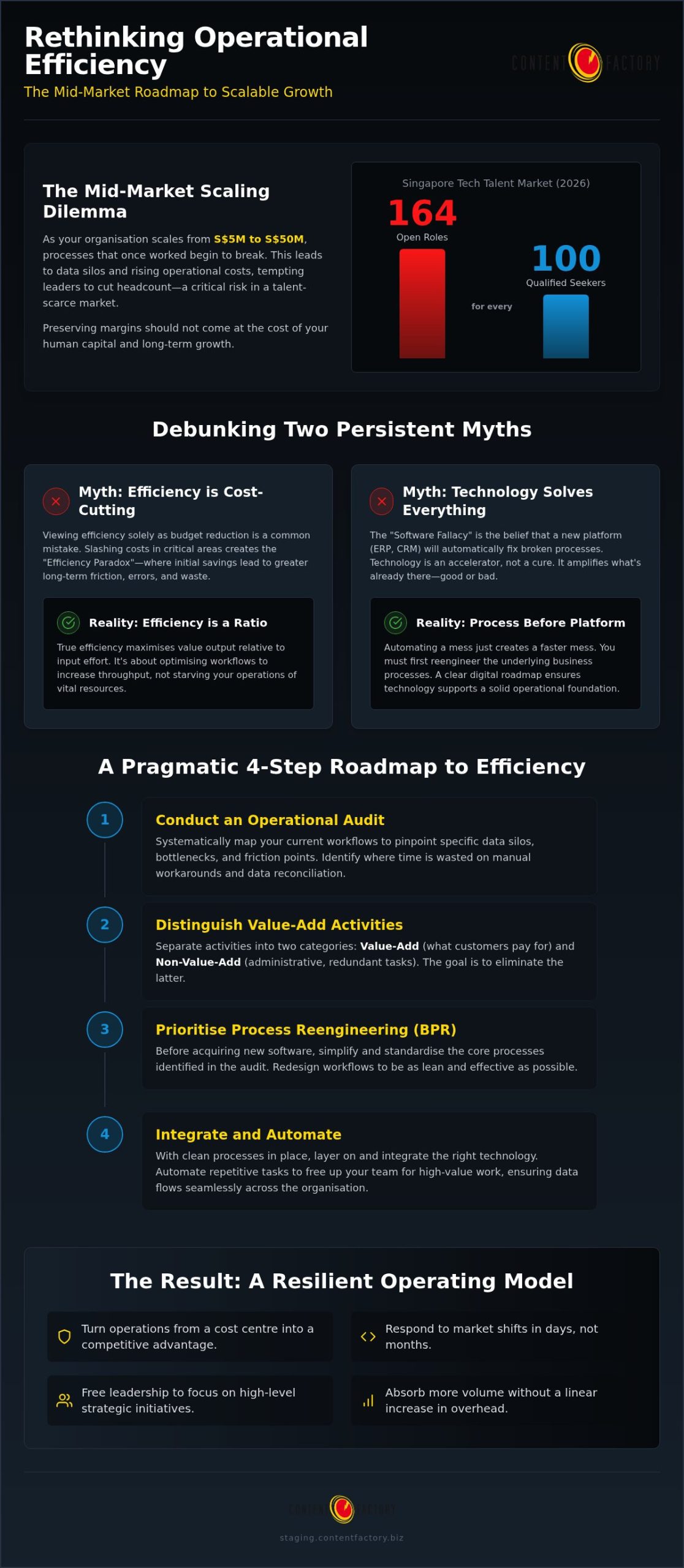
A Pragmatic Roadmap to Operational Efficiency for Mid-Market Firms
Achieving operational efficiency for mid-market firms requires a transition from reactive firefighting to a structured, five-step execution framework. This roadmap bridges the gap between your growth vision and the tangible operational reality. By following a methodical approach, you ensure that your resources are allocated to high-impact improvements that support long-term scalability.
- Step 1: Conduct an operational audit to identify friction points and data gaps.
- Step 2: Reengineer core processes to eliminate redundant steps and manual workarounds.
- Step 3: Develop a digital roadmap that prioritises high-ROI integrations over vanity features.
- Step 4: Implement change management to ensure staff adoption of new workflows.
- Step 5: Establish KPIs to measure ongoing efficiency gains and ROI.
Auditing your current state
The first step is a brutal assessment of your existing workflows. You must differentiate between “the way we’ve always done it” and the optimal path for your current scale. This process requires involving front-line staff who deal with day-to-day friction; they often know exactly where the system breaks. By mapping these workflows, you can identify “quick wins” that deliver immediate operational relief without requiring massive capital investment. These small victories build the internal momentum needed for larger, more complex transformations.
Executing the digital roadmap
Once you’ve simplified your processes, you can begin the technology layering phase. A successful digital roadmap starts with ERP and Finance System Integration to anchor your business data. This ensures that every department operates from a single source of truth, eliminating the reconciliation delays that plague mid-market firms. Technology choices must always support your long-term strategic vision rather than just solving a temporary symptom.
However, the most advanced software will fail without human alignment. Sustainable results depend heavily on Change Management and Training. You must prepare your workforce for new ways of working, ensuring they understand the “why” behind the shift. Establishing operational efficiency for mid-market growth is an ongoing cycle of measurement and refinement. Use specific KPIs such as order processing time, data accuracy rates, and throughput per employee to track your progress and justify further investment.
Operationalising Transformation with ContentFactory
ContentFactory serves as the execution engine for organisations that have outgrown their legacy workflows. We move beyond the abstract advice of traditional consultancies to provide a hands-on extension of your leadership team. Our focus is on delivering measurable ROI by synchronising your business processes with your digital infrastructure. This ensures that every strategic move you make is backed by a resilient operational foundation.
By choosing a senior-led advisory, you gain the expertise of a Singapore Certified Management Consultant with over 25 years of experience without the excessive overhead associated with global firms. We prioritise tangible outcomes over theoretical slide decks, working directly with your team to implement the reengineering strategies discussed in this article. Achieving operational efficiency for mid-market scale requires a partner who understands the specific pressures of regional business ecosystems and government frameworks.
Moving from slide decks to funded execution
Many organisations possess a growth vision but lack the internal capacity to translate that vision into daily operational reality. ContentFactory bridges this gap by identifying the specific friction points that stall your progress. Our localised expertise in the Singapore and ASEAN landscape allows us to navigate regional compliance and market entry intricacies effectively. A critical practical takeaway for any leader is to conduct a comprehensive process audit before committing to any major software purchase. This prevents the “software fallacy” where technology is layered onto broken workflows.
We work as a dedicated part of your leadership team, ensuring that digital roadmaps are not just planned but fully operationalised. This pragmatic approach reduces technical debt and ensures that your technology adoption is sequenced for maximum impact. By focusing on the “how” of execution, we help you build a system that supports sustainable, long-term growth.
Strategic support for your digital initiatives
Your journey toward operational excellence doesn’t have to be unassisted. Eligible digital transformation projects may be supported by the Enterprise Development Grant (EDG) for up to 50% of qualifying costs. This support allows you to accelerate your digital roadmap while maintaining financial resilience. ContentFactory provides strategic grant advisory and financial modelling to ensure your proposals are robust and aligned with government requirements. Achieving operational efficiency for mid-market success is about leveraging available resources to build a more resilient organisation. For a broader view of how these principles apply across the region, our guide to business optimization consulting Singapore outlines how mid-market leaders can pragmatically realign their technology and human capital for measurable ROI.
Grant quantum, support levels and eligibility criteria are set by the relevant Singapore government agencies and are subject to change. Eligibility is assessed case by case.
If you are ready to eliminate the silos preventing clear decision-making and build a scalable operational engine, book a 30-minute discovery call.
Building a Scalable Foundation for Future Growth
Achieving sustainable operational efficiency for mid-market organisations requires a fundamental shift from reactive firefighting to proactive process reengineering. You’ve seen that technology acts only as an accelerator for the underlying workflows you’ve already established. True resilience comes from standardising your operations to eliminate the key person risks and data silos that naturally emerge as you scale toward larger turnovers. You cannot simply hire your way out of complexity; you must systemise your way through it.
ContentFactory serves as your execution engine; bridging the gap between high-level strategic vision and daily business reality. Led by a Singapore Certified Management Consultant with 25 plus years of strategic consulting expertise, we bring a proven track record in digital transformation and process redesign to your leadership team. We don’t just deliver reports; we implement the systems that drive measurable growth and long-term stability. You can move beyond the growth trap and build a business that scales without chaos.
It starts with a pragmatic audit of your current state to identify the friction points holding you back. Your path to a more efficient, scalable organisation is within reach.
Frequently Asked Questions
What is the difference between cost-cutting and operational efficiency?
Operational efficiency is the ratio of output value to input effort, whereas cost-cutting is the mere reduction of expenditure. While cutting costs might provide short-term margin relief, it often leads to operational fragility if critical resources are removed. True efficiency focuses on maximising throughput and eliminating non-value-add activities. This approach ensures your business can scale without a linear increase in overhead, maintaining quality and service levels even as volume grows.
How do I know if my mid-market business needs process reengineering?
Your business likely needs process reengineering if workflows that functioned at a S$5M turnover are now causing bottlenecks at S$50M. Common indicators include frequent manual data reconciliation, a reliance on hero-based individual efforts rather than systems, and data silos that prevent clear C-suite decision-making. If your headcount is growing faster than your revenue, it suggests that your current operating model is no longer fit for purpose and requires structural redesign.
Can technology alone improve my operational efficiency?
Technology acts as an accelerator, but it cannot fix a broken process. Digitising an inefficient manual workflow simply creates a faster, more expensive mess. To achieve sustainable operational efficiency for mid-market firms, you must first simplify and standardise your core processes. Only after reengineering these workflows should you layer on software solutions like ERP or CRM systems to automate the newly optimised steps and ensure data integrity.
What are the most common operational bottlenecks in mid-market firms?
The most frequent bottlenecks include manual data entry between disconnected software systems and centralised approval points that stall workflow progress. Fragmented islands of information lead to double-entry and reconciliation errors, wasting significant staff time. Additionally, a lack of documented standard operating procedures (SOPs) often creates a key person risk, where operations grind to a halt if a specific individual is unavailable. Identifying these friction points is the first step in any successful transformation. A data driven business process improvement approach can help you locate exactly where cycle times lag and resources are being wasted.
How long does a typical business process reengineering project take?
The duration of a business process reengineering project depends on the complexity of your organisation, but initial phases typically span three to six months. This timeline includes the operational audit, process mapping, and the design of a new digital roadmap. Quick wins can often be implemented within the first 30 to 60 days to provide immediate relief. Full-scale implementation and change management are ongoing processes that ensure long-term adoption and measurable ROI.
Is operational efficiency only for large corporations?
Operational efficiency is a strategic necessity for mid-market firms looking to scale without falling into the growth trap. While large corporations have the capital to absorb some inefficiency, mid-market organisations must maintain lean, high-output operations to protect their margins. Improving operational efficiency for mid-market players allows them to compete more effectively with larger rivals by being more agile, responsive to market shifts, and capable of delivering consistent customer value.
How do I measure the ROI of operational improvements?
You measure the ROI of operational improvements by tracking specific KPIs before and after implementation. Key metrics include processing time per order, error rates in data entry, and throughput per employee. If a process reengineering project reduces manual reconciliation time by 40%, the saved labour hours can be redirected toward higher-value strategic tasks. ContentFactory focuses on these measurable outcomes to ensure that every digital initiative contributes directly to your bottom line.

Article by
Mayuresh Godse
Mayuresh Godse is a Singapore Certified Management Consultant and Business Strategist specializing in Sustainability, ESG, AI-driven Digital Transformation, and business growth. Based in Singapore, he writes about Sustainability, Digital Innovation, Business Strategy, and Content Marketing for global audiences.
Disclaimer
This article is provided by ContentFactory for general information only and is not legal, tax, accounting or financial advice. Regulations and government scheme criteria change; grant eligibility and quantum are set by the relevant Singapore agencies and assessed case by case, with no outcome guaranteed. Verify current requirements before acting.
One thing worth checking on the tool side: if the disclaimer is switched on globally, the grant caveat already written into your Global Writing Instructions will appear as well, so grant articles will carry the same point twice. Remove the required-disclaimer section from the instructions file if you enable this one.