

There is no single fixed penalty for ESG non-compliance in Singapore. Depending on the breach, penalties for ESG non-compliance in Singapore can include fines, imprisonment, civil damages or compensation, environmental clean-up costs, and enforcement action under SGX rules. Directors may also face personal consequences if they breach their duties.
The consequences of ESG non-compliance in Singapore depend on what went wrong. A misleading sustainability claim, failure to meet listing requirements, environmental offence or governance failure can each trigger different legal or regulatory responses. This guide explains the possible sanctions for each type of breach, how directors’ duties fit into the picture, and why accurate ESG data and disclosures matter. The practical point is simple: manage ESG reporting as a controlled business process, not a set of claims assembled at the last minute.
Key Takeaways
- Identify whether your exposure comes from a misleading ESG claim, an SGX disclosure breach, an environmental offence or a directors’ duty issue. Different breaches can lead to different sanctions.
- Keep environmental and sustainability claims aligned with the evidence behind them. Gaps between public statements and supporting data can create legal and reputational exposure.
- For listed issuers, understand the relevant SGX reporting and board requirements, and assign clear responsibility for accurate, timely disclosures.
- Assess material ESG risks as part of directors’ oversight, strategy and risk management, rather than treating them as a reporting task alone.
- Strengthen your reporting foundations with clear ownership of ESG data, documented calculations and a consistent review process before information is disclosed.
1.1 What are the main substantive ESG-related regulations and who is driving the regulatory agenda in your jurisdiction?
Singapore’s ESG obligations cover climate disclosures, environmental controls, workplace requirements and corporate governance. The relevant authority and potential consequences depend on the company’s activities, listing status and the specific obligation.
Singapore ESG Regulators and Legislation
Singapore’s regulatory framework is fragmented across laws and regulators covering emissions, waste, workplace conduct and listed-company disclosures. The Carbon Pricing Act 2018 introduced a carbon tax for business facilities exceeding prescribed direct greenhouse-gas emissions thresholds and requires greenhouse-gas emissions reporting, according to Attorney-General’s Chambers, Singapore. The Resource Sustainability Act 2019 addresses specified packaging and waste obligations.
The Energy Conservation Act 2012 also prescribes requirements for qualifying companies. For your business, the practical task is to map each activity to its applicable obligation, responsible authority and source records. A Singapore ESG framework overview can help frame that mapping.
Climate Disclosure and Enforcement
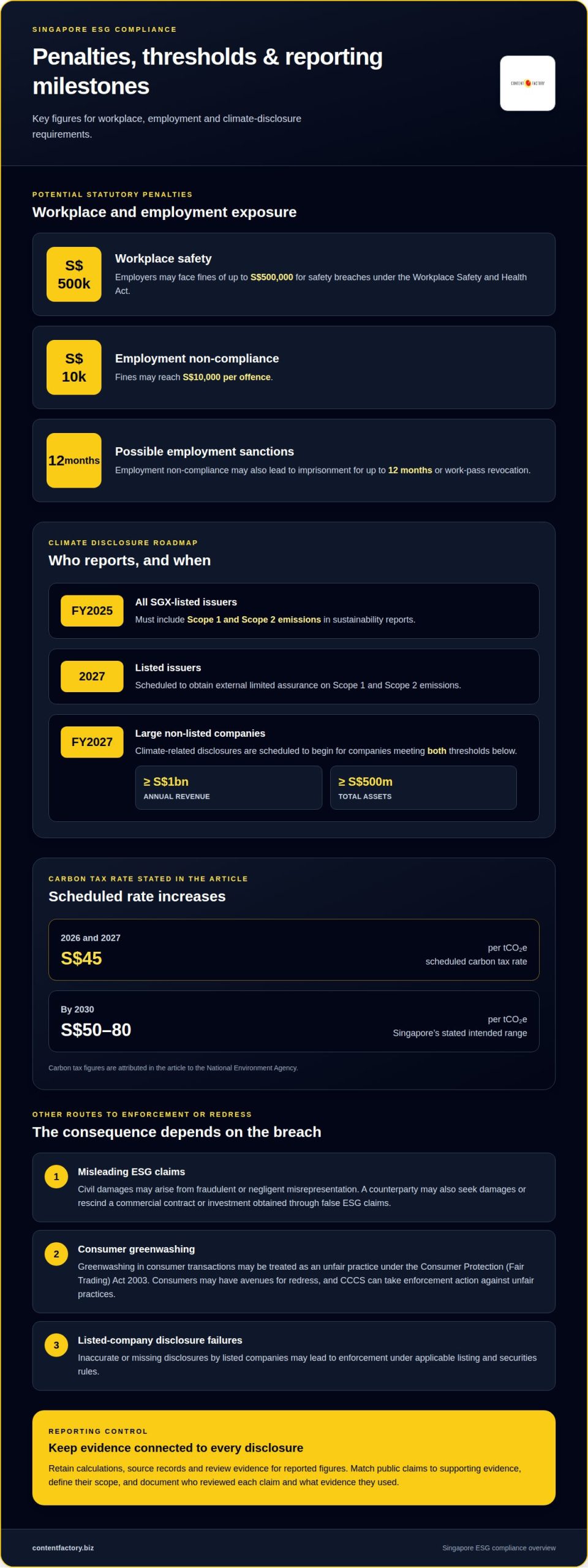
Singapore’s climate disclosure requirements combine SGX rules with a staged roadmap for large non-listed companies. From financial year 2025, all SGX-listed issuers must include Scope 1 and Scope 2 emissions in sustainability reports. Listed issuers are scheduled to obtain external limited assurance on those emissions from 2027.
Large non-listed companies with annual revenue of at least S$1 billion and total assets of at least S$500 million are scheduled to begin climate-related disclosures from FY2027. According to the National Environment Agency, Singapore’s carbon tax rate is scheduled to increase to S$45 per tCO2e in 2026 and 2027. Singapore intends to raise its carbon tax to S$50-80 per tCO2e by 2030, according to the National Environment Agency.
Climate reporting requirements are shaped by SGX rules and Singapore’s regulatory roadmap. Inaccurate or missing disclosures by listed companies may lead to enforcement under applicable listing and securities rules. Retain calculations, source records and review evidence for every reported figure.
ESG-related requirements vary by company size and status. Listed issuers face SGX reporting rules; large non-listed companies meeting both thresholds are scheduled for climate disclosures from FY2027. SMEs may still have obligations under environmental laws when their activities meet prescribed thresholds.
Social ESG obligations include workplace safety and employment requirements. Employers may face fines of up to S$500,000 for safety breaches under the Workplace Safety and Health Act. Employment non-compliance may lead to fines of up to S$10,000 per offence, imprisonment for up to 12 months or work-pass revocation.
To reduce compliance risk or address a breach, identify affected data and disclosures, preserve source records, correct inaccurate information and document the review. Assign owners for emissions, environmental and workforce data. Escalate material gaps through governance channels before the next filing or report.
ESG misrepresentation and greenwashing enforcement
A sustainability claim can create exposure if it gives customers, investors or business partners a misleading picture. In Singapore, the legal route depends on the claim, who relied on it and whether it appeared in a consumer transaction, commercial agreement or investment context. For example, a broad “net-zero” statement should reflect the organisation’s actual plans and supporting evidence.
Section 2(1) of Singapore’s Misrepresentation Act 1967 may make a company liable for damages in civil proceedings for fraudulent or negligent misrepresentation. A counterparty may also seek damages or rescind a commercial contract or investment obtained through false ESG claims. The consequences turn on the representation and transaction, so an environmental statement in a sales pitch may raise different issues from a statement in an investment document.
Consumer claims have a separate protection route. Section 4 of Singapore’s Consumer Protection (Fair Trading) Act 2003 treats greenwashing in consumer transactions as an unfair practice and gives consumers potential avenues for redress. Misleading environmental labels can fall within this concern. The Competition and Consumer Commission of Singapore (CCCS) can take enforcement action against unfair practices, making accuracy relevant beyond a company’s formal sustainability report.
Handle net-zero targets carefully: they can influence purchasing decisions and investor expectations. Do not present an ambition as an achieved result or imply that a target covers activities it excludes. State the target’s boundary, basis and progress clearly, and retain the calculations, approvals and records supporting each claim. Transparent reporting connects public statements to actual conduct.
Before publishing a climate or environmental claim, match each statement to evidence, define its scope and check whether images or labels imply more than the wording. For example, a product label suggesting a complete environmental benefit may mislead if the evidence supports only one limited attribute. Keep an approval record showing who reviewed the claim and what evidence they used.
Investors and consumers may respond differently, but both need accurate, non-misleading information. Identify affected statements promptly, preserve relevant records, correct inaccurate material and document the response. These steps do not remove potential liability, but they create a clear record of the company’s conduct and its efforts to restore transparency.
Where climate targets or product claims are difficult to substantiate, a structured review can help expose gaps before publication. You can discuss a review of ESG claims and supporting evidence as a practical next step.
SGX Listing Rules and environmental legislation
Singapore’s requirements for listed companies combine sustainability reporting, board governance and environmental controls. The consequences depend on the rule breached and the conduct involved.
SGX Sustainability Reporting
SGX sustainability reporting requires listed issuers to publish an annual sustainability report and maintain a board diversity policy under Listing Rules 710A, 711A and 711B. These rules matter because incomplete or inaccurate disclosures can become a listing compliance issue, not merely a reporting weakness.
Section 203 of the Securities and Futures Act 2001 addresses intentional, reckless or negligent failures to notify the approved exchange of information required under listing rules. A listed company should therefore assign responsibility for report preparation, evidence review and timely escalation. Keep the supporting records alongside the published report.
Environmental Damage Costs and Penalties
Environmental legislation can expose a company to financial and operational consequences beyond a fine. Singapore environmental violations may result in fines of up to S$1 million or imprisonment for up to six months, while companies may also bear clean-up costs for damage caused by non-compliance.
The applicable consequence depends on the offence and any environmental harm. Pollution, hazardous substances and waste management are relevant areas of control. Preserve incident records, identify the affected activity and document corrective measures. Clean-up expenses may arise alongside regulatory enforcement.
The Monetary Authority of Singapore issued its Guidelines on Environmental Risk Management in 2020 for banks, asset managers and insurers. These guidelines place environmental risk within regulated financial institutions’ risk management, making governance and documentation relevant to how they assess exposure.
Carbon tax compliance also has distinct reporting and payment elements. The Carbon Pricing Act 2018 applies to business facilities exceeding prescribed direct greenhouse-gas emissions thresholds and requires emissions reporting. Breaches involving reporting or payment may prompt regulatory enforcement under the applicable requirements; the issue and conduct determine the relevant exposure.
Environmental advertising claims can also create risk if they conflict with evidence of the company’s operations. For example, a broad claim that a product is environmentally friendly should not suggest benefits beyond those supported by evidence. Review each claim against its underlying records and ensure the wording accurately describes the specific environmental attribute.
Build these controls into corporate governance: identify the rule, name the evidence owner, review the disclosure and escalate unresolved gaps before publication or submission. This helps distinguish a correctable data issue from an ongoing failure to meet a reporting or environmental obligation.
If you need to strengthen the evidence behind environmental disclosures, you can discuss your ESG reporting requirements.
Directors’ duties and ESG-related breaches
ESG oversight can become a directors’ duty issue when decisions or disclosures affect the company’s interests. Section 157 of Singapore’s Companies Act 1967 requires directors to act honestly and use reasonable diligence in discharging their duties. The obligation concerns how directors perform their roles, not simply whether a report contains sustainability language.
Singapore directors’ duties under the Companies Act 1967 and common law also require good faith and action in the company’s best interests. That includes considering material ESG risks and opportunities affecting long-term value. For example, a board overseeing a business exposed to climate-related disruption should consider how that risk affects strategy, operations and the company’s financial position.
The key question is whether an ESG issue matters to the company’s performance, strategy or risk management. A board need not treat every sustainability topic as equally important. It should understand which matters could affect the business, ask management for relevant evidence and record how significant risks shaped decisions. Listed companies also need oversight of accurate sustainability disclosures and the supporting data.
Shareholders may bring claims alleging breach of fiduciary duties if directors fail to consider ESG issues relevant to the company’s performance, strategy and risk management. The claim depends on the directors’ conduct and the issue’s connection to the company, not merely its ESG label. A documented discussion of a material risk can help show how directors considered it, although records do not replace sound judgement.
Misstated emissions data creates a more direct exposure where it appears in statutory filings. Directors in Singapore may face fines of up to S$50,000 for intentionally misrepresenting sustainability data in those filings. The focus on intentional misrepresentation makes clear data ownership and review important. Directors should know who prepared the figures, what source records support them, and how inconsistencies were escalated.
Practical governance starts with clear responsibilities. A board can assign management ownership of emissions data, require assumptions to be reviewed and put material ESG risks on the agenda when they affect strategy or operations. For instance, if reported emissions conflict with facility records, directors should require an investigation before approving a filing.
Directors should distinguish a data error from deliberate misrepresentation. Preserve source records, identify affected disclosures, correct inaccurate information through the appropriate process and document decisions. These practices support accurate reporting and help the board respond coherently to questions from shareholders, regulators or other stakeholders.
This is general information, not legal advice. The legal consequences of a specific ESG breach depend on the facts, the relevant duties and the directors’ conduct.
Legal action and enforcement
Legal consequences depend on the claim, filing, data or environmental conduct involved. For listed companies, false or misleading statements may result in statutory compensation under Singapore’s Securities and Futures Act. This is separate from regulatory action for breaching a listing rule. Depending on the facts, exposure may also include civil claims, corrective action and related costs.
For an investor or other affected party, the central question may be whether a statement was misleading and caused loss. For example, a sustainability figure in a listed company’s filing may be assessed differently from an unverified statement made outside that filing. Preserve the published version, supporting records, internal approvals and any later corrections. These materials help establish what the company reported and how it responded.
Environmental enforcement can involve more than a fine. Environmental non-compliance in Singapore may lead to legal action and compensation claims from affected parties. A company may also have to pay to clean up environmental damage it caused. An incident assessment should identify the affected site or activity, preserve relevant records and document remediation and communications.
ESG data collection also creates a separate compliance risk. Singapore’s Personal Data Protection Act 2012 requires organisations to obtain consent for data collection and provide individuals with access and correction rights. The Act can impose fines of up to S$1 million for data protection breaches, and severe breaches can result in imprisonment of up to three years. ESG teams should assess whether collected workforce or supplier information includes personal data.
Build an evidence trail for reporting and data collection. Record the purpose and source of each data set, who can access it and how corrections are handled. If a reported figure is challenged, pause its reuse, trace it to source records and document the assessment. This supports accurate accounting and reporting, while helping distinguish a data-quality issue from a potentially misleading statement.
Enforcement may also involve claims from affected parties. Where environmental damage affects others, the available facts may shape compensation claims and legal action. Keep incident records, relevant correspondence and remedial steps together. A consistent record helps the organisation explain its conduct, identify affected disclosures and coordinate its response across reporting and operational teams.
When a concern arises, follow a defined response: preserve records, identify affected statements or data, assess the issue, correct inaccurate reporting and document decisions. Do not overwrite earlier versions of a filing or calculation. A dated correction trail can show what changed, why it changed and which records support the revised position.
Singapore’s enforcement landscape can involve statutory compensation, environmental claims and data-protection penalties, rather than one universal ESG sanction. For a structured review of ESG reporting controls and evidence, Contact Us.
ContentFactory: ESG Readiness & Materiality Assessments
ContentFactory helps you identify material ESG issues, assess reporting gaps and strengthen the data behind disclosures. Its ESG Readiness & Materiality Assessments clarify which risks and topics need attention. GHG Emissions Calculation and Carbon Accounting supports emissions data, while Multi-Framework Sustainability Reporting helps organise disclosures across reporting frameworks.
Consider this work when responsibilities are unclear, supporting records are inconsistent or reporting requirements are changing. The aim is a practical foundation: clear ownership, traceable information and reporting aligned with your organisation’s priorities. These services support ESG readiness and reporting, not legal representation or legal advice.
To discuss your organisation’s ESG readiness, contact ContentFactory.
Build ESG accountability into your next decisions
Use your next leadership meeting to decide how ESG considerations should shape business priorities, capital allocation and oversight. A clear decision-making approach helps your organisation respond consistently as expectations change, rather than treating each new requirement as an isolated task.
Understanding penalties for ESG non-compliance in Singapore is a reason to make decisions deliberately, not a substitute for them. Set a leadership review point to consider emerging risks, agree priorities and record the rationale for key choices.
Take the next step with a focused discussion about your organisation’s priorities. Contact Us. You can build a considered approach from there.
Frequently Asked Questions
What are the sanctions for non-compliance with ESG regulations?
Sanctions can be regulatory, civil or operational, and one incident may create more than one type of exposure. For example, an inaccurate public claim could prompt regulatory review and affect a commercial relationship. The response generally depends on the obligation breached, the company’s conduct, the available evidence and any resulting harm. Preserve relevant records and distinguish verified facts from assumptions when assessing an incident.
1.2 What are the main ESG disclosure regulations and how have they evolved during the past 12 months?
Singapore’s disclosure framework is moving towards more detailed climate information and stronger evidence for reported figures. Companies need to coordinate data collection, management review and preparation for external assurance, rather than treating disclosure as a year-end drafting exercise. Map each reporting obligation to its source data and accountable owner, then record how estimates and corrections are reviewed.
2.3 What are the principal regulators with respect to ESG issues, and what issues are being pressed by those regulators?
Different authorities oversee different ESG-related conduct. SGX RegCo’s remit concerns listed-issuer requirements; the National Environment Agency is relevant to emissions reporting and carbon-tax administration; and the Monetary Authority of Singapore addresses environmental risk management in regulated financial institutions. CCCS can act on unfair consumer practices. For your organisation, identify which activities fall under each remit, then assign an internal owner to monitor related submissions, claims or risk controls.
Can a company be sued for not reaching its “Net Zero” target?
A company is not automatically liable simply because it misses a stated target. Exposure may arise if the target was presented misleadingly, unsupported claims influenced a transaction or a counterparty relied on the statement and suffered loss. Keep the target’s boundary, assumptions, progress measures and approval history together. If performance falls short, explain the variance accurately and update public statements so they do not claim progress the evidence cannot support.
Is climate reporting mandatory for all companies in Singapore?
No, the reporting duty is not universal. Applicability depends on factors such as listing status, business activity and the thresholds relevant to the company. A smaller organisation may not fall within the same climate-disclosure schedule as a listed issuer, but it could still face other environmental reporting duties or customer requests. Review each entity and facility separately, as group-level assumptions may obscure different obligations across operations.
What are the possible legal implications of Non-Compliance in Singapore?
Beyond sanctions, non-compliance can disrupt business relationships, require disclosure corrections and divert management time to investigations or remediation. A counterparty may challenge information that influenced a contract or investment, while affected parties may pursue claims related to environmental harm. Directors and management may also need to explain how controls failed and what changed afterwards. A dated record of decisions, corrections and follow-up actions helps maintain a clear response trail.
What Singapore laws and regulations impose ESG compliance obligations on companies?
Relevant obligations arise across several areas of law, not one consolidated ESG statute. Environmental laws address matters such as emissions, energy, packaging and pollution; SGX rules govern listed-issuer reporting and governance; and company law sets directors’ duties. Consumer protection rules may also apply to environmental claims. Build an obligations register by entity and activity, recording each applicable requirement, evidence owner, reporting process and escalation route.
What are the penalties for ESG non-compliance in Singapore?
There is no single penalty for every ESG breach. The consequences depend on the conduct, the applicable legal route, whether a statement was intentional or careless, and any resulting harm or loss. Start by classifying the issue as a disclosure error, misleading claim, environmental incident or governance failure. Then preserve source documents, identify affected parties and disclosures, and record any correction or remediation decision.

Article by
Mayuresh Godse
Mayuresh Godse is a Singapore Certified Management Consultant and Business Strategist specializing in Sustainability, ESG, AI-driven Digital Transformation, and business growth. Based in Singapore, he writes about Sustainability, Digital Innovation, Business Strategy, and Content Marketing for global audiences.
Disclaimer
This article is provided by ContentFactory for general information only and is not legal, tax, accounting or financial advice. Regulations and government scheme criteria change; grant eligibility and quantum are set by the relevant Singapore agencies and assessed case by case, with no outcome guaranteed. Verify current requirements before acting.