

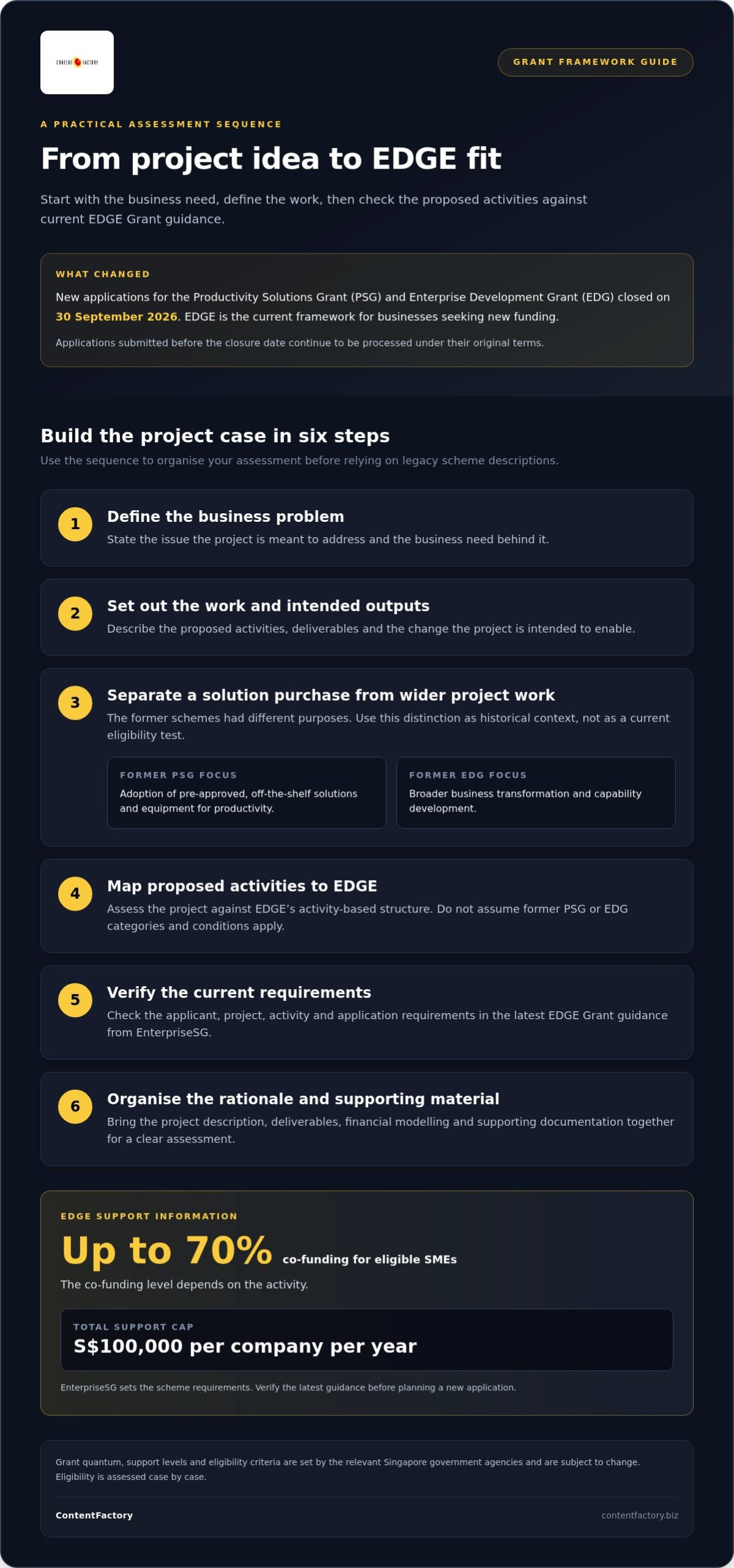
Choosing a grant starts with understanding what your project is designed to do. Since 30 September 2026, new applications for the Productivity Solutions Grant (PSG) and Enterprise Development Grant (EDG) are no longer accepted. The EDGE Grant is now the scheme for businesses seeking new funding, so begin by checking how your project fits its current framework.
The productivity solutions grant vs enterprise development grant comparison still helps explain the former schemes: PSG supported pre-approved, off-the-shelf solutions, while EDG supported broader transformation projects. This guide explains that distinction, what changed and what to verify before committing to a new application. It also shows how to assess a project’s purpose, activities and documentation against EDGE’s activity-based structure.
Enterprise Singapore states that EDGE provides eligible SMEs with up to 70% co-funding, depending on the activity, subject to a total support cap of S$100,000 per company per year. Treat the former PSG and EDG criteria as context, not as routes for new applications. Map your proposed work to the current scheme’s activities and check the latest requirements with EnterpriseSG before proceeding.
Key Takeaways
- New PSG and EDG applications closed on 30 September 2026. For new funding, assess your project against the current EDGE Grant framework.
- The productivity solutions grant vs enterprise development grant comparison still explains the schemes’ former focus: pre-approved solutions versus broader transformation projects.
- Start with the business problem and intended project outputs. Then map the activities to the current scheme rather than relying on legacy grant descriptions.
- Verify the applicant, project and solution requirements in the official EDGE Grant guidance before proceeding.
- Structured project planning, financial modelling and clear documentation can help you assess the project’s fit and prepare for its obligations.
Productivity Solutions Grant vs Enterprise Development Grant: what separates them?
The practical difference was the project’s purpose and structure. The Productivity Solutions Grant (PSG) supported the adoption of pre-approved, off-the-shelf solutions, while the Enterprise Development Grant (EDG) supported broader business transformation projects. EnterpriseSG stopped accepting new applications for both schemes on 30 September 2026. Businesses seeking new funding should assess their projects under the current EDGE Grant framework, rather than treat the former schemes as open options.
The distinction remains useful for understanding the types of projects each legacy scheme was designed for. It is not an eligibility decision or a prediction of approval. A project that resembles a scheme’s former scope does not establish that an applicant met its requirements, and historic descriptions do not determine fit under EDGE. Applications submitted before the closure date continue to be processed under their original terms.
What the Productivity Solutions Grant was intended to support
PSG focused on adopting pre-approved, off-the-shelf IT solutions and equipment to improve productivity. Businesses selected from solutions listed for support. They could not assume that any product they chose would qualify. The supported solutions and conditions depended on the scheme guidance at the time of application.
That made PSG relevant to a defined adoption need, such as implementing a listed solution for a specific operational task. A solution’s presence on an approved list did not, by itself, establish that the applicant met the scheme’s requirements. Applicant, project and solution conditions all mattered, and new applications are now closed.
What the Enterprise Development Grant was intended to support
EDG supported projects intended to build business capabilities. EnterpriseSG described its pillars as Core Capabilities, Innovation and Productivity, and Market Access. Unlike a straightforward purchase of an off-the-shelf solution, an EDG project was generally broader and bespoke, with defined activities and outcomes. A technology component alone did not describe the full scope. The business needed to assess the project’s objectives, deliverables and capability changes as a whole.
A solution purchase addresses a defined adoption need; a capability project changes how the business is equipped to perform. This distinction can help you describe your project clearly, but it does not establish current eligibility under EDGE or predict an agency decision. Check EnterpriseSG’s current EDGE guidance for the relevant activity and requirements before planning a new application.
For a practical assessment, write down the business problem, the proposed work, the deliverables and the change the project is intended to enable. Then separate the cost and role of any solution from the wider project activities. Structured grant advisory and financial modelling can help organise the project rationale and supporting documentation.
Which grant fits your project? Compare purpose, scope and evidence
For a new application, the choice is no longer between PSG and EDG. EnterpriseSG closed new applications for both schemes on 30 September 2026, so businesses seeking new funding should assess their project under the EDGE Grant. The former schemes offer useful context for distinguishing a defined solution-adoption need from a wider capability project, but that comparison is historical, not a current eligibility test.
Applications submitted before the closure date continue under their original terms. Assess those applications against the requirements in force at the time of submission. For a new project, check the current EDGE activities, applicant requirements and application conditions with EnterpriseSG before settling the project scope. The agency assesses applications; a project description or technology purchase cannot establish eligibility or predict an approval decision.
When a defined solution requirement may point towards PSG
Historically, PSG was relevant when a business had a specific productivity need that could be addressed by a supported, pre-approved solution. That was a starting point for assessing fit, not a guarantee. The business still needed to check that the particular solution, applicant and project met the scheme’s requirements at the time of application.
To describe this type of project, identify the operational need, the solution intended to address it and the work involved in adopting it. For example, a business might have needed a listed solution to support a defined task. That example alone would not demonstrate eligibility. The specific solution and application route had to be supported under the applicable PSG guidance. New PSG applications are closed.
When a broader capability project may point towards EDG
EDG historically supported wider business transformation, including projects under Core Capabilities and Innovation and Productivity. A project could involve technology, but the relevant assessment concerned its overall scope and intended capability development, not simply the presence of a new system. The business needed to explain its objectives, activities and deliverables as a coherent project.
For a new project, do not assume those former EDG categories or conditions apply to EDGE. Map the proposed activities and outputs to the current EDGE guidance instead. Avoid using historic EDG rates to plan a new application. The relevant support level depends on current scheme rules and the activity, and any funding decision rests with EnterpriseSG.
To make the comparison practical, prepare a short project note covering:
- Purpose: the business problem and intended outcome.
- Scope: the activities, solutions or services involved, and what sits outside the project.
- Deliverables: the specific outputs you expect to complete.
- Evidence: documents that substantiate the need, proposed work and expected outputs.
This note gives you a clearer basis for checking current scheme requirements before committing resources. If you need help organising the project rationale and supporting material, discuss your grant project requirements.
What eligibility and application details should you verify first?
Start by confirming which scheme is open for your project. The former PSG and EDG schemes are closed to new applications, so businesses planning a new funding application should check EnterpriseSG’s current EDGE Grant guidance. If you submitted a PSG or EDG application before the closure, verify the requirements that apply under its original terms. The former productivity solutions grant vs enterprise development grant distinction is useful context, not a current eligibility checklist.
Use this sequence before committing project resources:
- Define the project. Record the business need, proposed activities, intended deliverables and the person responsible for managing the work. Describe the project specifically enough to distinguish its core activities from routine operating costs or unrelated work.
- Check the applicant and project criteria. Read the relevant agency’s current guidance and confirm how it defines eligible applicants, supported activities, solutions and costs. Do not assume historic PSG or EDG criteria carry over to EDGE.
- Confirm timing and submission requirements. Check the current application window or status, required forms, supporting documents and any conditions on when work can begin. Use official scheme pages for the latest instructions, not older articles or supplier descriptions.
This sequence helps you check requirements, but it is not a definitive eligibility assessment. Requirements can differ by scheme, activity and application. The relevant government agency determines eligibility and funding decisions.
Build a coherent project file before submitting
Bring the project rationale and evidence together in one organised file. Include a clear scope, proposed deliverables, relevant quotations and supporting records where the current scheme requires them. Each document should relate to the same version of the project, so the activities, outputs and costs remain consistent across the narrative and attachments.
Make the assumptions in your financial model visible. Label estimates, explain their basis and retain the source documents used to prepare them. If scope or cost assumptions change, update the model and project description together. This gives your team a traceable basis for deciding whether the proposed work remains viable, without treating a forecast as proof of grant eligibility.
A practical file structure could include:
- Project rationale: the business need, objectives and expected outputs.
- Scope and delivery: proposed activities, responsibilities and relevant timelines.
- Cost support: quotations, cost breakdowns and documented modelling assumptions.
- Application evidence: applicant and project records requested by the current official guidance.
Before submission, cross-check each item against the latest agency instructions and resolve inconsistencies. Strategic grant advisory and financial modelling can help structure project plans, assumptions and documentation. Preparation supports sound internal decisions, but it cannot guarantee an approval outcome.
How should an SME decide between PSG and EDG?
For a new application, an SME can no longer choose between PSG and EDG. EnterpriseSG stopped accepting new applications for both schemes on 30 September 2026. The productivity solutions grant vs enterprise development grant comparison can still help you describe the kind of project you planned, but the next step is to assess that project against current EDGE Grant guidance.
Use the former distinction as a diagnostic, not a grant selector. Ask whether your business needs to adopt a defined solution or develop a broader capability. Then turn the answer into a clear project brief and check whether its activities and outputs fit the current scheme. This keeps the decision grounded in the business need rather than a grant label.
Use the project brief to narrow the options
Write a short problem statement before considering funding. Describe what is not working, what the project will do, what it will deliver and how your business will use those outputs. Name an internal project owner who can explain the scope, coordinate records and track delivery. Be specific: “improve operations” is less useful than identifying the task or capability the project is intended to change.
Next, list unresolved points, such as whether an activity is supported, which costs may qualify or what documents are required. Check each against the latest official EDGE guidance. Do not carry over PSG or EDG criteria simply because a previous project appeared to match their former scope.
Test the project against both schemes without forcing a fit
For a pre-closure PSG or EDG application, assess it against the applicable scheme guidance and original terms. For new funding, assess the project against EDGE instead. Compare its purpose, activities, deliverables and evidence with the relevant published requirements. If a key condition is unclear, record it for verification rather than assuming a favourable interpretation.
Keep the project intact. Do not divide or reshape work solely to make it appear eligible under a particular grant. Artificially separating linked activities can weaken the project rationale and create inconsistencies in scope, costs and deliverables. A sound assessment may show that the project does not fit a particular funding route. That is still useful: you can make an informed internal decision before committing resources.
Use this quick review before proceeding:
- Need: Can you state the business problem in plain terms?
- Outputs: Are the proposed activities and deliverables clearly defined?
- Fit: Have you matched them to current official scheme guidance?
- Evidence: Can your records support the project description and cost assumptions?
This framework helps you prepare, but it cannot establish eligibility or determine an agency’s decision. EnterpriseSG assesses applications under the relevant requirements. For a deeper look at the former EDG’s purpose and project structure, see this Enterprise Development Grant guide. If you want support structuring your project rationale and documentation, Contact Us.
Prepare the grant decision and application with structured advisory
Once you have defined the project and checked the current scheme guidance, the work shifts from comparison to preparation. PSG and EDG no longer accept new applications. For new funding, structure the project against current EDGE Grant requirements. For an existing application, follow the terms that apply to that submission. In either case, clear documentation helps your team understand the commitment and keep the project rationale consistent.
Grant advisory is not a route to approval or a substitute for the agency’s assessment. Its practical value is helping you make the project, assumptions and evidence coherent before you submit or commit resources.
Where grant advisory can support preparation
ContentFactory’s grant advisory helps organise a project’s scope, business rationale, deliverables and supporting documents around the relevant published requirements. Financial modelling can set out projected costs and assumptions in a way your team can trace back to source material. This gives decision-makers a clearer view of what the project involves and what remains uncertain, without presenting forecasts as guaranteed outcomes.
The project narrative, cost model and supporting records should describe the same scope. If the deliverables change, review the related assumptions and documents as well. Strategic grant advisory and financial modelling can support this preparation through project structuring and documentation.
Before submission, check that the project description answers three practical questions: why the work is needed, what it will deliver and how the proposed costs relate to those activities. Check any eligibility question against current official guidance, rather than resolving it through assumptions or advisory alone.
Plan for responsibilities after a grant decision
Preparation does not end when an agency makes a decision. If a grant is awarded, your business should understand the conditions attached to it and the records or compliance obligations that apply to the project. These can depend on the scheme and approval terms, so use the relevant agency’s current instructions rather than relying on a generic checklist.
Assign an internal owner to track project documents, decisions and changes against the approved scope. Keep records organised as the work progresses, and clarify uncertainty through the applicable official channels. ContentFactory also provides post-approval audit and compliance support to help businesses understand and manage relevant obligations. This support is distinct from application preparation and does not influence agency decisions.
Structured preparation can help you make a more informed internal decision, but it cannot guarantee funding. If you want support with project structuring, financial modelling or documentation, book a 30-minute discovery call.
Turn your grant assessment into a clear next step
Use the productivity solutions grant vs enterprise development grant comparison to sharpen your project rationale, not as a shortcut to a funding decision. Match the work you intend to undertake with current official scheme guidance, then decide whether the project makes sense for your business on its own terms. A well-defined project can support better internal decisions, whatever the funding outcome.
ContentFactory supports Singapore businesses with strategic grant advisory, financial modelling and project documentation. Mayuresh Godse is a Singapore Certified Management Consultant with 25+ years of consulting experience. If a grant is awarded, post-approval compliance support can also help your team understand and manage applicable obligations. This is structured preparation and follow-through, not a promise of approval or influence over an agency decision.
Grant quantum, support levels and eligibility criteria are set by the relevant Singapore government agencies and are subject to change. Eligibility is assessed case by case.
Ready to assess your project and plan the work ahead? Book a Strategic Consultation (30-minute discovery call).
Frequently Asked Questions
Is the Productivity Solutions Grant the same as the Enterprise Development Grant?
No. They were separate schemes with different project focuses, but EnterpriseSG stopped accepting new applications for both on 30 September 2026. The EDGE Grant is now the scheme for new applications. If you are reviewing an application submitted before the closure date, refer to the scheme terms that applied when it was submitted rather than treating the former PSG and EDG as one grant.
Can a company apply for PSG and EDG for the same project?
New applications for either scheme are closed, so a company cannot now submit a new PSG or EDG application for a project. For applications submitted before closure, do not assume that both schemes could support the same costs or activities. Check the terms and agency guidance applicable to each application, and disclose related funding where required. For new projects, check EDGE guidance for applicable funding conditions.
How do I know whether my project fits PSG or EDG?
For new funding, assess your project against EDGE, not the closed PSG and EDG schemes. The former productivity solutions grant vs enterprise development grant distinction can still help you describe whether the original need was a defined solution adoption or broader capability development. Write down the intended activities and outputs, then match them to current EDGE guidance. Only EnterpriseSG can assess eligibility and decide an application.
Does buying a pre-approved solution guarantee PSG support?
No. Under the former PSG, a pre-approved solution was a route to consider, not a guarantee that a company would receive support. Applicant and project conditions also applied. PSG is closed to new applications, so buying a solution now does not create a PSG entitlement. If you are planning a new project, check whether its activities and costs align with current EDGE Grant guidance before making commitments.
What documents should an SME prepare before applying for a grant?
There is no single document set that applies to every scheme or project. Start with a concise project rationale, defined activities and outputs, relevant quotations, cost assumptions and records that substantiate the applicant and project details. Treat this as a working file, not a definitive checklist. Before submitting, compare it with the latest official guidance so you can provide the documents requested for the specific application.
Can a grant consultant guarantee an EDG or PSG application outcome?
No. A consultant can help organise project scope, financial assumptions and supporting documentation, but cannot guarantee an outcome or influence EnterpriseSG’s decision. PSG and EDG are closed to new applications, and any existing application remains subject to its applicable scheme terms. Be cautious of claims that a consultant can secure approval. The agency assesses applications against its requirements.
What happens after a grant application is approved?
Read the award terms before starting or changing project activities. Identify the conditions that apply, who in your business will oversee delivery and what records or claims the agency requires. Keep project documents together and check the official instructions if the scope changes or a requirement is unclear. Post-approval obligations vary, so do not rely on a generic checklist in place of the award terms.

Article by
Mayuresh Godse
Mayuresh Godse is a Singapore Certified Management Consultant and Business Strategist specializing in Sustainability, ESG, AI-driven Digital Transformation, and business growth. Based in Singapore, he writes about Sustainability, Digital Innovation, Business Strategy, and Content Marketing for global audiences.
Disclaimer
This article is provided by ContentFactory for general information only and is not legal, tax, accounting or financial advice. Regulations and government scheme criteria change; grant eligibility and quantum are set by the relevant Singapore agencies and assessed case by case, with no outcome guaranteed. Verify current requirements before acting.