

The SASB framework for small business can help you identify sustainability topics and metrics relevant to investors. Its industry-specific standards cover 77 SICS industries and are designed for companies of all sizes. In Singapore, ACRA says companies may refer to and consider SASB materials voluntarily under the draft sustainability disclosure standards.
Sustainability reporting can seem designed for large companies with dedicated teams. For a small business, the practical question is simpler: which information matters to your business, and how can you organise it without treating every topic as relevant?
This article explains what SASB is, why its standards can be useful beyond the United States, and how financial materiality shapes disclosure. You’ll learn how to identify your industry, assess relevant topics, choose metrics, and use technical protocols to collect and present data.
Key Takeaways
- Use your business activities to identify the relevant industry standard, especially if you operate across more than one industry.
- Assess which disclosure topics could affect your financial condition, operating performance or risk profile instead of treating every topic as automatically relevant.
- Match each priority topic to its associated metrics and technical protocols so you can organise the data consistently.
- In Singapore, SASB materials may be considered voluntarily under the draft sustainability disclosure standards, according to ACRA.
- Start with a focused review of your business model, risks and available data to make the assessment manageable for a lean team.
Applying the SASB Sustainability Reporting Standards in Your Organization?
Make the assessment manageable by linking sustainability information to decisions your business already makes. Identify who needs the information, who can provide it, and how your team will keep it up to date.
Identifying Sustainability Risks and Opportunities
Assess sustainability-related risks and opportunities by tracing how an issue could affect a business activity or decision. For example, a company that relies on specialist employees could examine whether staff retention affects its ability to deliver work.
Map each relevant issue to a decision, such as staffing, supplier selection or operational planning. This helps distinguish a material business concern from a topic that is simply prominent in general discussion. A discussion of ESG benefits for employee retention can help frame the workforce connection.
For each priority, record the potential business effect, the available evidence, and who is responsible for reviewing it. Keep the assessment specific to your activities. A topic matters because it relates to your business, not simply because another organisation reports on it.
Applying SASB Alongside Other Standards
If you use SASB alongside another reporting standard, coordinate the information required for each disclosure. Before collecting data, map overlapping requests and identify whether one source record can support multiple disclosures.
If you are applying ISSB Standards, the accompanying guidance to IFRS S1 points to paragraphs IG11-24 and IE1-15 for consideration. Use those references to understand how the information you collect relates to your reporting approach. Avoid treating every metric as automatically relevant simply because it appears in an industry standard.
Keep a concise mapping record that shows each disclosure’s purpose, source information, and preparation method. It gives staff a practical reference when the reporting process is repeated or responsibilities change.
Industry-Specific Coverage and ESG Issues
Industry standards help focus attention on sustainability issues linked to particular business activities. If your organisation carries out distinct activities, assess whether one standard covers them all or whether different areas need separate topic reviews.
For each activity, identify operational dependencies, key relationships, and decisions that sustainability issues could affect. Compare those issues with the topics in the relevant standard. This makes industry guidance useful without assuming every topic applies equally across your organisation.
If several topics appear relevant, prioritise those clearly linked to business decisions and investor information needs. Record why other topics receive less attention so your reasoning is transparent.
Small-Business Reporting Practicalities
Build a workable reporting routine around existing roles and records. Assign an owner to each selected disclosure, locate the supporting information, and decide when it will be reviewed.
Maintain a simple evidence log recording the source, reporting period, calculation method, and any assumptions. If a figure depends on information from another team, note the handover point and who is responsible. These steps make it easier to trace how a disclosure was prepared.
Start with information your business can maintain reliably. As reporting needs evolve, use the evidence log to spot gaps and decide which data processes need attention. This supports consistent reporting without expanding the exercise beyond your organisation’s needs.
Global applicability and financial materiality
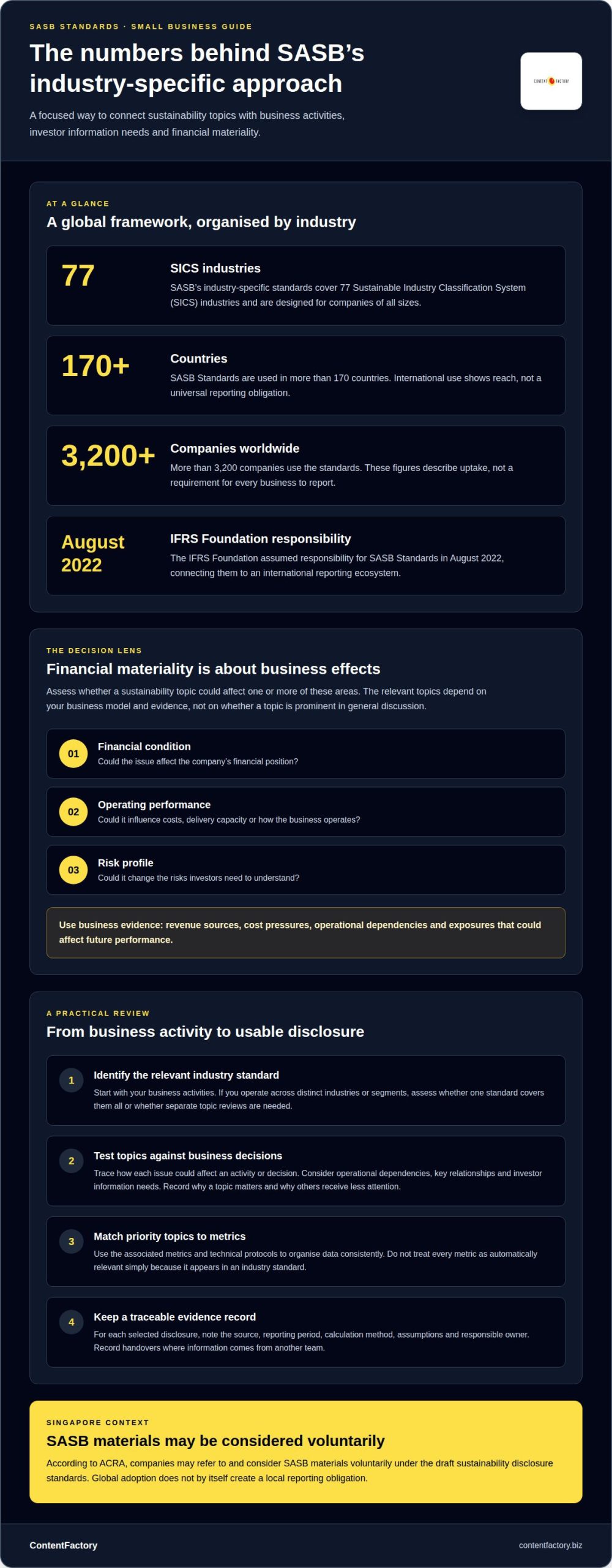
SASB Standards began as a US-focused disclosure initiative, but their use extends well beyond that market. The standards are used in more than 170 countries and by over 3,200 companies worldwide. Those figures show international uptake, not a universal reporting obligation. For a Singapore business, the practical question is whether industry-specific sustainability information helps investors assess financial performance and risk.
The Sustainability Accounting Standards Board developed the initiative around financially material sustainability topics. The IFRS Foundation assumed responsibility for SASB Standards in August 2022. That transition connects the standards to an international reporting ecosystem, but it doesn’t mean every company must use them. Global adoption and local requirements are separate considerations, so distinguish investor-focused reporting from obligations applying to your organisation.
Financial materiality asks whether a sustainability topic could affect a company’s financial condition, operating performance, or risk profile. A topic may matter even if it is not prominent in public discussion. For example, a manufacturer might assess whether resource use affects operating costs, while a service business might examine how workforce practices influence delivery capacity. The business model determines which sustainability topics deserve attention.
Assess materiality using business evidence, not assumptions about your sector. Identify revenue sources, cost pressures, operational dependencies, and exposures that could affect future performance. Then consider whether investors need information about those factors to understand the business. Record why each topic is relevant, what evidence supports the judgement, and where uncertainty remains. This gives you a reasoned basis for reporting decisions.
Companies operating across multiple industries may need to review more than one SASB industry standard. A business with distinct operating segments can compare the risks and investor information needs of each. Prioritisation may also consider segment size, relative risk, and the cost-effectiveness of collecting data. The aim is not to report every possible topic, but to explain the choices behind material disclosures.
Global use makes SASB useful for businesses engaging investors across markets, but it doesn’t make every metric equally relevant. Similar companies can face different exposures because their activities, locations and business strategies differ. Test each proposed disclosure against your own operations and financial context. If your materiality assessment needs a clearer structure, you can discuss your materiality priorities with an adviser.
SASB disclosure topics, metrics and technical protocols
SASB industry standards pair disclosure topics with quantitative and qualitative accounting metrics. Each industry includes an average of six disclosure topics and 13 metrics. These averages describe the framework’s typical structure, but they don’t determine what your business must report. Your business model, strategy and relevant legal requirements guide which disclosures fit your circumstances.
A topic describes a sustainability issue that may affect a company’s prospects. A metric turns that issue into information investors can assess. Technical protocols guide the collection and presentation of sustainability data. Together, these components define what a disclosure covers, how to measure or describe it, and how to report it consistently.
For example, a commercial bank reviewing its industry metrics could encounter identifiers in Deutsche Bank’s SASB index. FN-CB-230a.1 covers data-breach counts, the percentage involving personal data and the number of affected account holders. FN-CB-410.b1 covers absolute gross financed emissions, separated into Scope 1, Scope 2 and Scope 3. These codes tie particular disclosures to specified information.
Banking metrics are not a template for every small business. The SASB framework for small business reporting should help you identify relevant topics and measures, not encourage you to copy metrics from another sector. Select disclosures by considering your activities, strategy, and applicable requirements. This keeps the information relevant to the decisions investors need to understand.
Create an evidence trail for each selected metric. Record the information source, reporting period, calculation method, and person responsible for maintaining the data. For qualitative disclosures, note the basis for your explanation and the records supporting it. Clear ownership and documentation make consistent preparation easier when reporting responsibilities change.
- Topic: identify the sustainability issue addressed by the relevant industry standard.
- Metric: determine which associated measure reflects your business activities.
- Protocol: follow the standard’s guidance for collecting and presenting information.
- Evidence: retain source records and the rationale behind each reported figure.
Start with topics clearly connected to your business, then check whether reliable information supports each proposed metric. If records have gaps, identify the missing source or calculation step and assign responsibility for addressing it. This gives your team a practical way to improve data quality while keeping disclosures focused on useful, decision-relevant information.
What is the SASB framework and what are its industry-specific standards?
SASB refers to the Sustainability Accounting Standards Board and its industry-specific sustainability reporting standards. The standards help companies communicate sustainability information that may be useful to investors. Although often called a framework, SASB is a set of standards organised around industries, topics and related metrics. It began in 2011, with the aim of making financially relevant sustainability disclosures more consistent and comparable.
The structure starts with the Sustainable Industry Classification System, or SICS. SICS organises businesses by the activities that shape their sustainability risks and opportunities. SASB Standards cover 77 SICS industries across 11 sectors, from consumer goods to financials. This industry focus matters because a sustainability topic’s importance can differ between businesses, even when they operate in the same broad sector.
Each industry standard identifies disclosure topics and associated accounting metrics. The topics describe sustainability issues that could affect an organisation’s prospects. Metrics provide a way to report on those issues, using quantitative or qualitative information. Across industries, SASB’s Materiality Map covers 26 sustainability topics. It helps readers see how potential topics vary across industries, but companies still assess relevance to their own circumstances.
SASB’s institutional history explains where the standards sit today. SASB announced its merger with the International Integrated Reporting Council in November 2020. The Value Reporting Foundation formed in June 2021 following that merger. The IFRS Foundation assumed responsibility for SASB Standards in August 2022. These developments changed stewardship, not the practical need to select disclosures suited to your business and investors.
For a Singapore small business, the standards provide an organised reference, not a checklist that automatically applies in full. Start by identifying the SICS industry closest to your main business activity. Review its disclosure topics and metrics, then consider which issues relate to your strategy, operations, and financial risks. If you operate across distinct industries, review the relevant standards for each activity before deciding what to report.
This approach keeps reporting focused. For example, a small food producer should review the standard associated with its industry rather than borrow metrics from a bank or technology company. Document why each selected topic matters and how you can support its disclosures. For a closer look at how the standards apply to Singapore companies, see this guide to SASB Standards in Singapore.
Is SASB reporting mandatory for small businesses in Singapore?
The Accounting and Corporate Regulatory Authority (ACRA) says that, under Singapore’s draft sustainability disclosure standards, companies may refer to and consider SASB materials voluntarily rather than being required to do so. The Accounting and Corporate Regulatory Authority (ACRA) says companies may refer to and consider SASB materials, rather than being required to use them. For a small business, the key distinction is between choosing a reporting framework and meeting any separate obligations that apply to the organisation.
Voluntary use can still serve a practical purpose. Your business may choose SASB when investors request industry-specific sustainability information or management needs a structured way to assess financially relevant topics. That choice does not make every disclosure topic mandatory. Select topics and metrics according to your activities, strategy, and stakeholders’ information needs.
Before starting, define the purpose of reporting. An investor request, customer questionnaire, and internal review may each call for different information. Record the intended audience and the decisions the information should support. This keeps the work proportionate and avoids collecting data without a clear use.
Next, identify the standard that best matches your business activities. Review its disclosure topics, assess which apply to your circumstances, and record why you selected or excluded each one. If your business operates across different industries, consider the standards for those activities. Keep the assessment and supporting records together so you can explain your choices if reporting needs change.
A manageable starting approach for a small team is to:
- Set the purpose and intended audience for your sustainability reporting.
- Identify the relevant industry standard and potential disclosure topics.
- Prioritise topics using business relevance, investor information needs and available data.
- Assign responsibility for each selected metric and retain its evidence and calculation method.
For example, if an investor asks about a sustainability issue, map the request to the relevant SASB topic and metric. Record the data source and why the topic matters to your business. If you cannot yet support the metric, document the data gap and decide which records would address it. This creates a practical improvement plan without implying that voluntary SASB use is a legal duty.
Singapore’s draft standards and ACRA’s explanation provide a useful basis for distinguishing voluntary reference from a requirement. Treat SASB as a tool for focused reporting, then assess any separate requirements applicable to your organisation using relevant official guidance. Contact Us to discuss a structured sustainability reporting approach for your business.
ContentFactory: ESG Readiness & Materiality Assessments
ContentFactory helps you turn SASB considerations into a focused assessment of your organisation’s ESG readiness and material topics. An ESG Readiness & Materiality Assessment can help identify sustainability issues linked to your business activities, where relevant information sits, and which data gaps need attention.
Consider this support when you face investor questions, need to prioritise disclosures, or are comparing SASB with other reporting frameworks. An assessment can structure those decisions around your business context, rather than treating every industry topic as automatically relevant. Use the resulting priorities to guide your reporting approach and internal data collection.
For a practical discussion of your organisation’s reporting priorities, contact ContentFactory.
Turn your SASB priorities into a practical reporting plan
The SASB framework for small business is most useful when disclosure choices become part of everyday management. Assign an internal owner to each priority topic, agree how its information will be maintained, and revisit the rationale when your activities or investor needs change. This keeps reporting connected to decisions instead of becoming a document prepared once and set aside.
ContentFactory supports this work through ESG Readiness & Materiality Assessments, GHG Emissions Calculation and Carbon Accounting, and Multi-Framework Sustainability Reporting. These services help you assess priorities, organise emissions information, and align reporting across frameworks when your business needs a broader view.
Choose a starting point based on the task at hand: clarify material topics, build emissions data, or structure disclosures across frameworks. A focused plan helps your team move from analysis to consistent reporting while keeping sight of what matters to your organisation.
Contact Us to discuss the right next step for your business. Clear priorities make progress easier to manage.
Frequently Asked Questions
What Is SASB?
SASB stands for the Sustainability Accounting Standards Board, the organisation associated with industry-specific sustainability disclosure standards. The standards are neither a certification nor an ESG rating. Using them does not certify a business or guarantee a particular investor response. For a Singapore SME, this distinction matters: SASB can structure voluntary disclosures, while any separate reporting obligations should be considered on their own terms.
How Do They Set Their Standards?
SASB’s standard-setting approach is evidence-based and informed by market needs. When assessing a proposed disclosure, ask whether it reflects a real industry exposure and whether investors can use the information. Keep that reasoning alongside the supporting data. This creates a clear internal record of why a topic and metric were considered relevant, rather than relying on a generic claim.
How Does SASB Compare To Other ESG Frameworks and Initiatives?
Choose reporting frameworks by starting with the audience and purpose of each disclosure. An investor request may call for financially focused industry information, while broader stakeholder communications may also need impact information. If you use multiple frameworks, create a simple cross-reference showing which records support each disclosure. This can help identify duplicate data requests and clarify differences in scope without treating the frameworks as interchangeable.
Why Are SASB Standards Important for Companies?
The standards can give management a consistent reference when investors ask for sustainability information. For example, if an investor asks about a risk, your team can use its reporting rationale and supporting records to respond consistently. This preparation is useful even when reporting selectively. It connects external responses to internal decisions instead of treating every investor request as a separate, one-off task.
How can a small business identify the relevant SASB industry standard and disclosure topics?
If your business has several revenue streams, compare the activities behind them rather than choosing a standard based only on your registered business description. Consider which activities have distinct operations, customers, or risk exposures. If one standard appears to cover only part of the business, document that boundary. This makes your choice easier to explain and helps prevent a narrow classification from obscuring other significant activities.
What are the steps for a small business to implement SASB reporting?
Set an internal review point before sharing information externally. Ask the relevant manager to confirm that the figures and explanations reflect the reporting period and the organisation’s current activities. Then have another responsible person review the draft for consistency and clarity. Keep a record of approved disclosures and decisions. This simple governance step helps prevent conflicting answers across reports, investor materials, and stakeholder communications.
What data and metrics do SASB standards require for small businesses?
SASB does not prescribe an identical set of metrics for every small business. The relevant industry standard provides candidate disclosures, and your organisation decides which ones apply. When selecting a metric, check that its definition matches the data your business can produce. Keep units, boundaries, and reporting periods consistent over time, and explain any change in methodology so readers can interpret comparisons fairly.
What are the benefits and risks of SASB reporting for small businesses?
A structured basis for responding to investor questions is useful, but committing to disclosures your team cannot maintain reliably creates risk. Selective reporting can also be hard to interpret if you do not explain the basis for your choices. Before publishing, check that each statement has supporting evidence, a clear scope, and an accountable owner. A manageable reporting process is more useful than a broad set of disclosures that quickly becomes outdated.
ContentFactory supports organisations with ESG Readiness & Materiality Assessments and Multi-Framework Sustainability Reporting, helping you develop a reporting approach suited to your priorities. Book a 30-minute discovery call to discuss a practical next step.

Article by
Mayuresh Godse
Mayuresh Godse is a Singapore Certified Management Consultant and Business Strategist specializing in Sustainability, ESG, AI-driven Digital Transformation, and business growth. Based in Singapore, he writes about Sustainability, Digital Innovation, Business Strategy, and Content Marketing for global audiences.
Disclaimer
This article is provided by ContentFactory for general information only and is not legal, tax, accounting or financial advice. Regulations and government scheme criteria change; grant eligibility and quantum are set by the relevant Singapore agencies and assessed case by case, with no outcome guaranteed. Verify current requirements before acting.