

By 2026, SASB standards for Singapore companies will be the mandatory technical engine powering ISSB-aligned reporting. SGX and ACRA expect these industry-specific metrics to form the backbone of climate-related disclosures. Many leadership teams currently struggle to identify which material issues require reporting, leading to wasted resources and data gaps that won’t pass a professional audit.
You need a strategy that moves beyond abstract theory into tangible, audit-ready outcomes. This guide provides a pragmatic roadmap to implement SASB standards efficiently, focusing data collection only on the metrics that matter to investors and regulators. The following analysis explores how to bridge the gap between current internal capabilities and the rigorous standards required for 2026 sustainability programmes, ensuring your organisation remains compliant and resilient in a tightening regulatory environment.
Key Takeaways
- Understand the transition from voluntary disclosures to mandatory, ISSB-aligned reporting for SGX-listed and large non-listed companies by 2026.
- Discover why SASB standards for Singapore companies are the essential content engine for meeting the new IFRS S1 and S2 disclosure requirements.
- Learn how to use the SASB Materiality Map to prioritise the specific ESG issues that directly impact your industry’s financial performance.
- Master a structured framework for conducting a gap analysis to ensure your internal data collection is ready for mandatory assurance.
- Evolve your sustainability programme from a basic reporting task into a pragmatic tool for long-term operational resilience.
Navigating the Mandatory Sustainability Reporting Landscape in Singapore
The era of voluntary ESG disclosures is ending. Singapore’s regulatory environment is undergoing a structural shift as ACRA and SGX RegCo move toward mandatory climate-related disclosures aligned with the International Sustainability Standards Board (ISSB). This alignment ensures that SASB standards for Singapore companies are no longer optional extras; they are foundational components of a compliant disclosure strategy. By adopting these standards, your business moves from vague qualitative statements to the rigorous, industry-specific data that regulators now demand.
The Regulatory Push: ACRA and SGX RegCo Requirements
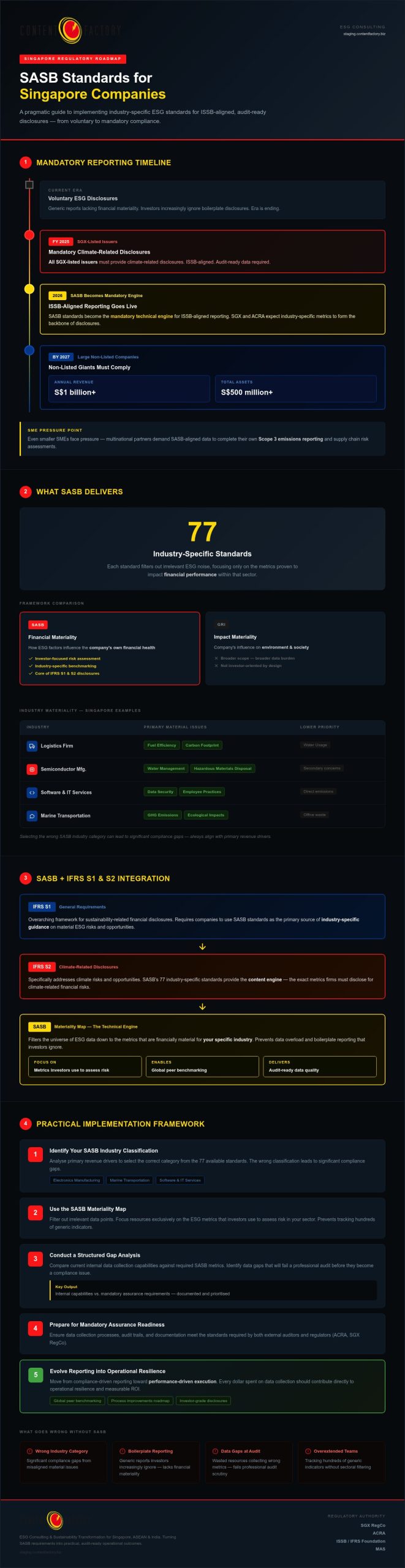
Starting from financial year 2025, all SGX-listed issuers must provide climate-related disclosures. By 2027, large non-listed companies with annual revenue of at least S$1 billion and total assets of at least S$500 million will follow suit. These requirements necessitate high-quality, verifiable data that can withstand scrutiny. Firms must prepare for mandatory sustainability assurance readiness to satisfy both auditors and regulators. Even smaller SMEs face pressure as larger multinational partners demand SASB-aligned data to complete their own Scope 3 emissions reporting and supply chain risk assessments.
Why Industry-Specific Standards Matter in 2026
Generic ESG reports often fail because they lack financial materiality. The Sustainability Accounting Standards Board (SASB) provides 77 industry-specific standards that filter out irrelevant noise, allowing leaders to focus on the metrics that drive long-term value. For a Singaporean logistics firm, water usage might be a secondary concern compared to fuel efficiency and carbon footprint. Conversely, a semiconductor manufacturer prioritises water management and hazardous materials disposal. By adopting SASB standards for Singapore companies, you ensure your reporting remains relevant to your specific operational realities.
Using industry-specific metrics prevents the “boilerplate” reporting that investors increasingly ignore. They want hard data that demonstrates how a company manages its unique risks. Implementing these standards allows for better benchmarking against global peers and provides a clear roadmap for internal process improvements. It’s a move away from compliance-driven reporting toward performance-driven execution. This focus on materiality ensures that every dollar spent on data collection contributes directly to operational resilience and measurable ROI.
Industry-Specific Materiality Filters Data to Focus on Financial Value
SASB identifies the subset of ESG issues most likely to impact financial performance across 77 distinct industries. This approach focuses strictly on financial materiality, which differs from the impact materiality found in GRI frameworks. While GRI looks at a company’s influence on the environment and society, SASB prioritises how ESG factors influence the company’s own financial health. For leadership teams, this distinction is vital when aligning with Monetary Authority of Singapore sustainability reporting requirements. Using the SASB Materiality Map allows you to filter out irrelevant data points and concentrate resources on the metrics that investors actually use to assess risk.
Implementing SASB standards for Singapore companies reduces the reporting burden for resource-constrained organisations. Instead of tracking hundreds of generic indicators, organisations only measure what is proven to be financially relevant to their sector. This efficiency is essential for mid-market firms that need to provide high-quality data without overextending internal teams. Focusing on these specific levers ensures that disclosures are both manageable and meaningful to external capital providers.
The 77 Industry Standards: Finding Your Category
Identifying your specific SASB industry classification is the first step toward a compliant disclosure. In Singapore, many firms fall into core sectors such as Electronics Manufacturing, Marine Transportation, or Software & IT Services. Selecting the wrong category can lead to significant compliance gaps, as the material issues for a logistics provider differ fundamentally from those of a technology firm. You must analyse primary revenue drivers to ensure the chosen standard accurately reflects operational risks and meets the expectations of your specific stakeholder group.
Materiality Assessment: The Foundation of Your Report
A materiality assessment is the process of identifying ESG issues that significantly influence business value. This exercise ensures that a sustainability report isn’t just a collection of anecdotes but a strategic document focused on long-term resilience. SASB standards for Singapore companies provide the technical definitions needed to make these assessments objective and audit-ready. By anchoring a report in these standards, you demonstrate a sophisticated understanding of how sustainability risks translate into financial outcomes.
ContentFactory’s ESG Readiness & Materiality Assessments streamline this process by mapping specific operations against global benchmarks. This methodology moves organisations past the confusion of overlapping frameworks to reach a clear, defensible list of material topics. If you’re unsure where your business sits within the 77 industry categories, a consultation can clarify reporting obligations and start the process of building a resilient disclosure framework.
Deciphering the Integration of SASB Standards into IFRS S1 and S2
The merger of the Value Reporting Foundation into the IFRS Foundation has formalised the relationship between these frameworks. IFRS S1 and S2 provide the overarching structure, while SASB provides the industry-specific metrics. Within the SGX mandatory sustainability reporting framework, these elements function as a single system. You shouldn’t assume that adopting ISSB allows you to ignore SASB standards for Singapore companies. Regulators and investors expect you to use these standards to pinpoint the exact risks and opportunities that impact your financial performance.
IFRS S1 and S2: The New Global Baseline in Singapore
IFRS S1 establishes how you disclose sustainability-related financial information to the market. IFRS S2 narrows the focus to climate-related disclosures, requiring companies to detail their physical and transition risks. Both standards explicitly reference SASB as required guidance for identifying industry-specific disclosure topics. This makes SASB the technical engine that makes your IFRS report functional. Without these granular metrics, your report remains too high-level to satisfy professional auditors. Preparing for Mandatory Sustainability Assurance Readiness requires this level of detail. Auditors need to see the specific data points defined by SASB to verify your climate resilience claims.
SASB vs. GRI: Choosing the Right Framework Mix
Singaporean firms often face a choice between SASB and GRI. The decision depends entirely on who you are reporting to. SASB prioritises financial materiality, showing investors how ESG factors influence your balance sheet. GRI focuses on impact materiality, detailing your organisation’s effect on the economy, environment, and society. You don’t have to view these as mutually exclusive. Many successful organisations use a multi-framework approach to satisfy different stakeholder groups simultaneously. The challenge lies in operationalising this without doubling your workload. You must identify the data overlaps between the two frameworks to create a single, efficient collection process. This avoids data silos and ensures your sustainability programme remains a tool for growth rather than a purely administrative burden.
A Practical Framework for Implementing SASB Standards in Your Organisation
Implementing SASB standards for Singapore companies requires a methodical shift from high-level commitments to granular data management. It’s not enough to simply publish a report; you must build a system that produces reliable, verifiable information year after year. This framework moves your organisation from initial assessment to audit-ready integration. Follow these five steps to ensure your reporting is both compliant and strategic.
- Identify Industry and Material Topics: Use the SASB Materiality Map to pinpoint the exact disclosures required for your sector.
- Conduct a Gap Analysis: Compare your current data collection against SASB’s technical protocols to identify missing information.
- Establish Internal Controls: Create formalised processes for data capture, review, and approval to ensure the accuracy required by auditors.
- Integrate Disclosures: Embed your ESG data into your annual report or financial statements to show the link between sustainability and value.
- Review and Iterate: Update your processes based on regulatory shifts from ACRA or feedback from your primary investors.
Closing the Data Gap: From Spreadsheets to Systems
Many mid-market firms in Singapore rely on manual spreadsheets to track ESG data. This approach is prone to error and difficult to audit. Moving toward Digital ESG Integration and Automation reduces the administrative burden and provides a clear trail for assurance providers. You need a system that captures data at the source, whether it’s energy bills from a factory or safety records from a logistics site. Documenting these processes now ensures you don’t scramble when mandatory assurance becomes a requirement.
Capability Building: Training Your Finance and Operations Teams
Sustainability is no longer a marketing exercise. It’s a core business function that requires technical literacy across the organisation. Your finance team, in particular, must understand how SASB metrics impact the company’s risk profile. Through ESG Capability Building and Training, you can foster internal ownership of these standards. This ensures that data collection becomes part of daily operations rather than an annual panic. When your leadership team understands the “why” behind the metrics, they can make better strategic decisions based on the data.
ContentFactory Converts SASB Requirements into Practical Operational Outcomes
ContentFactory operates as a high-level strategic partner and execution engine for firms facing the 2026 reporting deadlines. We deliberately distance ourselves from abstract consulting models that deliver static slide decks. Instead, we prioritise tangible outcomes by integrating SASB standards for Singapore companies directly into your operational workflows. Our approach ensures your disclosures aren’t just compliant; they’re audit-ready and financially meaningful.
Led by a Singapore Certified Management Consultant, our team understands the specific pressures of the mid-market and SME sectors. We support your organisation from the initial materiality assessment through to final multi-framework reporting. This comprehensive approach ensures that your ESG data is robust, verifiable, and aligned with the expectations of ACRA and SGX RegCo. We don’t just advise; we act as a dedicated, hands-on extension of your leadership team to drive structural change.
Driving Strategic Business Value Through Sustainable Performance
Effective sustainability disclosures provide a clear path to green finance and capital in Singapore. Local financial institutions increasingly use SASB-aligned data to assess eligibility for sustainable loans and preferential credit facilities. By demonstrating a sophisticated grasp of industry-specific material risks, you enhance your market resilience across the ASEAN region. This transition turns compliance from a regulatory hurdle into a tool for operational efficiency, identifying waste reduction opportunities that directly improve your bottom line.
Building an Audit-Ready Roadmap for 2026
The most efficient way to begin is through an ESG Readiness Assessment Singapore. This initial step identifies your current data maturity and maps out the path to full compliance. We integrate SASB standards for Singapore companies into a broader sustainability transformation roadmap, ensuring your internal processes support your reporting needs. This synchronised approach prevents the creation of data silos and prepares your firm for the rigours of mandatory assurance.
Grant quantum, support levels and eligibility criteria are set by the relevant Singapore government agencies and are subject to change. Eligibility is assessed case by case.
Future-Proofing Your Business for 2026 Compliance
Transitioning to mandatory reporting requires more than just high-level awareness; it demands the technical integration of SASB standards for Singapore companies to satisfy the industry-specific requirements of IFRS S2. By focusing on financial materiality, you ensure your organisation prioritises the data that directly impacts business value and investor decisions. This structured approach moves your sustainability programme from a compliance burden to a strategic asset that improves operational resilience.
ContentFactory provides the pragmatic expertise needed to bridge these technical gaps. Led by a Singapore Certified Management Consultant, we specialise in results-led ESG Readiness & Materiality Assessments that move beyond theoretical reporting. Our deep expertise in ISSB, SASB, and GRI frameworks ensures your disclosures are audit-ready and structurally sound for the 2026 deadlines.
The 2026 threshold is a strategic opportunity to refine your operations and improve access to green finance. Start building your roadmap today to turn regulatory pressure into a definitive competitive advantage in the ASEAN market.
We’re ready to help you navigate these requirements with confidence and precision.
Frequently Asked Questions
What are the SASB standards for Singapore companies?
SASB standards are industry-specific disclosure requirements that identify the ESG issues most likely to impact a company’s financial performance. For organisations in Singapore, these standards provide a structured way to report on sustainability risks that matter to investors. They cover 77 industries, offering technical protocols and metrics that ensure data remains comparable and verifiable across the global market. ContentFactory helps firms identify which of these standards apply to their specific operational context.
Is SASB reporting mandatory in Singapore for 2026?
SASB standards for Singapore companies are effectively mandatory as they serve as the required guidance for the ISSB-aligned climate disclosures mandated by ACRA and SGX RegCo. By 2026, listed issuers and large non-listed companies must provide climate-related reports that reference these industry-based metrics. Even if not directly mandated for your specific size yet, large multinational partners often require this data from their supply chain to meet their own Scope 3 reporting obligations.
How do SASB standards differ from the GRI framework?
SASB focuses on financial materiality, which measures how ESG factors affect a company’s financial health and value creation. In contrast, the GRI framework focuses on impact materiality, detailing how a company affects the environment, economy, and society. Many Singaporean firms adopt a dual-reporting approach to satisfy both investors who prioritise financial risk and broader stakeholders who value social impact. ContentFactory’s materiality assessments help you navigate these overlapping requirements without duplicating your data collection efforts.
Can Singapore SMEs benefit from adopting SASB standards?
Singapore SMEs gain a significant competitive advantage by adopting SASB standards, particularly when competing for contracts with multinational corporations or applying for green finance. These standards provide a clear, manageable framework that prevents SMEs from being overwhelmed by irrelevant data points. By focusing only on industry-specific material issues, smaller firms can demonstrate institutional-grade ESG maturity to lenders and partners. This transparency often leads to better credit terms and stronger supply chain resilience.
What is the relationship between SASB and the ISSB standards?
The ISSB has fully incorporated SASB’s industry-based approach into its IFRS S1 and S2 standards. While IFRS S1 and S2 provide the global structure for sustainability and climate reporting, SASB standards for Singapore companies provide the specific metrics and technical protocols used to fulfil those requirements. In the Singapore context, you cannot achieve full ISSB compliance without utilising SASB’s granular, sector-specific content. They function as a single, integrated system for high-quality financial disclosure.
How do I choose the correct SASB industry standard for my business?
You select the correct standard by mapping your primary revenue-generating activities against SASB’s 77 industry classifications. It’s vital to choose the category that best reflects your operational risk profile rather than just your broad sector. For example, a firm might need to report under Electronics Manufacturing instead of a general technology category to capture specific material risks. ContentFactory’s readiness assessments provide the technical guidance needed to ensure you select the most defensible classification.
How much does it cost to implement SASB standards in Singapore?
The cost of implementing SASB standards varies based on your company’s data maturity, industry complexity, and the scale of your operations. Investment typically covers materiality assessments, gap analysis, and the integration of digital data collection systems. While there’s an initial outlay for capability building and system setup, these costs are often offset by operational efficiencies and improved access to capital. ContentFactory focuses on a pragmatic implementation that delivers measurable ROI rather than just a static report.
Can I get a government grant for SASB-aligned ESG reporting?
Eligible Singaporean companies can apply for the Enterprise Development Grant (EDG) to co-fund sustainability projects, including ESG readiness and reporting. This support helps qualifying firms build internal capabilities and implement international standards. ContentFactory provides strategic grant advisory to help you navigate the application process and documentation requirements. Grant quantum, support levels and eligibility criteria are set by the relevant Singapore government agencies and are subject to change. Eligibility is assessed case by case.
Article by
Mayuresh Godse
Mayuresh Godse is a Singapore Certified Management Consultant and Business Strategist specializing in Sustainability, ESG, AI-driven Digital Transformation, and business growth. Based in Singapore, he writes about Sustainability, Digital Innovation, Business Strategy, and Content Marketing for global audiences.
Disclaimer
This article is provided by ContentFactory for general information only and is not legal, tax, accounting or financial advice. Regulations and government scheme criteria change; grant eligibility and quantum are set by the relevant Singapore agencies and assessed case by case, with no outcome guaranteed. Verify current requirements before acting.
One thing worth checking on the tool side: if the disclaimer is switched on globally, the grant caveat already written into your Global Writing Instructions will appear as well, so grant articles will carry the same point twice. Remove the required-disclaimer section from the instructions file if you enable this one.