

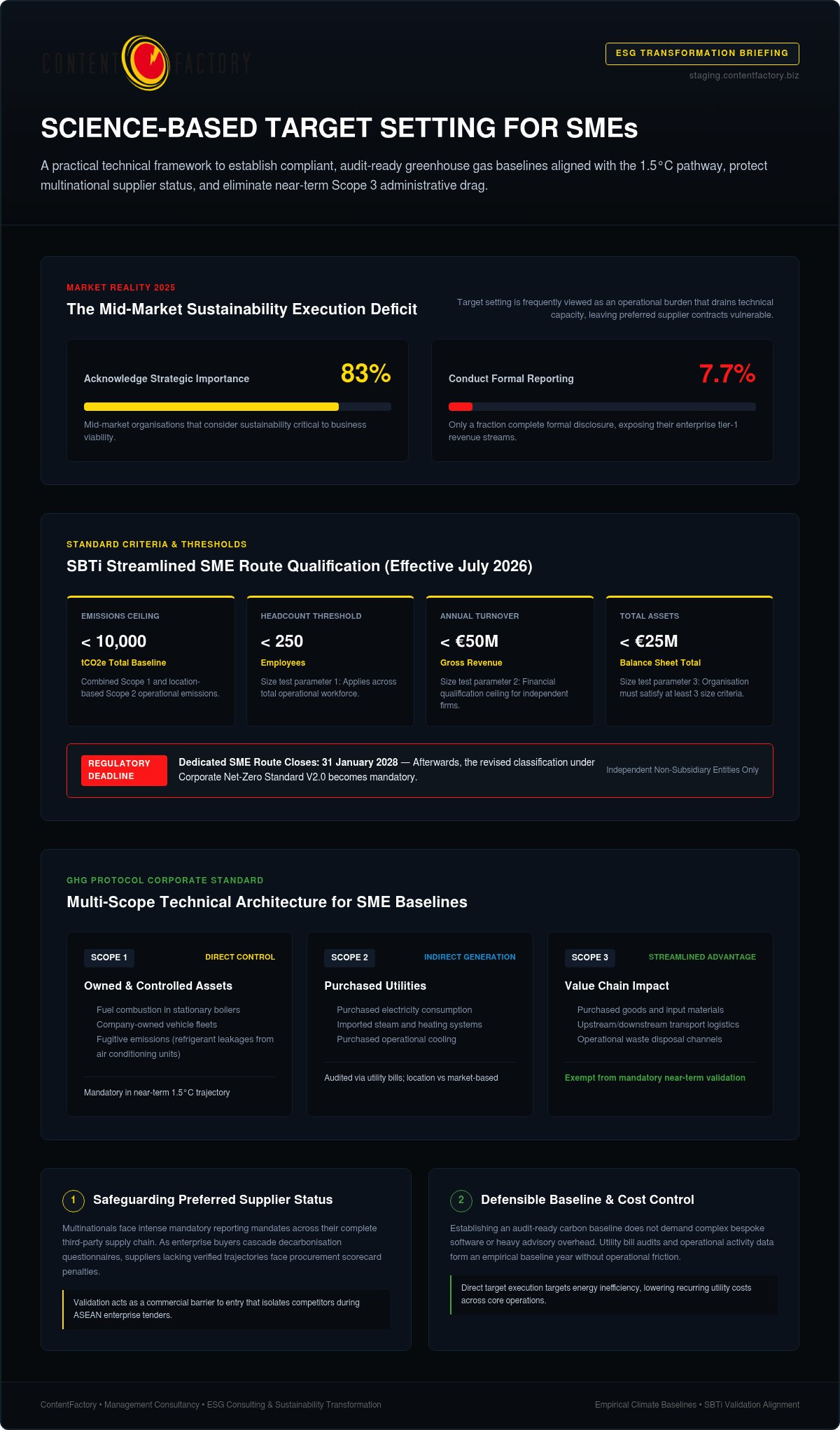
A 2025 survey revealed that while 83 percent of mid-market companies consider sustainability critical, only 7.7 percent undertake formal reporting. For most firms, implementing science-based target setting for SMEs feels like an operational burden that drains internal technical capacity. However, establishing an audit-ready carbon baseline doesn’t require complex software or excessive advisory overhead. You can secure a verified climate target aligned with the 1.5°C pathway through the Science Based Targets initiative’s streamlined SME route, which eliminates mandatory near-term Scope 3 target validation.
You’re likely facing urgent decarbonisation questionnaires from corporate enterprise buyers right now and cannot afford to risk your preferred supplier status. This strategic guide demonstrates how to set rigorous, compliant greenhouse gas baselines without administrative drag or operational disruption. We break down the transition from baseline measurement to target validation, providing a practical roadmap that lowers energy costs while protecting your major multinational revenue streams.
Key Takeaways
- Learn how to align your business with 1.5°C climate trajectories using the GHG Protocol Corporate Standard to structure your emissions baseline.
- Discover how science-based target setting for SMEs offers a streamlined validation route that eliminates the administrative drag of mandatory near-term Scope 3 targets.
- Master a practical, step-by-step framework to collect operational utility data and establish a defensible baseline year.
- Maintain your preferred supplier status with major multinational enterprise buyers by delivering verified, compliant climate data.
- Operationalise your carbon reduction strategy to lower energy costs and build long-term commercial resilience without disrupting daily operations.
Science-Based Targets Align SME Operations with 1.5°C Climate Science
Science-based targets are emissions reduction goals that align your business with the latest climate science to limit global warming to 1.5°C. The Science Based Targets initiative (SBTi) serves as the global standard setter, ensuring these goals aren’t just arbitrary numbers but scientifically rigorous pathways. For mid-market companies, science-based target setting for SMEs provides a simplified alternative to the standard corporate validation process. It allows you to bypass the technical complexity of Scope 3 targets in the near term while still achieving a credible, verified status.
The SBTi SME Pathway and Eligibility Criteria
As of July 2026, your business qualifies for the streamlined SME route if it meets specific operational thresholds. You must have fewer than 10,000 tCO2e in Scope 1 and location-based Scope 2 emissions combined. Additionally, your organisation must meet at least three of the following size criteria: fewer than 250 employees, turnover under €50 million, or total assets under €25 million. This pathway is restricted to independent, non-subsidiary enterprises, accelerating review times by removing the intensive validation stages required for larger multinationals. You should note that this dedicated route will close on 31 January 2028, after which the new classification system under Corporate Net-Zero Standard V2.0 becomes mandatory.
Why Enterprise Buyers Demand Science-Based Targets from Suppliers
Multinational corporations are under intense regulatory pressure to report on their Scope 3 emissions, which encompasses their entire third-party supply chain. This pressure cascades directly to you as a vendor. Large corporate buyers now utilise procurement scorecards that penalise suppliers lacking validated climate reduction plans. If you don’t have a credible roadmap, your business risks losing its preferred supplier status. Establishing ESG readiness through target validation acts as a commercial shield. It differentiates your business during competitive tenders by proving you’re a low-risk, compliant partner. Early adoption ensures you aren’t scrambling when decarbonisation requirements become a non-negotiable term of contract eligibility across ASEAN supply chains.
Accurate Carbon Accounting Requires a Multi-Scope Technical Architecture
The GHG Protocol Corporate Standard provides the structural rigour required for accurate carbon accounting. To establish a credible baseline, you must categorise emissions into three distinct “scopes” to ensure no double-counting occurs. Following SBTi’s standards and guidance ensures your data collection meets the specific criteria for official validation. This technical foundation transforms abstract environmental goals into a defensible business roadmap.
Scope 1 and Scope 2 Emissions Baselines Explained
Scope 1 covers direct emissions from sources your business owns or controls. This includes fuel combustion in boilers, company-owned vehicles, and fugitive emissions like refrigerant leakages from air conditioning units. Scope 2 accounts for indirect emissions from purchased electricity, steam, or cooling. You’ll need to choose between location-based and market-based calculation methods depending on your energy procurement strategy. Utility bill audits are your primary evidence here. They provide the verifiable historical data needed to establish a defensible base year for your reduction trajectory.
Scope 3 Expectations and Supply Chain Engagement
A major advantage of science-based target setting for SMEs is the treatment of Scope 3 emissions. Unlike large corporates, SMEs aren’t mandated to set quantified near-term Scope 3 targets under the current streamlined route. You must, however, commit to measuring and reducing these value chain impacts over time. You should focus on high-impact categories like purchased goods, transport logistics, and operational waste. This commitment signals to enterprise buyers that you’re actively managing your broader footprint without the immediate pressure of validated Scope 3 modelling.
Near-Term Versus Net-Zero Target Distinctions
Near-term targets focus on absolute reductions over a five to ten-year horizon. These are actionable milestones that demonstrate immediate progress and operational efficiency. Long-term net-zero commitments are more ambitious. They require at least 90 percent absolute abatement across all scopes by 2050. Most mid-market firms should prioritise near-term milestones first. This approach allows you to build internal capability and lower energy costs before tackling the deeper technical challenges of full decarbonisation. If you need help structuring these baselines, you can speak with our ESG consultants to ensure your data is audit-ready.
The Streamlined SME Route Reduces Administrative Burden and Validation Timelines
Choosing the correct validation pathway determines whether your carbon reduction strategy succeeds or stalls under technical strain. Standard corporate validation requires exhaustive reporting, often demanding dedicated sustainability departments to manage the workflow. Conversely, the streamlined framework for science-based target setting for SMEs scales down the evidentiary burden significantly. Adopting enterprise-level compliance frameworks prematurely risks overwhelming your internal teams without adding immediate commercial value or improving the accuracy of your baseline.
Data Complexity and Measurement Overhead Differences
Standard corporate validation routes demand an exhaustive screening across all fifteen categories of Scope 3 emissions, requiring deep engagement with every tier of your supply chain. This includes complex life cycle assessments of purchased goods and downstream product usage which can take months to model accurately. The SME pathway bypasses this entire requirement for near-term targets. Instead, it accepts primary operational activity data from Scope 1 and Scope 2 sources for immediate evaluation. This simplified data gathering prevents operational disruption within internal finance and facility teams. It allows you to focus on verifiable utility footprints rather than speculative supply chain estimations that are often prone to high error margins.
Target Validation Timelines and Resource Commitments
The institutional review process differs sharply between the two pathways in terms of speed and institutional cost. Corporate submissions involve multi-month technical query rounds and custom modelling reviews that require extensive back-and-forth with validation teams. The SME route utilises expedited processing windows with fixed, predetermined target options. Qualified small and medium businesses choose from set reduction percentages aligned directly with the 1.5°C pathway. This pre-calculated framework accelerates official approval and reduces upfront complexity. By avoiding protracted consulting cycles, you free up capital to invest directly in energy efficiency upgrades and physical emissions reductions that impact your bottom line.
Attempting to execute a full corporate validation when your business fits the SME criteria is a strategic error. It creates unnecessary reporting overhead and stretches lean operational teams to a breaking point. Your primary objective should be securing a credible, verified target efficiently to maintain tier-one supplier status with multinational buyers. This streamlined route delivers that exact commercial outcome without the enterprise-level administrative drag that slows down mid-market growth.
A Step-by-Step Implementation Framework for SME Target Setting
Transitioning from climate ambition to verified action requires a methodical execution plan. While the streamlined route simplifies the validation process, the integrity of your underlying data remains paramount. Effective science-based target setting for SMEs begins with a rigorous internal audit that transforms raw utility data into a defensible environmental baseline. This framework ensures your business meets international standards without exhausting your operational bandwidth.
Establishing an Accurate Organisational Greenhouse Gas Inventory
You must first consolidate twelve consecutive months of primary activity data to form your base year. This involves auditing energy bills, fuel logs for company vehicles, and operational receipts for refrigerant top-ups. Once collected, apply verified regional emission factors to calculate your total baseline carbon equivalent figures. Rigorous documentation of your carbon accounting methodology is essential. It prepares your business for mandatory sustainability assurance readiness and ensures that third-party reviewers can verify your claims without technical delays.
Selecting Ambition Levels and Submitting the SBTi SME Form
After establishing your baseline, you must choose a target ambition level that aligns with the 1.5°C pathway. Most mid-market firms prioritising commercial resilience opt for near-term absolute reduction targets. These require a commitment to reduce Scope 1 and 2 emissions by a fixed percentage within a five to ten-year horizon. You’ll complete the standardised online validation submission using your confirmed organisational metrics. It’s critical to secure formal corporate governance endorsement from your executive leadership before the public portal upload. This ensures the target is integrated into your long-term business strategy rather than treated as an isolated compliance task.
Establishing Governance, Monitoring, and Annual Disclosure Routines
Validation is only the beginning of the decarbonisation journey. You must assign clear operational accountability for emissions tracking to your facility or operational managers. Establishing quarterly energy review routines allows you to identify consumption spikes or operational inefficiencies early. These reviews turn data into actionable insights that can lower your utility costs. Finally, you must commit to annual public disclosure. Publishing your emissions progress reports on your company website maintains transparency with enterprise buyers and ensures ongoing compliance with the Science Based Targets initiative’s reporting requirements.
Operationalising Your Science-Based Transition with ContentFactory
Setting a climate target is a strategic milestone, but the true commercial value lies in execution. Lean mid-market organisations cannot afford to waste resources on abstract consulting slide decks that fail to influence daily operations. ContentFactory serves as your pragmatic execution engine. We translate complex international frameworks into clear, structured decarbonisation programmes that protect your revenue streams while lowering your utility costs.
Closing Data Gaps with Audit-Ready Carbon Accounting
We deploy rigorous carbon accounting methodologies that align directly with the GHG Protocol. Our senior-led teams focus on identifying facility-level energy waste, allowing you to secure immediate bottom-line operational cost reductions. This hands-on process eliminates data gaps across your Scope 1 and Scope 2 footprints. By structuring your emissions inventory properly from the start, we prepare your business for future regulatory disclosures and stringent commercial buyer audits. This technical foundation ensures your science-based target setting for SMEs withstands intense external scrutiny.
Building In-House ESG Competency and Transition Roadmaps
We don’t believe in creating long-term dependency on outside vendors. Our consultants focus on building ESG capability within your leadership team and operational staff. We upskill your managers to handle data collection routines independently over successive reporting cycles. This internal competency ensures long-term compliance without recurring advisory overhead. Additionally, we build practical engineering and energy efficiency roadmaps tailored to your specific commercial constraints. This methodical approach transitions your business from initial ESG readiness to a position of sustainability leadership within your regional supply chain.
Partnering with us means choosing a partner focused entirely on tangible business outcomes. We ensure your target validation moves forward efficiently, allowing you to retain your preferred supplier status with major multinational enterprise customers. Our cross-sector expertise across ASEAN supply chains guarantees that your environmental strategy strengthens your broader market position.
Securing Your Position in the Global Low-Carbon Supply Chain
Transitioning to a verified climate roadmap ensures your business remains a preferred partner for multinational enterprises. By leveraging the streamlined route for science-based target setting for SMEs, you bypass administrative drag while establishing the audit-ready carbon accounting required for long-term compliance. This strategic shift doesn’t just satisfy procurement scorecards; it identifies operational waste and lowers energy costs through practical efficiency roadmaps.
ContentFactory provides pragmatic, execution-focused ESG advisory led by a Singapore Certified Management Consultant with 25 years of experience. We support mid-market leaders across manufacturing, technology, logistics, and retail to build internal competency rather than relying on abstract slide decks. Our approach ensures your greenhouse gas baselines are grounded in rigorous data, preparing you for mandatory assurance and supplier disclosures. Protecting your revenue starts with a defensible, science-aligned strategy.
Frequently Asked Questions
What qualifies a business as an SME under the Science Based Targets initiative?
To qualify for the streamlined SME pathway, your business must have operational emissions under 10,000 tCO2e across Scope 1 and location-based Scope 2. It must be an independent, non-subsidiary enterprise outside the financial and oil sectors. Additionally, your organisation must meet at least three criteria: fewer than 250 employees, annual turnover below €50 million, or total assets under €25 million. This classification simplifies science-based target setting for SMEs significantly.
Can an SME set a science-based target without calculating all Scope 3 emissions?
Yes, you can set a verified near-term target without completing exhaustive Scope 3 value chain calculations. The streamlined SME framework mandates absolute reductions only for Scope 1 and Scope 2 operational footprints. However, your business must still commit to measuring and reducing its broader value chain impacts over time. Full Scope 3 accounting only becomes a mandatory requirement if your organisation chooses to submit an official long-term net-zero target.
How long does the SME target validation process typically take?
The streamlined SME route features an expedited review window that bypasses the lengthy technical query rounds of the standard corporate pathway. Once you submit the completed assessment form and clear the validation fee, approval typically concludes within a few weeks. This accelerated timeline allows mid-market companies to establish verified climate credentials quickly. It eliminates the protracted administrative delays that frequently disrupt internal commercial operations.
Is target setting mandatory for mid-market suppliers serving corporate clients?
While not legally mandated by governments for smaller firms, target setting is increasingly becoming a commercial requirement. Multinational enterprise buyers must decarbonise their supply chains to meet their own Scope 3 commitments. Consequently, they use procurement scorecards that penalise or exclude vendors without validated reduction plans. Implementing science-based target setting for SMEs protects your contract eligibility and preserves your preferred supplier status during competitive tender reviews.
What is the difference between a near-term target and a net-zero target?
Near-term targets focus on immediate absolute emissions reductions over a five to ten-year horizon, primarily targeting your direct utilities and fuel consumption. A net-zero target requires a long-term commitment to achieve at least 90 percent absolute abatement across your entire value chain by 2050. Any residual emissions must be permanently neutralised. Mid-market firms should categorise these goals sequentially to avoid overextending their internal data tracking capacity.
How do science-based targets benefit an SME commercially beyond compliance?
Aligning with verified carbon reduction pathways drives material efficiency across your operations. Conducting a rigorous greenhouse gas inventory highlights facility-level energy waste, allowing you to implement targeted interventions that lower utility bills. Beyond direct cost savings, these credentials enhance your brand equity with sustainability-focused investors and corporate clients. It positions your organisation as a resilient, forward-looking partner equipped for a low-carbon regional economy.
What happens if an organisation fails to meet its annual reduction milestones?
Failing to meet an annual milestone doesn’t result in immediate disqualification or financial penalties from the standard setters. However, your progress must be disclosed publicly every year, meaning enterprise buyers will observe any performance gaps. Persistent stagnation risks undermining your commercial credibility and scorecards with major corporate clients. If emissions spike, your management team must re-analyse operational inefficiencies and adjust your energy efficiency roadmap accordingly.

Article by
Mayuresh Godse
Mayuresh Godse is a Singapore Certified Management Consultant and Business Strategist specializing in Sustainability, ESG, AI-driven Digital Transformation, and business growth. Based in Singapore, he writes about Sustainability, Digital Innovation, Business Strategy, and Content Marketing for global audiences.
Disclaimer
This article is provided by ContentFactory for general information only and is not legal, tax, accounting or financial advice. Regulations and government scheme criteria change; grant eligibility and quantum are set by the relevant Singapore agencies and assessed case by case, with no outcome guaranteed. Verify current requirements before acting.
One thing worth checking on the tool side: if the disclaimer is switched on globally, the grant caveat already written into your Global Writing Instructions will appear as well, so grant articles will carry the same point twice. Remove the required-disclaimer section from the instructions file if you enable this one.