

A project idea is not enough to build a funding plan. If you are assessing funding for sustainability projects Singapore businesses can pursue, start by defining the work, its business purpose and its expected costs. Then compare that scope with the relevant scheme’s published criteria. A scheme name alone cannot confirm eligibility.
Funding options can feel scattered across agencies and directories. This guide explains how to assess project fit, compare a potential route with your proposed work and assemble a clear project file. It also outlines the Enterprise Development Grant (EDG) support levels for qualifying sustainability projects, without treating funding as guaranteed.
Before committing expenditure or setting a start date, read the administering agency’s guidance for the scheme you are considering. Check the application sequence, eligible costs and evidence requirements, then assess whether the project remains viable without assuming grant support.
Key Takeaways
- Define the project need, scope, deliverables and costs before comparing funding routes.
- Use current agency guidance to assess whether the project and your organisation meet a scheme’s criteria.
- A relevant project and a well-prepared application do not guarantee funding. The relevant agency makes the decision.
- Build a project file that connects the proposed work and costs to supporting evidence.
- Grant advisory can help organise project information and documentation, while funding decisions remain with the relevant agencies.
Funding for sustainability projects in Singapore starts with project fit
A project idea is not yet a fundable project scope. “Improve sustainability” describes an intention, not the activities, deliverables, costs or business need an agency can assess. Before comparing schemes, turn the idea into a defined project with clear boundaries.
Start by describing the business issue the project will address and the work you propose to do. For example, if the project concerns resource efficiency, identify the planned activities and the outputs you expect. Keep this description specific, but do not assume that an example project or cost is eligible. The scheme’s current rules determine what can be considered.
A scheme is a potential route to investigate, not a decision on eligibility or funding. Keep project fit, applicant eligibility, cost eligibility and approval as separate checks. This distinction matters when you plan budgets or timing. Treat possible support as unconfirmed until the relevant agency has assessed the application.
Which business sustainability projects should you assess first?
Start with the operational issue, then describe the work that could address it. Energy efficiency, water efficiency, waste reduction and sustainability reporting can be useful categories for organising your research. They are not evidence that a particular activity, applicant or expense is covered by a scheme.
Clarify the project before looking for a matching route. Write down:
- The business problem the project is intended to address.
- The activities and deliverables included in the proposed scope.
- The costs associated with each activity.
- The records or other evidence that could show what the project delivered.
For example, “reduce energy use” is a broad objective. A clearer project description explains the work being proposed, the equipment or services involved and the outputs you expect. Keep project costs distinct from routine operating expenses, and label estimates as estimates. The agency’s rules determine which expenses may be considered.
How to assess funding for sustainability projects Singapore businesses can pursue
Use the relevant administering agency’s published guidance as the basis for your assessment. Enterprise Singapore and the National Environment Agency (NEA) are starting points for information about their respective programmes. The Singapore Green Plan 2030 funding page can help you discover possible routes, but a directory listing does not confirm that a scheme fits your project.
For broader context on grant application preparation, the Enterprise Singapore Grants guide can help you organise your research. For each potential route, record its purpose, applicant criteria, eligible project costs, application sequence and evidence requirements. Compare those details with your project scope instead of choosing based on the scheme name or a headline figure.
Before committing expenditure or setting a start date, read the latest instructions for the route you are considering. Keep a note of the guidance you used and the points that still need clarification. This gives your team a practical basis for deciding whether to investigate the route further.
Compare Singapore funding routes by the project they support
Once your project has a defined purpose, compare possible schemes by what they are designed to support. For a sustainability project, the Enterprise Development Grant (EDG) may be relevant to investigate. Enterprise Singapore’s grant information lists support of up to 50% for core capabilities and digital initiatives, and up to 70% for qualifying sustainability projects. Eligibility and the applicable support level depend on the agency’s criteria.
Do not treat a support level as a project budget or a confirmed award. First check whether your organisation and proposed work fit the scheme, then establish which costs may be considered and what evidence is required. Grant details and eligibility criteria are set by the relevant agencies and may change.
When should an SME investigate EDG or the Sustainability Reporting Grant?
Investigate the EDG when your proposed project appears to match the grant’s stated purpose and your business wants to check the applicable criteria. For a sustainability project, the listed support level is up to 70% for qualifying projects. That does not mean every sustainability activity or cost qualifies. Review Enterprise Singapore’s requirements for the project and applicant before using a possible grant contribution in your financial plan.
The Sustainability Reporting Grant has a specific stated purpose: supporting eligible companies producing their first sustainability report incorporating climate-related disclosures based on ISSB standards. Treat it as a route to research for that defined reporting purpose, not a general source of support for any sustainability activity. Compare your project, costs and organisation against the scheme’s current published requirements before proceeding.
For either route, record what you have verified and what remains uncertain. A simple comparison can include the project purpose, applicant conditions, eligible costs, application sequence and supporting documents. ContentFactory’s grant advisory and financial modelling can help organise this assessment without presuming an agency decision.
What can NEA-listed funding directories help you shortlist?
NEA directories and the Singapore Green Plan 2030 funding page can help you discover programmes to research by topic. Use the Singapore Green Plan 2030 Funding page as a discovery tool, then follow any relevant listing to the administering agency’s instructions. A directory is not a substitute for current scheme terms or an eligibility decision.
Before adding a possible route to your shortlist, verify:
- Whether applications are open and which applicants may apply.
- Which project activities and costs the published rules cover.
- How and when to apply, including any conditions on project timing.
- Which documents, records or claims evidence the agency requires.
This keeps your research focused: match the project purpose to the scheme, then test the details against the agency’s current rules. If you need support structuring the assessment and documentation, Contact Us.
Does a strong sustainability project guarantee funding approval?
No. A relevant project and a carefully prepared application do not guarantee funding. The agency sets the scheme rules and assesses applications against the criteria in force. Treat funding as conditional, and do not make the project dependent on an assumed award.
For funding for sustainability projects Singapore businesses may investigate, keep four questions separate. Does the work match the scheme’s purpose? Does the applicant meet the stated criteria? Which proposed costs may be considered? Will the agency approve the application? A positive answer to one question does not settle the others.
Some funding initiatives are designed for a different audience or purpose. For example, the Ministry of Sustainability and the Environment describes the SG Eco Fund as supporting community projects that advance environmental sustainability. That description does not establish that a business project fits. Read the published terms before including any programme in your funding plan.
What should you verify before treating a scheme as a fit?
Read the latest information from the agency administering the scheme. Confirm its status, applicant criteria, project scope, eligible costs and application sequence. If the rules refer to a particular project stage or application timing, check the exact instructions before authorising work or placing orders.
Scheme details can change. Before using them in a business plan, note when you checked the agency’s information and which requirements you relied on. If a term is unclear, record it for clarification. Do not interpret a broad sustainability objective as proof that a project qualifies.
How can you reduce avoidable gaps in a funding case?
Make the project file consistent. The business need should explain why the work is proposed. The activities should show what will be done, the deliverables should describe what the work will produce, and the proposed costs should map to those activities. If the scope changes, revisit the cost model and supporting evidence too.
Keep the basis for each estimate and claim traceable to the proposed work. Organise relevant quotations, activity descriptions and other supporting records in line with the agency’s instructions. Label estimates clearly and avoid presenting a possible grant as assured. Clear documents help describe the project accurately, but they cannot guarantee an agency decision.
Record-keeping also matters after an application decision. If funding is approved, follow the award conditions and agency instructions for project records and claims. ContentFactory provides post-approval grant compliance support to help organise those obligations. This support does not influence the agency’s decision.
Prepare a sustainability funding application with a clear project file
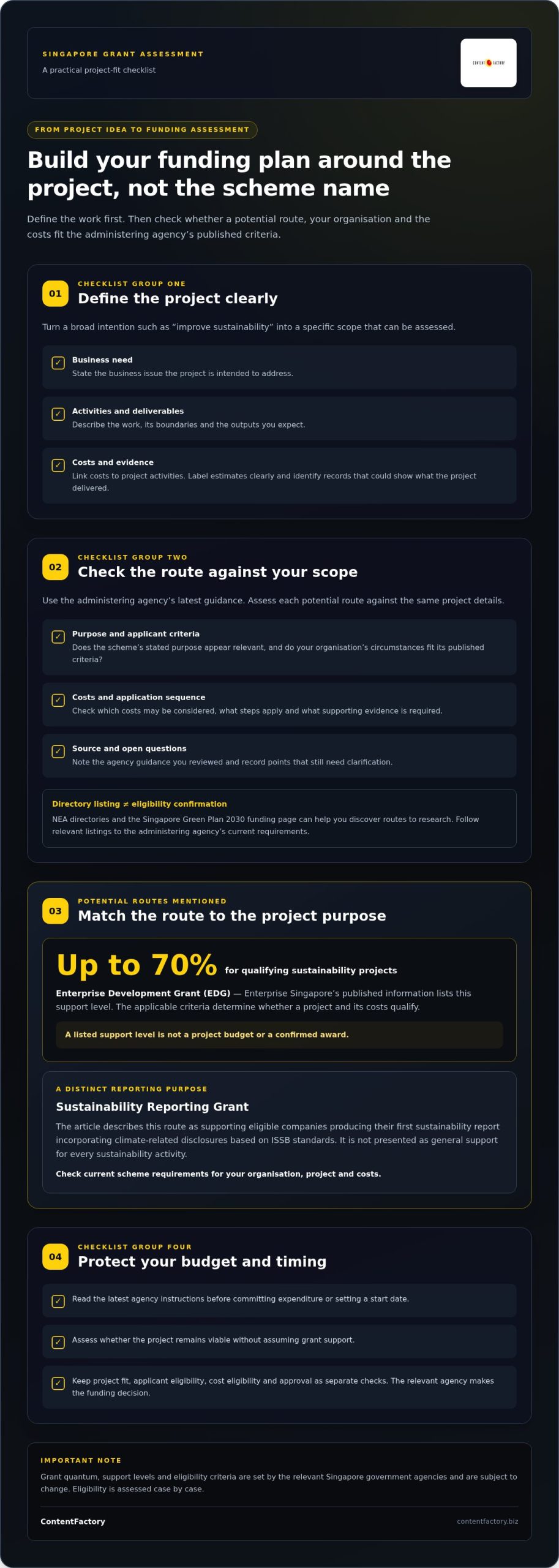
A clear project file connects the business need to the proposed work, costs and evidence. To assess funding for sustainability projects Singapore businesses may pursue, prepare the file in sequence: define the need, scope the work, model costs, map the evidence and check the agency’s instructions. This is a working method, not a replacement for the specific application guidance.
Start a simple project folder before drafting application answers. Keep a record of the scope and budget versions you are using. That makes it easier to check that figures and descriptions remain consistent as the project develops.
- Define the need. State the business issue and why the organisation is considering a project. Link the explanation to the work you propose.
- Scope the work. Describe the activities, deliverables, timeframe and people responsible. Separate the proposed project from routine operations or unrelated work.
- Model the costs. List expected expenditure against the activities it supports. Mark estimates clearly and record the assumptions behind them.
- Map the evidence. Identify the records and cost information that support the need, scope and budget. Follow the agency’s document instructions.
- Verify the rules. Compare your project file with current agency guidance, including application sequence, eligible costs and record-keeping requirements.
What belongs in a clear project scope and financial model?
A useful scope states the need, proposed activities, deliverables and responsibilities without relying on broad claims. For example, explain the work proposed to improve resource efficiency and what the project is expected to produce. Describe intended benefits as aims, not guaranteed results.
Build the financial model around that scope. Connect each budget line to an activity or deliverable, and separate confirmed costs from estimates. Record the basis of each estimate and any unresolved figures. This makes the model easier to review and revise if the project changes. It does not establish that every listed cost is eligible. The agency’s rules determine which costs may be considered. ContentFactory’s strategic grant advisory and financial modelling page explains how project budgeting can be structured.
How should you organise supporting records and compliance steps?
Build your document checklist from the selected agency’s latest application and claims guidance. Arrange records under clear headings, such as project scope, budget, supporting evidence and approvals. Keep dated versions so you can identify which scope and figures informed each step. Retain invoices and project records according to the scheme’s instructions.
Before submitting, compare the scope, cost model and supporting documents. Check that they describe the same work, and flag assumptions that still need confirmation. You can start by creating the project folder, drafting a one-page scope and listing each cost beside the activity it supports. If you need help structuring the budget and project file, Contact Us.
Turn funding research into a responsible next step with ContentFactory
A shortlist is useful only if it helps your business decide what to do next. Compare your project plans with the agency’s current guidance before applying or committing expenditure. Assess whether the project is viable on its own terms, with potential funding treated separately.
ContentFactory provides grant advisory, financial modelling and documentation support to help you organise that assessment. The work focuses on preparing a coherent project scope and supporting information. Agencies set scheme rules and decide eligibility and application outcomes.
What can grant advisory help you put in order?
Grant advisory can help align your project scope, financial model and application documents. The scope describes the work and deliverables. The model connects proposed expenditure to that work and makes assumptions visible. The documents should reflect the same project plan, giving your team a consistent basis for review before submission.
After an agency approves an application, post-approval audit and compliance support addresses a separate set of responsibilities. Your business must follow the award conditions and agency instructions for records and claims. Preparing for that stage does not predict the outcome of an application.
What should happen after you identify a potential funding route?
Recheck the administering agency’s current rules before finalising an application or making project commitments. List the decisions you need to resolve, including applicant criteria, eligible activities and costs, required documents, project timing and claims. If the published guidance leaves a point unclear, use the agency’s stated channels for clarification.
Bring together your project description, budget assumptions and questions so the next discussion can focus on specific decisions. ContentFactory can help organise grant preparation and financial modelling, with post-approval compliance support as a distinct stage.
Make your next funding decision with a clear plan
Before committing to a project, compare your plan with the agency’s latest guidance. Note what still needs confirmation, including assumptions that affect the scope, budget or timing. Your team can then decide whether to proceed, revise the project or investigate another route.
Funding for sustainability projects Singapore businesses can explore is a possibility to assess, not money to include in a plan before approval. Ground the decision in the business need, proposed work and delivery requirements. Consider any potential support separately.
ContentFactory helps businesses organise grant advisory, financial modelling and application documentation. Grant quantum, support levels and eligibility criteria are set by the relevant Singapore government agencies and are subject to change. Eligibility is assessed case by case.
Discuss your project in a 30-minute discovery call: Book a Strategic Consultation.
Frequently Asked Questions
Can an SME apply for more than one sustainability funding scheme?
Possibly, but check each scheme’s rules before planning around more than one source of support. Confirm whether the same project or cost can be included in multiple applications, and disclose other applications or support if the agency’s instructions require it. Keep separate budget lines for distinct activities. Assess each route against its own criteria rather than assuming schemes can be combined.
Can a sustainability grant cover consultant or professional fees?
It depends on the scheme and the service. Do not assume a professional fee is eligible because it relates to a sustainability project. Check the agency’s current list of supportable costs and describe each fee by its purpose and project deliverable. If the published guidance does not address a proposed cost clearly, seek clarification through the agency’s stated channels before including it in your funding plan.
Can a business start a project before applying for funding?
Project-start conditions vary by scheme. Check the current instructions before authorising work, placing orders or beginning delivery. Do not assume that an application can cover costs incurred earlier. Confirm the relevant timing requirements in the administering agency’s guidance.
How do I check whether a sustainability funding scheme is still open?
Check the administering agency’s scheme page rather than relying on a directory listing or older guide. Look for current application information and instructions. If the status or timing is unclear, use the agency’s official channel to clarify it before committing to a schedule or budget. For funding for sustainability projects Singapore businesses are assessing, save the relevant guidance and note when you reviewed it.
Does a sustainability project automatically qualify for EDG funding?
No. A project’s sustainability purpose alone does not establish eligibility for Enterprise Singapore’s Enterprise Development Grant (EDG). Check the agency’s current criteria for applicant eligibility, project fit and costs before deciding whether to pursue an application. The listed support level of up to 70% applies to qualifying sustainability projects, subject to eligibility criteria.
What information should I prepare before discussing a funding application?
Prepare a short project description, the business need it addresses, the proposed activities and deliverables, and a preliminary budget. Note which figures are confirmed and which are estimates, including the assumptions behind them. Identify the scheme you are considering and list unresolved questions about eligibility, timing or evidence. This gives an adviser a specific project to discuss rather than a broad intention.
Where can Singapore businesses find official sustainability funding information?
Start with Enterprise Singapore for its grant guidance and the National Environment Agency for relevant programmes. The Singapore Green Plan 2030 funding directory can help you discover possible routes, but it does not determine eligibility. Follow each listing to the administering agency’s current rules, since scheme status, applicant criteria and application steps can differ.

Article by
Mayuresh Godse
Mayuresh Godse is a Singapore Certified Management Consultant and Business Strategist specializing in Sustainability, ESG, AI-driven Digital Transformation, and business growth. Based in Singapore, he writes about Sustainability, Digital Innovation, Business Strategy, and Content Marketing for global audiences.
Disclaimer
This article is provided by ContentFactory for general information only and is not legal, tax, accounting or financial advice. Regulations and government scheme criteria change; grant eligibility and quantum are set by the relevant Singapore agencies and assessed case by case, with no outcome guaranteed. Verify current requirements before acting.