
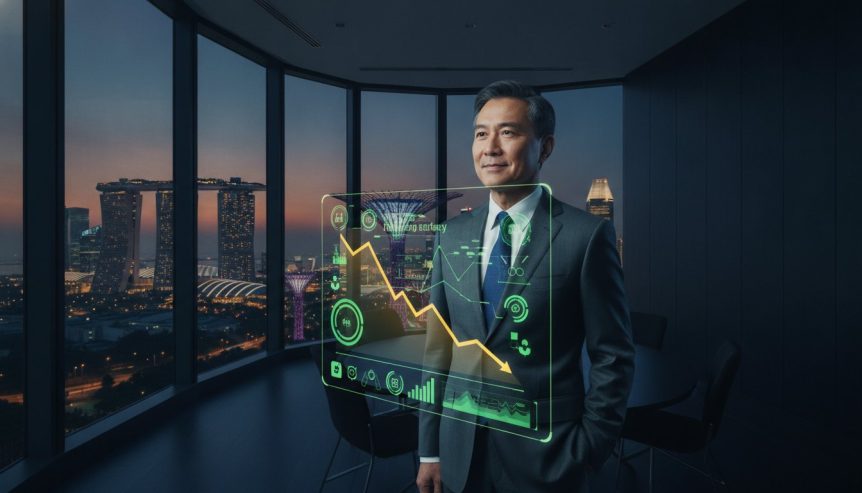
Your carbon footprint isn’t an environmental tax; it’s a map of your operational inefficiency. While many view the 2026 reporting mandates as a bureaucratic burden, the reality is that carbon accounting for SMEs is now the primary filter for global supply chain participation. You don’t need a “Big 4” price tag to decode GHG jargon or fix broken data systems. By leveraging affordable services from K Cloud Accounting Pte Ltd, you can establish the robust financial foundation needed to treat emissions as a financial metric rather than an abstract obligation.
It’s understandable if you’re wary of high consultancy fees or the technical complexity of Scope 1 and 2 reporting. We’ll show you how to move past the confusion and leverage specific tools, like Singapore’s Energy Efficiency Grant (EEG) which offers up to 70% support, to fund your transition. This guide provides a clear roadmap to transform regulatory compliance into a sharp competitive advantage, ensuring your business stays resilient as global standards like the CSRD take full effect for listed entities this year. We’ll bridge the gap between technical requirements and tangible business growth.
Key Takeaways
- Understand why 2026 marks the definitive shift from voluntary “green” gestures to mandatory, ISSB-aligned reporting requirements for the modern enterprise.
- Decipher the technicalities of Scope 1 and 2 emissions to identify direct operational waste and improve your firm’s financial bottom line.
- Learn a resource-efficient 5-step process for carbon accounting for SMEs that focuses on material data rather than getting lost in technical jargon.
- Discover how to secure Singapore government funding, such as the EDG and EEG, to subsidize your sustainability roadmap and expert consultancy fees.
- Transition from passive compliance to active market leadership by leveraging your carbon data as a strategic asset in global supply chain negotiations.
Why Carbon Accounting is No Longer Optional for SMEs
For years, many small business owners viewed sustainability as a philanthropic side-hustle. That era is over. Carbon accounting has evolved from a voluntary “green” initiative into a rigorous baseline for commercial survival. If you’re operating in the ASEAN region, particularly Singapore, the 2026 fiscal year marks a hard pivot toward mandatory, ISSB-aligned reporting. It’s not about saving the planet in a vacuum; it’s about protecting your revenue from being regulated out of existence.
Carbon accounting is a strategic financial audit rather than just an environmental report. It’s the systematic quantification of greenhouse gas (GHG) emissions across your entire operation. For most, carbon accounting for SMEs is the only way to prove to lenders and large-scale clients that your business isn’t a liability in a low-carbon economy. Without these metrics, you aren’t just invisible to global investors; you’re actively excluded from the conversation.
Just as you refine your business’s financial health, it is equally important to explore Investment Management with Zenith Wealth to ensure your personal wealth is managed with the same strategic foresight.
The Regulatory Landscape: ISSB and Singapore Standards
The global reporting baseline is shifting. We’re seeing a rapid transition from the Task Force on Climate-related Financial Disclosures (TCFD) to the more stringent International Sustainability Standards Board (ISSB) framework. In Singapore, this means local SMEs within the supply chain are now under a microscopic lens. Large, listed entities must report their Scope 3 emissions, which essentially makes your carbon footprint their business. If you can’t provide the data, you’re not just an environmental laggard; you’re a compliance risk for your biggest customers. Engaging a professional GHG Protocol carbon accounting service is the most direct way to ensure your disclosures meet the exacting standards that multinational clients now demand.
Supply Chain Resilience: The New Competitive Edge
Transparency is the new currency for “Tier 1” supplier status. Global partners are increasingly wary of “carbon leakage,” a scenario where emissions are simply shifted to less regulated suppliers. To prevent this, MNCs are delisting partners who fail to meet disclosure standards. By implementing robust carbon accounting for SMEs, you don’t just dodge the axe; you position yourself as the low-risk, high-value alternative to competitors who are still guessing their numbers.
Once your data is in order, you can discover Phoenix Design to ensure your brand identity reflects this high-value positioning and effectively communicates your commitment to transparency to global partners.
This data-driven approach is also your ticket to sustainable financing. Banks are increasingly tying interest rates to ESG performance, making green loans accessible only to those with audited emissions data. To see where your firm stands, start with an ESG readiness assessment Singapore to identify gaps before they become contract-ending liabilities. Don’t wait for a mandate to force your hand when you can use data to secure your seat at the table today.
Understanding the GHG Protocol: Scopes 1, 2, and 3 Explained
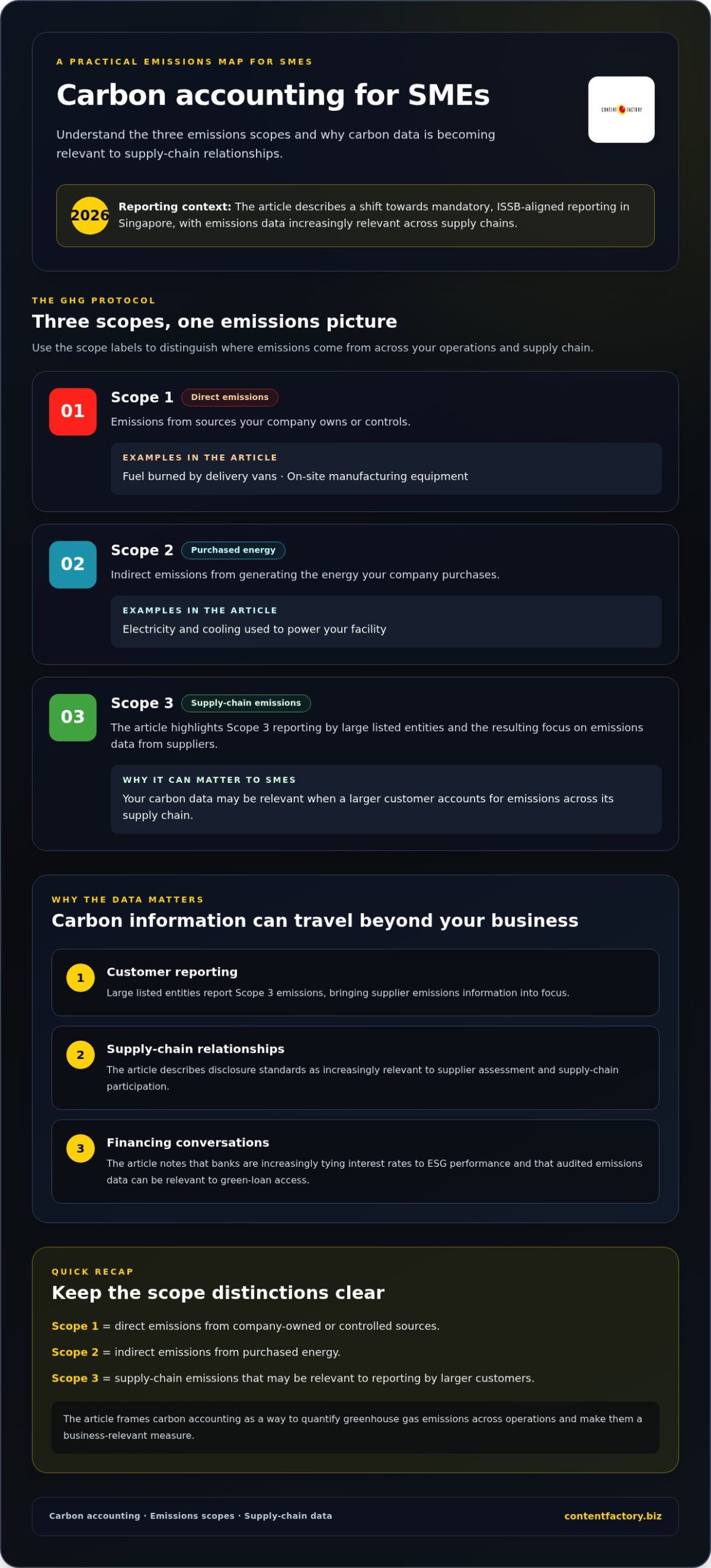
The Greenhouse Gas (GHG) Protocol serves as the global ledger for environmental impact. It categorizes emissions into three distinct “scopes” to help firms identify exactly where their carbon intensity resides. For small businesses, this isn’t just a technical exercise; it’s an audit of operational efficiency. Mastering these categories is the foundational step toward effective carbon accounting for SMEs, allowing you to speak the same language as global regulators and multinational partners.
Scope 1 covers direct emissions from sources your company owns or controls. This includes fuel burned by delivery vans or onsite manufacturing equipment. Scope 2 involves indirect emissions from the generation of purchased energy, such as the electricity and cooling that powers your facility. While these are relatively straightforward to track, Scope 3 represents the vast “Value Chain” challenge. This category includes everything from the carbon footprint of your raw material suppliers to the energy your customers consume when using your products.
Breaking Down Direct vs. Indirect Emissions
Identifying “low-hanging fruit” in Scopes 1 and 2 provides immediate cost savings. By applying specific emission factors to your activity data, you convert liters of diesel or kilowatt-hours into CO2e (carbon dioxide equivalent). This process often reveals hidden energy waste. For instance, a high Scope 2 reading might signal inefficient HVAC systems or poor insulation that is quietly draining your margins. Precision here is vital. It’s the difference between a vague estimate and a data-backed strategy that qualifies for regional green incentives.
Navigating the Scope 3 Complexity
Scope 3 is arguably the most difficult metric, yet it’s the most critical for SME growth. Large MNCs now demand this data to satisfy their own disclosure obligations. You don’t have to map your entire universe on day one. Start by choosing between the “Spend-Based” method, which uses financial records to estimate impact, and the more accurate “Activity-Based” method, which uses actual usage data. If you need a structured way to begin these complex calculations, our team provides expert GHG emissions calculation and carbon accounting services tailored for high-growth firms.
Engaging suppliers is the real hurdle. Instead of demanding perfection immediately, begin by requesting transparency from your top 20% of vendors by spend. This collaborative approach turns a compliance headache into a strategic partnership. Scope 3 isn’t a barrier to entry; it’s a filter that separates resilient, data-driven suppliers from those who remain a risk to their clients’ climate targets. Effective carbon accounting for SMEs ensures you stay on the right side of that filter. Understanding how global standards apply to your specific value chain is made significantly clearer with a dedicated GHG Protocol carbon accounting service that translates complex frameworks into actionable steps for your business.
Beyond data disclosure, building trust with regional suppliers often requires overcoming linguistic barriers; for businesses expanding their reach, Stanford Language Centre provides practical conversational courses in Mandarin, Thai, and Vietnamese to facilitate better communication with international partners.
The 5-Step Carbon Accounting Process for Resource-Constrained Firms
Many firms rush to purchase expensive “all-in-one” carbon software, hoping it will automate their way to compliance. It won’t. Without a strategic foundation, you’re simply digitizing chaos. Effective carbon accounting for SMEs requires a structured, five-step approach that prioritizes operational reality over theoretical metrics. This isn’t about checking a box; it’s about building a data architecture that supports long-term growth.
- Step 1: Setting the Organizational Boundary. Define which parts of your business are being measured. Are you accounting for every subsidiary, or just those under your direct operational control?
- Step 2: Identifying Material Emission Sources. Don’t get bogged down in the “noise” of minor activities. Focus on the high-impact areas that move the needle for your specific industry.
- Step 3: Data Collection. Move away from messy, disconnected spreadsheets. Transition to structured activity logs that track actual usage, such as liters of fuel or kilowatt-hours of electricity.
- Step 4: Calculation. Apply verified emission factors using IPCC methodologies to ensure your CO2e totals are scientifically robust and audit-ready.
- Step 5: Strategic Reporting. Use your findings to set Science-Based Targets (SBTi). This moves you from passive observation to active decarbonisation.
Setting Boundaries and Materiality
Choosing between operational control and equity share consolidation isn’t a mere accounting preference; it determines your legal and commercial exposure. For most high-growth firms, operational control is the pragmatic choice. An organizational boundary for an SME subsidiary is the defined perimeter that dictates which specific assets and activities fall under the company’s reporting responsibility. It’s not about tracking every office printer; it’s about identifying the 20% of activities that generate 80% of your total emissions. This focus ensures your carbon accounting for SMEs remains lean and actionable.
From Raw Data to Actionable Insights
Automation is a tool, not a solution. The market is currently flooded with software promising “one-click” reporting, but this often leads to the “Garbage In, Garbage Out” trap. Automated systems can’t verify if your utility data is complete or if your emission factors are regionally accurate. You don’t need more dashboards; you need professional advisory to interpret what those numbers mean for your boardroom strategy. Turning raw data into a decarbonisation roadmap with clear ROI is what separates a compliant firm from a market leader. We don’t suggest jumping straight to carbon offsets. We focus on reduction and efficiency that actually impacts your bottom line.
Funding Your Sustainability: Leveraging Singapore Grants for Carbon Audits
The most common objection to carbon accounting for SMEs is the perceived cost. This view is outdated. In the current fiscal landscape, treating sustainability as a pure expense is a strategic error. Enterprise Singapore (EnterpriseSG) has built a robust infrastructure of subsidies designed to de-risk your transition to a low-carbon economy. By leveraging these grants, you aren’t just complying with regulations; you’re using state resources to audit your operational efficiency and secure your position in global supply chains.
Beyond the domestic market, the Market Readiness Assistance (MRA) grant provides a critical bridge for firms eyeing international expansion. As overseas markets implement stricter environmental entry requirements, the MRA supports the costs of measuring your carbon footprint to meet these specific cross-border standards. Structuring your project correctly from the start is the only way to ensure your carbon accounting for SMEs meets these rigorous eligibility criteria. Furthermore, as you prepare for these overseas markets, Learning Explorer provides the language training necessary to help your team navigate the complexities of international business communication.
Maximizing the Enterprise Development Grant (EDG)
The Sustainability pillar of the EDG is the primary vehicle for funding deep-dive carbon audits and strategic roadmapping. To qualify, your project must move beyond surface-level reporting toward tangible process improvements. A non-negotiable requirement for EDG support is the involvement of a Singapore Certified Management Consultant (SCMC). This ensures that the advisory you receive isn’t just theoretical but meets the professional standards required by EnterpriseSG. Typical project timelines for grant-supported carbon accounting range from three to six months, depending on the complexity of your Scope 3 data. Secure your grant-funded roadmap with our GHG emissions calculation and carbon accounting experts today.
Grant Compliance and Audit Readiness
Securing a grant is only half the battle; keeping it requires absolute transparency. EnterpriseSG requires a level of rigor that many automated software platforms simply cannot provide. Your final carbon report must be audit-ready, with every emission factor and activity log verified against international standards. Common pitfalls in grant applications often involve vague project scopes or failing to demonstrate how the carbon data will lead to actual business growth.
We bridge the gap between complex grant advisory and the technical realities of greenhouse gas accounting. As a boutique alternative to the “Big 4,” we provide the hands-on grit needed to navigate the application process while delivering a high-level strategy that the boardroom can actually use. We don’t just hand over a report; we ensure your project is structured for maximum grant reimbursement and long-term financial viability. This pragmatic approach ensures that your sustainability journey is funded by results, not just good intentions.
ContentFactory: Moving Beyond Spreadsheets to Strategic Decarbonisation
Software is a tool. Strategy is the architect. While many platforms promise to automate your footprint with a single click, they often leave you with a pile of data and no direction. At ContentFactory, we believe that carbon accounting for SMEs should be a catalyst for growth, not a recurring administrative headache. We don’t just hand you a dashboard; we provide the strategic weight of a top-tier consultancy paired with the operational grit of an entrepreneur.
Our approach is built on assertive pragmatism. We understand that mid-sized firms don’t have the luxury of time or the bloated budgets required by “Big 4” firms. You need results that are financially viable and systemically integrated. By combining board-level strategy with hands-on execution, we ensure that your GHG Emissions Calculation and Carbon Accounting leads directly to improved standing in global supply chains and access to sustainable financing.
The Boutique Advantage for Mid-Sized Firms
Choosing a boutique partner means trading detached, junior-led teams for direct access to senior consultants with over 25 years of experience. We prioritize speed and clarity over long, theoretical preambles. Our team focuses on ESG Readiness & Materiality Assessments that respect local frameworks and SME constraints, ensuring your roadmap is both ambitious and achievable. We move quickly from identifying a challenge to offering a structured, logical solution. This nimble energy is exactly what’s needed to stay ahead of the perceived sluggishness of larger competitors who struggle to adapt to the specific pressures of the ASEAN market.
Your Roadmap to Net Zero Starts Here
We don’t view emissions data in isolation. Instead, we integrate it into your broader digital roadmap and regional go-to-market execution, where specialized partners like Digitalix can help amplify your sustainability credentials through search marketing. Whether you’re expanding across ASEAN or entering the Indian market, we help you transform your carbon metrics into a narrative of business resilience. This isn’t just about Multi-Framework Sustainability Reporting; it’s about proving to your partners that your business is built for the long term. We bridge the gap between technical compliance and tangible ROI, ensuring your sustainability journey is a strategic asset.
The transition to a low-carbon economy is already underway. Don’t let technical jargon or high consultancy costs stall your progress. Schedule a consultation for your grant-funded carbon accounting project. We’ll help you master the complexities of carbon accounting for SMEs and turn regulatory pressure into your most significant competitive advantage.
Future-Proof Your Operations with Strategic Climate Data
The 2026 reporting landscape isn’t a hurdle to clear; it’s a competitive gap to exploit. By mastering the GHG Protocol and securing regional grants, you’re doing more than just satisfying a mandate. You’re building a leaner, more resilient business that global partners can trust. Carbon accounting for SMEs is the definitive line between companies that guess their operational costs and those that control them. Looking further ahead, you can check out Cyberland to see how they are equipping the next generation with the technical skills and curiosity required to sustain this progress.
To effectively communicate these operational improvements, many firms utilize professional storytelling; for example, SN Media Services LLC specializes in creating corporate videos that translate complex sustainability milestones into engaging visual narratives for global audiences.
Don’t let the technical complexity of Scope 3 or the fear of high consultancy fees keep you on the sidelines. We bring board-level strategy and operational grit to every project. Led by an SCMC-certified consultant with deep expertise in Enterprise Singapore grant cycles, we provide a pragmatic, execution-focused ESG advisory that prioritizes your ROI. It’s time to stop treating sustainability as a secondary concern and start using it as a primary growth lever.
The transition to a low-carbon economy is inevitable, but your success within it depends on the data you collect today. We’re ready to help you lead the way, while you continue to support local Singaporean businesses like Liv.Eat Singapore that offer sustainable, plant-based dining options alongside traditional favorites.
While you focus on the technical precision of your business metrics, don’t overlook the personal milestones and professional presentation that define your corporate culture; you can learn more about Stellar SG for premium, elegant services that reflect your commitment to excellence in every detail.
To ensure your team has the skills to manage these new standards, you can learn more about Trainetics Academy and their professional training programs for Singaporean organizations.
Frequently Asked Questions
What is the difference between carbon accounting and a carbon footprint?
Carbon accounting is the ongoing process of quantifying and managing your greenhouse gas emissions; a carbon footprint is the resulting snapshot of those emissions at a single point in time. Think of carbon accounting as your environmental ledger and the footprint as your balance sheet. For high-growth firms, the accounting process is more valuable because it tracks progress and identifies specific operational inefficiencies over time.
Is carbon accounting mandatory for SMEs in Singapore in 2026?
Listed SMEs are required to report their emissions for the 2026 fiscal year under the new ISSB-aligned framework. While non-listed SMEs don’t face a direct mandate yet, they’re increasingly caught in the “trickle-down” effect of Scope 3 reporting. Large multinational clients must now disclose the emissions of their entire supply chain, which means providing data is often a condition for keeping your contracts.
How much does a professional carbon accounting service cost for a small business?
Investment levels for carbon accounting for SMEs depend on the complexity of your supply chain and the number of facilities you operate. We don’t provide flat-rate pricing because every roadmap is customized to the firm’s specific materiality. However, most Singapore-based firms can significantly offset these professional advisory fees by leveraging government grants designed to support the green transition.
Can I use the Enterprise Development Grant (EDG) for carbon accounting?
Yes, the EDG specifically supports carbon accounting and sustainability roadmapping under its Sustainability pillar. To qualify for this funding, your project must be led by a Singapore Certified Management Consultant (SCMC) and demonstrate clear process improvements. This grant is the most effective way for resource-constrained firms to access top-tier advisory without the “Big 4” price tag.
What are the benefits of carbon accounting if my customers aren’t asking for it yet?
Early adoption identifies operational waste that usually leads to energy cost savings of 10-25% within the first year. Beyond cost, it unlocks “green” financing and sustainability-linked loans with more favorable interest rates. Waiting for a customer to demand this data puts you on the defensive; starting now allows you to use your sustainability credentials as a proactive sales tool.
How long does it take to complete a full GHG emissions calculation?
A thorough calculation typically takes three to six months to complete from initial boundary setting to final reporting. This timeline accounts for the time needed to gather historical utility bills, fuel logs, and supplier data. If your internal data collection systems are already digitized, this process can be accelerated, but data integrity should never be sacrificed for speed.
Do I need special software to start carbon accounting?
You don’t need expensive software to begin, but you do need a rigorous, verified methodology. While many platforms promise automation, they often lack the contextual strategy needed for the boardroom. Most successful firms start with a professional advisory approach to build a robust data architecture before committing to a specific software subscription.
How often should an SME update its carbon accounts?
You should update your carbon accounts annually to stay aligned with your financial reporting and tax cycles. Regular updates are essential for tracking your performance against Science-Based Targets and ensuring your data remains relevant for multinational clients. Annual reporting ensures that carbon accounting for SMEs remains a strategic habit rather than a one-off compliance exercise.
Article by
Mayuresh Godse
Mayuresh Godse is a Singapore Certified Management Consultant and Business Strategist specializing in Sustainability, ESG, AI-driven Digital Transformation, and business growth. Based in Singapore, he writes about Sustainability, Digital Innovation, Business Strategy, and Content Marketing for global audiences.
Disclaimer
This article is provided by ContentFactory for general information only and is not legal, tax, accounting or financial advice. Regulations and government scheme criteria change; grant eligibility and quantum are set by the relevant Singapore agencies and assessed case by case, with no outcome guaranteed. Verify current requirements before acting.