

More software does not automatically mean better control. ERP system integration for SMEs in Singapore connects functions such as finance, inventory, sales and customer relations, helping information move between business processes instead of staying in disconnected tools. An ERP system brings these functions together on a shared platform and can connect with systems your business already uses.
When your team relies on separate tools, repeated data entry and manual updates can make work harder to manage. ERP system integration for SMEs in Singapore starts by identifying where information gets stuck and matching technology to the workflow, rather than adding software for its own sake.
This guide explains how ERP connects business systems, which options Singapore SMEs can consider, and how to assess readiness and select a system. You will have a clearer basis for deciding whether ERP fits your business and what to consider before adopting it.
Key Takeaways
- ERP integration links finance, inventory, HR and customer information, helping reduce duplicate data entry and improve visibility across operations.
- Compare cloud, modular and custom ERP approaches against your business processes, integration needs and plans for change.
- Centralised inventory and order management can give teams a clearer view of stock, purchasing and fulfilment.
- Define requirements with the people who use each process, then assess functionality, local GST support, implementation and training needs.
- A phased implementation can start with core modules and add capabilities as your processes and priorities become clear.
ERP integration with finance, inventory, HR, and CRM
ERP integration connects key business functions through shared information and workflows. For Singapore SMEs, its value lies in linking day-to-day operations with financial records, not simply adding another system.
Connections Across Core Business Systems
An ERP system links finance, inventory, HR and CRM so information can move between teams without repeated manual updates. A sales order, for example, can inform stock planning and finance, while HR records support workforce administration. In manufacturing, connecting resource planning with inventory can help teams coordinate materials and production. These links clarify ownership and handovers across operations.
Shared Operational and Financial Information
Shared ERP information gives authorised teams a common view of operational activity and its financial effect. A manager can relate orders, stock movements and purchasing activity to finance records, rather than assembling separate reports. During implementation, define which roles need access to each record and which decisions the information supports. Mapping those workflows can also expose process gaps, as explored in business process improvement for Singapore SMEs.
Automated Data Entry and Reconciliation
ERP automation transfers information between connected processes, reducing the need to enter the same transaction in several systems. For example, sales data can flow into a general ledger, while payment records can be matched against transactions for reconciliation. Staff still need to review exceptions, such as a payment that does not match an invoice. Clear approval steps help teams resolve exceptions while maintaining an audit trail.
Financial Management and Singapore GST Support
For Singapore businesses, financial-management modules should support local GST calculations. Assess how the system records transaction details, applies configured tax treatment and presents information for review. ERP systems can also generate IAF, or IRAS Audit File, exports. Local ERP support matters because IRAS and CPF updates may affect system settings and workflows. Confirming these capabilities during selection helps avoid a mismatch between system processes and local operations.
What Examples of ERP Systems Are Out There in Singapore?
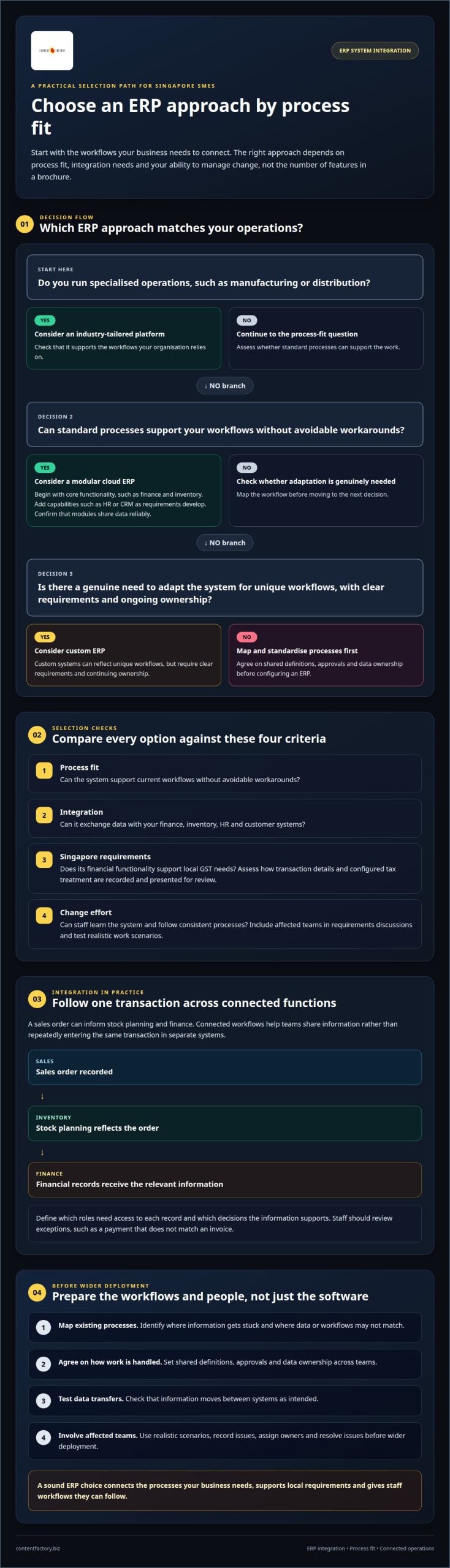
Singapore businesses can consider cloud-based modular ERP systems, industry-tailored platforms or custom systems. The right option depends on your processes, integration needs and ability to manage change, not the number of features in a brochure.
Common integration risks include mismatched data, disrupted workflows and low staff adoption. Singapore SMEs can reduce these risks by mapping existing processes, testing data transfers and involving affected teams before implementation.
A modular cloud ERP system lets a business start with core functionality, then add capabilities as requirements develop. For example, a business might begin with finance and inventory, then connect HR or CRM. This phased approach can limit unnecessary complexity, but only if modules share data reliably and support the workflows your teams use.
Industry-tailored systems suit organisations with specialised operations, such as manufacturing or distribution. Custom ERP can reflect unique workflows, but it requires clear requirements and ongoing ownership. Before considering either option, identify where standard processes will work and where a genuine business need calls for adaptation.
Assess each option against practical criteria:
- Process fit: Can it support your current workflows without avoidable workarounds?
- Integration: Can it exchange data with your finance, inventory, HR and customer systems?
- Local requirements: Does its financial functionality support Singapore GST needs?
- Change effort: Can staff learn the system and follow consistent processes?
Standardisation matters because disconnected departmental methods create inconsistent records and handovers. Map a process such as order approval from sales through fulfilment and finance. Agree on shared definitions, approvals and data ownership before configuring the ERP. This gives integration a stable operating model instead of automating conflicting practices.
Change management should start before launch. Involve representatives from finance, operations, HR and sales in requirements discussions, then use realistic scenarios during training. A staff member processing a purchase or updating a customer record can test whether the workflow reflects daily work. Record issues, assign owners and resolve them before wider deployment.
For a practical selection discussion, talk through your ERP integration requirements and the processes your business needs to connect.
ERP integration across accounting, inventory, payroll, procurement and sales
Connecting these functions lets an SME coordinate transactions across its supply chain. A wholesale order, for example, can be considered alongside available stock, purchasing requirements, delivery progress and the records finance needs. The practical benefit is a joined-up view of commitments, not a collection of departmental snapshots. Managers can use this view to spot when an order or replenishment decision depends on information held elsewhere.
Centralised order management can bring website, retail-counter and wholesale orders into a shared workflow. Staff can see each order’s fulfilment status and the inventory assigned to it. This is useful when different channels draw on the same stock. It also helps teams identify orders needing attention, such as one awaiting stock or a delivery update.
Inventory management can track stock movements and support automated reorder alerts for critical items. Before deciding what to replenish, a team can review on-hand quantities alongside open orders and incoming purchases. This view helps address both stockout and overstock risks. For businesses with warehousing or manufacturing activities, inventory records can also inform decisions about where materials are needed next.
Procurement data adds supplier and lead-time context to inventory planning. Keeping purchase orders, supplier performance and delivery lead times together helps staff assess whether incoming stock will meet operational needs. If a key item is delayed, the team can identify affected orders and decide what to do next. This connects purchasing decisions to fulfilment rather than treating each purchase as an isolated transaction.
Payroll and accounting provide a different operational view. Payroll information can help managers understand staffing costs in relation to departments or activities, while accounting records support oversight of business commitments. Access should reflect job responsibilities. For example, an operations manager may need staffing and stock information without unrestricted access to payroll details.
To assess a connected workflow, trace one order and its dependencies:
- Identify the sales channel and the order information it captures.
- Follow the stock allocation, fulfilment status and any purchase needed.
- Note supplier lead-time information that affects delivery planning.
- Map which accounting and payroll views support operational decisions.
This exercise reveals where teams need shared information and where permissions should differ. Start with the workflow that crosses the most functions, then assess whether its records support sound day-to-day decisions across sales, procurement and operations.
ERP selection for Singapore SMEs
ERP selection starts with business requirements, not a software demonstration. Define the workflows, integrations and reporting needs the system must support before reviewing products.
ERP Software Selection Criteria
Selection criteria are the capabilities and operating conditions you use to compare ERP software. They matter because a poor fit can leave staff relying on workarounds. Assess finance, inventory, purchasing and sales functions against the tasks your teams perform. Then consider integration options, reporting, user access, configuration flexibility and the support needed to maintain the system. A growing SME may also value modular functionality that can expand as requirements change.
Separate essential requirements from preferences. If your finance team needs consistent transaction records, for example, that is a core requirement. A specialised dashboard may be useful, but it should not outweigh process fit or reliable data exchange. Include user experience in the assessment: even a technically capable system depends on staff using it correctly.
Planning the ERP Selection Process
A selection plan sets out who will assess the options, which workflows matter and how each system will be compared. Gather input from the people responsible for finance, operations, purchasing and sales. Map a representative process, such as a purchase request moving through approval, receipt and record-keeping. This grounds discussions in everyday work rather than broad feature claims.
Prepare a shared requirements brief and use it to assess each shortlisted option consistently. Ask vendors to demonstrate the same scenarios, including exceptions such as a changed order or an incomplete record. Record gaps, dependencies and decisions. This makes trade-offs visible and helps prevent one department’s preference from determining the system for the whole organisation.
Implementation Steps and Timeline
Plan for what happens after the selection decision. Identify the data to migrate, systems to connect, workflows to configure and staff who need training. Assign an owner to each area, then establish how testing issues will be recorded and resolved. These details help reveal implementation demands before the project scope is finalised.
Use the assessment to define a manageable first phase and its acceptance criteria. For example, specify which records and user tasks must work before a process goes live. Keep the requirements brief available during configuration and testing so the team can judge whether the chosen system meets the original need. For connected finance workflows, assess ERP and finance system integration as part of the overall design.
What are the steps and timeline for ERP implementation and integration in a Singapore SME?
ERP implementation moves from process definition to configuration, data migration, testing and staff adoption. Packaged ERP implementation is estimated at 3 to 6 months; a custom ERP build is estimated at 5 to 12 months. The scope, existing systems and level of customisation shape the work. A clear sequence helps your team manage dependencies and keep daily operations moving.
Start by defining the project scope and the processes the ERP must support. For example, map a sales order from entry through stock allocation, delivery and accounting. Identify which existing tools must exchange information, who owns each process and what successful testing should demonstrate. This prevents teams from configuring software around conflicting assumptions.
- Prepare processes and data. Document workflows, data owners and system connections. Clean customer, supplier and product records before migration.
- Configure core functions. Set up agreed workflows, roles and approval routes. Begin with the modules needed for priority operations.
- Connect systems. Define how records move between ERP, accounting and other retained tools. Test a complete transaction, not just an individual connection.
- Validate the setup. Use representative transactions, such as a purchase order, stock receipt and supplier invoice. Record mismatches and resolve them before launch.
- Train users and launch. Practise role-specific tasks, confirm support ownership and move into live use with a clear issue-escalation process.
During data migration, match fields between the old system and the ERP. A product code, unit of measure or customer identifier must retain its intended meaning. Test migrated records against source data, then check that connected processes still work. For example, confirm that a completed sales order updates fulfilment and the relevant finance record.
Testing should include exceptions, not just routine cases. Try a cancelled order, a changed quantity or a supplier delivery recorded against the wrong purchase order. These scenarios reveal whether staff can correct errors and whether updates reach connected functions. Keep an issue log with an owner and resolution status.
For a phased launch, choose a defined business process or module as the initial scope. Review user feedback and unresolved issues before expanding to further functions. This gives the project team a controlled way to identify workflow or integration gaps before they affect more operations.
To plan your ERP implementation and integration approach, Contact Us.
ContentFactory
ContentFactory helps Singapore SMEs make ERP decisions as part of a wider digital transformation, connecting system choices to business processes and operational priorities. This support is useful when separate tools create repeated work, information gaps or unclear handovers, but the next step is not always a full ERP rollout. First decide which process needs improvement and what a system must change.
An ERP project involves more than choosing software. Your workflows, data, connected systems and staff responsibilities all affect implementation. ContentFactory helps you assess these dependencies and set a practical direction for technology adoption. The focus is on an approach your organisation can put into operation, rather than a technology plan detached from daily work.
Before discussing a project, identify the decision you need to make. You may be deciding whether to connect finance and inventory first, replace disconnected tools or standardise a process before automating it. Note which teams handle the process and where information currently needs manual transfer. These details make the initial discussion concrete.
ContentFactory can frame the next steps around your actual requirements: clarify the process problem, define integration priorities, assess implementation considerations and account for staff adoption. This is particularly relevant when several departments depend on the same records or a system change affects established responsibilities. A staged roadmap can distinguish immediate needs from capabilities that can wait, keeping the scope tied to business priorities.
Seek support before software selection becomes a commitment, or when an existing implementation has stalled over process or integration questions. A focused discussion can help you define the decision at hand and determine what planning is needed next. It should clarify the operational issue, the systems involved and the choices requiring further analysis, without assuming one ERP approach suits every SME.
If you’re planning an ERP decision or integration project, book a 30-minute discovery call with ContentFactory.
Make the next ERP decision a practical one
Treat ERP as an operating-model decision, not just a software purchase. Before committing, identify the business process that needs attention, the systems it depends on and the changes your teams will need to adopt. This gives you a grounded basis for deciding what to integrate first and what can wait.
ERP system integration for SMEs in Singapore works best when the technology roadmap reflects actual workflows, data needs and implementation capacity. For ERP system integration for SMEs in Singapore, ContentFactory helps businesses assess these factors through digital roadmap and implementation planning, business process reengineering, and technology adoption and system integration. The aim is a clear path from operational challenges to practical system decisions.
If your team is weighing ERP options or needs to bring disconnected processes together, a focused discussion can help clarify priorities and the decisions ahead. Contact Us to book a 30-minute discovery call with ContentFactory and explore a practical next step for your business.
Frequently Asked Questions
How Do You Know If Your SME Is Ready for an ERP System?
Your SME may be ready when separate tools create recurring data gaps, repeated work or delays between teams. Managing business information across three or more tools is one potential indicator. Readiness also depends on process clarity, staff capacity and whether your business expects to expand within the next 12 to 24 months. A business with fewer than five employees may find a full ERP premature.
How Does an ERP System Actually Save a Small Business Money?
An ERP can reduce avoidable operating effort by limiting duplicate entry, improving stock visibility and automating routine handovers. To assess its potential value, identify tasks your team repeats, such as matching orders against invoices or updating the same stock record in multiple systems. Compare the time and error-handling involved with the proposed workflow. Savings depend on actual adoption and process fit, not software features alone.
What Are the Core Modules and Features of an ERP System?
Core ERP modules commonly cover finance, inventory, purchasing, sales and human resources. A business may also need customer relationship management, order fulfilment or manufacturing functionality. Assess features such as role-based access, approval workflows, reporting, data exchange and configurable processes. For example, a distributor may prioritise supplier and stock records, while a service SME may focus more on finance and customer records.
What ERP systems are popular with SMEs in Singapore?
ERP choices for Singapore SMEs include cloud-based modular systems, industry-tailored platforms and custom-built solutions. The right category depends on how closely standard functionality fits your workflows and which integrations matter. Rather than choosing by popularity alone, assess a realistic transaction, such as a customer order moving through fulfilment and finance. Include local GST support and staff adoption in the comparison.
What does ERP implementation and integration cost for Singapore SMEs?
There is no single cost that applies to every SME. The total depends on the selected software, number of modules, implementation scope, data migration, integrations, customisation and training. A packaged system and a custom build involve different work and cost structures. Compare the full project scope, ongoing licences and support requirements, rather than relying only on the initial software charge.
How do SMEs integrate ERP with accounting, payroll, CRM, e-commerce and inventory systems?
Start by defining which system owns each record, such as customer details, product codes or payroll information. Then specify what triggers data exchange, such as an online order updating available stock. Map the fields between systems and test routine and exception cases. For example, confirm how the integration handles a cancelled e-commerce order before relying on it in daily operations.
What Singapore tax, GST, invoicing and data protection requirements affect ERP integration?
For tax workflows, assess local GST calculation support and whether the system can generate IAF exports for IRAS. InvoiceNow and Peppol readiness may also matter when planning e-invoicing. For data protection, set access permissions by job role, limit unnecessary access to personal information and establish how teams handle corrections. Treat these as system-design considerations and seek appropriate professional advice on specific compliance obligations.
How do cloud ERP and on-premise ERP compare for Singapore SMEs?
Cloud ERP is generally cheaper to adopt than on-premise ERP because it is delivered as a service, with lower upfront hardware costs and less ongoing maintenance. It can also provide automatic updates and shared data across teams.

Article by
Mayuresh Godse
Mayuresh Godse is a Singapore Certified Management Consultant and Business Strategist specializing in Sustainability, ESG, AI-driven Digital Transformation, and business growth. Based in Singapore, he writes about Sustainability, Digital Innovation, Business Strategy, and Content Marketing for global audiences.
Disclaimer
This article is provided by ContentFactory for general information only and is not legal, tax, accounting or financial advice. Regulations and government scheme criteria change; grant eligibility and quantum are set by the relevant Singapore agencies and assessed case by case, with no outcome guaranteed. Verify current requirements before acting.