

A strategy deck won’t grow an SME. The choices it informs might. For Singapore businesses with limited management time and investment capacity, strategic advisory for business growth needs to connect priorities with practical decisions, clear measures and day-to-day execution. Otherwise, AI, digital transformation, sustainability and regional expansion can become competing projects instead of parts of a coherent plan.
Leaders know growth requires focus. The harder questions are what to prioritise, what to fund and how to tell whether an initiative is working. Advice that ends with recommendations leaves those decisions unresolved. Effective advisory helps a business test strategic fit, assess its capacity and adapt as evidence and market conditions change.
This article explores trends shaping SME growth strategy in 2026, including more purposeful AI adoption, connected digital and sustainability priorities, and agile execution. It also sets out a practical framework for ranking initiatives against business objectives and available resources, then linking strategic choices to investment, accountable action and measurable progress. The aim is not a longer plan, but a clearer route from ambition to results.
Key Takeaways
- Assess how digital change, sustainability, B2B demand generation and regional readiness relate to your SME’s growth goals.
- Use strategic advisory for business growth to connect recommendations with accountable owners, milestones and review points.
- Distinguish actionable advisory from a strategy deck by checking whether each recommendation leads to a clear capability or implementation decision.
- Rank growth initiatives through five steps: diagnose, choose, test, resource and review.
- Consider advisory when a consequential decision, capability gap or execution bottleneck exceeds your team’s current capacity to resolve.
Why Strategic Advisory for SME Growth is Changing
A growth plan can look convincing and still falter when it meets limited cash flow, stretched managers or missing capabilities. For Singapore SMEs, the useful shift is from treating strategy as a finished document to using it as a set of evidence-led choices: who owns each priority, what needs to happen first, and when to review the decision.
Strategic advisory is structured support for choosing, sequencing and executing growth priorities, so strategy leads to decisions and action rather than one-off recommendations. It doesn’t mean handing over day-to-day operations. It means connecting business direction to the people, resources and implementation choices that can move the business forward.
What strategic advisory means for a growing SME
Effective strategic advisory for business growth starts with the objective, then tests it against market evidence and the organisation’s capabilities. An SME considering regional expansion, for example, can examine customer demand, internal capacity and the operational changes involved before committing resources. The aim is a decision the business can act on, not a generic recommendation that overlooks its constraints.
Strategic management offers a useful foundation: it connects the formulation of major goals and initiatives with their implementation. Advisory applies that connection to the choices a business faces. It isn’t legal advice, custom software development or outsourced daily operations. Recommendations should reflect available skills, management attention, time and cash flow. If the team can realistically advance only one major initiative, sequencing matters more than adding several priorities to the plan.
Why growth plans are becoming more integrated
Digital capability, sustainability and customer acquisition can all affect the same growth decision. A new digital channel may change how a company reaches customers. A buyer’s sustainability requirements may affect what information the company needs to provide. Regional expansion may call for a different approach to demand generation. Treating each as an isolated workstream risks duplicated effort or conflicting priorities.
That doesn’t make every trend essential for every business. A manufacturer responding to supply-chain questions may need to assess its sustainability information, while a service firm focused on qualified enquiries may prioritise its digital roadmap and B2B content. A company exploring other markets may first need to test customer demand and its capacity to deliver across borders. The right sequence depends on the sector, supply chain, customer expectations and stage of growth.
For Singapore SMEs, the practical test is straightforward: does a proposed initiative support a clear business objective, and can the organisation resource and measure it? Integrated advice helps leaders make that call, adjust as evidence changes and keep investment tied to priorities rather than buzzwords.
Four growth advisory trends reshaping SME strategy in 2026
These trends are prompts for investigation, not a checklist every SME must follow. The strategic advisory question is whether a shift affects your customers, costs, capabilities or growth options, and what evidence would justify action.
1. From isolated technology projects to digital roadmaps
Buying a tool before defining the problem can add work rather than improve performance. Start by identifying a process bottleneck, then assess the data, skills and adoption changes needed to address it. An implementation plan can clarify requirements and priorities before you select technology. For a closer look at how to do this, see this practical guide to digital technology implementation planning. It doesn’t require custom software development. Track whether the change improves a relevant business measure, such as response time or lead quality.
2. From sustainability statements to decision-useful evidence
Some SMEs encounter sustainability questions through customer, lender or supply-chain discussions. Useful preparation may include identifying material issues and understanding what emissions information the business can reliably collect. That’s different from assuming every SME faces the same reporting duties. Check applicable requirements and stakeholder expectations before deciding what to measure or report. A focused ESG readiness assessment can help clarify gaps and next steps.
3. From broad visibility to sharper B2B demand generation
More marketing activity doesn’t automatically create more demand. B2B firms can sharpen their approach by defining the buyers they need to reach, the problems those buyers are actively solving and the evidence that would earn their attention. Content, search and sales conversations should reinforce the same proposition. When frontline capability needs strengthening, resources from Just Go Sell can provide teams with practical sales training and coaching to navigate client dialogues more effectively. Review lead quality and progression, not just traffic or publishing volume, before committing more resources.
4. From local traction to regional readiness
Interest in ASEAN or India raises a question, but doesn’t settle the decision. Before entering a market, test customer demand, route-to-market assumptions and the organisation’s ability to deliver consistently. Consider whether the offer, service model and available team capacity fit the target market. Stage regional growth around evidence and operating readiness, rather than the appeal of a large potential market.
Harvard Business School Online’s guide to business growth strategies frames growth choices around a company’s objectives and circumstances. That supports a practical rule: monitor trends for relevant evidence, but let your own customers, capabilities and business goals determine the response.
For Singapore SMEs weighing these priorities, digital roadmap and regional go-to-market planning can help connect strategic choices with implementation considerations.
How to tell strategic advisory from a strategy deck
A polished presentation can explain what a business should do. The harder test is whether the work helps the team decide who does what next, with which resources, and how progress will be assessed. Consultancies differ in what they include, so ask questions that clarify the scope of a proposed engagement.
| Recommendation-only work | Advisory tied to execution |
|---|---|
| Lists opportunities without showing how they rank against current objectives. | Explains priority choices, trade-offs and the assumptions behind them. |
| Describes desired outcomes without naming internal owners or next steps. | Connects each priority to a responsible owner, capability and realistic action. |
| Sets out a plan but leaves dependencies and resource constraints unclear. | Identifies dependencies, required decisions and capacity considerations. |
| Ends with delivery of the document, without a defined review point. | Sets review points to assess evidence, learn and adjust the plan where needed. |
What credible advisory deliverables should make clear
Look for a documented diagnosis, prioritised choices and the assumptions supporting them. The work should make dependencies visible. A new market initiative, for example, may depend on customer research, staff capacity or changes to existing processes. Deliverables should also identify internal owners and the next decisions required. Ask how progress will be reviewed, what evidence will be considered and how recommendations may change if that evidence shifts.
Useful measures start with a baseline, even if the first step is to establish one. For a demand-generation priority, the team might track qualified enquiries against its current position. For a process improvement, it might define a relevant measure of delay or rework. The adviser and SME should agree what can be measured reliably, who will provide the information and when it will be reviewed. A target without an agreed method or owner is difficult to act on.
Questions that expose a strategy-to-execution gap
- How will the recommendations account for our existing systems, workforce skills and management capacity?
- Which decisions or activities will your team support, and which remain our responsibility?
- What assumptions underpin the proposed priorities, and what evidence would change them?
- How will we select success measures that reflect our objectives and starting point?
- When will we review progress, and how will we decide whether to continue, adapt or pause an initiative?
These questions help distinguish strategic advisory for business growth from advice that stops at recommendations. Look for clarity on ownership, milestones and review points, not unsupported performance guarantees. The right engagement should make the SME’s role explicit, too. Advisory can support decisions and implementation planning, but leaders and teams still need to provide context, make choices and carry out agreed actions.
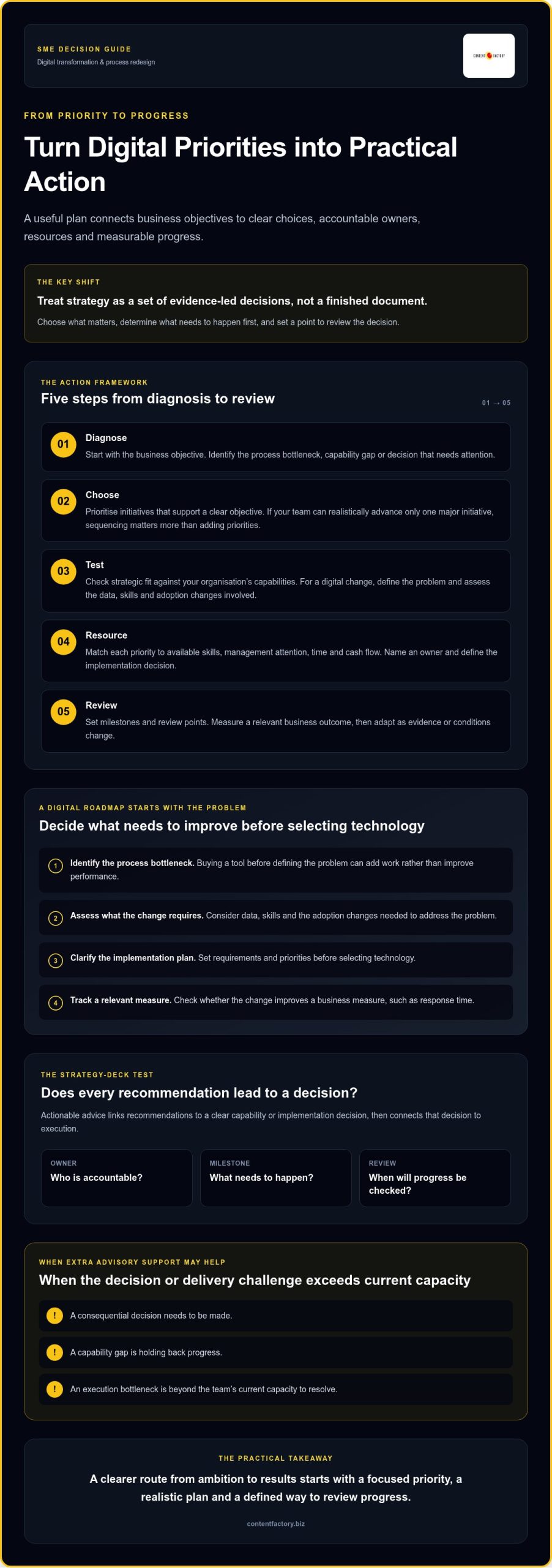
A practical framework for turning growth priorities into action
A useful roadmap is a sequence of decisions, not a wish list. For strategic advisory for business growth to lead to execution, leaders need to connect each initiative to a business constraint or opportunity, test its assumptions, assign resources and review evidence as work progresses.
Prioritise initiatives against evidence and capacity
Use five steps to move from ideas to action:
- Diagnose: Define the business constraint or opportunity, establish a baseline and gather relevant customer, operational or market evidence.
- Choose: Compare initiatives by strategic fit, evidence quality, feasibility, dependencies, downside risk and timing. Record uncertainty instead of treating assumptions as facts.
- Test: Run a focused, limited experiment where possible. For example, validate buyer interest or a process change before committing to a broader rollout.
- Resource: Decide what the initiative requires in budget, staff time, skills and management attention, and name the owner accountable for moving it forward.
- Review: Check implementation progress and business indicators, then continue, adapt, pause or stop based on what the evidence shows.
Separate near-term experiments from longer-term capability investments. An experiment can test a specific assumption. A capability investment may require sustained training, process changes or new ways to measure performance. Focused sequencing helps SMEs protect management attention and avoid spreading limited resources across too many priorities at once.
Fund and govern the work responsibly
Before committing, map expected costs, internal capacity, decision rights, dependencies and delivery milestones. Establish a baseline, then pair leading indicators with outcomes. For a customer-acquisition initiative, leading indicators might include qualified conversations, while outcomes could include conversion or repeat business. For a sustainability priority, track the agreed data and actions alongside the business objective they support.
Grant support may be worth investigating, but it shouldn’t determine whether an initiative makes strategic sense. Confirm current eligibility, application requirements and terms against official Singapore government guidance before including potential support in a funding plan. For emissions measurement, define why the data matters to the business, such as a customer or supply-chain request, before deciding what to measure.
Review progress and adapt the roadmap
Set a review cadence that fits the initiative, and assign an owner to each measure and decision. Compare results with the baseline, surface delivery blockers and revisit assumptions when customer needs, available capacity, evidence or relevant requirements change. A roadmap should preserve direction while allowing tactics to adjust.
For help connecting priorities with practical digital implementation planning, explore ContentFactory’s digital roadmap and implementation planning.
When to bring in strategic advisory for business growth
External support is most useful when a consequential choice has outgrown informal discussion. You may be weighing a new market, facing unclear growth priorities or finding that promising initiatives repeatedly stall because key skills, evidence or management capacity are missing. Strategic advisory for business growth can bring structured analysis and an independent challenge to those decisions, but it isn’t the right first move for every issue.
Signs external strategic support may add value
Consider advisory when leaders need to align teams around competing priorities, test assumptions before committing resources or connect decisions across functions. A digital capability gap may call for roadmap planning. Supply-chain or customer questions about sustainability may make ESG readiness or emissions measurement relevant. A regional opportunity may require a closer look at market-entry readiness. The fit depends on the business question, not the popularity of the topic.
Readiness matters. The SME should be able to state the decision it needs to make, share relevant information and involve people with authority to act on the recommendations. If the challenge is still vague, start with internal discovery: gather customer feedback, map the process causing friction or clarify the outcome leadership wants. If the need is specific, a targeted diagnostic evaluation like those offered at significantbusinessresults.com may be more proportionate than a broad advisory engagement.
How to scope a useful first conversation
Bring a concise picture of the objective, current challenge, evidence available and constraints such as staff capacity, timing or budget. You don’t need a polished strategy document. A clear account of what’s getting in the way is more useful than a long list of disconnected ambitions.
Then ask prospective advisers practical questions:
- What scope would address this challenge, and what would fall outside it?
- What information and access to decision-makers would you need?
- Which responsibilities would your team support, and which would remain with us?
- How would recommendations connect to implementation planning and progress reviews?
ContentFactory is a Singapore-based consultancy with capabilities in ESG readiness and materiality assessments, GHG emissions calculation and carbon accounting, high-intent SEO and content marketing advisory, digital roadmaps and implementation planning, and regional go-to-market execution. These services may suit a defined priority. They aren’t a substitute for legal advice, custom software development or day-to-day operational outsourcing.
If you have a clear challenge but want to test the fit before deciding on a scope, discuss a growth challenge with ContentFactory. A focused conversation can help clarify the question, responsibilities and practical next steps without assuming a particular outcome.
Turn Growth Priorities Into Your Next Practical Move
SME growth doesn’t come from chasing every new trend. It comes from identifying which shifts matter to your customers, choosing initiatives your team can realistically deliver and reviewing evidence before committing more resources.
Keep three principles in view: connect digital, sustainability and market-expansion decisions to clear business objectives; look for advisory that defines owners, milestones and review points, not recommendations alone; and sequence work around evidence, capacity and risk. That’s how strategic advisory for business growth becomes a practical decision-making discipline rather than another document on the shelf.
For Singapore SMEs, the right support depends on the challenge. ContentFactory’s capabilities include digital roadmap and implementation planning, ESG readiness, carbon accounting, high-intent SEO and content marketing advisory, and regional go-to-market execution. The consultancy is led by Mayuresh Godse, a Singapore Certified Management Consultant (SCMC).
Bring your priority, the evidence you have and the constraints your team faces. Discuss your growth priorities with ContentFactory to explore a suitable scope and practical next steps. You don’t need every answer before you begin, just a clear question and a willingness to act on what you learn.
Frequently Asked Questions
What is strategic advisory for business growth?
Strategic advisory for business growth is structured support for choosing, sequencing and executing priorities that advance a business’s objectives. It connects goals with market evidence, organisational capabilities and practical implementation decisions. Useful advisory clarifies assumptions, owners, resources and review points instead of delivering recommendations alone. The scope should fit the SME’s question and capacity, whether it concerns digital planning, sustainability readiness, customer acquisition or expansion into another market.
How can strategic advisory help an SME grow?
Strategic advisory can help an SME focus limited management attention and resources on initiatives that fit its goals and capabilities. An adviser may help leaders compare opportunities, test assumptions, identify dependencies and set measures for tracking progress. Before investing in a new customer channel, for example, a business could assess buyer demand, internal capacity and how it will evaluate lead quality. Advice should support better decisions, not promise a particular growth result.
When should a small business hire a strategic adviser?
Consider an adviser when a consequential decision is approaching, priorities conflict, an important capability is missing or execution repeatedly stalls. External support may also help when leaders need independent challenge or alignment across teams. If the question is still unclear, start with internal discovery, such as gathering customer feedback or mapping a process bottleneck. A narrower specialist assessment may be more suitable when the need is well defined and limited in scope.
What should a strategic advisory engagement include?
A useful engagement should make its scope, objectives, assumptions and responsibilities clear. Ask what diagnosis and evidence will inform the recommendations, how priorities will be ranked, and which decisions or work remain with your team. The plan should identify realistic next actions, internal owners, dependencies and review points. Agree how progress will be assessed before work begins. No single process suits every consultancy, so confirm the proposed approach fits your needs and capacity.
How do you measure whether business growth advisory is working?
Measure both delivery and business outcomes against a starting point. If the priority is B2B demand generation, track implementation progress alongside measures such as qualified enquiries or conversion, using indicators that match your sales process. For an operational initiative, select a relevant measure of efficiency or service performance. Agree who owns each measure and when it will be reviewed. Results can guide whether to continue, adapt or pause, but don’t prove advisory alone caused an outcome.
Can Singapore SMEs use government grants for strategic advisory?
Grant support may be relevant to some business projects, but it isn’t automatic funding for advisory. Whether an SME or project qualifies depends on the current scheme’s official eligibility criteria, application requirements and terms. Check these with the relevant Singapore government source before making a funding decision or starting work. Treat grant support as one possible resourcing consideration, not a substitute for strategic fit, and don’t assume approval or funding will be granted.
Should an SME combine ESG and digital growth planning?
Combine ESG and digital planning when they support connected business objectives, not simply because both are prominent topics. For instance, a company responding to customer or supply-chain questions about emissions may need reliable data processes alongside clear sustainability priorities. Digital planning could help assess the information and capabilities required, but the right approach depends on the business context. First clarify stakeholder needs, applicable expectations and internal capacity, then decide whether an integrated plan is more practical than separate work.

Article by
Mayuresh Godse
Mayuresh Godse is a Singapore Certified Management Consultant and Business Strategist specializing in Sustainability, ESG, AI-driven Digital Transformation, and business growth. Based in Singapore, he writes about Sustainability, Digital Innovation, Business Strategy, and Content Marketing for global audiences.
Disclaimer
This article is provided by ContentFactory for general information only and is not legal, tax, accounting or financial advice. Regulations and government scheme criteria change; grant eligibility and quantum are set by the relevant Singapore agencies and assessed case by case, with no outcome guaranteed. Verify current requirements before acting.