

Most Singaporean firms treat grant applications as a bureaucratic lottery; however, the 2026 funding landscape rewards only those who treat capital acquisition as a high-stakes strategic play. You’ve likely experienced the friction of a rejected Enterprise Development Grant (EDG) application due to poor project scoping or confusion over the mandatory Singapore Certified Management Consultant (SCMC) requirement. It’s a common pain point that stalls growth and leaves available capital on the table while competitors move forward.
Securing professional strategic grant application help transforms these administrative hurdles into catalysts for ESG transformation and market expansion. This guide provides a roadmap to navigate the upcoming transition to the EDGE scheme, ensuring your projects align with national economic goals. We’ll examine how to leverage the enhanced 70% support levels for sustainability and why integrating financial modelling is non-negotiable for approval. You’ll learn to move beyond mere compliance to build a resilient, funded enterprise that dominates the mid-market sector.
Key Takeaways
- Align internal growth objectives with specific government criteria to ensure project feasibility and long-term scalability.
- Engaging a Singapore Certified Management Consultant (SCMC) is a mandatory requirement for high-value Enterprise Development Grant (EDG) projects; don’t risk automatic rejection.
- Secure professional strategic grant application help to leverage enhanced 70% funding rates for sustainability and ESG-led business transformations.
- Use a structured roadmap of diagnostic audits and strategic scoping to prevent the 6-month re-application penalty caused by poor project design.
- Integrate carbon accounting and business process reengineering into a single, cohesive funding strategy that drives measurable ROI.
Beyond Paperwork: Defining Strategic Grant Application Help
Securing strategic grant application help isn’t about administrative compliance; it’s about engineering a project that justifies government investment. Many firms view grants as a passive subsidy. However, authorities evaluate applications based on their ability to drive national economic resilience. You must transform your project from a simple request for funds into a strategic growth catalyst. This involves a fundamental shift from a “subsidy mindset” to a “growth-catalyst mindset” where every dollar requested is tied to a specific, scalable outcome.
While a comprehensive guide to grant writing provides the structural basics, strategic grant application help goes deeper. It identifies hidden funding frameworks like the upcoming EDGE scheme or the Energy Efficiency Grant (EEG) that DIY applicants often overlook. This approach ensures your business goals aren’t just funded; they’re accelerated through precise alignment with national priorities.
To better understand the foundational elements of this process, watch this helpful video:
The Difference Between Grant Writing and Strategic Advisory
Grant writing focuses on the narrative. Strategic advisory focuses on the business case. While a writer might describe your vision, a strategic advisor builds the financial modelling that serves as the backbone of a successful application. This process identifies project risks before they ever appear in an evaluator’s notes. It’s the difference between telling a story and proving a return on investment. Evaluators look for measurable outcomes; they don’t want abstract promises of “better service.” They want data-backed evidence of productivity gains or carbon reduction. By integrating market entry strategy and feasibility studies into the application, you demonstrate a level of preparedness that DIY submissions cannot match.
Common Pitfalls in Independent Grant Submissions
Most DIY applications fail because they under-scope the project. Small, timid goals often lead to rejection because they don’t suggest enough impact to warrant government support. Evaluators want to see structural change, not just incremental tweaks. Consider these common errors that lead to immediate disqualification:
- Inadequate documentation of “Capability Building”: This is a core requirement for the Enterprise Development Grant. If you don’t show how your team’s skills will improve, the grant won’t be approved.
- Lack of ITM alignment: Projects must link to Singapore’s Industry Transformation Maps. If your project doesn’t serve the broader sector goals, it’s seen as a private benefit rather than a national asset.
- Weak financial modelling: Without a clear ROI and a breakdown of qualifying costs, the business case collapses under scrutiny.
Avoiding these traps requires a pragmatic approach to project design. It’s about ensuring that your business process reengineering efforts are documented with the same rigour as your financial statements.
Navigating the Enterprise Development Grant (EDG) Framework
The EDG framework isn’t a menu of isolated choices; it’s a structural blueprint for mid-market resilience. In 2026, the criteria have shifted from simple operational support to demanding high-impact transformation. Core Capabilities now focus heavily on business process reengineering that supports scalability. Market Access pillars require rigorous feasibility studies for ASEAN regional expansion. This level of scrutiny mirrors the complexity found in the federal grant application process, where every claim must be backed by data. Professional strategic grant application help ensures your project isn’t just a request for capital, but a synchronized plan for market dominance.
Sustainability as a Strategic Grant Priority in 2026
Sustainability has moved from a peripheral concern to a central funding requirement. With special enhanced support levels of up to 70% available for green projects until March 31, 2026, ESG Readiness is now a funded necessity. This transformation starts with materiality assessments that identify which environmental and social factors actually impact your commercial viability. You can’t just claim to be “green.” You must integrate carbon accounting into your grant-funded roadmap to meet strict government sustainability quotas. Framing these projects as strategic assets rather than compliance costs is the only way to secure maximum funding.
Innovation and Digital Growth Pillars
Innovation in 2026 goes beyond purchasing off-the-shelf software. The government now prioritizes integrated digital marketing ecosystems that drive measurable commercial outcomes. High-intent B2B lead generation strategies are increasingly viewed as qualifying components of digital transformation projects when linked to productivity gains. To succeed, your application must define a “Productivity Gain” using specific KPIs, such as reduced man-hours or increased revenue per employee. If you don’t quantify these efficiency gains, your EDG claim will likely face rejection.
Securing strategic grant application help allows you to bridge the gap between these innovation pillars and your long-term growth targets. This methodical approach ensures your digital shift results in a resilient, synchronized system rather than a collection of disconnected tools. If your firm needs to align these complex requirements into a winning submission, you can speak with our strategic advisory team to evaluate your project’s readiness.
The ROI of Strategic Advisory vs. DIY Applications
The cost of a failed DIY application extends far beyond the initial administrative time lost. When a submission is rejected, firms face a mandatory six-month wait period before they can re-apply for the same project scope. In the fast-moving 2026 market, this delay results in missed commercial opportunities and stalled digital transformation. Professional strategic grant application help isn’t an overhead; it’s a risk mitigation strategy that protects your most valuable asset: time. By treating the application as a bridge between C-suite vision and operational execution, you ensure that your project is viable, fundable, and ready for immediate implementation.
Beyond immediate approval, a strategic approach sets the stage for future funding rounds. Government evaluators maintain records of past project performance. A successfully executed, well-documented grant project builds the institutional credibility required to access larger capital pools later. Moving from a fragmented DIY process to an expert-led model transforms your capital acquisition into a repeatable, scalable business function.
Why the SCMC Certification Matters
For the Enterprise Development Grant (EDG), engaging a Singapore Certified Management Consultant (SCMC) is a non-negotiable mandate. Enterprise Singapore requires this certification to ensure that consultants possess the technical rigour and ethical standards necessary to guide SME growth. An SCMC-led firm provides professional indemnity and a level of quality assurance that independent writers cannot offer. At ContentFactory, Mayuresh Godse leverages his SCMC status to streamline the approval process, ensuring that every project aligns with the latest regulatory frameworks. This certification serves as a trust-builder with evaluators, signaling that your business case has been vetted by a recognized industry expert.
Quantifying the Value of Expert Project Scoping
Expert scoping prevents “scope creep,” a common reason for claim rejections where the final project outcomes deviate from the approved proposal. Strategic advisors optimize the grant-to-equity ratio, ensuring that mid-market firms maximize their qualifying costs without overextending their internal capital. This precision involves:
- Audit-ready documentation: Establishing tracking systems from day one to ensure seamless reimbursement.
- KPI Alignment: Defining measurable milestones that satisfy government auditors while driving actual business value.
- Risk Assessment: Identifying potential operational bottlenecks that could derail the project timeline.
Securing strategic grant application help ensures your documentation is robust enough to withstand the scrutiny of a final audit. This methodical preparation reduces the administrative burden on your internal team, allowing them to focus on execution rather than paperwork. By optimizing the financial modelling behind the project, you ensure that every dollar of grant support works harder for your bottom line.
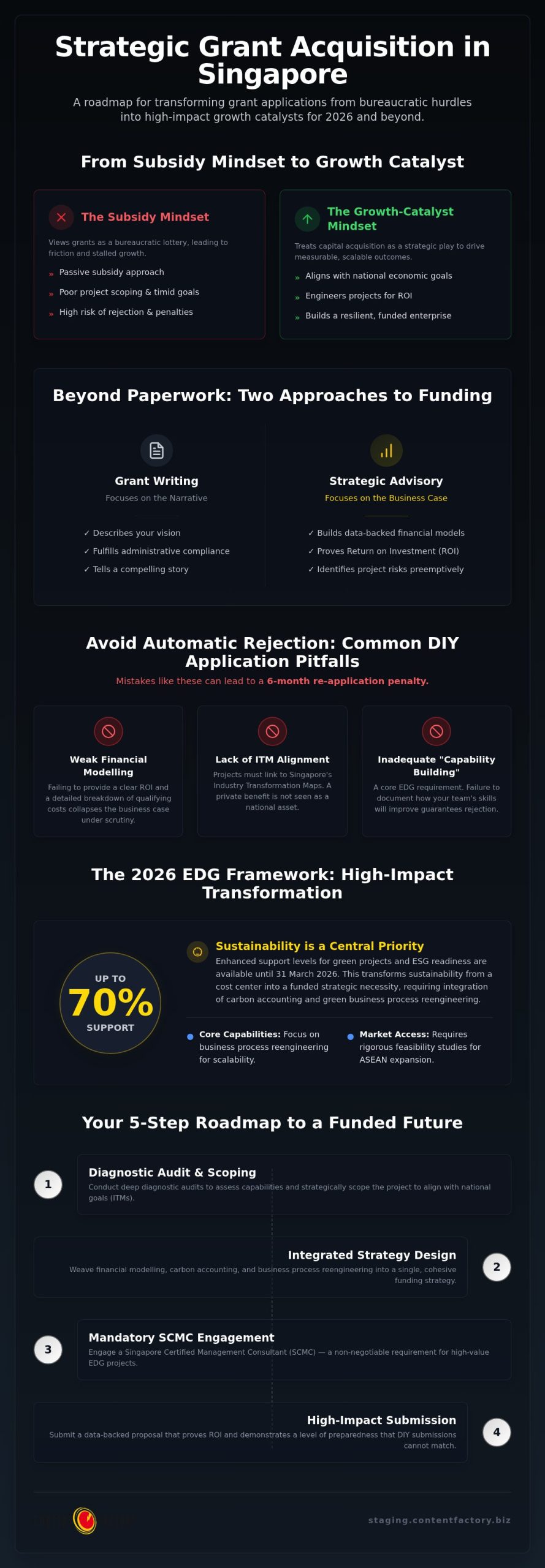
A Roadmap for High-Success Grant Submissions
Winning a grant requires a methodical execution engine rather than a passive wait-and-see approach. It’s not a linear application process; it’s a synchronized strategic roadmap. Securing professional strategic grant application help ensures that every phase, from initial audit to final reimbursement, is engineered for success. This structured approach moves your firm from administrative uncertainty to a position of funded operational strength.
- Step 1: Diagnostic Audit. We evaluate your business readiness to identify specific funding gaps and ensure the project addresses core commercial needs.
- Step 2: Strategic Scoping. We define KPIs that align with national economic goals and Industry Transformation Maps to resonate with evaluators.
- Step 3: Financial Modelling. We project the ROI and cash flow impact to prove the project’s commercial viability and necessity. Learn how robust financial modelling for business expansion transforms complex data into a pragmatic roadmap for capital allocation and funding success.
- Step 4: Application & Negotiation. We navigate the Business Grants Portal (BGP) with technical precision, managing evaluator queries to accelerate approval timelines.
- Step 5: Implementation & Claim Management. We establish tracking systems to ensure every qualifying dollar is accounted for and reimbursed.
Conducting a Pre-Application Diagnostic
This phase assesses the materiality of the project to your core business functions. We identify where internal capabilities suffice and where external expertise is required to meet government standards. A Grant-Ready Project is one that balances innovation with financial viability. By vetting these factors early, we eliminate projects that risk rejection due to poor commercial logic or weak scalability. This proactive vetting saves months of wasted effort on non-viable submissions.
Navigating the Post-Approval Claim Process
Approval is only the first milestone; the actual capital injection depends on successful claim management. The external audit is a mandatory requirement in the EDG claim cycle, and any discrepancy in documentation can lead to significant delays. Common reasons for claim friction include shifting project scopes or inadequately tracked man-hour costs. Maintaining strict compliance during the project execution phase is essential to ensure that your final reimbursement matches the approved grant amount. If you don’t establish these audit-ready systems from day one, you risk losing the very funding you’ve been awarded.
Integrating ESG and Growth into Your Grant Strategy
2026 marks a decisive shift in how Singaporean SMEs access government capital. ESG is no longer a peripheral “nice-to-have” but a core requirement for those seeking the Enterprise Development Grant. With enhanced support levels of up to 70% available for sustainability projects until March 31, 2026, the financial incentive for transformation has never been higher. Securing strategic grant application help allows you to move beyond simple compliance. You’ll transform these requirements into an engine for market differentiation and operational efficiency.
ESG as a Driver for Market Access
Regional expansion within ASEAN now requires transparent sustainability reporting. Large multinational partners and regional investors increasingly demand audit-ready data before finalizing supply chain contracts. ContentFactory simplifies carbon accounting by integrating it directly into your broader grant-funded transformation roadmap. We don’t just report emissions; we use the data to identify process inefficiencies and cost-saving opportunities. This approach aligns your ESG reporting with global standards, turning a regulatory hurdle into a strategic advantage for overseas market entry. This strategy helps you leverage the Market Readiness Assistance (MRA) grant, which provides up to 70% support for overseas expansion until 2029. By combining these frameworks, you secure the capital needed to dominate new markets while maintaining a lean, resilient carbon footprint.
Next Steps: Securing Your Strategic Partner
A grant-funded transformation isn’t a passive project. It requires a partner who functions as an execution engine rather than a mere advisor. When evaluating a consultant, look for specific industry track records and the mandatory SCMC certification. Your leadership team must be prepared for a shift that integrates financial modelling for business expansion, business process reengineering, and sustainability metrics into a single, synchronized system. This isn’t just about filling forms; it’s about building a resilient enterprise capable of scaling in a low-carbon economy. Every project we undertake is designed to move your firm toward a realization of operational necessity, ensuring no wasted space in your growth narrative.
Securing professional strategic grant application help ensures your firm doesn’t just survive the 2026 transition to the EDGE scheme but leads it. By combining ESG readiness with digital growth pillars, you create a business case that is irresistible to government evaluators and regional investors alike. Our team acts as a dedicated, hands-on extension of your leadership, ensuring every project milestone translates into measurable commercial growth. Firms planning cross-border operations should also explore strategic advisory for ASEAN market expansion to navigate the distinct regulatory environments across the region and anchor their growth in Singapore’s favourable tax and grant frameworks.
Contact ContentFactory for a strategic grant diagnostic today
Capitalizing on 2026 Funding Frameworks
The 2026 funding landscape demands a shift from passive compliance to active strategic execution. Securing strategic grant application help ensures your firm doesn’t just fill out forms but engineers a business case that aligns with national economic roadmaps. By integrating ESG readiness and digital transformation into a single, synchronized system, you transform government support into a long-term commercial catalyst.
ContentFactory operates as your pragmatic execution engine. Led by an SCMC-certified consultant, we specialize in navigating the complexities of the EDG and the upcoming EDGE scheme with a results-led approach. We bridge the gap between high-level vision and audit-ready operational reality; this ensures every project milestone translates into measurable scalability and resilience.
Your growth project deserves the rigour of professional advisory to avoid the pitfalls of rejection and re-application delays. With the right roadmap, your enterprise is well-positioned to dominate the mid-market sector and lead the regional transition to a sustainable economy.
Frequently Asked Questions
What is the most common reason for EDG application rejection?
Rejections usually result from poor project scoping and a lack of measurable commercial outcomes. Many DIY applications fail to link the proposed project to Singapore’s Industry Transformation Maps (ITMs) or provide inadequate documentation for “Capability Building.” If your financial modelling doesn’t demonstrate a clear return on investment, evaluators will likely deem the project non-viable. Precision in the diagnostic phase is the only way to avoid these common pitfalls.
Do I really need a Singapore Certified Management Consultant (SCMC) for my grant?
Yes, engaging a Singapore Certified Management Consultant (SCMC) is a non-negotiable requirement for EDG projects. Enterprise Singapore mandates this certification to ensure that firms receive high-quality, ethical advisory that drives genuine business growth. Working with an SCMC-certified advisor like ContentFactory’s Mayuresh Godse provides the technical rigour and professional indemnity required to navigate the Business Grants Portal (BGP) with confidence and secure project approval.
Can I apply for a grant if my project has already started?
No, government grants in Singapore do not provide retrospective funding for projects that have already commenced. You must receive an official Letter of Offer before you sign any contracts, make payments, or start work with external vendors. Seeking strategic grant application help during the planning phase is critical to ensure your project scope meets all eligibility criteria before you commit internal capital.
How long does the strategic grant application process typically take?
The end-to-end process typically spans eight to twelve weeks from the initial diagnostic audit to the receipt of a Letter of Offer. This timeline includes strategic scoping, financial modelling, and the government evaluation period. Expert-led applications often move faster through the Business Grants Portal (BGP) because they anticipate evaluator queries and provide audit-ready documentation from day one, minimizing administrative friction and delays.
What is the maximum funding support available for SMEs in 2026?
As of 2026, SMEs can receive up to 50% funding for qualifying costs under the Enterprise Development Grant. Sustainability-focused projects enjoy an enhanced support level of up to 70% until March 31, 2026. Additionally, the Market Readiness Assistance (MRA) grant provides up to 70% support for overseas expansion, capped at S$100,000 per new market. These levels ensure that firms have significant capital to drive ESG and digital transformation.
Can strategic grant help be used for digital marketing and SEO?
Yes, you can use strategic grant application help to fund high-intent SEO, content marketing, and B2B lead generation when they are part of a larger digital transformation or market entry strategy. The key is to frame these digital activities as tools for measurable commercial growth rather than standalone expenses. We help firms integrate these digital growth pillars into their broader business process reengineering projects to meet strict government criteria.
What is the difference between the EDG and the Productivity Solutions Grant (PSG)?
The EDG is for bespoke, strategic projects that involve business process reengineering or capability building. In contrast, the Productivity Solutions Grant (PSG) is for adopting pre-approved, “off-the-shelf” IT solutions and equipment. While the PSG has a support cap of S$30,000 per financial year, the EDG supports larger, more complex transformations that require professional advisory to align the project with national economic and sustainability roadmaps.
How do I prove the ‘Productivity Gain’ of my project to Enterprise Singapore?
You must prove productivity gains by providing quantifiable KPIs such as reduced man-hours, improved revenue per employee, or faster process cycle times. Enterprise Singapore requires data-backed evidence that the project has fundamentally improved your operational efficiency. We establish these metrics during the strategic scoping phase, ensuring your final claim documentation clearly demonstrates the required gains to auditors, which is essential for successful grant reimbursement.

Article by
Mayuresh Godse
Mayuresh Godse is a Singapore Certified Management Consultant and Business Strategist specializing in Sustainability, ESG, AI-driven Digital Transformation, and business growth. Based in Singapore, he writes about Sustainability, Digital Innovation, Business Strategy, and Content Marketing for global audiences.
Disclaimer
This article is provided by ContentFactory for general information only and is not legal, tax, accounting or financial advice. Regulations and government scheme criteria change; grant eligibility and quantum are set by the relevant Singapore agencies and assessed case by case, with no outcome guaranteed. Verify current requirements before acting.
One thing worth checking on the tool side: if the disclaimer is switched on globally, the grant caveat already written into your Global Writing Instructions will appear as well, so grant articles will carry the same point twice. Remove the required-disclaimer section from the instructions file if you enable this one.