

Your largest enterprise clients no longer care about your “intent” to be sustainable; they only care about your verifiable data. By 2026, supply chain ESG compliance for SMEs has transformed from a corporate social responsibility exercise into a high-stakes barrier to entry. If you can’t provide accurate carbon accounting or materiality assessments, you aren’t just losing a “green” badge. You’re losing your seat at the table to competitors who have their data in order.
We know the frustration of staring at complex GHG Protocol terminology or receiving a consultancy quote that costs more than your annual R&D budget. It’s easy to feel like the system is rigged for the giants. However, you don’t need a massive compliance team to win this. You need a structured, execution-focused plan that leverages Singapore’s robust support ecosystem rather than fighting against it.
This article delivers a pragmatic, grant-aligned roadmap designed to help you meet enterprise ESG demands while protecting your margins. We’ll show you how to unlock Enterprise Development Grant (EDG) funding for up to 70% of your sustainability projects and provide a practical 2026 checklist to maintain your preferred supplier status. It’s time to stop viewing compliance as a cost center and start using it as a strategic moat to secure your future contracts.
Key Takeaways
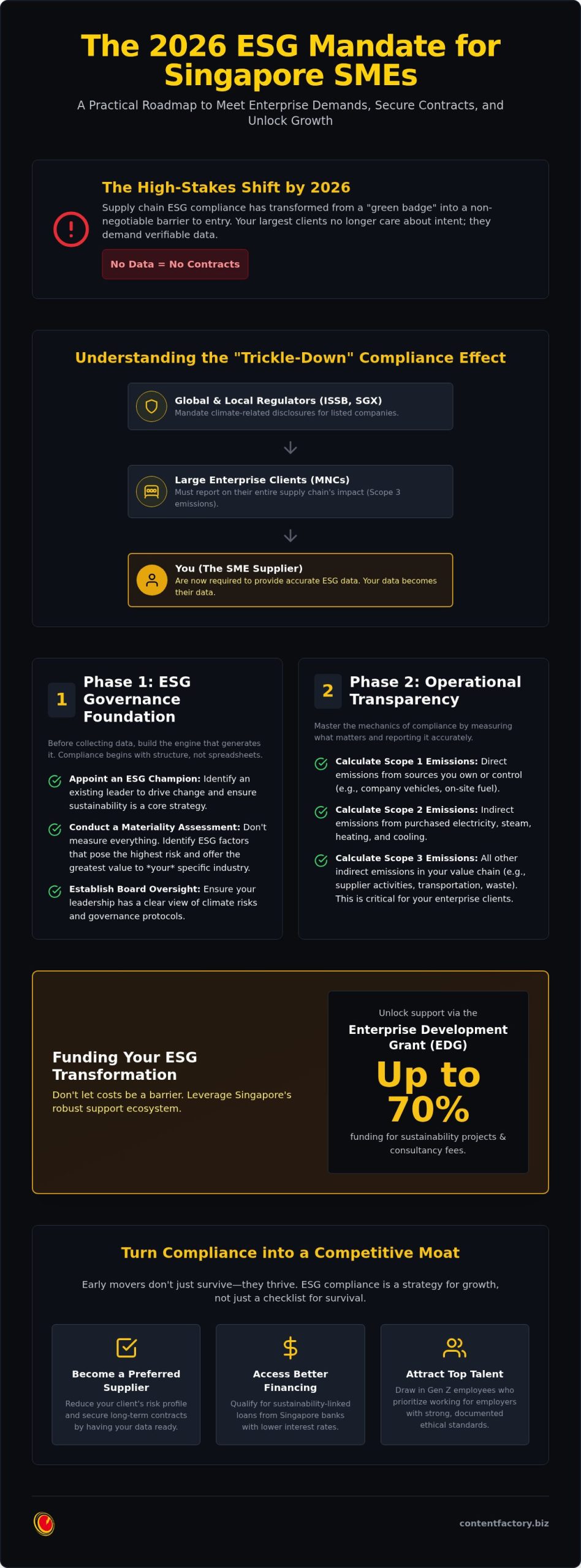
- Understand why MNC reporting mandates are no longer optional and how to decode the “trickle-down” compliance requirements affecting Singapore suppliers in 2026.
- Establish a lean governance foundation by appointing internal ESG champions and conducting focused materiality assessments that identify high-impact risks.
- Master the operational mechanics of supply chain ESG compliance for SMEs by mapping supplier risk exposure and calculating Scopes 1, 2, and 3 emissions.
- Discover how to leverage the Enterprise Development Grant (EDG) to secure up to 70% funding for your sustainability transformation and professional consultancy fees.
- Ditch the 200-page theoretical reports in favor of an execution-ready roadmap that builds a strategic moat around your business.
Beyond “Nice-to-Have”: The 2026 ESG Trickle-Down Effect
For years, sustainability was a buzzword reserved for multinational corporations with deep pockets and dedicated CSR departments. That era is over. By 2026, supply chain ESG compliance for SMEs has shifted from a voluntary “nice-to-have” to a non-negotiable requirement for doing business in Singapore. Large enterprises are now under immense pressure from regulators and investors to report on their Scope 3 emissions, which essentially means they’re responsible for the environmental and social impact of their suppliers. If you’re part of that chain, your data is now their data.
This isn’t just about carbon footprints. True sustainable supply chain management encompasses a broad spectrum of ethics and governance. It’s about proving you don’t use forced labor, showing how you manage waste, and demonstrating that your board has oversight of climate risks. It’s not a theoretical exercise; it’s a rigorous audit of your operational integrity. SMEs that fail to provide this transparency aren’t just seen as “less green”-they’re seen as a liability. In 2026, the risk of “ESG exclusion” is real. You might lose a tender before the price is even discussed because you couldn’t check the mandatory compliance boxes.
The Regulatory Landscape: ISSB and SGX Impact
The shift from voluntary to mandatory reporting in Singapore is driven by the International Sustainability Standards Board (ISSB) frameworks, which have been adopted by SGX. Listed companies must now disclose climate-related risks, and this requirement is rapidly trickling down to non-listed entities. When a large-cap client asks for your emissions data, they’re trying to close their “Materiality Gap.” They need your specific numbers to satisfy their own regulatory filings. If you don’t have a system to calculate these figures, you become a bottleneck in their compliance process. It’s not about your size; it’s about your role in their ecosystem.
The Commercial Advantage of Early Compliance
Don’t view these requirements only as a burden. SMEs that move early to operationalize ESG gain a massive competitive moat. You aren’t just a vendor; you’re a “Preferred Supplier” who reduces your client’s risk profile. Beyond contract retention, there are tangible financial incentives. Singapore banks now offer sustainability-linked loans with lower interest rates for businesses that can prove their ESG credentials. Furthermore, as the local labor market tightens, having a clear, purpose-driven governance structure helps you attract Gen Z talent who prioritize working for employers with documented social and environmental standards. It’s a strategy for growth, not just a checklist for survival.
Phase 1 Checklist: Establishing Your ESG Governance Foundation
Compliance isn’t a data collection exercise; it’s a structural transformation. Before you can report on your carbon footprint or social impact, you must build the engine that generates that data. Establishing supply chain ESG compliance for SMEs begins with governance, not spreadsheets. Without a clear chain of command and a defined scope of impact, your sustainability efforts will remain fragmented, expensive, and ultimately ineffective in the eyes of your enterprise clients.
Your first move is appointing an ESG champion. This doesn’t require a new, high-salary hire. Instead, identify an existing leader who understands your operational floor and has the authority to drive change across departments. This champion’s role is to ensure that sustainability isn’t a side project, but a core component of your business strategy. They’re the bridge between your board’s vision and the daily execution of your sustainability goals.
Governance and Materiality
The biggest mistake SMEs make is trying to measure everything at once. We advocate for a “not this, but that” approach. Don’t waste time on generic metrics that don’t move the needle for your business. Instead, conduct a formal materiality assessment to identify the ESG factors that actually drive value and risk in your specific industry. Achieving holistic ESG compliance requires you to focus on high-impact areas, such as energy efficiency for manufacturers or labor rights for service providers. Board-level oversight ensures these priorities are integrated into your financial planning and long-term roadmap.
Policy Development and Internal Alignment
Once you’ve identified your material risks, you need the paperwork to back up your actions. This means drafting a Supplier Code of Conduct that aligns with international standards like the UN Guiding Principles. Your policies on anti-bribery, human rights, and environmental management shouldn’t be 50-page academic documents. They should be clear, actionable, and shared with every vendor you work with. Training your staff on these fundamentals is critical; if your procurement team doesn’t understand why ESG matters, your policy is just a dead PDF. Communicating your vision to partners early prevents friction when you eventually start requesting their data.
Setting baseline ESG KPIs is the final step of this phase. These metrics must be measurable and realistic. Start with what you can track today, such as electricity usage or employee turnover rates. If you’re struggling to identify which metrics will satisfy your specific clients, an ESG Readiness & Materiality Assessment can help you cut through the noise and focus on what matters. By building this foundation now, you ensure that your business is ready for the technical demands of carbon accounting and supply chain mapping in the next phase.
Phase 2 Checklist: Operationalizing Supply Chain Transparency
Once you’ve established your governance foundation, the focus must shift from policy to practice. Operationalizing supply chain ESG compliance for SMEs requires a granular understanding of your vendor network. You can’t manage what you haven’t mapped. Start by identifying your Tier 1 suppliers, then push deeper into Tier 2 for high-risk categories. This isn’t just a list of names; it’s a risk exposure map that highlights where environmental or social liabilities might be hiding in your production process.
Deploying supplier self-assessment questionnaires (SAQs) is your primary tool for data gathering. However, don’t send a generic 50-page document that your vendors will ignore. Focus on the material factors identified in Phase 1. To ensure long-term success, establish a data collection cadence that aligns with your annual sustainability reporting cycle. This creates a predictable rhythm for both your team and your partners, transforming a one-off scramble into a streamlined, repeatable process.
Carbon Accounting and GHG Protocol
The GHG Protocol is the global standard for carbon accounting. While calculating Scope 1 (direct emissions) and Scope 2 (purchased energy) is relatively straightforward, Scope 3 represents the most significant challenge for SMEs. This category covers emissions generated by your suppliers and the use of your products. You have a choice: stick to manual spreadsheets or invest in automated carbon accounting software. Manual tracking is acceptable for your first reporting cycle, but it lacks the audit trail and scalability that enterprise clients demand. Automated tools reduce human error and provide the verifiable data needed to maintain your status in the global value chain. On the retail and operational floor, similar digitization efforts help reduce recurring material waste; businesses seeking modern digital display solutions can discover ESLtags, Corp. to upgrade from manual paper tags to electronic shelf labels.
Supplier Audits and Remediation
Data on a screen only tells half the story. For high-risk suppliers, you must verify claims through audits. A desktop audit is a cost-effective way to review certifications and policies, but on-site audits are necessary for partners operating in sectors with high labor or environmental risks. If a supplier fails to meet your standards, don’t immediately terminate the relationship. Instead, develop a Corrective Action Plan (CAP) that outlines specific, time-bound improvements. This collaborative approach builds a more resilient supply chain. Finally, integrate these ESG criteria into your procurement and onboarding process. Whether you are engaging licensed trade contractors like A ACME Design for commercial window and glass repairs or evaluating primary material vendors, making proper licensing and standards a prerequisite ensures that your supply chain naturally evolves toward your sustainability goals without constant manual intervention.
Funding Your ESG Roadmap: Leveraging Singapore Government Grants
Compliance is a strategic moat, but building it shouldn’t drain your working capital. In Singapore, the transition from theoretical sustainability to operational transparency is heavily subsidized, provided you know how to structure your application. The Enterprise Development Grant (EDG) remains the primary vehicle for this transformation, offering up to 70% support for qualifying sustainability projects through 2026. This isn’t a passive handout; it’s a strategic co-investment designed to ensure local firms remain competitive in global value chains. By leveraging these funds, supply chain ESG compliance for SMEs becomes an affordable reality rather than a financial burden.
Successfully securing these funds requires more than just filling out a form. Enterprise Singapore (EnterpriseSG) looks for projects that drive systemic capability building. This means your roadmap must demonstrate how you’re integrating ESG into your core business processes, from carbon accounting to supplier risk management. Furthermore, as the new consolidated grant “EDGE” prepares to launch in late 2026, SMEs must act decisively now to lock in current support levels for their sustainability reporting and GHG calculation initiatives.
The EDG Grant for Sustainability
To qualify for the EDG, your company must be registered and operating in Singapore with at least 30% local shareholding. The grant typically covers internal manpower costs, hardware, and professional consultancy fees. However, there is a catch: for any management consultancy project, EnterpriseSG requires the use of a Singapore Certified Management Consultant (SCMC). This certification ensures that your advisor has the technical weight and ethical standing to deliver results that meet national standards. Without a certified partner, your application will likely be rejected before the first audit.
Strategic Advisory vs. Pure Compliance
Don’t fall into the “check-box” trap. Hiring a consultant just to pass a single client audit is a short-term fix that ignores the long-term ROI of sustainability. The most successful SMEs use grants to combine ESG readiness with digital transformation. For example, using the Productivity Solutions Grant (PSG) to adopt carbon accounting software while using the EDG for strategic materiality assessments creates a high-integrity data loop. This approach doesn’t just satisfy an MNC’s Scope 3 request; it identifies operational inefficiencies that, when corrected, directly improve your bottom line. If you’re expanding into ASEAN, the Market Readiness Assistance (MRA) grant can further offset up to 70% of your costs for regional ESG compliance and market entry. To navigate these complex funding requirements, you need expert grant advisory for ESG projects that prioritizes execution over theory.
Scaling Without the Bloat: Why Boutique ESG Advisory Wins
Boutique firms offer a distinct advantage by staying nimble. We don’t hide behind junior associates who are learning on your dime. Instead, you get direct access to senior advisors who understand the specific pressures of the Singapore market. We bridge the gap between high-level strategic authority and grounded, execution-focused energy. It’s not about checking every box in a global manual; it’s about identifying the boxes that actually secure your contracts and improve your financial viability. If you’re evaluating your options, understanding what separates boutique ESG consultants Singapore firms from global giants can help you make a more informed, cost-effective decision for your 2026 compliance roadmap.
The ContentFactory Advantage
ContentFactory provides an end-to-end approach that moves you from initial assessment to grant disbursement. We don’t just calculate your carbon footprint and walk away. Our SCMC-certified consultants ensure your project is structured to meet rigorous EnterpriseSG requirements, maximizing your chances of successful funding. We also offer a unique edge by integrating your ESG wins with high-intent SEO and content marketing. This ensures that once you’ve achieved compliance, your potential clients actually find out about it. It’s a systemic integration of sustainability, digital transformation, and market positioning designed to drive growth, not just satisfy a regulator.
Your Next Steps to ESG Readiness
The 2026 deadline for mandatory reporting is closer than it appears. Waiting for your largest client to demand data before you act is a high-risk strategy that leaves you vulnerable to contract loss. Your transition should start with a clear understanding of where you stand today. A professional gap analysis identifies the specific technical and governance hurdles you need to clear before applying for the Enterprise Development Grant (EDG).
Stop viewing sustainability as an abstract burden. It’s a strategic asset that, when funded correctly, pays for itself through improved efficiency and secured revenue. You can book a consultation today to explore your grant eligibility and define a roadmap that fits your specific industry needs. Don’t let the complexity of the GHG Protocol or the high fees of the Big 4 stop your progress. Secure your competitive edge with a ContentFactory ESG assessment and turn compliance into your most powerful sales tool.
Secure Your Competitive Moat for 2026 and Beyond
The window for treating sustainability as a secondary concern has closed. By now, it’s clear that supply chain ESG compliance for SMEs is the definitive factor for retaining high-value contracts in Singapore’s evolving market. Success doesn’t require over-engineering; it requires a focused governance foundation and a clear roadmap for operationalizing transparency. By leveraging current EDG and MRA support levels, you can transform these regulatory hurdles into a distinct commercial advantage without the overhead of a massive compliance department.
ContentFactory brings over 25 years of strategic consulting expertise to the table, led by SCMC-certified advisors with a proven track record in securing grant approvals. We don’t just hand over a report; we deliver a systemic integration of carbon accounting and materiality that works for your specific operational reality. It’s time to stop reacting to client demands and start leading with data that proves your value. Take the first step today to protect your margins and position your business as a preferred partner in the global value chain.
Start your ESG readiness journey with a grant-eligible assessment
Frequently Asked Questions
Is ESG compliance mandatory for non-listed SMEs in Singapore?
While not a direct legal requirement for non-listed entities in 2026, it is commercially mandatory. Multinational corporations (MNCs) are now legally bound to report on their full value chain impact. If you want to remain a supplier, you must provide the data they need to satisfy their own regulatory filings. Failure to comply often results in being phased out of the tender process entirely.
How much does an ESG readiness assessment typically cost for an SME?
Costs vary based on the depth of your operations and the number of material factors you need to track. Instead of focusing on the upfront fee, consider that sustainability projects are eligible for up to 70% support through the Enterprise Development Grant (EDG). This turns a perceived expense into a subsidized strategic investment that builds long-term capability.
Can I use the EDG grant for carbon accounting software?
The Productivity Solutions Grant (PSG) is the primary vehicle for adopting pre-approved carbon accounting software, offering up to 50% support. The EDG is better suited for the strategic consultancy required to set up your reporting framework and governance structure. Combining these grants ensures you have both the digital tools and the expertise to use them effectively.
What is the difference between Scope 2 and Scope 3 emissions?
How long does it take to become “ESG ready” as a supply chain partner?
Most SMEs can establish a foundational ESG reporting framework within three to six months. This timeline includes conducting a materiality assessment and setting up basic data collection systems. Achieving full operational maturity takes longer, but you can satisfy initial MNC audit requests much sooner by demonstrating a structured, board-approved roadmap.
What happens if my suppliers refuse to provide ESG data?
If suppliers are uncooperative, you can initially use secondary data or industry averages to estimate impacts for your reporting. However, you should eventually integrate ESG requirements into your procurement contracts and onboarding processes. This assertive approach ensures that your supply chain evolves with you rather than becoming a permanent compliance bottleneck.
Do I need a dedicated sustainability officer to manage this?
You don’t need a full-time sustainability officer to start. It is more efficient to appoint an internal “ESG champion” from your existing leadership and partner with a boutique advisory firm for technical execution. This provides boardroom-level strategy and shop-floor grit without the overhead of a permanent new executive role.
How does ESG compliance affect my ability to get bank loans?
Strong ESG credentials directly improve your access to green financing and sustainability-linked loans in Singapore. Local banks are increasingly using sustainability data to lower risk profiles. This often results in more favorable interest rates and higher credit limits for enterprises that can prove their environmental and social governance standards.
Article by
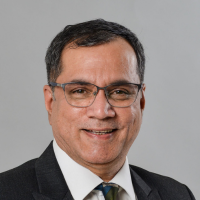
Mayuresh Godse
Mayuresh Godse is a Singapore Certified Management Consultant and Business Strategist specializing in Sustainability, ESG, AI-driven Digital Transformation, and business growth. Based in Singapore, he writes about Sustainability, Digital Innovation, Business Strategy, and Content Marketing for global audiences.
Disclaimer
This article is provided by ContentFactory for general information only and is not legal, tax, accounting or financial advice. Regulations and government scheme criteria change; grant eligibility and quantum are set by the relevant Singapore agencies and assessed case by case, with no outcome guaranteed. Verify current requirements before acting.