

By 2026, the cheapest carbon accounting solution in Singapore will likely become your most expensive line item. While a low-cost software subscription might seem efficient, the hidden price of audit failures and tax overpayment under the new $45 per tonne rate can quickly erode your margins. You’re likely facing significant pressure to manage Scope 3 data while navigating a saturated market of over 50 competing platforms. It’s a high-stakes environment where accuracy isn’t just a compliance goal; it’s a financial necessity.
This guide delivers a pragmatic breakdown of the total cost of carbon accounting in Singapore for the 2026 fiscal year. We’ll move past surface-level pricing to examine the integration of consulting expertise, software scalability, and strategic tax mitigation. You’ll learn how to leverage the Enterprise Development Grant (EDG) to offset up to 70% of your investment before the March 2026 deadline. By the end of this article, you’ll have a clear budget framework to secure audit-ready reports that satisfy MAS and SGX requirements without wasting capital on fragmented solutions.
Key Takeaways
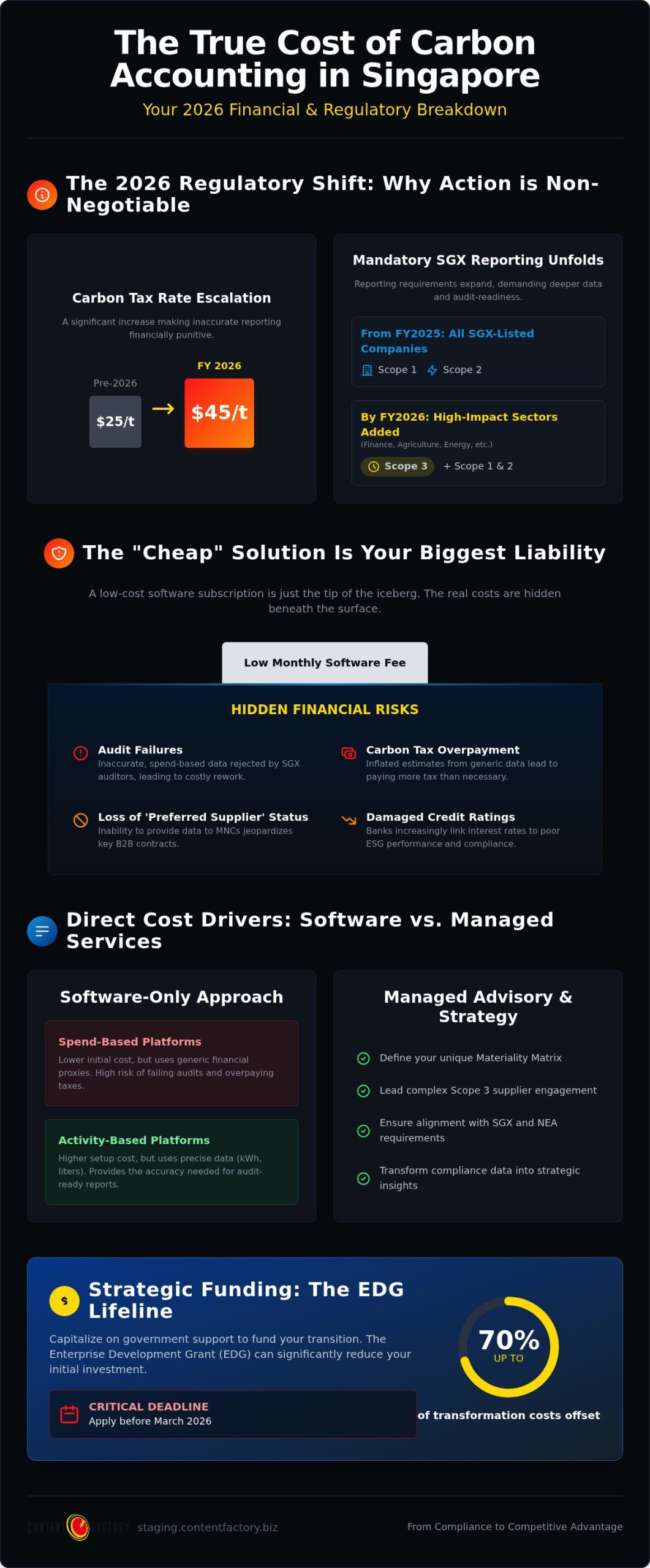
- Prepare for the 2026 regulatory shift as the carbon tax rises to $45 per tonne and mandatory Scope 1-3 reporting takes effect for high-impact sectors.
- Benchmark the total cost of carbon accounting in Singapore by weighing the scalability of software platforms against the precision of managed advisory services.
- Avoid the “overpayment penalty” by ensuring your emissions reports are audit-ready, preventing inflated tax liabilities caused by inaccurate data.
- Capitalize on government support by utilizing the Enterprise Development Grant (EDG) to offset up to 70% of your sustainability transformation costs before March 2026.
- Shift from baseline compliance to strategic growth by using materiality assessments to identify high-impact areas for operational efficiency.
The 2026 Regulatory Landscape: Why Carbon Accounting is Non-Negotiable
Carbon accounting is no longer a niche sustainability exercise. It has evolved into a financial-grade measurement of Greenhouse Gas (GHG) emissions across a company’s entire value chain. This process, formally known as carbon accounting, allows firms to quantify their environmental impact with the same rigor applied to their balance sheets. In 2026, the cost of carbon accounting Singapore businesses face is driven by a rapid shift from voluntary disclosure to strict, audit-ready regulatory enforcement.
To better understand how these measurements are being applied in a local context, watch this helpful video:
The introduction of TR 149:2026, Singapore’s national standard for sustainability reporting, marks a turning point for the local business ecosystem. It establishes a unified framework that demands audit-readiness as the baseline. Any data submitted must be verifiable by third-party auditors to ensure it meets the National Environment Agency (NEA) and Singapore Exchange (SGX) requirements. This isn’t just about “reporting”; it’s about building a defensible data trail that can withstand professional scrutiny.
ISSB S2 and the SGX Mandate
Starting from financial year 2025, all SGX-listed companies are required to report Scope 1 and Scope 2 emissions. By FY2026, those in high-impact industries, such as finance, agriculture, and energy, must extend this to include Scope 3 emissions. This regulatory escalation means that failing to implement robust systems today creates a significant financial liability tomorrow. Non-compliance leads to more than just regulatory penalties. It triggers institutional divestment and damages credit ratings as banks increasingly link interest rates to ESG performance metrics.
The Supply Chain Ripple Effect
While large enterprises face direct mandates, the impact on the mid-market is driven by the supply chain. Multi-national corporations (MNCs) operating in Singapore now require carbon transparency from their vendors to satisfy their own Scope 3 reporting needs. Many SMEs assume they can delay these investments because they aren’t listed on the SGX. This is a strategic error. If you can’t provide granular, audit-ready data, you risk losing “Preferred Supplier” status. Conversely, firms that proactively manage the cost of carbon accounting Singapore offers can position themselves as low-risk partners in high-value B2B procurement cycles. A rigorous supply chain ESG risk assessment is increasingly becoming a prerequisite for maintaining these competitive supplier relationships.
Direct Cost Drivers: Software vs. Managed Advisory Services
Calculating the true cost of carbon accounting in Singapore requires looking beyond a monthly SaaS invoice. Many firms fall into the trap of comparing only licensing fees, ignoring the significant internal resources required to maintain these systems. A pragmatic budget must account for both the digital infrastructure and the strategic expertise needed to transform raw data into an audit-ready disclosure. The total cost of ownership is often influenced by the complexity of your supply chain and the precision of your data sources.
SaaS Platform Pricing Tiers
Subscription models typically scale based on the number of legal entities, users, or specific emission sources. However, the most critical price differentiator is the calculation methodology. Spend-based platforms are often more affordable but rely on generic financial proxies that frequently fail to satisfy SGX auditors. In contrast, activity-based platforms require direct input data, such as kilowatt-hours or fuel liters. While activity-based systems carry a higher implementation cost, they provide the precision necessary to avoid overpaying carbon taxes through inflated estimates.
The Value of ESG Advisory
Software is an execution engine, not a strategy. A platform cannot define your materiality matrix or lead the complex supplier engagement required for Scope 3 mapping. This is where professional service fees for ESG consultants become essential. Engaging a Singapore Certified Management Consultant ensures your reporting framework aligns with MAS requirements and ISSB standards. Strategic support is often eligible for the Enterprise Development Grant (EDG), which can significantly lower the financial barrier for mid-market firms seeking professional guidance.
The most overlooked cost driver is data ingestion. Most ERP systems don’t output sustainability data in a clean, usable format. Your internal team will likely spend hundreds of hours cleaning messy spreadsheets before they ever reach the software. Successful firms often adopt a hybrid model. They utilize SaaS for ongoing data management while hiring advisors to handle the heavy lifting of initial data architecture and annual reporting. If you’re unsure how to balance these investments, you can consult with an ESG specialist to design a cost-efficient implementation roadmap.
Hidden costs also include API integrations and staff training. If your carbon accounting software doesn’t talk to your existing utility portals or logistics trackers, you’ll be stuck with manual data entry. This manual overhead often costs more in salary hours than a premium API integration would. For the 2026 fiscal year, the goal is to automate as much of the data pipeline as possible to ensure resilience and scalability.
The Financial Risk of Inaccuracy: Carbon Tax and Audit Failures
The financial stakes of emissions reporting shift dramatically as we approach the 2026 fiscal year. While the cost of carbon accounting Singapore firms invest in might seem like a compliance burden, the cost of inaccuracy is far higher. Singapore’s carbon tax is legislated to reach $45 per tonne of CO2e for the 2026 to 2027 period. This steep increase transforms carbon from a corporate social responsibility metric into a critical line item on the profit and loss statement that requires C-suite oversight.
Poorly managed data often leads to the “Overpayment Penalty.” Without granular, activity-based accounting, companies frequently rely on conservative estimates that overstate their actual footprint to avoid regulatory friction. A mere 10% margin of error in emissions data can result in an industrial facility overpaying tens of thousands of dollars in annual carbon tax, effectively wiping out the initial savings of a cheaper accounting solution. Precision isn’t just about compliance; it’s about capital preservation.
As regulatory scrutiny intensifies, the distinction between limited assurance and reasonable assurance becomes vital for your budget planning. Limited assurance is a baseline check on reporting processes, while reasonable assurance involves a deeper, more rigorous verification of actual data points. Verification fees vary significantly between Big 4 firms and specialized boutique auditors. However, firms can mitigate these expenses by utilizing the Sustainability Reporting Grant (SRG), which supports companies in producing their first climate-related disclosures. Implementing audit-ready systems from day one ensures that year-end verification is a streamlined exercise rather than a costly forensic investigation.
Audit failures carry significant structural risks. If an SGX-listed firm or a large private enterprise fails an external assurance check, the cost of re-reporting and emergency data cleaning can triple the original project budget. There’s also the reputational damage that complicates future procurement cycles and investor relations. Investing in high-fidelity data structures today is the only way to insulate your business from the escalating financial risks of the 2026 regulatory environment.
Strategic Funding: Leveraging the Enterprise Development Grant (EDG)
Funding the transition to a low-carbon operation is the primary hurdle for mid-market firms. While the regulatory pressure is high, the Singapore government provides substantial financial levers to mitigate the cost of carbon accounting Singapore. The Enterprise Development Grant (EDG) serves as the cornerstone for sustainability-related capability building. It allows businesses to offset a significant portion of qualifying costs associated with carbon footprinting, sustainability reporting, and strategic ESG roadmap development. By utilizing these funds, companies can shift their ESG spend from a pure compliance cost to a subsidized investment in operational resilience.
Maximizing Grant Support Levels
In 2026, the support levels remain a critical factor for project feasibility. Eligible SMEs can access an enhanced support level of up to 70% for sustainability-related projects until March 31, 2026. This enhanced tier is specifically designed to accelerate the adoption of green practices before the next carbon tax hike. To qualify for this funding, projects must be led by a Singapore Certified Management Consultant (SCMC). ContentFactory provides this certified expertise, ensuring that your application meets Enterprise Singapore’s rigorous standards for technical competency and project impact. You can also stack these incentives with the Energy Efficiency Grant (EEG) to fund hardware upgrades identified during your initial carbon accounting phase.
The Grant Application Process
Navigating the Business Grants Portal (BGP) requires a structured approach to avoid administrative delays. A successful application follows a clear, three-step roadmap:
- Phase 1: Project Scoping. We define the technical requirements for Scope 1, 2, and 3 accounting to ensure the project meets ISSB and SGX standards.
- Phase 2: Proposal Development. You receive a detailed project proposal from our certified consultants, outlining specific deliverables, commercial outcomes, and implementation timelines.
- Phase 3: Submission and Approval. The application is submitted via the BGP. Approval cycles typically range from 8 to 12 weeks, making early engagement essential for FY2026 reporting cycles.
ContentFactory acts as your strategic grant advisor and execution engine. We don’t just provide a static report; we manage the entire lifecycle from materiality assessment to final audit-ready disclosure. This hands-on integration ensures that the project isn’t just a compliance exercise but a catalyst for measurable business growth. Our track record in securing EDG approvals allows your leadership team to focus on core operations while we handle the technical complexities of ESG readiness.
Implementation Roadmap: Maximizing ROI on Your ESG Spend
Transitioning from mandatory compliance to commercial performance requires a shift in perspective. Carbon accounting shouldn’t be viewed as a sunk expense. Instead, it’s a strategic tool that optimizes the cost of carbon accounting Singapore firms must bear by unlocking operational efficiencies and market access. A structured roadmap ensures that every dollar spent on ESG readiness contributes directly to the bottom line.
Phase 1: ESG Readiness and Materiality Assessment. Execution starts with identifying which environmental and social factors actually drive business value. We filter out the noise of generic reporting and focus on the metrics that SGX regulators and institutional investors prioritize. This phase prevents “reporting for the sake of reporting,” ensuring your resources are allocated to high-impact areas that improve your risk profile.
Phase 2: Establishing a Carbon Data Baseline. Once the scope is defined, we move to the rigorous collection of Scope 1, 2, and 3 data. This phase builds the audit-ready foundation required to manage your carbon tax exposure. By establishing a precise baseline, you gain the visibility needed to negotiate better energy contracts and identify supply chain bottlenecks that inflate your footprint and your costs. Firms that complement this baseline work with a structured supply chain ESG risk assessment checklist are better positioned to surface Tier 2+ supplier data that would otherwise remain opaque.
We bridge the gap between technical ESG advisory and digital growth. Most consulting firms stop at the report; we focus on the commercial execution. Our “Audit-Ready” guarantee ensures your disclosures meet the highest standards of accuracy, protecting your firm from the reputational and financial risks of audit failure. For a deeper dive into our methodology, see our Carbon Accounting Services SG: A Strategic Guide.
Next Steps for Leadership Teams
The 2026 regulatory deadline is approaching quickly. Leadership teams should prioritize a preliminary carbon gap analysis to identify immediate data deficiencies. This proactive step allows you to secure your EDG funding and begin the implementation process before the March 2026 deadline. Scheduling a consultation is the first move toward transforming your compliance requirements into a competitive advantage. Explore our ESG Readiness Assessment Singapore to begin your transformation.
Securing Operational Resilience for FY2026
The convergence of mandatory climate disclosure and the $45 carbon tax makes reporting precision a financial imperative. You can’t afford to rely on fragmented data or superficial software when the risks involve institutional divestment and inflated tax liabilities. By integrating audit-ready reporting today, you secure your position as a resilient partner in the regional supply chain. Effectively managing the cost of carbon accounting Singapore requires a strategic balance of digital efficiency and specialized consulting expertise.
As Singapore Certified Management Consultants, we specialize in EDG grant advisory and comprehensive Scope 1-3 reporting. Our approach ensures your business isn’t just checking a box but building a foundation for long-term scalability. We bridge the gap between technical compliance and tangible business growth. Start your transition today to turn these regulatory requirements into a commercial engine for your firm.
We’re ready to help you navigate this transition with the precision your business deserves.
Frequently asked questions
Tap a question to read the answer.

Article by
Mayuresh Godse
Mayuresh Godse is a Singapore Certified Management Consultant and Business Strategist specializing in Sustainability, ESG, AI-driven Digital Transformation, and business growth. Based in Singapore, he writes about Sustainability, Digital Innovation, Business Strategy, and Content Marketing for global audiences.