

A sound grant application starts with a defined project, not a funding figure. If you’re assessing the enterprise development grant edg, first check whether the scheme still accepts new applications. Enterprise Singapore consolidated the EDG, MRA and PSG schemes into the EDGE Grant from 30 September 2026. The former EDG is closed to new applications, although existing projects continue to be processed. Check the latest EnterpriseSG guidance before acting on information about the former scheme.
A broad business goal is only a starting point. Define the project’s scope, intended outcomes, costs and supporting evidence, then check the requirements for the current scheme. Applications are assessed, and approval is not guaranteed. Requirements can change.
This guide explains how to make a preliminary fit assessment, turn a business objective into a practical project scope and organise application preparation. It also covers what to verify before proceeding and how to plan for delivery, records and claims without assuming approval.
Key Takeaways
- Check the current scheme before preparing an application. EnterpriseSG consolidated EDG, MRA and PSG into the EDGE Grant from 30 September 2026. Existing EDG projects continue to be processed.
- Use the former EDG criteria only as a preliminary self-check. Verify current company and project requirements with EnterpriseSG; a self-check does not confirm eligibility.
- Define the project need, scope, intended outcomes and delivery plan before assessing potential funding support.
- Check which costs may qualify separately from the support level. Confirm current agency guidance before relying on any rate or cost category.
- Plan for delivery and claims from the outset. Follow the approved project scope, retain cost and outcome records, and verify current requirements before starting work or submitting a claim.
What the Enterprise Development Grant is and what it supports
The Enterprise Development Grant (EDG) was a Singapore government grant administered by Enterprise Singapore (EnterpriseSG). It supported businesses undertaking projects to upgrade, innovate and grow. It was intended for businesses with a defined need and a project that met the scheme requirements, not as an open-ended subsidy for routine operating costs.
There is a key change for businesses considering a new application: EDG stopped accepting new applications on 29 September 2026. From 30 September 2026, support under EDG, MRA and PSG was consolidated into the EDGE Grant. EnterpriseSG continues to process projects already under the former schemes. The right route therefore depends on whether you’re planning a new project or managing an existing EDG project.
For a concise overview of the former grant and its advisory process, see ContentFactory’s EDG advisory guide.
The video below offers additional context on EDG. It may describe the former scheme, so check current EnterpriseSG guidance before relying on it for a new application.
What kinds of business projects does EDG support?
Under the former EDG, projects were grouped into three broad areas: Core Capabilities, Innovation and Productivity, and Market Access. Examples included business strategy or financial management work, process redesign or automation, and projects supporting overseas growth. These categories described broad areas of support; they did not make every activity within them eligible.
The EDGE Grant covers similar broad areas, including Business Strategy, Automation and Digitalisation, and Internationalisation. A project’s label alone does not establish fit. The scope, activities and supporting information must meet the requirements of the relevant scheme.
How does EDG differ from a guaranteed funding offer?
A grant is assessed support, not a promised payment. Submitting an application does not guarantee approval or a particular level of support. EnterpriseSG assesses applications against the current criteria and the information provided about the project.
For an SME, the practical starting point is to define the business need, the work the project will deliver and the intended outcomes. Then confirm whether it falls under an existing EDG application or a current EDGE Grant route. Treat the enterprise development grant edg as a framework for assessing project fit, not as funding to build a plan around before the scope is clear.
Check whether your company and project may fit EDG
Use this as a preliminary self-check, not an eligibility decision. EDG stopped accepting new applications on 29 September 2026. If you’re planning a new project, first identify the current scheme and criteria. For an existing EDG project, verify its approved terms and obligations. The official Enterprise Development Grant (EDG) guidance is a useful reference, but check current EnterpriseSG information before relying on it for a new application.
What should you verify about your company?
Check the current agency requirements for your organisation’s registration, operations, ownership and financial position. Don’t rely on figures from older articles or assume that meeting one condition establishes eligibility. Requirements can depend on the scheme and the circumstances of the application.
Note any uncertainty and resolve it against current EnterpriseSG guidance before investing time in an application. Company-level fit is only one part of the assessment. The project must also meet the relevant requirements.
What makes a project sufficiently defined?
A defined project connects a specific business need to a bounded scope, intended outcomes and clear delivery responsibilities. For example, “improve business capability” is a broad ambition. A stronger description explains what work will be undertaken, who will deliver and oversee it, and what practical change the business intends to achieve.
Keep the proposed scope distinct from routine operations or a general request for ongoing business support. EnterpriseSG assesses the information submitted against the applicable scheme requirements; a project category alone does not establish fit.
Before preparing documents, answer these questions:
- Which current scheme applies, and is this a new application or an existing EDG project?
- What business need is the project intended to address?
- What work is inside the scope, and what falls outside it?
- What outcomes will you use to assess whether the project has delivered its intended change?
- Who is responsible for delivery, oversight and keeping the supporting information?
- Which company or project criteria still need to be checked against current EnterpriseSG guidance?
If your answers are still broad, refine the scope before proceeding. ContentFactory’s strategic grant advisory includes support with project scope, financial modelling and supporting documentation. For help preparing your project, discuss your grant requirements.
Understand EDG support levels and eligible project costs
Support levels and eligible costs are separate questions. A published rate applies only to qualifying project costs under the relevant scheme. It does not mean every cost in a project budget qualifies or that an applicant will receive the maximum.
EDG stopped accepting new applications on 29 September 2026. For applications submitted before that date, EnterpriseSG stated that eligible SMEs could receive up to 50% support for qualifying project costs under the former EDG. This is a historical rate for a closed scheme, not a rate to assume for a new EDGE Grant application.
EnterpriseSG also offered up to 70% support for eligible SMEs undertaking qualifying sustainability projects under the Enterprise Sustainability Programme, from 1 April 2023 to 31 March 2026. That period has ended. Don’t treat the former enhanced rate as current support. Check EnterpriseSG’s latest scheme guidance or the Business Grants Portal for the rules that apply to your project.
Which project cost categories should you check?
Start with the cost categories in the guidance for the applicable scheme. Consultancy fees, software, equipment and manpower may appear in general discussions of grant costs, but a category’s appearance does not make every item eligible. For instance, when budgeting for warehouse machinery from suppliers like Springwell Industries Pte Ltd, applicants must verify whether specific material handling tools qualify under productivity or automation initiatives. The rules can depend on the scheme, project scope and nature of the expense.
For each proposed cost, record what it covers, how it relates to the project and which current rule supports its inclusion. Separate project-specific items from routine operating expenses. Don’t assume a cost is claimable until you’ve checked the relevant requirements. This makes the budget easier to assess without treating a broad cost category as confirmation of eligibility.
How should you interpret an EDG support level?
A published maximum is a ceiling for eligible support, not the amount every applicant receives. “Up to” describes the maximum under specified conditions. The assessed level and qualifying costs depend on the applicable scheme requirements and the project information submitted.
Keep the funding estimate separate from the full project budget. First identify which scheme applies, then verify its support level and map each proposed cost to its rules. The enterprise development grant edg rates refer to a closed scheme. Don’t use them as a basis for a new EDGE Grant budget.
ContentFactory can help organise project scope, financial modelling and supporting documentation through its strategic grant advisory and financial modelling support.
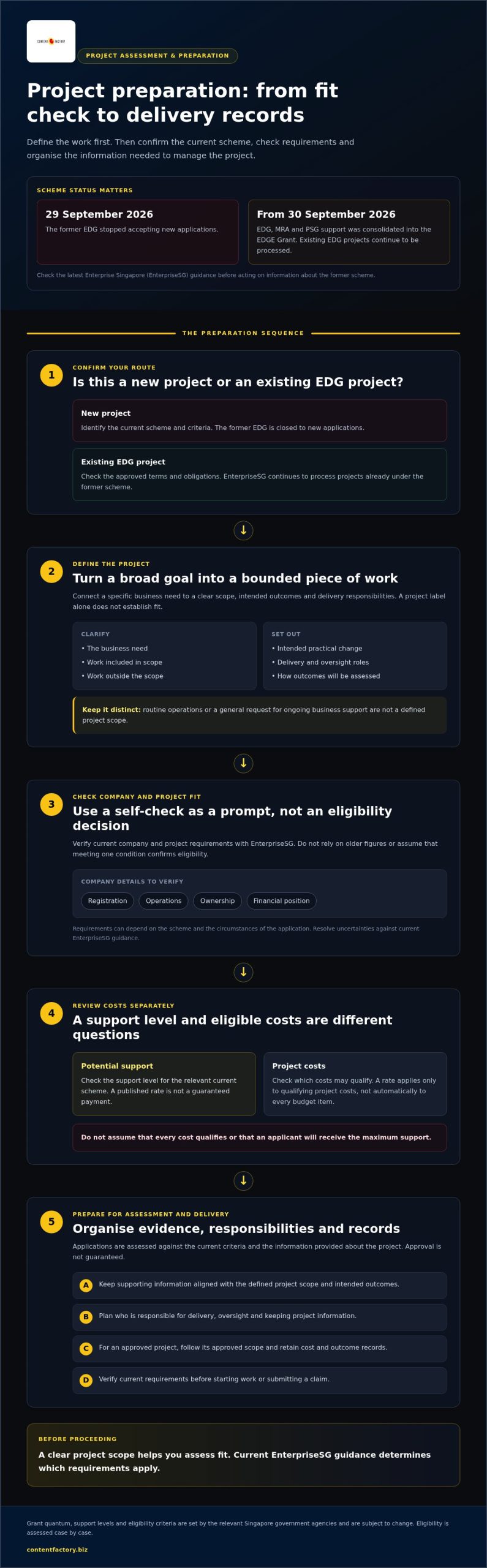
Prepare and submit an EDG application step by step
First, confirm which scheme applies. EnterpriseSG closed the former EDG to new applications on 29 September 2026, with support consolidated under the EDGE Grant from 30 September 2026. The steps below provide a preparation framework for a current application under the applicable scheme, or for understanding an existing EDG project. Follow the latest EnterpriseSG instructions rather than assuming the former EDG process still applies.
What should you prepare before submission?
Start with a concise project summary. Connect the business need to the proposed scope, activities, intended outcomes and delivery responsibilities. A broad ambition is not enough: explain what the project will do and how you’ll assess whether it has delivered the intended change.
For more background on grant preparation, read the EDG advisory for Singapore SMEs.
Use this sequence to organise your preparation:
- Define the project. Set out the business need, work in scope, intended outcomes and delivery plan.
- Build the cost view. Record proposed project costs, the basis for each assumption and how each item relates to the project. Check the current scheme rules for cost eligibility.
- Assemble supporting information. Organise documents that substantiate the project description, costs and company information. Use current agency guidance to identify what is required. Don’t rely on an old checklist or assume a particular form is still in use.
- Confirm the application route. New applications for support consolidated from EDG, MRA and PSG are handled under the EDGE Grant. Check EnterpriseSG’s current instructions and the Business Grants Portal before submitting.
What happens after an application is submitted?
Monitor the official channel and follow EnterpriseSG’s instructions if it requests further information. Don’t treat submission as approval or assume a particular assessment timeline or support amount. The agency makes the decision based on the applicable criteria and information provided.
Keep the stages distinct. An application is assessed first. An approved project must then be delivered in line with its approved terms, and a claim is a separate step with its own requirements. Before starting or changing project activities, check the applicable instructions. Retain project, cost and outcome records to support later reporting or claims in line with agency requirements.
ContentFactory can help organise project scope, financial modelling and application documentation. For support with your grant preparation, Contact Us.
Manage EDG delivery and compliance after approval
Approval is not the end of the grant process. If you’re managing an existing Enterprise Development Grant (EDG) project, keep delivery aligned with the approved scope and the instructions that apply to your project. New applications for the former EDG closed on 29 September 2026. Refer to the terms attached to your project rather than applying current scheme information to an older approval.
How can you keep project delivery aligned with approval?
Use the approved project scope as your working reference. Keep a clear record of key activities, who is responsible for them and how they relate to the intended outcomes. If the project needs to change, don’t assume the change is acceptable or can be handled informally. Follow EnterpriseSG’s stated process and obtain any required direction before proceeding.
Build regular reviews into project management. Compare completed work with the approved plan, note issues and keep relevant correspondence together. This creates a clear account of delivery and helps you identify questions to raise through the agency’s process.
What records help prepare for claims and compliance?
Keep project records as the work progresses, not only when it is time to submit a claim. Depending on the approved project and current agency requirements, relevant records may include:
- Documents describing project activities and delivery progress.
- Invoices, payment evidence and cost records linked to the approved scope.
- Supporting documents requested under the grant’s current claims requirements.
- Evidence of completed work and progress towards the intended outcomes.
- Communications and approvals relating to any changes or clarifications.
EnterpriseSG’s grant disbursement process is reimbursement-based: the company completes the project and pays the costs in full before submitting a claim. This does not mean every submitted cost will be accepted or reimbursed. Verify the current claim requirements, eligible costs, supporting documents and submission process for your project. Retain records in the form and for the period specified by the agency.
Keep the stages distinct: approval sets the project terms, delivery produces the work and records, and a claim is assessed against the applicable requirements. The enterprise development grant edg process does not make a claim outcome automatic.
ContentFactory provides Singapore Government Grant Consulting, including post-approval audit and compliance support, project documentation and compliance preparation. Book a Strategic Consultation.
Build your next step around a clear project
A sound grant plan starts with a defined business need, a deliverable project scope and records that support your costs and outcomes. EDG has transitioned: it closed to new applications on 29 September 2026, with support consolidated under the EDGE Grant from 30 September. Check current EnterpriseSG guidance to confirm the right route and requirements for your project.
Grant support is assessed, not guaranteed. Treat company eligibility, project fit and qualifying costs as separate checks, then plan for delivery and claims before work begins. This gives you a practical basis for making decisions without building your project around an assumed grant outcome.
ContentFactory provides grant advisory, financial modelling and post-approval compliance support. Mayuresh Godse is a Singapore Certified Management Consultant with more than 25 years of consulting experience. To discuss your project preparation in a 30-minute discovery call, use the link below.
Frequently Asked Questions
What is the Enterprise Development Grant?
The Enterprise Development Grant (EDG) was a Singapore government grant administered by EnterpriseSG to support qualifying business projects that build capabilities, improve productivity and support business growth and transformation. Its broad areas included Core Capabilities, Innovation & Productivity, and Market Access. EDG stopped accepting new applications on 29 September 2026, with support consolidated under the EDGE Grant from 30 September. Funding was assessed against agency requirements, not provided automatically.
Who can apply for the EDG in Singapore?
Applicants had to meet the scheme’s company-level requirements and propose a qualifying project. Check EnterpriseSG guidance for requirements relating to registration, operations, ownership, financial position and other applicable criteria. EDG is closed to new applications, so businesses planning a new project should verify the current EDGE Grant requirements. Treat eligibility as a preliminary assessment: EnterpriseSG assesses applications case by case, and approval is not guaranteed.
How much funding can a company receive through EDG?
For applications submitted before EDG closed, EnterpriseSG’s standard support was up to 50% of qualifying project costs for eligible SMEs. EnterpriseSG also offered up to 70% for eligible SMEs undertaking qualifying sustainability projects under the Enterprise Sustainability Programme, from 1 April 2023 to 31 March 2026. That enhanced period has ended. These are historical EDG rates, not current EDGE Grant rates. The amount assessed depended on eligibility and the project.
What costs can the Enterprise Development Grant support?
Eligible costs depended on the scheme rules and approved project scope. Consultancy fees, software, equipment or internal manpower may be cost categories to check, but their inclusion in a general overview does not make a specific expense eligible. Map each proposed cost to current EnterpriseSG guidance and the project activities it supports. Don’t assume an item will receive funding or be reimbursed. Verify the applicable claim rules and documentation requirements.
Can a business start its EDG project before applying?
Project commencement and application timing can affect eligibility. Under the former EDG guidance, the project must not have started before the application was submitted. Contracts, payments or other commitments may be relevant when determining whether work has begun. As EDG is closed to new applications, check EnterpriseSG’s current instructions for the EDGE Grant before committing to project work or costs.
How do I apply for the Enterprise Development Grant?
Start by defining the project need, scope, intended outcomes and delivery plan. Then check the current scheme’s company and project criteria, organise cost assumptions and supporting information, and follow EnterpriseSG’s published application route. The former EDG process used the Business Grants Portal, but EDG no longer accepts new applications. For current support, verify the EDGE Grant instructions and application channel. Submission does not guarantee approval or a particular support level.
What happens after an EDG application is approved?
After approval, deliver the project in line with its approved scope and EnterpriseSG’s instructions. Keep project, cost and delivery records, and check the current claims process before submitting supporting documents. Claims are assessed against applicable conditions; approval does not mean every cost will be reimbursed automatically. Confirm any requirements for changes to project activities through the agency’s stated process, and retain the records required for your project.
Can a grant consultant guarantee EDG approval?
No. A consultant cannot guarantee EnterpriseSG’s decision or claim influence over the agency. Grant advisory can help you organise project scope, financial modelling and supporting documentation. Post-approval support can help with compliance preparation. EnterpriseSG assesses each application against current criteria and the information submitted. Preparation can make your project information clearer, but it cannot promise eligibility, funding or approval for an EDG or EDGE Grant application.
Grant quantum, support levels and eligibility criteria are set by the relevant Singapore government agencies and are subject to change. Eligibility is assessed case by case.

Article by
Mayuresh Godse
Mayuresh Godse is a Singapore Certified Management Consultant and Business Strategist specializing in Sustainability, ESG, AI-driven Digital Transformation, and business growth. Based in Singapore, he writes about Sustainability, Digital Innovation, Business Strategy, and Content Marketing for global audiences.
Disclaimer
This article is provided by ContentFactory for general information only and is not legal, tax, accounting or financial advice. Regulations and government scheme criteria change; grant eligibility and quantum are set by the relevant Singapore agencies and assessed case by case, with no outcome guaranteed. Verify current requirements before acting.