

An ESG assessment should create decisions, not another folder of disconnected data. For Singapore SMEs, a readiness assessment can show which environmental, social and governance issues matter to your business, where the gaps are and who should take the next step. The benefits of ESG readiness assessment for SMEs are practical: clearer priorities, better-informed decisions and actions your team can own.
It’s understandable to worry that an assessment will add work without changing how you operate. A focused review can help organise information you already have and prepare more consistent responses to customer or business-partner questions. The aim isn’t to address every issue at once, but to focus on what’s relevant to your business.
This guide explains how to use readiness findings to clarify priorities, responsibilities and practical next steps. You’ll learn how materiality helps focus effort and how to assess whether the findings can inform decisions, rather than leave you with a report that sits on a shelf.
Key Takeaways
- The benefits of ESG readiness assessment for SMEs start with clearer priorities, evidence and practical next steps, not guaranteed outcomes.
- Map existing information, identify relevant ESG issues, assess gaps and prioritise actions around your organisation’s context.
- Use assessment findings to prepare more consistent stakeholder responses, improve internal visibility and focus your team’s effort.
- Before starting, define the purpose, information available, responsible owners and decisions the assessment should inform.
- Useful findings can guide ESG priorities through readiness, materiality and gap analysis, rather than leaving you with a generic checklist.
Why ESG readiness assessment benefits matter to SMEs
An ESG readiness assessment gives you a structured view of your organisation’s current practices, information, gaps and priorities across environmental, social and governance matters. Its value is practical: it helps you see what is already in place, what needs attention and which decisions require better evidence. The benefits of ESG readiness assessment for SMEs come from that clearer basis for action, not from a guaranteed commercial outcome.
An assessment is not the same as completing every ESG initiative or producing a public sustainability report. It is a diagnostic step. It can help you decide whether further analysis, defined responsibilities or improved records should come next. For Singapore businesses, the relevant context matters; an approach to ESG in Singapore should reflect the organisation and its operating environment, rather than assume one checklist suits every business.
What does ESG readiness mean for a smaller business?
Readiness is about whether relevant practices, responsibilities and information are sufficiently clear to support decisions and respond to reasonable questions. A smaller business may already have workplace safety procedures, staff policies, supplier checks or resource-use records. Yet these may sit with different people, in separate documents, or as informal routines that are hard to explain consistently.
That does not mean the business has no ESG activity. It may mean the evidence is scattered, ownership is unclear or a practice has not been reviewed against the business’s priorities. An assessment brings these elements into view. It also recognises that an SME’s relevant issues depend on its activities, relationships and stakeholder expectations. Priorities and reporting duties are not identical across all SMEs.
Why assess before committing to a long list of initiatives?
Starting with a baseline helps distinguish a material gap from an activity that may be less relevant now. For example, a business might have a policy but no clear record of who maintains it, or useful information that is not gathered in a consistent way. Identifying the actual gap helps you avoid treating every possible ESG topic as an immediate project.
This focus matters when people have limited time and competing responsibilities. A prioritised set of findings can help you decide what to address first, who should own the work and what information is needed to make a sound decision. It can also show where existing processes are useful and where they need clearer documentation. The assessment informs choices; it does not promise savings, new customers or other commercial gains.
To judge whether the exercise is useful, check that its findings connect evidence to decisions. Look for specific observations, clear owners and practical next steps, rather than broad statements that leave you guessing what to do. Findings can inform priorities, but any benefit depends on follow-through: assigning responsibility, acting on agreed priorities and reviewing progress as the business changes. An assessment is a starting point for better-informed action, not an outcome in itself.
How an ESG readiness assessment turns gaps into usable insight
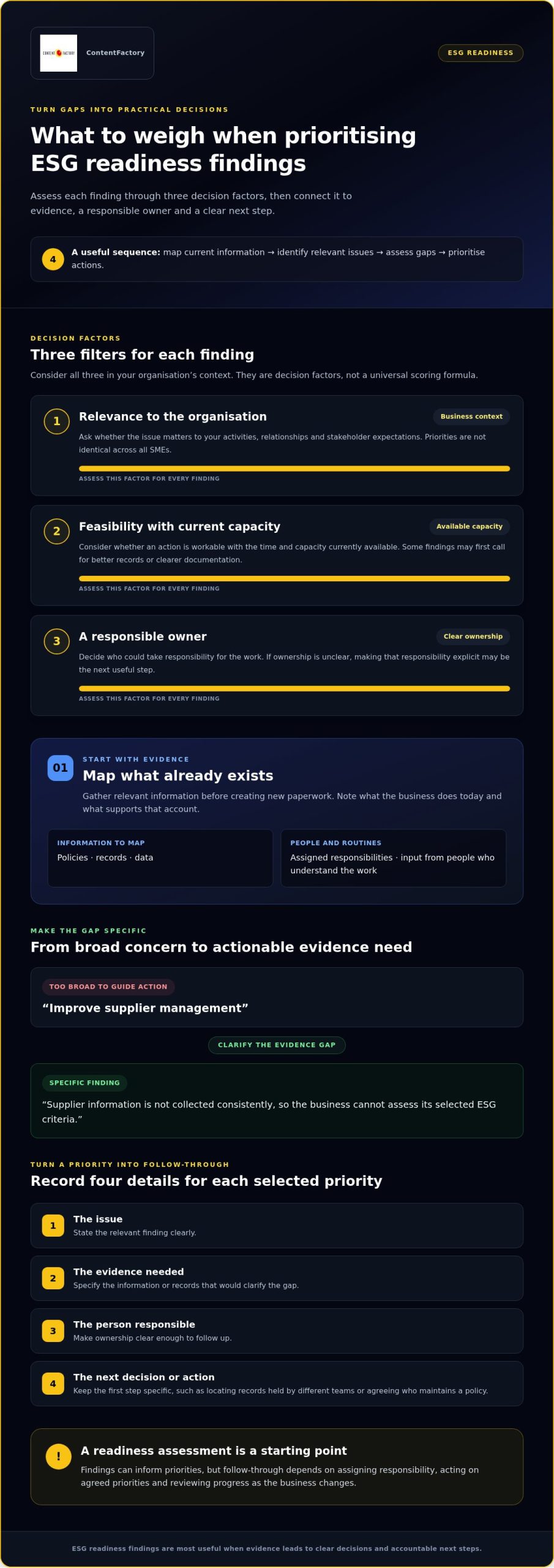
A useful assessment turns a collection of documents, routines and unanswered questions into a sequence your team can act on: map current information, identify relevant ESG issues, assess gaps, then prioritise actions. The sequence is consistent, but the questions and evidence should fit your organisation. A small food manufacturer and a professional services firm won’t have identical operations, stakeholders or areas of focus.
A readiness gap is the difference between your current practice and a relevant objective for your organisation. Naming the difference matters. “Improve supplier management” is too broad to guide action. “Supplier information is not collected consistently, so the business cannot assess its selected ESG criteria” points towards a specific evidence need and a possible owner.
From current-state information to a clear gap picture
Begin by gathering what already exists: relevant policies, records, data, assigned responsibilities and input from people who understand the work. The aim is not to create paperwork for its own sake. It is to establish what the business does today and what evidence supports that account.
A gap analysis then records established practices, partial evidence and areas where information is missing. For instance, a policy may exist, but no one may be assigned to review it. This kind of distinction makes findings more useful than a simple checklist. An ESG readiness gap analysis and strategy can connect documented gaps with the business context and decisions they may inform.
From findings to priorities and accountable next steps
Not every gap deserves equal attention at once. Consider each finding in terms of its relevance to the organisation, whether an action is feasible with current capacity, and who could take responsibility. These are decision factors, not a universal scoring formula. A finding with incomplete evidence may call first for better records, while another may need a policy owner or a management decision.
For each priority, record the issue, the evidence needed, the person responsible and the next decision or action. Keep the first step specific enough to follow up, such as identifying the records held by different teams or agreeing who maintains a policy. Translating selected priorities into an SME ESG strategy can help link assessment findings to implementation without treating every gap as an immediate project. Embedding structured governance frameworks, such as those developed by Elev8 Strategic Partners, can also assist business leaders in maintaining accountability and guiding sustainable operational execution.
This sequence makes the benefits of ESG readiness assessment for SMEs more tangible: findings become usable management information when they show what is known, what remains uncertain and who can move the work forward. You can test the approach internally by choosing one relevant issue and documenting its current practice, evidence gap, owner and next decision. If you need support turning findings into a practical plan, discuss your ESG readiness priorities with ContentFactory.
Which business benefits can readiness work support?
An ESG readiness assessment can support better decisions by giving leaders a more organised view of relevant information, responsibilities and evidence gaps. The benefits of ESG readiness assessment for SMEs are best understood as potential decision-use cases, not assured financial or operational results. The assessment produces findings; customer confidence, employee engagement, financing decisions and business performance are downstream outcomes that depend on your circumstances and what you do next.
That distinction keeps the exercise grounded. A clear finding may help you respond to a customer’s ESG question or decide which internal process needs attention. It cannot guarantee that a customer will choose your business, employees will stay, or a financing provider will make a particular decision. Those outcomes involve factors beyond the assessment itself.
Better-informed decisions and stakeholder responses
A consolidated view can help you answer relevant questions more consistently. If a business partner asks about a policy, practice or piece of ESG information, staff can refer to an agreed record rather than assemble an answer from memory. Similarly, for leaders preparing for due diligence or broader exit planning for business owners, having organised internal documentation helps protect enterprise value and satisfy stakeholder scrutiny. This can also help leaders see where a response is supported by evidence and where further information is needed.
Internally, evidence linked to an owner makes discussion more precise. Instead of debating whether the business is “doing enough”, a team can identify what information exists, who maintains it and what decision remains open. If you communicate ESG claims externally, keep each statement aligned with evidence that supports it; an assessment can help surface where that evidence needs strengthening.
More focused effort and organisational learning
Prioritised findings can direct attention towards relevant actions rather than scattered activity. A business might decide to clarify responsibility for a policy before collecting more information, or improve how existing records are maintained before considering a new initiative. The right sequence depends on the gap, its relevance and the capacity available to address it.
Readiness work can also show where employees need clearer roles or practical knowledge. If a task depends on information held by several people, staff need to understand what they contribute and how it will be used. ESG capability building and training can help develop that understanding, while keeping responsibilities connected to the organisation’s actual priorities.
These use cases are not automatic gains. Clearer answers require maintained records; more focused effort requires owners to act; and improved internal understanding depends on people applying what they learn. Customer, employee and financing outcomes remain context-dependent. The assessment can clarify the starting point and inform choices, but it cannot control how stakeholders respond or guarantee a particular result.
To make the findings useful, connect each priority to a decision your organisation needs to make, the evidence needed and the person responsible for moving it forward. That turns an assessment from a snapshot into a reference for follow-up. If you want to discuss how readiness findings could inform decisions in your business, book a 30-minute discovery call.
How SMEs can judge whether an ESG readiness assessment is useful
A useful assessment helps you make a decision, not just collect observations. Its findings should connect relevant ESG issues to your organisation’s priorities, show what evidence supports each finding and identify who can act on it. The benefits of ESG readiness assessment for SMEs depend in part on whether the outputs give your team a workable basis for follow-up.
Before starting, write down one decision you want the assessment to help clarify. That could be which information to improve first, who should own a particular issue, or how to respond to a relevant stakeholder question. A clear purpose helps you judge whether the scope and findings are useful.
Signs the assessment is connected to real business decisions
Look for a clear line from each finding to an organisational priority and an accountable owner. Useful outputs identify evidence sources, distinguish supported conclusions from information gaps and explain what decision or action could follow. A vague observation such as “improve ESG” gives little direction; a finding that names the missing evidence and the relevant decision gives your team something specific to consider.
No particular format, score or certification makes an assessment useful by itself. Judge it by whether you can use the findings. A simple written record may be more practical than a complex rating if it shows what the organisation knows, what remains unclear and who should review it. ContentFactory’s Singapore ESG readiness assessment approach centres on connecting findings with practical priorities.
Use this self-check before commissioning or reviewing the work:
- Purpose: What decision should the findings help you make?
- Information: What records, policies or data are available, and where are the known gaps?
- Ownership: Who can explain current practices and who could take responsibility for follow-up?
- Use: Which internal decision or relevant stakeholder response should the findings inform?
How to keep the work proportionate to SME capacity
A proportionate assessment focuses on relevant issues and evidence your organisation can reasonably examine. It does not require every possible topic to become an immediate project. Separate urgent information gaps from longer-term improvements, then consider what your team can own alongside its existing responsibilities.
An actionable roadmap makes that distinction visible. It links findings to proposed actions, responsible people and a sensible sequence. A list of observations without owners or order may describe the current state, but leaves the organisation to work out what happens next. Reassessment timing should reflect changes in your business, priorities or information needs; there is no universal interval that suits every SME.
For a practical first step, record the decision you want clarified, the information you already have and the person best placed to explain it. This gives you a concrete basis for judging scope and usefulness. If you want to discuss an assessment suited to your organisation’s priorities and capacity, Contact Us to book a 30-minute discovery call.
How ContentFactory helps SMEs act on ESG readiness findings
An assessment is useful when its findings lead to choices your organisation can own. ContentFactory helps SMEs connect ESG readiness, materiality and gap analysis with relevant priorities and practical next steps. The aim is not to produce a long list of initiatives. It is to help you understand which issues matter in your context, what information supports that view and where attention may be needed next.
From assessment findings to an ESG action plan
ContentFactory’s ESG readiness and materiality assessments can help organise current practices, stakeholder considerations and information gaps into a clearer picture. Gap analysis then helps distinguish what is already in place from areas requiring further attention. These findings can inform ESG strategy and implementation planning, including how priorities relate to available evidence and internal responsibilities.
This work is grounded in your organisation’s circumstances, not a one-size-fits-all checklist. An issue may call for clearer ownership, better information or a more considered decision about next steps. ContentFactory’s ESG readiness and materiality assessment services are intended to support practical execution. They can help structure the work, but they do not guarantee financial, regulatory or stakeholder outcomes. Those depend on the decisions made and actions taken by the organisation.
Senior-led guidance is supported by Mayuresh Godse’s experience as a Singapore Certified Management Consultant, with more than 25 years of consulting experience. This brings a pragmatic focus to interpreting findings and connecting them to business priorities, while keeping recommendations grounded in the evidence available.
What an SME can prepare before a discussion
You don’t need to assemble a perfect ESG file before discussing readiness. A short note can make the conversation more focused. List the ESG questions your organisation is already facing, any relevant policies or information you can readily access, and the decisions you hope an assessment will inform.
It can also help to identify who makes relevant decisions and who currently handles related information or practices. These people may hold different parts of the picture. Their perspectives can help clarify what is known, where ownership sits and what further information may be useful. Preparation is optional; there is no prescribed document set required to begin a discussion.
Bring what you have, including uncertainties. A clear account of the questions, available information and decision-makers gives you a practical starting point. ContentFactory can discuss how readiness and materiality assessment, gap analysis and ESG strategy may fit your organisation’s needs. To explore the next step, Contact Us to book a 30-minute discovery call.
Make your next ESG decision clearer
You don’t need to resolve every ESG question at once. Start with one decision that matters to your business, then identify what information would help you make it with confidence. That small step keeps the work connected to real priorities and gives your team a clear point of focus.
The benefits of ESG readiness assessment for SMEs are most useful when findings shape what happens next. Treat the assessment as a working reference: revisit priorities when your operations, stakeholder questions or available evidence change. This helps keep ESG work relevant without turning it into a disconnected checklist or a promise of results.
If you’re ready to clarify your priorities, ContentFactory can help you consider how an ESG readiness and materiality assessment could support your next steps. Contact Us to book a 30-minute discovery call and discuss a practical starting point for your business.
Frequently Asked Questions
Is an ESG readiness assessment worth it for a small business?
It can be worthwhile if you have a decision to make, a recurring ESG question to answer or uncertainty about which issues deserve attention. The benefits of ESG readiness assessment for SMEs are most relevant when the findings will inform a real business choice, such as what information to gather before responding to a customer. If there’s no clear purpose or plan to use the findings, consider first what you need the assessment to clarify.
Can an ESG readiness assessment help an SME respond to customer questions?
Yes, it can help you prepare a more consistent, evidence-based response. For example, if a customer asks how your business manages a relevant workplace or environmental issue, the assessment can help identify which records or practices support your answer and where information is still missing. It won’t determine how the customer evaluates your response, but it can help your team avoid unsupported claims and know when an answer needs further checking.
Does an ESG readiness assessment mean my business must publish a sustainability report?
No. An assessment is a review of readiness, not a requirement to publish a report or obtain an ESG certification. Whether a business has reporting obligations depends on its circumstances and applicable requirements, so don’t assume the assessment itself creates one. For many SMEs, the findings may be used internally to guide decisions or prepare information for relevant stakeholders without producing a public document.
What information should an SME prepare for an ESG readiness assessment?
There’s no single document set that suits every business. You could start with policies that relate to your operations, existing staff or supplier records, relevant environmental information and any ESG questions you’ve received. Note who holds each item and whether it covers the period or activity in question. Missing information is useful to identify; don’t delay a discussion just because your records aren’t complete.
How is an ESG readiness assessment different from a materiality assessment?
A readiness assessment looks at how prepared your organisation is to manage relevant ESG issues, including its practices, responsibilities and information. A materiality assessment helps determine which ESG topics are most relevant to the organisation and its stakeholders. They address different questions, but can inform each other: understanding which topics matter can help focus the readiness review, while readiness findings can show where information or management practices need attention.
Will an ESG readiness assessment guarantee better sales or access to finance?
No. An assessment cannot guarantee new sales, customer selection or access to finance. It can help you understand what evidence you have and where further work may be needed when responding to a customer or discussing ESG with a financing provider. Those parties make their own decisions, and outcomes depend on factors beyond the assessment. Treat the findings as decision support, not a promise of commercial or financing results.
Article by
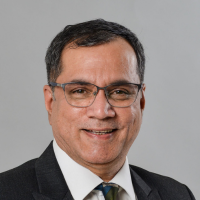
Mayuresh Godse
Mayuresh Godse is a Singapore Certified Management Consultant and Business Strategist specializing in Sustainability, ESG, AI-driven Digital Transformation, and business growth. Based in Singapore, he writes about Sustainability, Digital Innovation, Business Strategy, and Content Marketing for global audiences.
Disclaimer
This article is provided by ContentFactory for general information only and is not legal, tax, accounting or financial advice. Regulations and government scheme criteria change; grant eligibility and quantum are set by the relevant Singapore agencies and assessed case by case, with no outcome guaranteed. Verify current requirements before acting.