

The cost of hiring a digital marketing agency in Singapore depends on the scope of work, channels, strategic input and reporting required. Agency fees and advertising spend are separate budget lines, so the management fee alone won’t show your full investment.
It’s reasonable to want a clear figure before committing, but the cost of hiring a digital marketing agency in Singapore depends on the work involved. Fees are quoted against the scope, channels, content requirements and reporting needs. A lower fee may cover fewer deliverables, while a broader engagement may include strategic guidance and execution.
This guide explains what shapes agency fees, how to separate them from advertising spend, and what to check in the services, reporting and contract terms. It also shows how to compare Singapore agencies by scope and accountability, so you can judge whether a proposal fits your goals and budget, not just whether its headline price looks attractive.
Key Takeaways
- Compare agency proposals by channel, scope and deliverables, not headline fee alone.
- Separate management fees from advertising spend to understand the full budget.
- Use clear deliverables and useful reporting to assess what an agency’s fee covers.
- Review contract scope, fees and duration before committing.
- Match an agency’s approach to your business goals and capacity to manage the work.
Digital marketing costs vary by channel and provider
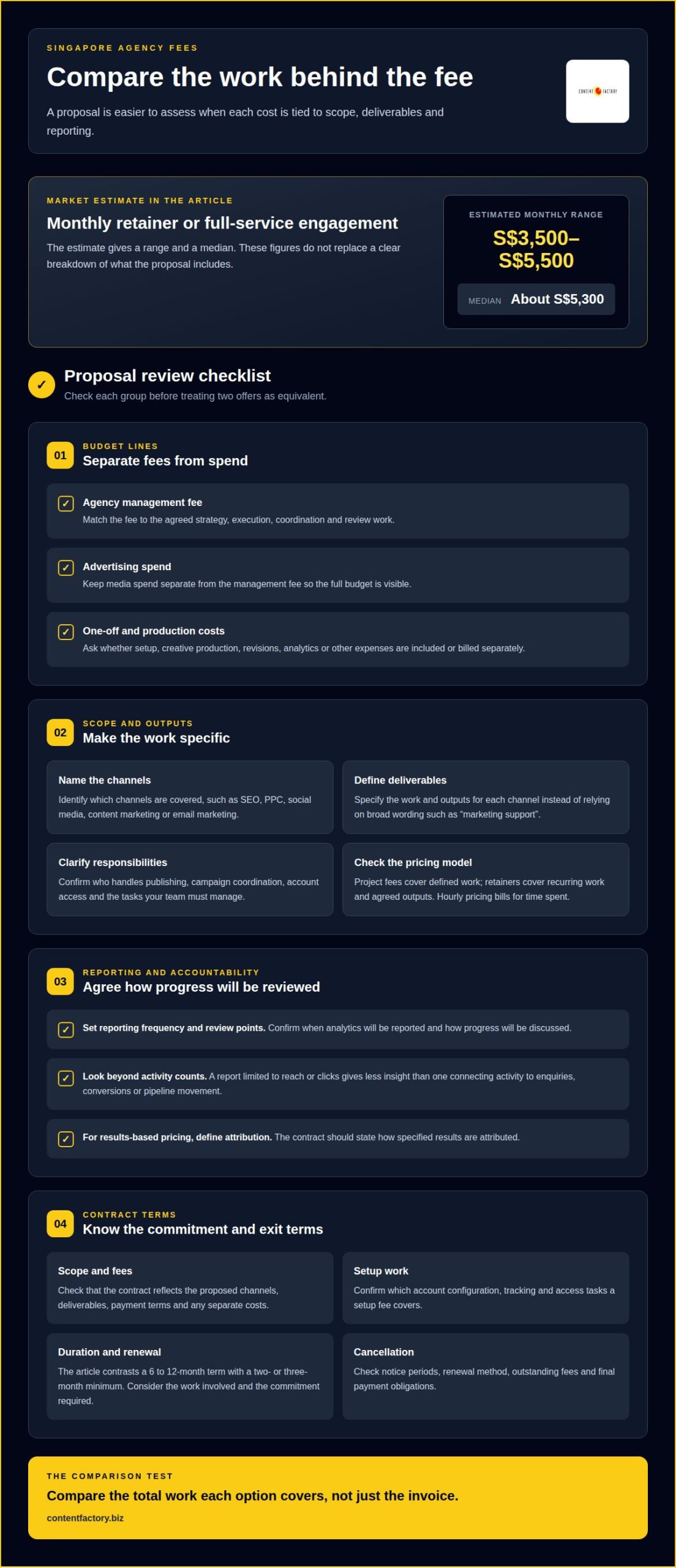
A market estimate puts Singapore agency retainers or full-service engagements at S$3,500 to S$5,500 per month, with a median of about S$5,300.
Agency Retainer Costs in Singapore
A retainer is a recurring fee for agreed marketing work, such as campaign planning, execution and review. It matters because the monthly fee reflects the scope, not a standard bundle shared by every agency. A strategy covering several channels needs different work from a single-channel campaign. Before comparing retainers, map each fee to deliverables, reporting and the work included across 12 months.
Monthly Costs Across Channels
Channel costs vary with the volume and complexity of work. SEO may involve technical analysis and ongoing optimisation; PPC management covers campaign setup and adjustments, while the advertising budget is separate. Social media fees depend on the platforms and publishing workload. Content marketing includes planning and production, while email marketing can involve campaign creation and audience segmentation. For a useful comparison, separate each channel’s management work from media spend and production costs. A Singapore inbound marketing approach can also combine channels around a shared strategy rather than treating each campaign in isolation.
Agency, Freelancer, and In-House Costs
An agency can coordinate multiple channels and specialist tasks, while a freelancer usually covers a narrower scope. An in-house hire gives your business more day-to-day capacity, but also brings salary and employment-related costs. Compare the total work each option covers, not just the invoice. A freelancer’s lower fee, for example, may exclude strategy, reporting or campaign coordination, leaving your team to manage those tasks.
Agency operating costs help explain why retainers differ: delivery requires staff time, tools and coordination. Starting an agency also involves setup expenses, while monthly operating costs continue as work is delivered. These are not additional charges you should assume are included in your proposal. Ask for a clear breakdown of services, advertising spend and any separate production expenses.
Clear deliverables and reporting make agency pricing easier to assess
A proposal is easier to assess when each fee is tied to defined work, deliverables and reporting. Compare the scope and pricing structure before treating two offers as equivalent.
Pricing by Agency Type
The type of provider affects how work is staffed, coordinated and priced. A freelancer may handle a focused task, while an agency can coordinate multiple channels and specialists. Small-business retainers and programmes from established agencies may also differ in strategic depth and account management. A lower quote may cover less work rather than the same service for less.
Common Agency Pricing Models
Project pricing sets a fee for a defined deliverable, such as a campaign plan or audit. A retainer covers recurring work and agreed outputs. Performance-based pricing ties some or all fees to specified results. The structure affects how costs relate to activity and growth. A project may suit a one-off task, while an ongoing campaign needs continued management.
Hourly and Results-Based Pricing
Hourly pricing bills for time spent, monthly pricing covers a recurring scope, and project fees cover agreed work. Results-based pricing links payment to outcomes, so the contract needs clear attribution rules. Task boundaries and time records help keep spending under control.
Look beyond the fee to the deliverables. A social media proposal should identify the platforms covered, publishing responsibilities, campaign coordination and reporting. A report that only lists reach or clicks offers less insight than one connecting activity to enquiries, conversions or pipeline movement. B2B marketing measurement helps frame which outcomes matter.
Before approving a proposal, match every fee to a named output and review how progress will be reported. Check whether revisions, creative production, account coordination and analytics are included or billed separately. This simple scope review exposes gaps between offers and clarifies what your team must manage internally. For a structured review of marketing scope and measurement, discuss your requirements.
Contract terms should define scope, fees and duration
A contract turns a proposal into clear responsibilities, payment terms and exit conditions. Before signing, check it against the actual deliverables, reporting, platforms and advertising spend.
Assess agency performance against agreed goals, not activity alone. Confirm how analytics will be reported, when reviews will take place and how cancellation works, including notice periods and outstanding fees.
Setup Fees and Contract Duration
Setup fees cover initial work needed to prepare an account or campaign, while contract duration sets how long the engagement runs. Separating setup tasks from ongoing work helps you understand the first invoice and recurring commitment. Ask the proposal to identify account configuration, tracking, access requirements and any one-off costs. When comparing a 6 to 12-month term with a two- or three-month minimum, consider how much time the work may need.
Duration should reflect the work, not obscure an exit. Month-to-month or quarterly terms limit the commitment compared with a locked 12-month contract. Check the notice period, renewal method and final payment obligations. If a setup fee appears, confirm which specific tasks it covers and whether it is separate from monthly fees.
Contract Terms and Red Flags
Contract terms define what the agency delivers, what you provide and how either party can end the engagement. Broad phrases such as “marketing support” can leave scope open to interpretation. Specify channels, campaign deliverables, reporting frequency, revision limits, account access and ownership of completed materials. State how changes affect fees and timelines.
A locked 12-month commitment is a red flag if deliverables and cancellation terms remain unclear. The agreement should explain notice requirements, renewal, early termination and payment for work already completed. If the agency handles customer data through analytics or email lists, consider whether the agreement should address data processing. Seek appropriate advice on the terms that apply to your circumstances.
Also distinguish agency fees from your internal employment costs. The CPF Board lists an employer CPF contribution rate of 17 per cent for employees aged 55 and below. That contribution is relevant when comparing an agency engagement with an in-house hire, but it does not form part of an agency retainer. Keep staffing assumptions separate from campaign fees.
Before signing, match each fee to a deliverable, review period and cancellation condition. For example, a monthly fee should identify recurring work, while a separate setup charge should name the initial tasks. Discuss contract scope and pricing if you need help structuring those requirements.
Agency management fees are separate from advertising spend
Yes. Google Ads spend is separate from the agency’s management fee, and setup or reporting may also be billed separately. Singapore GST is 9%, so check whether it appears as a separate invoice line.
For a complete budget, distinguish money paid to Google for advertising from fees for campaign management. The proposal should show each amount and who receives payment.
PPC and Google Ads Management Fees
PPC management fees cover campaign work, while ad spend funds the advertising itself. Increasing the Google Ads budget does not automatically increase the management fee by the same amount. A fee may be fixed or calculated as a share of ad spend. Confirm which method applies, what work it covers and whether Google bills your business directly.
Campaign setup, keyword organisation, bid adjustments and performance reviews are different tasks. A clear quote separates those tasks from the media budget. For digital advertising and B2B lead generation, define the campaign scope and reporting responsibilities before approving spend.
Factors Influencing Agency Fees
Agency fees reflect workload, channel count, campaign complexity and the level of strategic input. One Google Ads campaign for a single audience requires a different structure from several campaigns across multiple platforms. Creative production, landing-page coordination and analytics can also add work. Without a task breakdown, proposals are difficult to compare.
Reporting frequency can affect the engagement too. A monthly summary differs from frequent analysis and optimisation of active campaigns. Ask the proposal to identify who handles each task, which platforms are included and how scope changes affect fees. This ties the quote to actual delivery rather than a broad service label.
Additional Costs for Ads and Services
Additional costs sit outside the agreed management fee. They may include ad spend, setup, reporting or GST. Identify these charges because the retainer alone may not show the full cash requirement. Check whether Google Ads bills your business directly and whether setup or analytics configuration appears as a separate line item.
Reporting may be included in a retainer or priced separately, depending on the agreed scope. The same applies to creative work and additional campaigns. Singapore’s GST rate is 9%; check how GST is shown on the quotation and invoice. Treat it as a separate budget line when calculating the total payable.
Before approving an engagement, add the management fee, planned ad spend and separately listed charges. Confirm the billing route for Google Ads, then compare the expected total with your campaign budget. If you need to discuss how a proposal separates these costs, contact ContentFactory about your advertising budget.
Compare Singapore agencies against your business needs
Choosing an agency is about fit, not just price. Two proposals may name the same channels but assign different work, specialist input and accountability. Assess each against your business goals, internal capacity and desired conversion actions. A Singapore SME seeking qualified enquiries needs a different scope from a retailer focused on online purchases.
Start with the business outcome, then trace each proposal back to it. If you want more qualified enquiries, look for a clear link between campaign activity, lead quality and conversion tracking. If organic visibility is the priority, assess the proposed SEO work and how progress will be reported. Compare how well each plan addresses your actual constraint, not just how many services it lists.
Compare proposals using the same criteria:
- Scope: Identify the channels, campaigns and deliverables included.
- Specialist input: Note who leads strategy, execution and analysis.
- Measurement: Check which conversion events and business outcomes appear in reports.
- Commercial terms: Separate recurring fees, ad spend and additional charges.
- Working model: Clarify your team’s responsibilities, approvals and access requirements.
These checks reveal what a headline fee can hide. One proposal may include campaign planning and analytics, while another covers execution only. A low quote may mean a narrower scope; a higher quote may include more work, but only if those deliverables matter to your business. Compare like with like before deciding.
Also assess how the agency will work with your team. A specialist who can explain why a campaign targets a particular audience gives you a clearer basis for decisions than a list of platform tasks. Ask how learning from one campaign informs the next, and how performance will be tied to enquiries or sales. For a B2B company, lead quality may matter more than raw reach.
Create a comparison sheet based on your business priorities. Record each agency’s scope, responsibilities, reporting measures, fees and exit terms in the same order. Then identify which proposal addresses your biggest marketing constraint without charging for services your team cannot use. This keeps the decision focused on delivery and fit, not presentation style.
For a structured discussion about your agency comparison and business needs, Contact Us.
ContentFactory supports digital marketing strategy and execution
After comparing proposals, decide how to turn your priorities into a workable plan. A clear strategy connects your business objective to channel choices, campaign activity and measures of progress. A business seeking qualified enquiries, for example, needs to track lead quality, not just audience reach.
ContentFactory helps businesses turn strategic direction into execution. Start with your commercial goal, target audience and existing marketing activity. Then translate priorities into a focused plan, with responsibilities and measures aligned to the work. A defined scope keeps activity tied to outcomes rather than spreading effort across channels without a clear purpose.
Before work begins, clarify the decisions that will shape delivery:
- Business objective: Specify the outcome that matters, such as qualified enquiries or online conversions.
- Priority audience: Describe the people or organisations your campaigns need to reach.
- Channel focus: Choose channels based on how your audience discovers and evaluates your offer.
- Measures of progress: Set reporting around meaningful actions, not activity counts alone.
- Internal responsibilities: Identify who supplies information, approves work and follows up enquiries.
These decisions give your marketing work a practical structure. If lead follow-up is inconsistent, more campaign activity may not solve the underlying problem. If your message is unclear, adding channels can make the issue harder to diagnose. A focused plan connects each activity to its purpose and makes review discussions more useful.
ContentFactory’s digital marketing strategy and execution work connects strategic priorities with practical delivery. It can help when your business needs clearer direction, stronger alignment between marketing and commercial goals, or more useful measures of performance.
Bring your priorities and current challenges to a 30-minute discovery call. Book a 30-minute discovery call with ContentFactory to discuss the next step.
Make your next marketing decision with a clear brief
The cost of hiring a digital marketing agency in Singapore is easier to assess when you know what the work needs to achieve. Before taking the next step, write a short brief covering your priority audience, desired commercial outcome and current marketing constraints. This gives discussions a practical starting point and keeps the focus on fit, not activity for its own sake.
ContentFactory supports digital marketing strategy and execution, including SEO and content marketing advisory, digital advertising and B2B lead generation. The right starting point depends on the challenge you need to address, whether that is sharpening your marketing direction or aligning campaign work with business priorities. A focused conversation can help define the scope and identify a sensible next step.
Bring your brief and questions to a 30-minute discovery call. Contact Us to discuss how ContentFactory can support your digital marketing priorities. A clearer starting point makes it easier to move forward with purpose.
Frequently Asked Questions
In-House, Freelancer, or Agency?
Choose the model that covers the work your business needs consistently. An in-house marketer suits organisations that need daily coordination and close product knowledge. A freelancer can be a practical fit for a defined specialist task, such as writing a campaign email. An agency can coordinate several disciplines when work spans strategy, execution and analysis. Before deciding, consider who will manage approvals and follow up leads.
How do I measure whether an agency is working?
Measure whether marketing supports a business outcome, not just whether tasks were completed. For a lead campaign, track qualified enquiries and how many progress to sales conversations. For an online shop, examine completed purchases alongside conversion activity. Agree on attribution before campaigns begin, and use consistent definitions in every review. This helps distinguish useful progress from a rise in clicks alone.
How long does it take to get results from each option?
Timelines depend on the channel and how quickly work can be implemented. Do not treat 3-6 months for SEO or 1-2 weeks for Google Ads as guaranteed timelines; results vary. A freelancer’s timing depends on the task and approval process, while in-house work depends on onboarding and access to internal information. Separate early indicators from longer-term commercial outcomes.
What About Quality, Accountability, and PDPA Compliance?
Set expectations for reviews, responsibilities and customer-data handling before work starts. Agree who approves email copy, who can access customer lists and how account access will be removed when an engagement ends. Make responsibilities clear in the working arrangements, and ensure reports use only data your business is authorised to share.
What do Singapore agencies charge for content marketing and copywriting?
There is no single fee for every content marketing or copywriting brief. Costs depend on format, research depth, subject expertise, revisions and whether planning or distribution is included. A product description differs from a series of technical articles for a specialist audience. Before comparing quotes, define the intended reader, content format, approval process and expected deliverables.
Do Singapore digital marketing agencies charge hourly, monthly retainers, or project fees?
Agencies may price work by the hour, by project, through a monthly retainer or against agreed results. A project fee can suit a defined deliverable, while a retainer fits ongoing campaign management. Hourly work may suit limited advisory tasks, but needs a clear time scope. Results-based arrangements require shared definitions of outcomes and attribution. Choose a structure that matches the duration of the work and how success can be measured.
What factors affect digital marketing agency pricing in Singapore?
The cost of hiring a digital marketing agency in Singapore depends on the work required, not just the channel. Research-heavy content, multiple audiences, technical campaign setup and frequent optimisation all affect workload. Your approval process and the information your team can provide matter too. When reviewing a quote, identify which activities are included and which require further input or a change in scope.
What should businesses compare when choosing a digital marketing agency in Singapore?
Compare how each agency’s proposed work addresses your specific business constraint. If sales teams need better-qualified enquiries, examine how the plan connects campaign targeting with lead follow-up. If your team already has strong execution capacity, consider whether you need strategic direction or specialist support. Assess communication, decision ownership and access to campaign accounts too. A proposal is a better fit when its working model suits your team’s capacity.

Article by
Mayuresh Godse
Mayuresh Godse is a Singapore Certified Management Consultant and Business Strategist specializing in Sustainability, ESG, AI-driven Digital Transformation, and business growth. Based in Singapore, he writes about Sustainability, Digital Innovation, Business Strategy, and Content Marketing for global audiences.
Disclaimer
This article is provided by ContentFactory for general information only and is not legal, tax, accounting or financial advice. Regulations and government scheme criteria change; grant eligibility and quantum are set by the relevant Singapore agencies and assessed case by case, with no outcome guaranteed. Verify current requirements before acting.