

Improving operational efficiency with technology means aligning people, processes and technology to reduce operating costs while maintaining or improving productivity. Technology can support that outcome, but only when it fits the work that needs to get done.
A new system will not fix an unclear process, and disconnected legacy tools can create extra work. The practical question is not simply whether to automate. It is where technology can improve cost, speed or quality without adding operational friction.
This article explains how to assess the factors behind operational efficiency, weigh technology costs and legacy systems, and identify where automation and integration can help. It also shows how to measure changes in speed and quality, keeping decisions tied to business benefits rather than technology for its own sake.
Key Takeaways
- Assess people, processes and technology together before deciding what to automate.
- Weigh technology investment against the operational problem it is meant to solve.
- Identify where legacy systems and disconnected data create avoidable work.
- Use monitoring and continuous improvement to track changes in speed, consistency and quality.
- Connect efficiency improvements to business benefits, then plan digital transformation around clear priorities.
What are the 3 factors of operational efficiency?
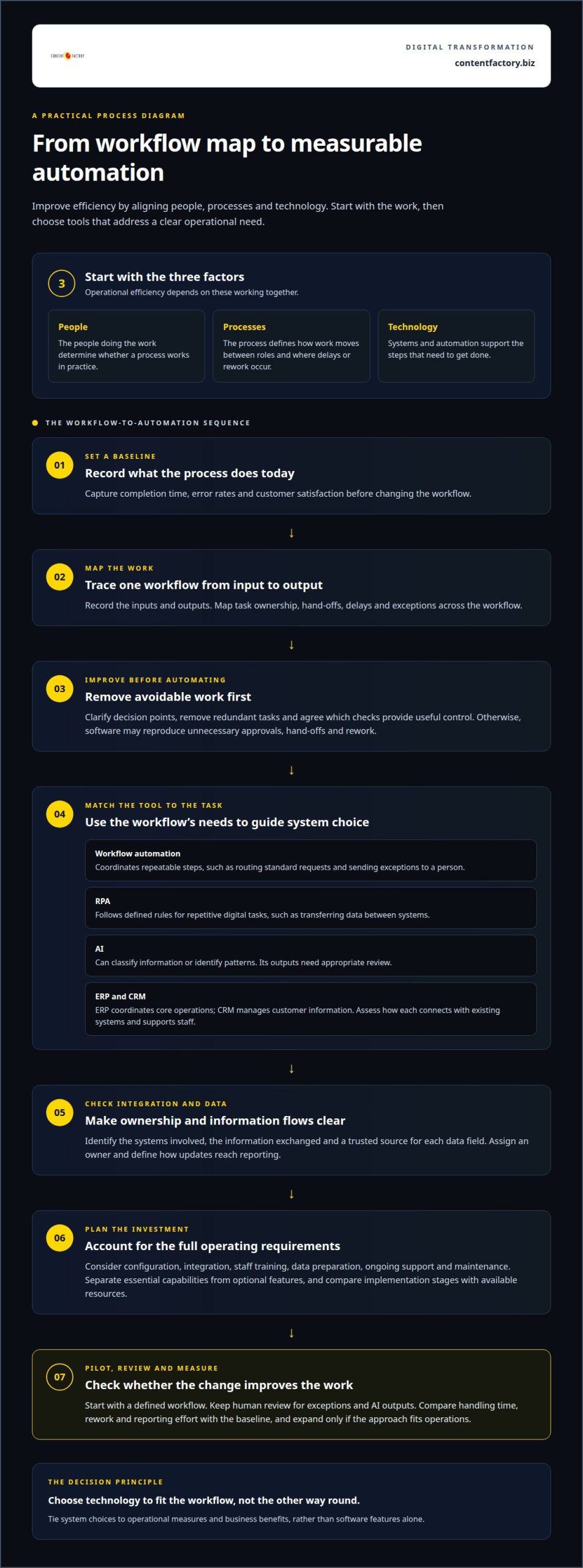
Operational efficiency depends on people, processes and technology working together to control costs while maintaining or improving productivity. Compare ERP, CRM, workflow automation and AI by the problem each is meant to solve: ERP coordinates core operations, CRM manages customer information, workflow tools automate repeatable steps, and AI supports tasks involving analysis or decisions.
Standards offer useful reference points for managing technology. According to the International Organization for Standardization (ISO), ISO/IEC 20000 is a standard for IT service management, while ISO/IEC 38500 is a standard for IT governance. They address different needs: service delivery and oversight of technology decisions.
People determine whether a process works in practice. Processes define how work moves between roles, from receiving an order to resolving a customer request. Technology supports those steps through systems and automation. Before choosing what to improve, a team can record completion time, error rates and customer satisfaction as a baseline.
Optimising Operating Models Before Automation
An operating model defines how people, processes and technology come together to deliver work. Optimise the process before automating it, or software may reproduce unnecessary approvals, hand-offs and rework at greater speed. Map ownership of each step, remove redundant tasks and clarify decision points. For example, a finance team should agree which invoice checks provide useful control before automating invoice routing.
Integrating Process Analysis and Automation
Process analysis helps identify where automation fits by tracing tasks, delays and exceptions. Start with one workflow and record its inputs and outputs. Then distinguish repeatable rules from decisions that need judgement. This makes it easier to choose a suitable tool and measure its effect. An approval workflow, for example, can route standard requests automatically and send exceptions to a person.
Robotic process automation (RPA) follows defined rules to handle repetitive digital tasks, such as transferring data between systems. Artificial intelligence (AI) can classify information or identify patterns, but its outputs still need appropriate review. The tools address different needs: RPA follows instructions, while AI supports tasks involving interpretation. Integrating either with existing systems requires clear process ownership and reliable data.
Choose technology to fit the workflow, not the other way round. ERP and CRM systems manage different operational records; workflow automation coordinates tasks, while AI supports analysis. A business considering technology adoption and system integration can assess how each tool connects with existing systems, supports staff and helps measure results. Start with the process, then match the tool to its requirements.
Initial investment and affordability
Technology investment involves more than purchasing a system. Your business may also need configuration, integration, staff training, data preparation and ongoing support. Map these costs against the process the investment is intended to improve. For example, an automated invoice workflow may reduce repetitive handling, but its value depends on reliable invoice data and staff adoption.
Affordability depends on timing and operational fit, not price alone. Separate essential capabilities from optional features, then compare implementation stages with available resources. An SME might begin with one department’s workflow, track processing time and rework, and expand only if the approach fits its operations. Staging the decision helps avoid investing in a broad platform before the need is clear.
Investor onboarding offers a practical example. Map each step, from receiving investor information to completing internal records and preparing reports. Repetitive data entry may suit automation, while exceptions still require staff review. Before investing, identify the systems involved, the information exchanged and the checks that protect reporting accuracy.
Let reporting needs shape the design. If teams collect the same investor details in separate files, automation may simply create duplicate records faster. Identify a trusted source for each data field, assign an owner and define how updates reach reporting. These steps support continuous reporting while preserving the review needed to keep information complete and consistent.
Generative AI can assist investigations by summarising documents, organising evidence or drafting an initial case narrative. Treat its output as a working aid, not a finding. A practical pilot uses a defined investigation task, approved information, human review and a record of corrections. Measure whether it reduces repetitive preparation while preserving the investigator’s ability to assess context and reach conclusions.
Compare tools by their full operating requirements: implementation effort, integration, staff readiness, support and the cost of maintaining the process. Estimate value through changes in handling time, rework and reporting effort, rather than software features alone. Discuss a structured technology investment plan when you need to connect these operational measures to system choices.
Legacy technology and disconnected systems
Older systems can fragment information and force staff to repeat work. This can lead to delays, inconsistent records and limited operational visibility.
A finance team might enter supplier details separately in accounting and purchasing tools. Staff then reconcile mismatched records manually, while managers wait for a reliable view of commitments. Legacy technology can leave data gaps and require analysts to work across systems that do not communicate. As the need for timely decisions grows, those gaps become harder to manage.
Almost 60% of surveyed CFOs identified data capture and data cleaning as their greatest challenges. That points to a practical issue: adding another tool will not resolve inconsistent records unless the underlying data and system connections improve.
Integrating Systems and Real-Time Data
System integration connects applications so information can move consistently between them. Teams need dependable records to coordinate work and make timely decisions.
An enterprise resource planning (ERP) system can coordinate finance, purchasing and inventory records. When connected systems share clearly defined data, a supplier update can inform purchasing and finance without repeated entry. A data platform and data management tools can help keep core information consistent across systems. This can improve communication between teams and support decisions based on more current records.
Real-time data is useful only when its source and meaning are clear. For example, an operations dashboard should distinguish a confirmed order from a draft record. Before connecting applications, map key data fields, identify their owners and trace how updates flow. This exposes duplicate entry and broken hand-offs, while giving staff a clear way to investigate discrepancies.
Technology Adoption Risks and Support
Adoption risk includes cybersecurity exposure, integration failures and disruption to daily work. Addressing these risks matters because a connected system can spread errors or expose sensitive information if access and data flows are poorly controlled.
In Singapore, assess the data involved, its storage location, who can access it and the obligations that apply before using cloud or AI services. Test integrations with representative records, restrict access by role and define how staff respond to failures. These controls help assess security and compatibility risks before wider deployment.
For example, a business connecting a cloud-based inventory tool to its finance system can test whether updates remain accurate when one system is unavailable. It can also document who handles exceptions and how records are reconciled after service resumes. A structured technology adoption discussion can help clarify system requirements, integration needs and operational priorities.
Consistency, speed and quality improvements
Technology can improve consistency by applying the same approved rules to repeated work. It can also shorten processing time and expose quality issues sooner. Before judging whether a change helps, compare each outcome with a baseline, such as completion time, error rates or rework.
Useful KPIs depend on the process. For a service desk, track mean time to resolution (MTTR), requests resolved and service-level compliance. For production, monitor availability, performance and quality. Compare results over consistent periods and investigate changes rather than assuming automation caused them.
Speed gains are valuable only when quality holds. In one ticket-classification example, AI-based automation reduces MTTR from 6 hours to 2.5 hours. That result illustrates a possible measure, not a universal outcome. A business can pilot classification on a defined request type, review misrouted tickets and adjust its rules before extending the workflow.
Automated testing can also improve release consistency. In a continuous integration and delivery example, post-deployment errors fall from 12% to 2%, while releases rise from 1 per sprint to 3 per sprint. Monitoring both measures matters: faster releases alone could conceal defects if teams stop tracking quality after deployment.
For equipment, overall equipment effectiveness (OEE) combines availability, performance and quality. One example calculates 83.61% from 95% availability, 90% performance and 98% quality. The combined measure helps locate the constraint: low availability points towards downtime, while weaker quality points towards defects or process variation.
Use continuous improvement to act on those findings. Six Sigma applies data to identify root causes, implement changes and monitor whether gains last. If repeated input errors create rework, for example, examine source fields, validation rules and hand-offs. Test a targeted change, then compare the same KPIs afterwards.
Technology supports learning when teams can see what changed and why. Review exceptions, user feedback and process data together; revise the workflow when evidence reveals a new bottleneck. A monthly review can compare processing time, rework and customer satisfaction, while assigning an owner to each corrective action.
Keep measurement focused. Select a speed indicator, a quality indicator and a user or customer outcome for each process. If cycle time improves but error rates or satisfaction worsen, the change has shifted the problem rather than improved performance. Use that signal to adjust the design and monitor the next cycle.
Operational efficiency and its business benefits
Operational efficiency means using business resources to reduce operating costs while maintaining or improving productivity. Technology can help reduce avoidable work and support better operational decisions. For businesses improving operational efficiency with technology, the priority is to connect each tool to a clear operational need.
Defining Operational Efficiency
Efficiency is not simply doing more with fewer people. It means delivering reliable work with less waste. A distributor, for example, might connect order records with inventory data so staff can spot stock discrepancies sooner. This helps the team respond to demand without relying on repeated manual checks.
The business benefit depends on the process and its constraint. If machine downtime interrupts production, preventive maintenance can help identify service needs before a breakdown. If staff repeatedly re-enter customer details, integrated systems can reduce duplication and free up time for work that needs judgement. In each case, technology should address a specific source of delay, waste or error.
Efficiency can also improve service consistency. Documented procedures give staff a shared way to handle recurring tasks, while technology can guide each step and record exceptions. A service team, for instance, could use a workflow to route requests by type, then review cases that need human attention. This clarifies ownership and reduces variation between hand-offs.
Business Benefits and Examples
Operational efficiency creates value when changes improve cost control, capacity or service quality without shifting the problem elsewhere. For example, a Singapore manufacturer using equipment sensors can monitor machine performance and plan maintenance around observed needs. This can help prevent breakdowns, extend equipment lifespan and maintain performance.
In another practical example, a local retailer could connect sales and stock records to identify fast-moving items and replenish them more accurately. That can reduce time spent reconciling separate records and improve the team’s response to changing demand. These are illustrative applications, not claims about a named Singapore company.
Look beyond labour savings when assessing benefits. Faster processing may help a business handle increased demand with existing capacity; fewer defects can reduce rework; and reliable records can support sounder decisions. Employee utilisation should not be driven towards 100%, which is impossible and undesirable. Sustainable gains depend on manageable workloads, clear procedures and staff learning.
A practical takeaway: choose one process, identify its main source of waste, and track a relevant measure before and after a change. Compare output, errors and customer impact, not just time saved. A disciplined approach to improving operational efficiency with technology connects process changes to outcomes the business can assess. Contact Us to discuss how process redesign and technology integration can support your operational priorities.
How ContentFactory supports digital transformation
ContentFactory can help you frame an operational challenge before you commit to a technology decision. This is a useful step when your team has identified friction but needs to clarify the business question behind it.
Start with the outcome your organisation needs, such as clearer information for decisions or a more reliable customer experience. Define what is happening now, who is affected and why it matters. This gives leaders a shared basis for discussing priorities without jumping straight to a preferred tool.
Include the perspectives of people closest to the work. Staff can explain where information gets lost, which tasks create avoidable effort and what a workable change would mean in practice. Management can weigh these observations against business priorities and decide which problem to address first.
A useful discussion distinguishes symptoms from causes. A delay may look like a system problem, but the underlying issue could be unclear responsibilities or inconsistent information. Clarifying the source helps your team decide what to address and what outcome to measure.
ContentFactory supports a practical, business-led discussion about your operational challenge and the decisions ahead. Use it to sharpen the problem statement, surface relevant considerations and identify what information decision-makers still need. The focus stays on your business context, rather than prescribing a tool before the need is understood.
This approach is useful when stakeholders see the same issue differently or a technology proposal lacks a clear link to business priorities. A focused discussion can establish the questions your organisation should resolve before moving ahead.
Bring the operational issue you want to address and discuss the next step with ContentFactory. Book a 30-minute discovery call with ContentFactory.
Turn operational priorities into a practical roadmap
Choose an operational priority and assign it a clear owner. Identify the decision your business needs to make, the teams it affects and the evidence that will guide progress. This keeps transformation focused on business needs rather than an expanding list of technology options.
Improving operational efficiency with technology works best as an ongoing management discipline, not a one-off system change. As your organisation evolves, review whether tools still support how people need to work. Adjust the roadmap as priorities shift, and keep implementation decisions tied to practical outcomes.
ContentFactory helps businesses shape digital roadmaps, plan technology adoption and system integration, and address process redesign and change management. If you are weighing a technology decision or need to turn an operational priority into a structured plan, discuss the next step with the team.
Contact Us to discuss your digital transformation priorities. A focused conversation can help you identify a practical starting point and move forward with clarity.
Frequently Asked Questions
What is Operational Excellence?
Operational excellence is an organisation-wide discipline that makes performance improvement part of everyday management. It connects business priorities with clear accountability, staff involvement and regular review. For example, a manager can discuss recurring service complaints during team reviews, assign responsibility for addressing their causes and track whether the response improves customer experience. The aim is sustained improvement, not a one-off efficiency project or technology purchase.
Which technologies have the biggest impact on operational efficiency?
No single technology has the biggest impact in every business. Process-mining tools can reveal where work takes longer than the documented procedure suggests. Digital forms can reduce incomplete submissions by prompting users for required fields, while workforce scheduling tools can align shift coverage with expected workloads. Value depends on the operational gap, available data and how readily teams can incorporate the tool into daily work.
How can businesses identify processes to automate or digitise?
Prioritise processes by considering business impact, the consequences of errors, customer effects and how often demand changes. A process with costly mistakes may deserve attention even if it occurs less often than routine administration. For instance, a business could compare the impact of errors in supplier approvals with delays in internal expense claims. This directs attention to meaningful operational risks, rather than tasks chosen only because they seem easy to digitise.
What are the steps to implement technology for operational efficiency?
Set up implementation governance before launch: name an executive sponsor, define who owns business data and agree who can approve changes. Prepare a migration plan covering record validation, access permissions and how teams will continue working if a system becomes unavailable. After launch, give staff a way to report defects and clarify who will resolve them. These controls make responsibilities clear beyond the initial deployment.
What are examples of Singapore businesses improving operational efficiency with technology?
An SME might automate one department’s workflow, track processing time and rework, then expand if the approach fits its operations. A business could also connect a cloud-based inventory tool to its finance system, test data accuracy and document how staff should handle failures.

Article by
Mayuresh Godse
Mayuresh Godse is a Singapore Certified Management Consultant and Business Strategist specializing in Sustainability, ESG, AI-driven Digital Transformation, and business growth. Based in Singapore, he writes about Sustainability, Digital Innovation, Business Strategy, and Content Marketing for global audiences.
Disclaimer
This article is provided by ContentFactory for general information only and is not legal, tax, accounting or financial advice. Regulations and government scheme criteria change; grant eligibility and quantum are set by the relevant Singapore agencies and assessed case by case, with no outcome guaranteed. Verify current requirements before acting.