

Choosing between a specialized ESG consultant vs generalist firm starts with the work your organisation needs, not the label on a proposal. A broad ESG brief does not always need a generalist, and a specialist is not automatically the right fit. In Singapore, attention to ISSB-aligned climate disclosures makes clear ESG data, emissions accounting and reporting expertise increasingly relevant.
A generalist firm may offer broad support, while a specialist may bring deeper technical knowledge. But expertise matters only when it translates into a workable scope, practical recommendations and delivery that fits your team’s capacity.
This guide compares the two models across ESG expertise, delivery scope and organisational fit. It shows how to assess proposals against priorities such as ESG readiness, materiality, GHG emissions calculation, reporting and assurance readiness. Compare deliverables, methods and implementation support rather than relying on firm labels alone.
Key Takeaways
- Choose an ESG provider by matching its expertise and proposed work to your organisation’s priorities.
- Compare proposals by checking named expertise, concrete deliverables, ownership and how your team can use the findings.
- Assess whether specialist depth fits the work instead of assuming it is always the better choice.
- Map your needs across assessment, emissions, ESG data, assurance readiness and staff capability before deciding what support to seek.
- Start with the ESG decision or requirement that prompted your search, then define the practical next step.
Specialized ESG consultant vs generalist firm: what is the difference?
A specialised ESG consultant centres its work on environmental, social and governance issues. A generalist firm advises across broader management areas and may include ESG within a wider scope. Neither label proves that a team has the right expertise or delivery approach. The useful comparison is whether the proposed work addresses the ESG outcome your organisation needs.
That outcome might be understanding current ESG gaps, setting priorities through a materiality assessment, calculating emissions, preparing ESG data or building internal capability. These needs call for different work. A broad organisational review may provide useful context, but it may not offer the technical depth needed for emissions accounting or assurance readiness.
Start by stating the decision or requirement that prompted your search. Then define what you need to understand, produce or put into practice. This keeps the provider decision grounded in the work itself. ContentFactory’s ESG consulting in Singapore can cover readiness, emissions, data and capability needs, based on the defined scope.
What does an ESG specialist typically address?
A specialist may assess ESG readiness, identify gaps, support strategy and clarify which issues are material to your organisation and stakeholders. The scope could also include GHG emissions calculation, carbon accounting, assurance readiness or ESG data processes. These areas are related, but each has distinct deliverables. A clear proposal should show which needs it covers and how the work will lead to practical next steps.
Subject knowledge does not guarantee a particular business result. Its value lies in a well-scoped assessment, sound analysis and recommendations your team can use. Agree what the engagement will deliver and which decisions remain with your organisation.
What does a generalist firm bring to ESG work?
A generalist may bring a broad management perspective that helps connect ESG priorities with wider organisational questions. That breadth is neither proof of weakness nor evidence of ESG depth. Review the people assigned to the work, their relevant experience and how the proposed approach fits your requirements.
Check whether the scope names concrete outputs, such as a gap analysis, emissions calculation or readiness recommendations, and explains how your team can use them. The right fit is the team whose expertise and delivery match the work, not the firm with the broadest or narrowest description.
Compare ESG consultants by expertise, deliverables and implementation
A proposal can sound technically strong and still leave you unclear about what your organisation will receive. Compare each option against the same criteria: who will do the work, what they will deliver, who will use the findings and what support follows the assessment. This makes the decision about fit rather than labels.
ESG project fit is the match between your defined scope, the team’s relevant expertise and deliverables your organisation can use.
- Expertise: Identify the people assigned to the work and the ESG topics they will address. Look for experience in the specific areas you need, not broad claims of capability.
- Scope: Check that the proposed assessment or gap analysis responds to your needs. If emissions accounting or assurance readiness is relevant, confirm that the work is clearly described rather than implied.
- Outputs: Establish what you will receive, such as findings, prioritised recommendations or a practical roadmap. A report may describe gaps without helping your team decide what to do next.
- Ownership and use: Clarify who will review the findings and how the outputs will inform decisions and subsequent ESG actions. Define implementation support separately from assessment work.
Which ESG outputs should your proposal make clear?
Start with the outcome you need. A readiness review should identify the assessment scope and the gaps it is intended to examine. Include emissions accounting or assurance-readiness work only when it matches your organisation’s needs. For each output, establish who will receive it, which decisions it should support and whether follow-on guidance is included.
ContentFactory’s ESG readiness, gap analysis and strategy support connects assessment with a practical roadmap.
How can you distinguish specialist depth from specialist jargon?
Ask the proposed team to explain how its approach connects analysis to the decisions your organisation needs to make. For example, a useful emissions assessment should clarify its scope and how the information will inform next steps, not simply introduce technical terminology. Look for a clear method and relevant outputs, rather than unsupported credentials or promised results.
You do not need to force every ESG requirement into one engagement. Verdantix’s discussion of the ESG and sustainability consulting market describes organisations combining broad advisory support with specialist input for particular projects. If more than one team is involved, specify ownership and hand-offs. To clarify your ESG scope, contact ContentFactory to discuss a 30-minute discovery call.
Does an ESG specialist offer enough breadth for your organisation?
Specialisation is useful when it matches the work, but it is not automatically the best choice for every organisation. A business with a defined emissions calculation may need focused technical expertise. Another may need several connected ESG workstreams brought together in a practical sequence.
Specialist depth fits when a priority requires focused ESG expertise and defined outputs. Broader advisory coverage matters when several connected ESG needs must be coordinated.
That breadth can remain within ESG. You might begin with a readiness assessment, identify material issues, calculate emissions, strengthen ESG data processes and prepare for assurance. These activities can form a connected scope without adding unrelated services. Define the stages you need and how each output will inform the next.
When is specialist ESG support a strong fit?
Focused support can suit a specific, bounded requirement. A readiness assessment can identify gaps and priorities. Carbon accounting can establish a clearer basis for tracking and reporting emissions. If assurance readiness is the concern, the work can focus on preparing ESG information and data processes for scrutiny. Each engagement should state its scope and usable outputs.
If your organisation is still defining its priorities, an ESG readiness assessment can help clarify which areas need attention before you commission more specific work. Specialist support fits when the expertise addresses a defined need, not simply because ESG appears in the firm’s name.
When might a broader advisory perspective matter?
A broader perspective can help when your organisation has several connected ESG needs to coordinate. Readiness findings, for example, may point to gaps in emissions data and staff understanding. The scope could connect assessment, carbon accounting and capability building, with clear ownership for each output. Breadth here means coordinating relevant ESG work, not adding unrelated services.
Assess the ESG team and its proposed scope. Who will lead each workstream? How will findings from one stage inform another? What will your team receive and be expected to do? These answers reveal more than a firm label. For SMEs, a phased scope can clarify internal responsibilities and help avoid commissioning work the organisation is not ready to use.
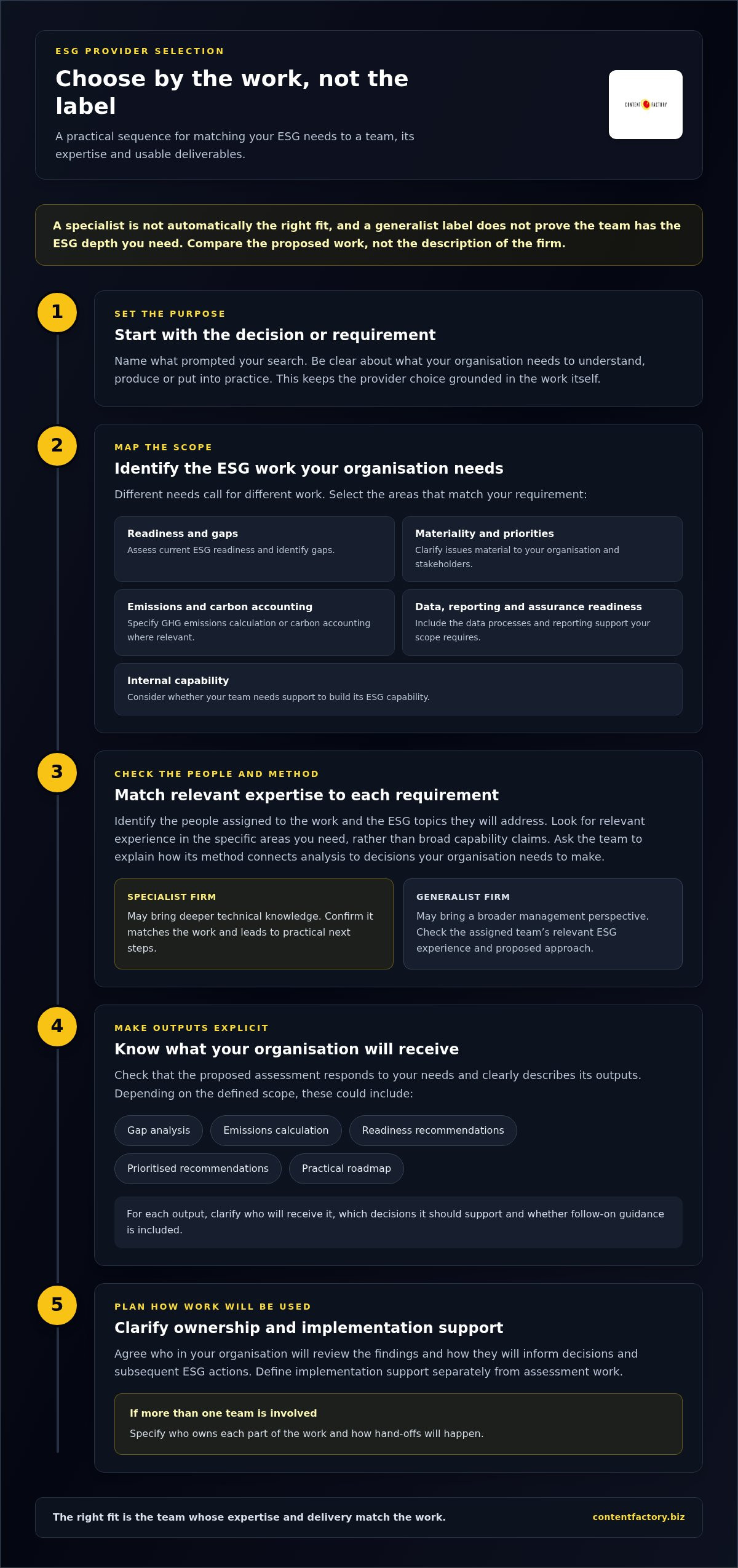
Use this ESG consultant selection framework before you decide
Before comparing proposals, write down what triggered your search. A clear starting point makes it easier to assess each option against the same organisational need, rather than different sales language.
How should you define the work before comparing firms?
Draft a short brief before speaking with consultants. It does not need to set technical benchmarks. It should explain the question you want answered, the ESG topics to cover and the decisions the findings should support.
- State the trigger: Identify the requirement or decision behind the search, such as understanding current ESG gaps or clarifying which information your organisation needs to prepare.
- Set the boundaries: List the ESG areas in scope, such as readiness, materiality, emissions, ESG data, assurance readiness or staff capability. Mark topics outside the immediate work.
- Record what you have: Note relevant data, existing assessments and internal owners. Flag gaps or constraints so the proposed approach reflects your starting point.
- Separate now from later: Distinguish the immediate assessment from possible follow-on priorities. A staged scope lets you review findings before deciding what further ESG work is needed.
If you are still defining the starting point, this ESG readiness assessment guide can help you consider what an assessment should clarify.
What should you evaluate in a proposal?
Use the same written checklist for every proposal. This keeps differences in terminology from obscuring differences in scope. Compare how each team will conduct the work, who will lead it and how its approach addresses your brief.
- Methodology: Does the proposal explain how the team will assess the topics in scope and identify relevant evidence?
- Expertise: Are the people assigned to the work and their relevant ESG experience clear?
- Outputs: Are the deliverables named and tied to decisions your organisation needs to make? Look for clear findings, recommendations or a roadmap where these are part of the agreed scope.
- Responsibilities: Are assumptions, exclusions, data needs and your team’s responsibilities stated plainly?
- Knowledge transfer: Does the proposal explain how findings will be shared with the people who need to act on them?
Finally, separate assessment from implementation. A proposal may identify priorities without including support to carry them out. Record what is included, what is excluded and which decision you will make once the findings are available. For help defining an ESG scope and next steps, contact ContentFactory.
How ContentFactory supports ESG work from readiness to action
The choice should come back to your defined need, the proposed outputs and your internal capacity. ContentFactory structures its ESG support around those factors: clarify the starting point, identify gaps, then set a practical direction for the work. The scope can reflect your organisation’s priorities rather than assume every ESG service is needed at once.
Explore ContentFactory’s ESG consulting services to see how readiness, emissions, assurance readiness, data and capability-building support can address different requirements.
What ESG support can ContentFactory provide?
ESG readiness, gap analysis and strategy can establish what needs attention and inform a practical roadmap. Where the scope calls for it, GHG emissions calculation and carbon accounting address emissions data, while assurance readiness focuses on preparing relevant ESG information and processes for scrutiny. ESG data integration and automation can support the management of ESG information, and capability building can help staff understand their roles.
These are distinct areas, not a bundle every organisation needs. The right scope depends on your priorities, available information and the decisions your team needs to make.
What is the next step for your organisation?
Before a discussion, write down the ESG question you need answered, the information you already have and the decision the work should support. This gives the conversation a useful starting point and helps define a scope that reflects your needs and capacity. ContentFactory provides senior-led ESG advisory for SMEs and mid-market companies.
Mayuresh Godse is a Singapore Certified Management Consultant with more than 25 years of consulting experience. Discuss your ESG priorities and possible next steps in a 30-minute discovery call with ContentFactory.
Choose support that moves your ESG priorities forward
Your choice comes down to the work your organisation needs, the expertise assigned to it and whether the deliverables will help your team act. Compare proposals against the same brief. Look for a clear scope, relevant experience, defined outputs and practical next steps, not a firm label alone.
Start with the ESG question that prompted your search. Then decide whether you need readiness and gap analysis, emissions accounting, assurance readiness or capability building. You can phase these needs rather than commission work your organisation is not ready to use.
ContentFactory supports ESG work from readiness and strategy through to relevant emissions accounting, assurance readiness and capability building. Mayuresh Godse is a Singapore Certified Management Consultant with 25+ years of consulting experience. To discuss your priorities and possible next steps, book a 30-minute discovery call. Book a Strategic Consultation
Frequently Asked Questions
What is the difference between a specialised ESG consultant and a generalist firm?
A specialised ESG consultant focuses its work on ESG, while a generalist firm advises across broader areas and may include ESG in its scope. Neither label proves that the assigned team has the expertise or delivery approach your organisation needs. Assess the proposed team, scope and usable outputs. A readiness assessment, for example, should clarify what it examines and which decisions its findings can inform.
When should a business hire a specialised ESG consultant?
Consider specialist support when your organisation has a defined ESG need that calls for focused expertise. This could include identifying readiness gaps, calculating GHG emissions, preparing for sustainability assurance or building staff capability. Define the question you need answered and the output you need, then assess whether the proposed experience and method fit. Specialist support is useful when it matches the work, not simply because the provider uses an ESG label.
Can a generalist consulting firm provide ESG expertise?
Yes. A generalist firm may have relevant ESG expertise, but its broad scope alone does not establish that. Assess the people assigned to your work, their experience with the ESG topics in scope and how their approach will address your needs. The proposal should make clear what the team will deliver, who will lead each workstream and how findings will be used. Judge the specific team and engagement rather than assuming generalists are unsuitable or fully equipped.
How do you assess an ESG consultant’s practical experience?
Assess how the consultant translates ESG analysis into defined outputs and decisions. Ask them to explain the proposed method, the information they will need and how they will present findings to your team. For example, an emissions engagement should specify its scope and outputs. Look for clear explanations that connect technical work to your organisation’s next steps, rather than relying on credentials or terminology alone.
What should an ESG consulting proposal include?
An ESG proposal should set out the business need, work scope, methodology, assigned expertise and named deliverables. It should also state assumptions, exclusions, required information and your organisation’s responsibilities. Check whether the engagement includes only an assessment or also a roadmap, knowledge transfer or implementation support. If emissions accounting or assurance readiness is proposed, the proposal should explain why it fits your priorities and what your team will receive.
Is an ESG specialist the right choice for an SME?
An ESG specialist can be a good fit for an SME when the expertise and scope match its priorities and internal capacity. Your organisation may need a focused readiness review, emissions accounting, assurance readiness or staff training rather than a broad engagement covering every ESG topic. Define the immediate decision first, then compare the proposed outputs and responsibilities. A clear, phased scope can help you address current needs before deciding on further ESG work.
How can a business tell whether an ESG engagement is too broad or too narrow?
An engagement may be too broad if it includes ESG topics without linking them to your organisation’s needs, decisions or capacity. It may be too narrow if it delivers analysis but leaves essential findings, recommendations or next steps unclear. Compare the proposal with a written brief that lists the question, topics, outputs and internal owners. Confirm what is included and excluded, and whether the agreed work will give your team enough information to act.
Article by
Mayuresh Godse
Mayuresh Godse is a Singapore Certified Management Consultant and Business Strategist specializing in Sustainability, ESG, AI-driven Digital Transformation, and business growth. Based in Singapore, he writes about Sustainability, Digital Innovation, Business Strategy, and Content Marketing for global audiences.
Disclaimer
This article is provided by ContentFactory for general information only and is not legal, tax, accounting or financial advice. Regulations and government scheme criteria change; grant eligibility and quantum are set by the relevant Singapore agencies and assessed case by case, with no outcome guaranteed. Verify current requirements before acting.