

The most comprehensive ESG framework may be the wrong starting point for your SME. Choosing among ESG reporting frameworks for SMEs is less about adopting the longest checklist and more about matching what you disclose to your stakeholders, material topics and available evidence.
It’s understandable if the options feel difficult to compare. GRI, IFRS Sustainability Disclosure Standards and other frameworks serve different purposes, while customers, lenders and investors may ask for overlapping but not identical information. For Singapore businesses, reporting requests linked to larger companies’ climate disclosures can add another layer, without necessarily making a full reporting framework the right fit.
This guide compares the main frameworks and explains the audiences and reporting needs they address. You’ll learn how to choose a proportionate starting point, when a combination may make sense, and how to avoid collecting data you can’t reliably support.
We’ll also connect framework selection to ESG readiness and materiality, so your first step builds a credible reporting process rather than a pile of unsupported claims.
Key Takeaways
- ESG reporting frameworks for SMEs serve different audiences and purposes, so start with the information your stakeholders actually need.
- Compare ISSB, GRI, SASB, ESRS and BRSR by reporting context, material topics and intended use, not by framework name alone.
- Balance the breadth of disclosures against your team’s capacity to collect reliable, supportable ESG data.
- Before choosing a reporting format, record stakeholder requests, your reporting purpose and any stated boundaries.
- Connect framework selection to ESG readiness and materiality to build a practical reporting approach that can develop with your business.
Why ESG reporting frameworks matter for SMEs
An ESG reporting framework is a structured way to organise and disclose information about a business’s environmental, social and governance topics. It provides shared topics and guidance for deciding what to report, helping an SME move from scattered data and ad hoc answers to disclosures that can be prepared consistently.
That structure can save effort, but it isn’t a shortcut to compliance. A framework is not a law, an ESG rating, a certification or an assurance opinion. Ratings assess performance using their own methods; certifications and assurance involve separate processes. Choosing a framework alone doesn’t establish that your business meets a specific legal, regulatory or contractual requirement.
What an ESG reporting framework does for a small business
A framework can help assign ownership for information, organise supporting evidence and make gaps visible. For example, a business responding to questions about energy use can identify who holds the relevant records, what period they cover and how the figures were prepared. Clearer processes make it easier to answer similar questions consistently, while avoiding claims the available evidence can’t support.
Frameworks differ in scope, audience and intended use. The Global Reporting Initiative (GRI), for example, is one option businesses may consider when organising sustainability disclosures. The right fit depends on what you need to communicate, not on adopting the most extensive set of guidance by default.
Why stakeholder requests should come before framework selection
Start with the request, not the framework name. Which customers, lenders or investors want ESG information? What decision will they use it for? A customer assessing suppliers may ask for operational or emissions data, while a lender or investor may focus on information relevant to business risks and performance. These needs can overlap, but they may not be identical.
Review past questionnaires, tender documents and recurring customer requests. Separate repeat disclosures from one-off forms: a recurring request may justify building a consistent data process, while a single tender question may not justify adopting a broad reporting structure. Record the requested topic, format, reporting period, boundary and evidence needed. This gives your team a practical basis for deciding what to standardise and where a focused response is enough.
For Singapore SMEs, obligations depend on the entity and the rules that currently apply to it. A framework does not determine whether a company is subject to a reporting requirement, nor does using one automatically satisfy that requirement. Check the relevant ACRA, SGX RegCo or other applicable guidance for your organisation’s circumstances before treating a voluntary framework choice as a compliance solution.
ContentFactory connects framework selection with ESG readiness, materiality and reporting preparation, helping Singapore businesses assess what is relevant and how to organise the supporting data. Its ESG support for Singapore businesses can help translate reporting needs into an implementable approach, rather than adding disclosure work without a clear purpose.
How the main ESG reporting frameworks differ
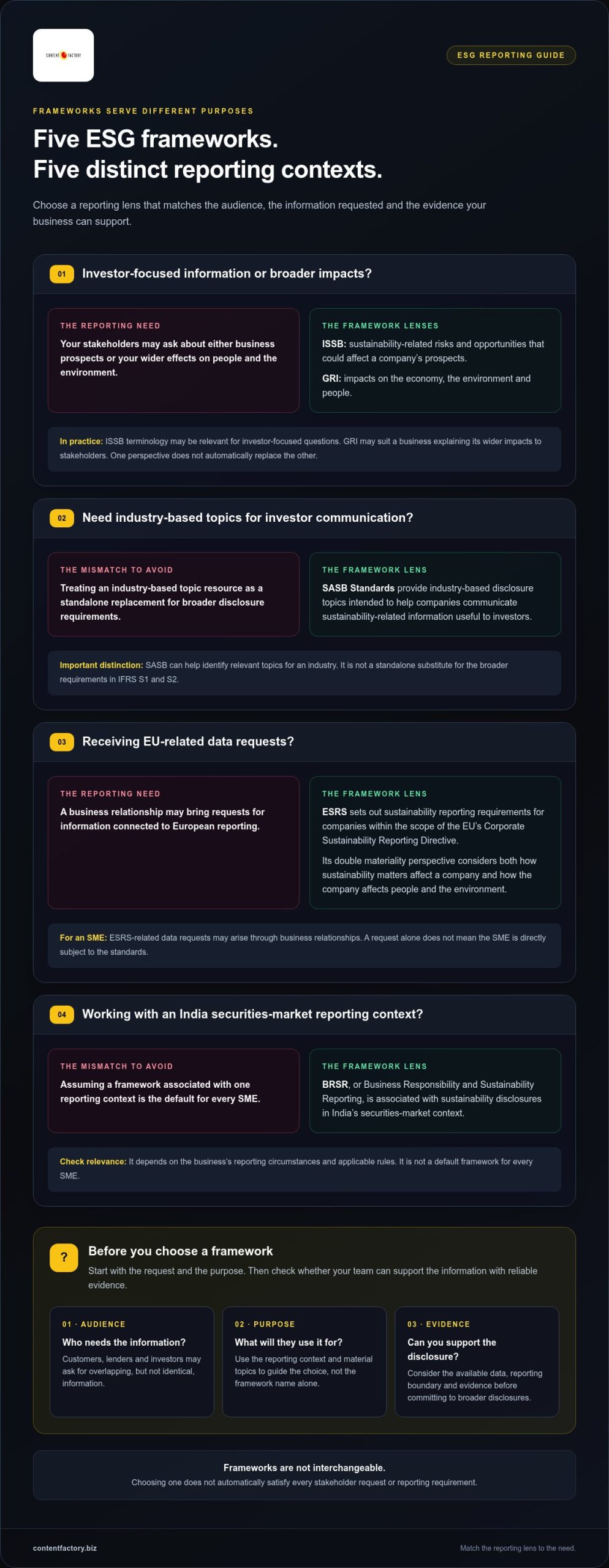
These frameworks aren’t interchangeable. They organise disclosures around different audiences, purposes and reporting contexts, so an SME shouldn’t assume that choosing one will satisfy every customer request or reporting requirement. The useful comparison is what each framework helps you communicate, and whether that matches your business’s actual needs.
ISSB and GRI: investor-focused and broader impact perspectives
The IFRS Foundation’s ISSB standards are designed to provide sustainability-related financial information for investors. IFRS S1 sets general requirements for sustainability-related financial disclosures, while IFRS S2 addresses climate-related disclosures. The focus is on information about sustainability-related risks and opportunities that could affect a company’s prospects.
GRI Standards take a broader impact perspective, helping organisations report their impacts on the economy, environment and people. In practical terms, an SME responding to investor-focused questions may find ISSB terminology relevant, while a business seeking to explain its wider impacts to stakeholders may look to GRI. Neither perspective automatically replaces the other.
SASB, ESRS and BRSR: when their context may matter
SASB Standards provide industry-based disclosure topics intended to help companies communicate sustainability-related information useful to investors. The IFRS Foundation maintains the standards, which can help identify relevant topics for an industry. They are not a standalone substitute for the broader requirements in IFRS S1 and S2.
ESRS, the European Sustainability Reporting Standards, set out sustainability reporting requirements for companies within the scope of the EU’s Corporate Sustainability Reporting Directive. Their double materiality perspective considers both how sustainability matters affect a company and how the company affects people and the environment. A Singapore SME may encounter ESRS-related data requests through business relationships, but that alone doesn’t mean the SME is directly subject to the standards.
India’s Business Responsibility and Sustainability Reporting (BRSR) framework is associated with sustainability disclosures in India’s securities-market context. Its relevance to a Singapore business depends on its reporting circumstances and applicable rules; it isn’t a default framework for every SME operating in Singapore.
Framework relevance depends on reporting context. A company’s location, stakeholder requests, business relationships and applicable requirements all matter. For a Singapore SME, a customer request referring to a particular framework may call for specific information, not automatic adoption of the entire framework. Confirm the purpose and boundaries of the request before expanding your reporting scope.
Used selectively, one or more frameworks can provide a structure for responding to different audiences. ContentFactory’s multi-framework sustainability reporting work connects framework choices with reporting preparation and data readiness. For help assessing which approach fits your needs, Contact Us.
Which ESG reporting framework fits your SME’s needs?
Choose by working backwards from the reason you’re reporting. A framework should help you answer a real business need, not create a larger disclosure exercise than your stakeholders require. Compare each option against four factors: who will use the information, which topics matter, what decision the reporting should support, and whether your team can produce reliable data.
A simple fit check can help:
- Audience: Is the information for investors, customers, lenders, employees or a broader stakeholder group?
- Purpose: Are you responding to a request, preparing a regular report or building a foundation for future disclosures?
- Topics: Which ESG matters are relevant to your business and its stakeholders?
- Capacity: Can you define the reporting boundary, locate evidence and assign responsibility for each disclosure?
If the expected scope is broad but the evidence is patchy, narrow the first reporting cycle to relevant, supportable disclosures and identify data gaps. A focused scope is more useful than an expansive report filled with estimates the business cannot explain. A materiality assessment can help distinguish stakeholder-requested disclosures from topics identified through your own assessment of business impacts, risks and priorities.
Match framework scope to material topics and reporting audience
Map material topics to the people who need the information. An investor-oriented request may call for disclosures about sustainability-related risks and opportunities; a customer may ask for operational information to assess its supply chain. Keep these needs distinct, even where topics overlap. For a deeper selection process, use this guide to choosing an ESG reporting framework to compare reporting purpose, audience and scope.
When one framework or a combined approach may be appropriate
One framework may be a sensible starting point when a clear audience and reporting purpose dominate, and the scope matches your current ability to prepare evidence. If customers and investors ask for different kinds of information, a combined approach may help organise responses across both needs. It can also mean more coordination: definitions, boundaries, reporting periods and data ownership need to align, or the same measure may be prepared inconsistently.
For example, an SME might use one reporting structure for its regular disclosures while mapping specific customer questions to relevant information from that process. That’s different from adopting multiple complete frameworks simply because different names appear in requests. ContentFactory’s Singapore multi-framework reporting guide explores how businesses can approach overlapping reporting needs.
If a stakeholder specifies a framework or supplies a questionnaire, treat that as a priority for the response they requested. Clarify the requested reporting period, boundaries and evidence, then decide whether the request should shape your wider reporting approach. Neither using one framework nor combining several automatically fulfils a particular legal, regulatory or contractual obligation. Singapore applicability depends on the entity and current requirements.
ContentFactory can help connect framework selection with ESG readiness, materiality and data preparation. If you’re weighing a reporting approach for your business, Contact Us.
How to select and start using an ESG framework
Turn framework selection into a short planning exercise before committing to a reporting format. For ESG reporting frameworks for SMEs, the practical starting point is to connect each request to its purpose, topic, reporting boundary and available evidence. That lets you make a deliberate choice rather than collecting data simply because a framework contains a disclosure.
Work through these steps with the people who hold the relevant information:
- Record stakeholder requests. Note who is asking, what they need, the format and deadline, and whether the request recurs.
- State the intended use. Identify whether the information supports a customer response, a business report or another specific decision.
- Set the boundary. Capture the entity, operations, reporting period and value-chain coverage the request specifies.
- Map topics to evidence. For each material disclosure, record the source, data owner, method and any gaps.
- Compare framework fit. Select a structure that supports the purpose and can be applied consistently with available capacity.
This register can be a simple spreadsheet. Its value is not the format, but the traceability: a reviewer should be able to see where a figure came from, who prepared it and what limitations apply.
Build a framework decision from requests and available evidence
Assign each disclosure to an existing record or a named internal owner, such as the person responsible for facilities, procurement or workforce records. If the information is incomplete, flag the gap and set out what is missing. Keep assumptions visible and distinguish estimates from verified figures. That discipline helps prevent uncertain data from being presented as established fact.
Set a proportionate first reporting cycle
Define a manageable scope and document why it was selected. Record methods, boundaries, exclusions and limitations so future reporting can be compared on a like-for-like basis. If a disclosure cannot yet be supported, explain the limitation rather than implying completeness. A documented first cycle gives the business a baseline for improving data processes without overstating progress.
Before issuing a report or questionnaire response, check that every claim has supporting evidence, the stated period and boundary are clear, and figures use consistent definitions. Keep a record of changes in methods or coverage; otherwise, apparent year-on-year movement may reflect a different calculation rather than a real change. A brief internal review can catch inconsistencies before information reaches customers or other stakeholders.
For a step-by-step implementation sequence, ContentFactory’s practical roadmap for starting ESG reporting can help translate planning into preparation. ContentFactory also supports ESG readiness, materiality assessment and reporting preparation, connecting framework decisions to data readiness.
If you want to develop a reporting approach around your business’s needs and evidence, Contact Us.
How ContentFactory helps SMEs turn framework choice into reporting
Selecting a framework is only useful if it leads to reporting your business can prepare and maintain. ContentFactory connects framework choice with ESG readiness, materiality and your organisation’s reporting purpose. The aim is to clarify what needs attention, what information you already have and what practical steps can make reporting more structured.
For SMEs, that means considering stakeholder requests alongside data capacity. A readiness process can help identify existing disclosures, evidence gaps and reporting priorities before the business commits to a format. Materiality assessment helps focus effort on the ESG topics that matter in your business context, rather than treating every possible disclosure as equally important.
ContentFactory supports SMEs with readiness and materiality assessments, multi-framework sustainability reporting and ESG data preparation. Its ESG support for Singapore businesses can help translate framework decisions into an implementable reporting approach, including where information needs to be organised across different requests.
From framework choice to an implementable reporting plan
Readiness work can review current disclosures, available records, reporting responsibilities and gaps. Materiality helps define which topics deserve focused attention and how they relate to the organisation’s reporting purpose. Together, these steps create a basis for deciding what to prepare first, what evidence supports each disclosure and where data processes need development.
The result is a practical plan, not just a framework selection. It can clarify reporting scope, information owners and preparation priorities while keeping limitations visible. That makes it easier to align the work with your team’s capacity and the requests your business needs to address.
What to bring into an initial discussion
A focused discussion is easier when you have relevant materials to hand. Gather current stakeholder questionnaires or requests, any existing ESG information, reporting deadlines and details about the organisation or operations covered. Note which disclosures are recurring, who currently holds the information and where you already see uncertainty or gaps.
- Requests: Stakeholder, requested topics, format and purpose.
- Information: Existing policies, records, calculations and reporting.
- Boundaries: Entities, operations and reporting periods in scope.
- Priorities: Deadlines, material topics and unresolved data questions.
These inputs help keep the discussion grounded in scope, data readiness and priorities, rather than assuming a single framework will answer every need. ContentFactory can use them to help assess reporting requirements and connect framework selection to preparation and data organisation.
To discuss a proportionate reporting approach for your business, Contact Us.
Build a reporting approach you can grow with
Your first reporting cycle doesn’t need to answer every possible ESG question. It should give your business a clear, supportable starting point and show where stronger data or processes would make future disclosures more useful. Treat framework selection as an operating decision: define what matters now, keep evidence traceable and revisit the scope as stakeholder needs develop.
Choosing among ESG reporting frameworks for SMEs can feel complex, but it becomes more manageable when decisions are grounded in your reporting purpose and actual readiness. ContentFactory can support that work through ESG readiness and materiality assessments, multi-framework sustainability reporting and ESG data preparation, helping connect framework choice to practical execution.
Bring your current requests, reporting materials and priorities into the conversation, then shape a plan that fits your organisation’s needs. Contact Us to discuss your next step with ContentFactory. A clear, evidence-led beginning can help your reporting develop with confidence.
Frequently Asked Questions
Is an ESG reporting framework mandatory for every SME in Singapore?
No, there isn’t one blanket framework requirement for every SME in Singapore. Whether a reporting requirement applies depends on the entity’s circumstances and current applicable rules. Requirements may also arise through a business relationship or contract, which is separate from a general regulatory obligation. Check current guidance from the relevant authorities, including ACRA or SGX RegCo where applicable, and assess how it relates to your organisation before deciding what to report.
Can an SME use more than one ESG reporting framework?
Yes. An SME may draw on more than one framework when it needs to address distinct reporting purposes or audiences. For instance, a business could organise its wider stakeholder disclosures one way while mapping investor-related information separately. A combined approach needs coordination: define which entity, period and topics each disclosure covers, and map shared data carefully. Otherwise, inconsistent definitions or boundaries can make the resulting disclosures harder to compare and explain.
How do SMEs choose between ISSB and GRI?
Start with the intended audience and decision. ISSB standards focus on sustainability-related financial information useful to investors, while GRI Standards support reporting on an organisation’s impacts on the economy, environment and people. An SME responding to different audiences may need to consider both perspectives, but not necessarily adopt both in full. Before selecting either, review the latest guidance from the IFRS Foundation and GRI, then compare it with the requests your business must address.
What happens if a customer asks an SME to report using a specific ESG framework?
Clarify what the customer expects before preparing a response. Confirm the framework or version referenced, the reporting period, which parts of your business are in scope, the requested format and the evidence required. Then map the relevant questions to information you can support. A framework named in a questionnaire doesn’t automatically mean the customer expects a complete report against every disclosure, so establish the request’s boundaries rather than assuming its scope.
Can an SME begin ESG reporting without collecting every possible data point?
Yes. An SME can begin with a defined scope shaped by material topics, stakeholder needs and the evidence it can prepare responsibly. For example, it can report supported information for the current period while identifying data it hasn’t collected. State exclusions, estimates and limitations clearly, and avoid presenting missing information as a positive result. A documented plan to improve data collection can make the next reporting cycle more consistent.
Does choosing an ESG framework make a company’s report independently assured?
No. Using a framework doesn’t mean an independent party has checked the report or issued an assurance opinion. Assurance is a separate engagement with its own scope, criteria and procedures. A company can prepare for that work by organising evidence, recording calculation methods and clarifying data ownership, but readiness is not assurance itself. If assurance is being considered or required, establish the applicable expectations and boundaries separately from the framework decision.
Is ESG reporting the same as sustainability reporting?
The terms often overlap in business use, but they don’t always mean precisely the same thing. A report described as sustainability reporting may cover environmental, social and governance topics, while an ESG disclosure may be shaped by a particular framework, audience or reporting purpose. Don’t rely on the label alone to understand what’s included. Check the chosen framework’s scope, the reporting boundary and the topics disclosed so readers can interpret the information accurately.

Article by
Mayuresh Godse
Mayuresh Godse is a Singapore Certified Management Consultant and Business Strategist specializing in Sustainability, ESG, AI-driven Digital Transformation, and business growth. Based in Singapore, he writes about Sustainability, Digital Innovation, Business Strategy, and Content Marketing for global audiences.
Disclaimer
This article is provided by ContentFactory for general information only and is not legal, tax, accounting or financial advice. Regulations and government scheme criteria change; grant eligibility and quantum are set by the relevant Singapore agencies and assessed case by case, with no outcome guaranteed. Verify current requirements before acting.