

A production line can run efficiently and still carry serious ESG exposure. ESG risks for manufacturing companies include environmental impacts such as emissions, energy use, waste and pollution; social issues such as worker safety and labour practices; and governance gaps in oversight, compliance and business conduct. In Singapore, the Environmental Protection and Management Act requires measures for pollution control and environmental conservation, according to Singapore Statutes Online.
These risks matter because they can disrupt operations, strain supplier relationships and expose weaknesses in how a business manages its impacts. Pressure extends beyond the factory floor: suppliers, contractors and business decisions can all affect a manufacturer’s ESG performance.
This article explains ESG risks for manufacturing companies and how to recognise them across operations, supply chains, compliance, energy, waste and pollution. It covers what to look for, why each area matters and how to assess risks practically in Singapore.
Key Takeaways
- Map suppliers and contractors to uncover exposure to labour, water, climate and emissions risks beyond your own facilities.
- Assess how climate hazards and resource constraints could disrupt production, access to materials and delivery schedules.
- Assign clear ESG oversight and track practical indicators across sites so gaps in compliance and accountability are easier to spot.
- Review worker safety, fair treatment and labour practices in both your operations and supply chain.
- Examine energy use, waste streams and pollution controls together to identify where operational risks and improvement opportunities intersect.
How to integrate ESG in the supply chain of manufacturing companies?
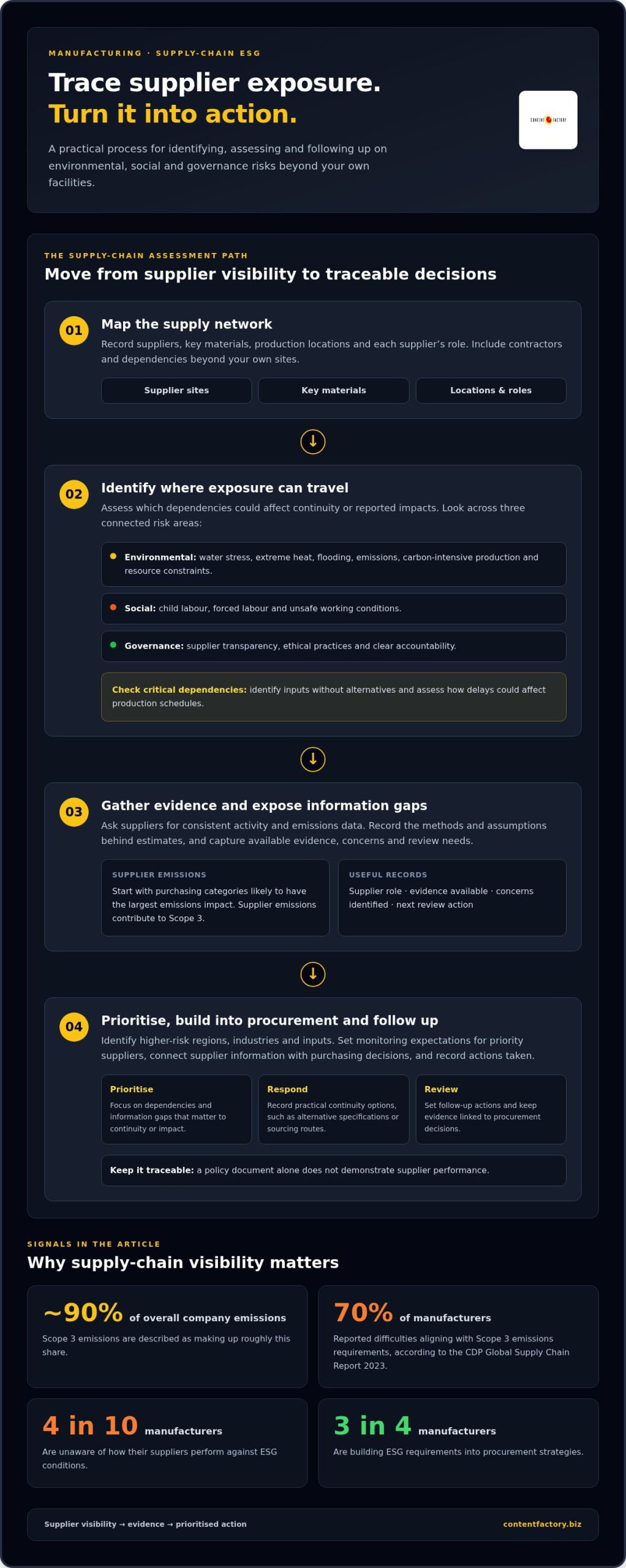
Supply-chain ESG work means identifying and managing environmental, social and governance risks beyond your own facilities. Start by mapping suppliers, materials and locations, then decide which dependencies could threaten continuity or affect your reported impacts. A Singapore-focused ESG assessment can help frame those priorities for your business.
Climate Disruption in Supply Chains
Climate-related disruption occurs when environmental conditions affect suppliers, transport routes or production. Water stress, extreme heat or flooding can constrain a supplier’s output, delay deliveries or interrupt operations. These effects can spread through a manufacturing network when essential inputs come from a limited number of locations.
Map supplier sites and key materials against climate and resource pressures. Identify inputs without alternatives and assess how delays could affect production schedules. Then record practical continuity options, such as alternative specifications or sourcing routes. This helps operations teams identify which dependencies need closer attention.
Supplier Emissions and Carbon Footprints
Supplier emissions arise from producing and transporting goods and services your business purchases. They contribute to Scope 3 emissions, which make up roughly 90% of overall company emissions. The CDP Global Supply Chain Report 2023 found that 70% of manufacturers reported difficulties aligning with Scope 3 emissions requirements.
Start with purchasing categories likely to have the largest emissions impact. Ask suppliers for consistent activity and emissions data, and record the methods and assumptions behind each estimate. Prioritise information gaps that limit your understanding of the supply-chain footprint. A consistent approach also makes supplier comparisons more useful and shows where better data is needed.
Supply-Chain Transparency and Ethical Sourcing
Supply-chain transparency means tracing suppliers, production locations and relevant environmental and labour practices. That visibility can reveal exposure to water stress, carbon-intensive production, child labour, forced labour or unsafe working conditions.
Four in ten manufacturers are unaware of how their suppliers perform against ESG conditions. Build a supplier map, identify higher-risk regions and industries, and set clear monitoring expectations for priority suppliers. Three quarters of manufacturers are building ESG requirements into procurement strategies. Use this opportunity to connect supplier information with purchasing decisions and follow-up actions.
Keep the process practical: record each supplier’s role, available evidence, concerns identified and next review action. This creates a traceable basis for procurement decisions. A policy document alone does not demonstrate supplier performance.
Environmental, social and governance pressures in manufacturing
Manufacturing ESG pressures span environmental impacts, workforce conditions and governance controls. Together, these factors shape production, resource use, emissions and the reliability of business decisions.
ESG Factors in Manufacturing
Environmental factors include emissions, energy use, water demand, waste and pollution. Social factors include worker safety, employee treatment and effects on local communities. Governance covers board oversight, accountability, ethical conduct and anti-corruption controls. Together, these areas show how manufacturing decisions affect people, resources and operational resilience.
Assess them at both site and company level. For example, compare energy and water use across facilities, review workforce safety practices, and identify who owns ESG decisions. The World Bank Group states that sourcing natural materials causes more than 90% damage to biodiversity. For manufacturers dependent on those materials, sourcing choices can therefore carry environmental and supply implications.
Financial Consequences of Poor ESG Governance
Poor ESG governance can translate into costs through pollution incidents, repairs, fines or legal problems. Moderate or serious sustainability events could trigger a stock market decline of as much as 7.5% in a given year period. That exposure makes oversight relevant to financial resilience, not just reporting.
Capital access may also reflect ESG performance. Manufacturers with strong ESG scores attract 11% more capital on average than companies with weaker ESG performance. Treat these figures as signals to examine exposure, not as a forecast for an individual business. Map the potential financial effects of resource constraints, operational incidents and weak controls, then assign responsibility for monitoring each issue.
Governance, Transparency and Risk Management
Governance connects ESG priorities to decisions, accountability and risk controls. In 2023, 42% of manufacturing firms were flagged for governance risks. Weak board oversight can leave operational concerns without clear owners, while opaque decisions can make it harder to identify misconduct or respond consistently.
Set clear responsibilities at board, corporate and site levels. Establish KPIs for ESG compliance and performance, and review them alongside operational information. Controls should address corruption and bribery risks, document decisions and provide a route for escalating concerns. Transparent reporting also helps investors and the public understand the organisation’s ESG performance. A practical starting point is to record each material risk, its owner, the evidence used to assess it and the action taken. For structured support with those priorities, explore ESG readiness gap analysis or discuss your assessment needs.
Corporate ethics, transparency, and regulatory compliance
Manufacturers need clear ethical controls, reliable records and a practical understanding of their regulatory responsibilities in Singapore. These systems support accountable decisions and help teams explain ESG performance to investors and other stakeholders.
No single reporting framework suits every manufacturer. Consider GRI, ISSB and SASB in light of your organisation’s impacts, intended readers and disclosure needs.
Corporate Ethics and Transparency
Corporate ethics set expectations for how people act, while transparency makes decisions and performance understandable. Both matter: unclear approvals or incomplete records can conceal conflicts, misconduct or unreliable environmental information. For example, document the basis for significant purchasing decisions, who approved them and how concerns were addressed.
Set clear expectations for bribery, corruption and responsible business conduct. Train relevant employees and leaders, and review policies when activities or responsibilities change. Consistent records make decisions easier to explain internally and support credible communication with investors.
Legal Liability and Noncompliance
Legal liability can arise when a business fails to meet applicable requirements or causes harm through its operations. For manufacturers, pollution incidents, unsafe practices or inaccurate disclosures can lead to costs such as fines, repairs or legal problems. Keep records of operational controls, incidents and corrective actions to trace decisions and demonstrate follow-up.
Singapore’s Environmental Protection and Management Act requires measures for pollution control and environmental conservation, according to Singapore Statutes Online. Identify the activities relevant to your sites and assign responsibility for monitoring applicable requirements.
Regulatory Demands and Complexity
Regulatory responsibilities can involve environmental controls, employment practices and the information a manufacturer discloses. In Singapore, the National Environment Agency and Ministry of Manpower are identified as regulatory bodies that monitor manufacturers and enforce ESG regulations. The requirements relevant to your business depend on its activities and circumstances.
Create a compliance register recording each relevant obligation, its operational owner, supporting evidence and review process. This gives site and corporate teams a consistent way to track responsibilities without treating every ESG topic as a regulatory requirement.
ESG Standards and Reporting Frameworks
Reporting frameworks structure how organisations select and disclose ESG information. GRI can help explain impacts on people and the environment; ISSB supports investor-focused sustainability-related financial disclosures; SASB sets out industry-specific sustainability topics. Choose a framework based on your reporting purpose and the information stakeholders need.
For each selected topic, identify the data owner, supporting evidence and reporting boundary. A Singapore manufacturer comparing framework options can use this guide to selecting an ESG reporting framework as a starting point.
If you’re reviewing governance or disclosure priorities, discuss your ESG reporting needs.
What are the ESG risks in manufacturing?
Social risks in manufacturing include unsafe work, unfair treatment and breaches of labour rights. They can arise in Singapore facilities and throughout supply chains, affecting workers, production and an organisation’s reputation.
Workplace Health and Safety
Workplace health and safety covers the conditions, equipment and procedures used to protect workers from injury and illness. It matters because an incident can harm employees and interrupt production. The International Labour Organization reported 2.8 million workplace injuries in the manufacturing sector in 2022.
Review hazards by task and work area. Check machine safeguards, protective equipment, emergency procedures and employee training. Ensure workers can report unsafe conditions and managers record their responses. At a Singapore factory, comparing incident records with changes to equipment or work processes can help identify where existing controls need attention.
Labour Standards and Employee Rights
Labour standards set expectations for fair employment, while employee rights include fair wages and safe working conditions. These issues matter within your own operations and among suppliers, where poor treatment can damage trust with workers and business partners.
Singapore’s Employment Act is cited as setting standards for fair employment practices and workplace safety. Review employment policies and workplace practices against the standards that apply to your operations. Clarify responsibilities, retain relevant records and provide a channel for workers to raise concerns. A documented process helps managers identify issues and follow up consistently.
Fair Labour and Employee Welfare
Fair labour and employee welfare mean treating workers fairly and supporting conditions that protect their wellbeing. Check how work is organised, how concerns are handled and whether employees receive training suited to their roles.
A textile manufacturer reduced turnover by 25% after implementing health and safety protocols, improving working conditions and offering regular training. This is an example, not a forecast for other businesses. Manufacturers can review staff feedback, training records and reported incidents together. That helps reveal whether workplace measures address practical concerns or exist only as written policies.
Ethical Sourcing and Labour Practices
Ethical sourcing means considering labour practices at suppliers and contractors, not just within your own facilities. Child labour, forced labour and unsafe working conditions in supply chains create social risks and can undermine confidence in your business.
Map supplier relationships and identify where labour practices need closer attention. Set expectations for partners, record concerns and assign owners to follow up. For a Singapore manufacturer sourcing components through several contractors, traceability can show which parties perform each production stage and where to direct questions about working conditions. Keep records current as suppliers or sourcing arrangements change.
Energy use, waste management and pollution control
Energy demand, pollution and discarded materials create environmental risks in manufacturing operations. Measure them at facility level to identify where controls, resource use and corporate strategies need attention.
Energy Use in Manufacturing
Energy use includes the power and fuel consumed by production equipment, buildings and processes. It matters because consumption affects operating emissions and exposure to energy price volatility. Manufacturing consumes 54% of global energy resources and is responsible for nearly 23% of global greenhouse gas emissions.
Begin by recording energy use by site, process and major equipment. Compare consumption with production activity to locate inefficient processes, then assess practical efficiency measures and renewable energy options. Manufacturers that adopt renewable energy report average savings of 20% on energy costs. Treat this as a reported average, not a guaranteed result for your facility.
Factory Pollution Management
Factory pollution management involves controls that limit releases from production and prevent harm to the surrounding environment. Weak controls can lead to fines, repairs or legal problems, as well as damage to local surroundings.
In Singapore, the Environmental Protection and Management Act requires measures for pollution control and environmental conservation, according to Singapore Statutes Online. Identify potential pollution sources at each site, assign responsibility for controls, and document incidents and corrective actions. Link monitoring records to production processes so teams can trace issues and assess whether controls are working.
Waste Management and Electronic Waste
Waste management means identifying, handling and reducing materials discarded during production or product use. Electronic waste is especially relevant to electronics and consumer goods manufacturing. The sector contributes to 40 million metric tons of e-waste generated annually.
Separate waste streams where they arise, including electronic components, packaging and production scrap. Record quantities, storage and disposal routes, then investigate recurring waste. This gives you a clearer basis for deciding whether process changes could prevent waste or improve material handling. Keep records consistent across production areas to make facility-level comparisons useful.
Waste Circularity and Recycling
Circularity keeps materials in use through reuse or recycling rather than sending them directly for disposal. Manufacturers can assess material flows to find opportunities to reuse offcuts, packaging or components in production.
Identify which materials can be recovered, what prevents reuse and how progress will be measured. Check whether sorting practices protect material quality, then record what is reused or recycled. These steps make waste management an operational priority and provide evidence to share with relevant stakeholders.
To assess energy, pollution and waste priorities across your operations, Contact Us.
ContentFactory: ESG Readiness & Materiality Assessments
ContentFactory helps manufacturers turn ESG concerns into prioritised assessment and reporting work. Its ESG Readiness & Materiality Assessments identify relevant issues across operations and supply chains, helping you focus on the risks and impacts that matter to your business.
Use this support when ESG responsibilities are spread across teams, emissions data needs a clearer basis or reporting frameworks need alignment. ContentFactory also provides GHG Emissions Calculation and Carbon Accounting, alongside Multi-Framework Sustainability Reporting. These services connect emissions information and reporting needs with the priorities identified in your assessment.
Start by organising your key operational, supplier and reporting questions. To discuss a suitable next step, contact ContentFactory.
Turn ESG priorities into operational decisions
Make responsibilities clear next. Assign an owner to each priority, agree what evidence will demonstrate progress and set a review point that fits your operating cycle. This gives your team a workable basis for deciding what to address first, rather than treating every issue as equally urgent.
Keep the process tied to real decisions. When production changes, supplier relationships shift or reporting needs evolve, revisit the assumptions behind your priorities. Regular, consistent reviews help leaders spot stalled actions and identify where teams need clearer direction.
For manufacturers, managing ESG risks for manufacturing companies is an ongoing discipline, not a one-off exercise. Start with an issue your business can influence, assign accountability and build from there. ContentFactory can help turn assessment priorities into a clearer approach for your organisation.
Contact Us to discuss what would help your business move forward.
Frequently Asked Questions
What is ESG in manufacturing and why does it matter?
In manufacturing, ESG brings non-financial impacts into routine business decisions. For example, assess a proposed equipment upgrade for energy use, changes to workers’ tasks, maintenance needs and effects on nearby communities. This gives decision-makers a fuller basis for comparing options than production output alone. It also connects site-level information with questions from customers, lenders and other stakeholders.
What are key challenges faced by companies trying to become ESG compliant?
A common challenge is making information collected for different purposes consistent enough to use together. Site teams may record incidents, finance may track energy expenditure, and procurement may hold supplier details in separate formats. Agree on definitions, reporting boundaries and record owners before combining data. Keep a concise record of assumptions and source documents so updates can be traced and teams do not unknowingly compare unlike information.
What are the consequences of poor ESG governance?
Weak governance can leave an organisation unable to explain how it reached an ESG decision or supported a public statement. This can slow responses to customer or investor questions and expose gaps between reported performance and underlying records. Retain approval notes, data sources and the rationale for significant judgements together. This creates an audit trail for internal review without relying on staff recollection.
What are the main environmental, social, and governance risks for manufacturing companies?
The most relevant risks depend on the product, process and business relationships, and they can interact. A change in production methods, for instance, may alter resource requirements, employee tasks and supplier specifications at once. Instead of assessing each topic in isolation, examine how a proposed operational change could affect different stakeholders. This helps decision-makers identify connected impacts and coordinate follow-up across teams.
What are the biggest ESG risks for manufacturers in Singapore?
No single priority list fits every Singapore manufacturer. Start with each site’s activities, the materials and processes involved, and the stakeholders affected. Then compare the issues identified with applicable Singapore requirements and the information your business is expected to provide. This keeps the assessment grounded in your operations, rather than assuming a risk in one manufacturing subsector applies equally to another.
How do manufacturing companies assess and prioritize ESG risks across their operations and supply chains?
Use a risk register to capture the issue, affected activity, evidence source, accountable owner and next review trigger. Include an evidence-quality field so estimates and incomplete records are not treated as verified measurements. Set review triggers around meaningful business changes, such as a new process, facility or sourcing arrangement. This makes the assessment easier to update and helps managers see which priorities depend on better information.
How do manufacturers manage supply-chain ESG risks, including human rights and labour practices?
Turn supplier expectations into a consistent process: communicate relevant standards, record concerns, assign a response owner and document agreed corrective actions. Set review points to establish whether actions were completed and whether concerns remain. For serious issues, define internally who can approve escalation and what factors will guide the response. A clear process helps teams act consistently instead of treating each supplier concern as an isolated exception.
What workplace health, safety, and labour risks should manufacturing companies monitor?
Look beyond recorded injuries when reviewing workplace conditions. Near-miss reports, recurring maintenance issues, contractor induction records, fatigue concerns and unresolved worker grievances can reveal emerging problems. Compare these indicators across shifts or work areas to identify patterns that company-wide totals may hide. Check whether corrective actions were completed and communicated to affected workers. This provides a clearer picture of how safeguards work in day-to-day operations.

Article by
Mayuresh Godse
Mayuresh Godse is a Singapore Certified Management Consultant and Business Strategist specializing in Sustainability, ESG, AI-driven Digital Transformation, and business growth. Based in Singapore, he writes about Sustainability, Digital Innovation, Business Strategy, and Content Marketing for global audiences.
Disclaimer
This article is provided by ContentFactory for general information only and is not legal, tax, accounting or financial advice. Regulations and government scheme criteria change; grant eligibility and quantum are set by the relevant Singapore agencies and assessed case by case, with no outcome guaranteed. Verify current requirements before acting.