

By 2026, the gap between companies that treat ESG as a reporting exercise and those that view it as a core operational strategy will become an unbridgeable commercial divide. You likely feel the mounting pressure from global reporting standards and the technical burden of tracking Scope 1-3 emissions across your entire supply chain. It’s a common frustration among Singaporean mid-market leaders who refuse to risk greenwashing accusations due to fragmented data. You know that a successful transition to sustainable business model requires more than a polished annual report; it demands a fundamental reengineering of how value is created and measured.
This article moves past theoretical consulting jargon to deliver a strategic, execution-focused roadmap for the next 24 months. We’ll show you how to institutionalize ESG readiness, leverage the Enterprise Development Grant (EDG) for financial support, and build a model that satisfies both international regulators and savvy investors. We’ll break down the integration of carbon accounting with business process optimization to ensure your sustainability efforts catalyze growth rather than stalling it. By the end of this guide, you’ll have a clear path to transform compliance into a distinct competitive advantage.
Key Takeaways
- Identify why the shift from profit-only models to resilient, sustainable structures is a commercial necessity for Singaporean firms by 2026.
- Master the step-by-step transition to sustainable business model, starting with high-impact materiality assessments and technical carbon accounting.
- Understand the “Scope 3 Ripple Effect” and how international reporting standards like ISSB will dictate your future supply chain eligibility.
- Discover how to utilize the Enterprise Development Grant (EDG) to fund ESG readiness and operational reengineering.
- Learn to integrate circular economy principles into your existing workflows to drive efficiency and reduce waste-related costs.
The 2026 Mandate: Why Transitioning to a Sustainable Business Model is Non-Negotiable
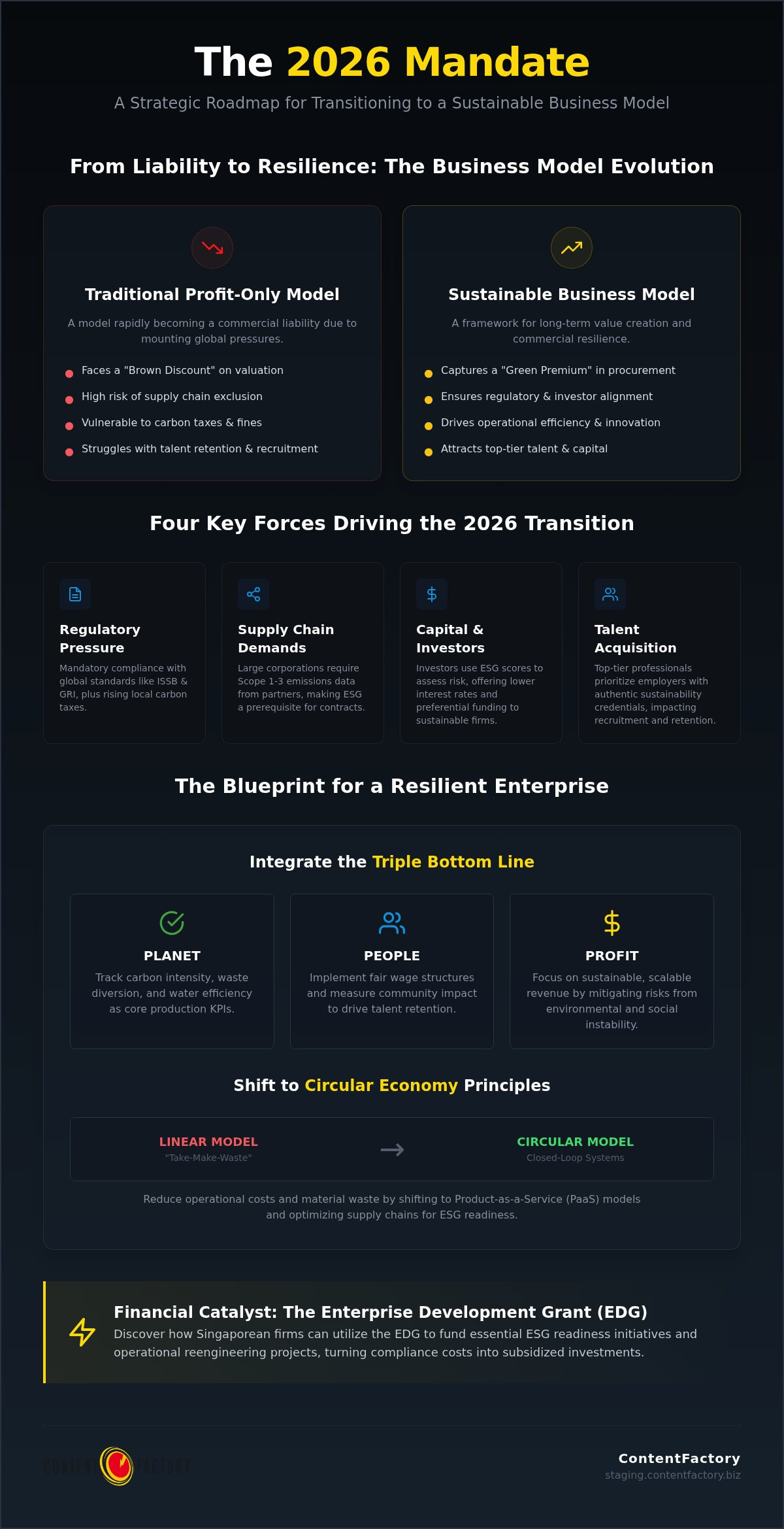
The traditional profit-only model is becoming a liability. By 2026, the transition to sustainable business model will shift from a voluntary corporate social responsibility (CSR) initiative to a mandatory operational requirement. For Singaporean enterprises, this means moving beyond high-level ESG goals to a model where sustainability is a core strategy for long-term value creation. Companies that lag behind face a “brown discount” on their valuation, while leaders capture a “green premium” in B2B procurement. This premium isn’t just a marketing advantage; it’s a structural preference as multinationals prioritize suppliers with lower carbon footprints to meet their own net-zero targets.
From Moral Choice to Operational Necessity
Global supply chains now demand unprecedented transparency. Large corporations are auditing their SME partners for Scope 3 emissions data, meaning your ability to secure contracts depends on your ESG maturity. The cost of inaction is no longer theoretical; it manifests as rising carbon taxes in Singapore and potential regulatory fines for non-compliance with ISSB or GRI frameworks. Gaining a foundational understanding sustainability within a corporate context is essential for leadership teams to navigate these pressures. A sustainable business model is a strategic framework that integrates environmental and social stewardship into the core value proposition to ensure long-term commercial resilience and regulatory alignment.
The Role of Stakeholder Capitalism in 2026
Capital allocation is now inextricably linked to ESG performance. Investors use ESG scores to determine risk profiles, often offering lower interest rates to firms that demonstrate robust carbon accounting and ethical governance. This shift isn’t limited to finance; it extends to the labor market. Top-tier talent, particularly in the tech and professional services sectors, increasingly prioritizes employers with authentic sustainability credentials. Companies that fail to demonstrate impact struggle with employee retention and higher recruitment costs.
Greenwashing has also evolved into a significant financial and legal risk. Misrepresenting ESG data can lead to litigation, reputational damage, and exclusion from major procurement panels. In the 2026 landscape, authenticity is enforced through data. Leaders must treat ESG metrics with the same rigor as financial reporting to avoid these pitfalls and secure their position in the global market.
The Structural Anatomy of a Sustainable Business Model
A sustainable business model isn’t a peripheral CSR project. It’s a structural overhaul of how your company creates, delivers, and captures value. Effectively executing a transition to sustainable business model means embedding ESG metrics directly into your Profit and Loss statement. You’re no longer just managing financial capital; you’re managing natural and social capital with equal rigor. When conceptualizing sustainable business models, pragmatic leaders focus on data-driven governance. Transparency becomes the engine that powers your transition, ensuring every operational decision aligns with long-term resilience.
Integrating the Triple Bottom Line
Successful firms treat the Triple Bottom Line as a balanced scorecard. Planetary metrics like carbon intensity and waste diversion rates are integrated into production KPIs. In Singapore, this includes monitoring water efficiency and preparing for tiered carbon tax hikes. Social metrics, such as fair wage structures and community impact, are positioned as talent acquisition and retention drivers. Economic metrics remain central, but the focus shifts to sustainable, scalable revenue. You aren’t sacrificing profit for the planet. You’re securing future profit by mitigating the risks that environmental and social instability create.
Circular Economy Principles for Mid-Market Firms
Executing a transition to sustainable business model requires rigorous business process reengineering. You’re redesigning core workflows to ensure they’re lean, compliant, and future-proof. This isn’t just about reporting; it’s about doing business differently to stay competitive in a 2026 global market. If you’re ready to move from theory to execution, reach out to our team for a tactical structural assessment and grant advisory support.
Analyzing the 2026 Drivers: Regulation, Supply Chains, and Capital
The momentum behind the transition to sustainable business model is fueled by a convergence of regulatory mandates and capital market shifts. By 2026, the “Scope 3 ripple effect” will be a standard operational reality. Large multinationals aren’t just reporting their own emissions; they’re auditing their SME suppliers to verify carbon data. If you’re a Singaporean mid-market firm, your inclusion in global supply chains depends on your ability to provide granular, verifiable ESG metrics. This isn’t a trend; it’s a prerequisite for market entry feasibility in any high-value sector. Firms that want to remain competitive should review the full ESG compliance for Singapore suppliers readiness checklist to benchmark their current standing against 2026 procurement standards.
The Impact of Mandatory Disclosure
The regulatory environment is simplifying but intensifying. We’re seeing a clear convergence of the International Sustainability Standards Board (ISSB) and Global Reporting Initiative (GRI) frameworks. This alignment provides a unified language for private firms to disclose their impact. To manage this technical burden, digital transformation is essential. Automated sustainability reporting tools now integrate with ERP systems to capture real-time data, but reporting everything is inefficient. You must use materiality assessments to determine which ESG factors actually drive value and risk for your specific industry. This focus ensures your transition to sustainable business model remains lean and results-oriented. For firms navigating the complexity of GRI, ISSB, and TCFD simultaneously, understanding how to start ESG reporting with a structured, pragmatic roadmap is the critical first step to building an audit-ready framework.
Capital Markets and the ‘Green Premium’
Capital is moving away from “brown” assets. In 2026, sustainable firms benefit from a lower cost of capital through ESG-linked loans and green financing options. Banks are increasingly tying interest rates to specific sustainability targets, such as carbon intensity reduction or waste diversion rates. This shift is particularly visible in manufacturing and commercial real estate, where energy-efficient assets command higher valuations. To fund these transitions, Singaporean businesses should leverage strategic grant advisory. The Enterprise Development Grant (EDG) remains a critical lever for offsetting the costs of Carbon Accounting (Scopes 1-3) and business process reengineering.
Consumer sentiment is also a driver, but in the B2B space, it manifests as a demand for radical transparency. Your partners don’t just want to see a “green” logo; they want to see the data backing your claims. This transparency is the price of entry for business expansion. Moving toward a sustainable model isn’t just about compliance; it’s about positioning your firm as a low-risk, high-readiness partner in a capital-constrained market.
The Pragmatic Roadmap: How to Execute the Transition
Execution is the primary filter that separates resilient enterprises from those merely performing compliance theater. A successful transition to sustainable business model follows a methodical four-step framework designed for deep operational integration. It starts with identifying strategic priorities and culminates in institutionalizing new capabilities across the entire workforce. This isn’t a project with a fixed end date; it’s a permanent shift in your company’s operational DNA.
The Foundation: Materiality and Readiness
Step 1 requires a rigorous Materiality Assessment to define “Double Materiality” for your specific sector. This involves analyzing how environmental factors affect your financial health and how your operations impact the external ecosystem. This process identifies the critical gaps between your current state and the 2026 mandatory reporting standards. Engaging stakeholders, including primary B2B customers and local regulators, ensures your assessment reflects the real-world pressures of the Singapore market. You’re looking for the intersection where environmental impact meets financial risk to prioritize your resource allocation.
Data and Reporting: Turning Metrics into Strategy
Step 2 focuses on technical accuracy through Carbon Accounting. You cannot manage what you don’t measure. Establishing baselines for Scopes 1, 2, and 3 is a prerequisite for any credible transition strategy. Most Singaporean SMEs struggle with Scope 3 emissions, which require deep supply chain engagement and data sharing. Selecting a Multi-Framework Reporting strategy that aligns with ISSB and GRI standards allows you to automate data collection and minimize human error. Data-driven process improvement directly correlates with ROI by identifying energy inefficiencies and resource waste that traditional accounting overlooks.
Step 3 involves Business Process Reengineering. This is the execution phase where you align core workflows with ESG goals. Finally, Step 4 addresses ESG Capability Building. Your leadership and staff must possess the technical literacy to execute the strategy daily. This transformation is often supported by the Enterprise Development Grant (EDG), which can offset costs for consultancy and training. Without internal literacy, even the most sophisticated strategy remains a static document rather than a living operational system.
Navigating the Transition with ContentFactory’s ESG Advisory
ContentFactory serves as the execution engine for your ESG transformation. We distance ourselves from abstract consulting styles, focusing instead on tangible outcomes that drive commercial viability. Our boutique approach provides an agile, high-intellect partnership tailored specifically for Singaporean mid-market firms. We don’t just report on your current status; we reengineer your workflows to ensure your transition to sustainable business model catalyzes growth rather than consuming resources. By integrating sustainability with B2B lead generation and digital growth strategies, we help you turn compliance into a distinct market advantage.
Results-Led ESG Readiness
Moving beyond theory requires a hands-on commitment to technical accuracy. Our ESG Readiness and Materiality Assessments provide a clear ROI roadmap by identifying exactly where sustainability overlaps with operational efficiency. We handle the complexities of Carbon Accounting across Scopes 1-3, ensuring your firm meets international standards like ISSB and GRI. To fund this shift, our strategic grant advisory helps you secure the Enterprise Development Grant (EDG), significantly lowering the barrier to entry for deep process reengineering. We’ve seen firms realize substantial cost savings by identifying waste in their supply chains, proving that ESG is a lever for financial performance when executed with precision.
Scale Your Impact Nationally
A resilient business model is your ticket to regional expansion. As global multinationals tighten their procurement standards, our market entry strategy and feasibility services ensure you remain a preferred partner. We don’t just leave you with a static report. We focus on ESG Capability Building through leadership workshops and staff training to institutionalize the skills your team needs to maintain compliance. This ensures your company isn’t just ready for the 2026 regulatory shift; it’s positioned to lead the market for the next decade. Take the first step toward a future-proof operation by partnering with an execution engine that values “doing” over mere reporting.
Future-Proofing Your Commercial Strategy for 2026
The shift toward ESG maturity is no longer a peripheral concern; it’s the new baseline for operational resilience and market entry feasibility in Singapore. You’ve seen how the convergence of global reporting standards and the “Scope 3 ripple effect” makes technical transparency non-negotiable for mid-market leaders. A successful transition to sustainable business model requires merging technical carbon accounting with strategic process reengineering to ensure your firm remains a preferred partner for global multinationals.
ContentFactory acts as your execution engine, providing boutique expertise in multi-framework reporting and Scopes 1-3 carbon accounting. As a firm led by Singapore Certified Management Consultants, we specialize in transforming compliance burdens into tangible efficiency gains. We’ll help you leverage the Enterprise Development Grant to fund this transformation, ensuring your leadership team possesses the internal competencies to navigate the 2026 landscape with confidence.
Your path to a commercially viable, compliant, and resilient future starts with a pragmatic roadmap focused on execution. We look forward to helping you build a business that thrives in the new global economy.
Frequently Asked Questions
What is a sustainable business model in 2026?
A sustainable business model in 2026 is an operational framework where ESG metrics are integrated directly into the core P&L. It prioritizes long-term resilience by managing natural and social capital with the same rigor as financial capital. This model ensures full alignment with mandatory ISSB standards and uses verifiable data to drive commercial value rather than treating sustainability as a peripheral CSR exercise.
How does a materiality assessment help in the transition?
A materiality assessment acts as a strategic filter to identify which ESG factors specifically impact your financial performance and external ecosystem. This “double materiality” approach prevents resource waste by focusing your efforts on high-impact areas. It provides a clear roadmap for your transition, ensuring that every operational change you make is lean, results-oriented, and relevant to your specific industry stakeholders.
Can an SME afford to transition to a sustainable model?
Yes, SMEs can afford this shift, particularly through Singapore’s Enterprise Development Grant (EDG), which offsets a significant portion of consultancy costs for ESG readiness. While there’s an initial investment, the long-term savings from resource efficiency and lower cost of capital outweigh the upfront expense. Inaction is often more costly due to rising carbon taxes and potential exclusion from global supply chains.
What is the difference between ESG reporting and a sustainable business model?
ESG reporting is the technical disclosure of performance data, while a sustainable business model is the operational engine that generates those results. Reporting is a retrospective exercise focused on compliance. In contrast, the business model involves reengineering your workflows and value proposition to ensure that sustainability becomes a permanent driver of efficiency and competitive advantage in the global market.
How do Scope 3 emissions affect small and medium-sized businesses?
Scope 3 emissions represent the indirect impact within your supply chain, and they’re increasingly scrutinized by multinational partners. Large corporations are now auditing their SME suppliers to meet their own net-zero targets. If your firm can’t provide granular and verifiable carbon data, you risk losing contracts. Managing these emissions is now a prerequisite for maintaining market entry feasibility in high-value sectors.
Are there government grants available for sustainability transitions?
Enterprise Singapore provides the Enterprise Development Grant (EDG) to support projects in sustainability, including materiality assessments and carbon accounting. These levers make the transition to sustainable business model financially feasible for mid-market players. Strategic grant advisory ensures you maximize this funding to offset the costs of business process reengineering and ESG capability building for your leadership team.
How long does it take to transition to a sustainable business model?
A comprehensive transition to sustainable business model typically takes 12 to 24 months to fully institutionalize across all departments. The initial readiness assessment and carbon baseline setting usually occur within the first three to six months. Deep process reengineering and internal capability building are multi-year journeys that require consistent leadership commitment to move from data collection to genuine operational transformation.
What are the first steps for a mid-market firm starting their ESG journey?
Start with an ESG Readiness and Materiality Assessment to identify your current operational gaps. It’s essential to establish a baseline for Scope 1 and 2 emissions immediately to understand your direct carbon footprint. Engaging a Singapore Certified Management Consultant ensures your strategy aligns with local grant requirements and international frameworks, providing a structured path from your current state to full 2026 compliance.
Article by
Mayuresh Godse
Mayuresh Godse is a Singapore Certified Management Consultant and Business Strategist specializing in Sustainability, ESG, AI-driven Digital Transformation, and business growth. Based in Singapore, he writes about Sustainability, Digital Innovation, Business Strategy, and Content Marketing for global audiences.
Disclaimer
This article is provided by ContentFactory for general information only and is not legal, tax, accounting or financial advice. Regulations and government scheme criteria change; grant eligibility and quantum are set by the relevant Singapore agencies and assessed case by case, with no outcome guaranteed. Verify current requirements before acting.
One thing worth checking on the tool side: if the disclaimer is switched on globally, the grant caveat already written into your Global Writing Instructions will appear as well, so grant articles will carry the same point twice. Remove the required-disclaimer section from the instructions file if you enable this one.