

A credible grant application starts with a defined project, not an assumed funding amount. If you’re researching using EDG grant for digital marketing, note that Enterprise Singapore stopped accepting applications under the legacy EDG scheme on 29 September 2026. New projects are considered under the EDGE Grant framework.
It’s reasonable to want clarity before committing time and budget. A project’s fit depends on its scope, deliverables, costs and applicable requirements. Naming an activity alone doesn’t establish eligibility, and approval should never be assumed.
This guide explains how to define a project for consideration, prepare application information and plan for post-approval records. You’ll get practical steps to assess your project before applying and decide whether grant advisory support would be useful.
Grant quantum, support levels and eligibility criteria are set by the relevant Singapore government agencies and are subject to change. Eligibility is assessed case by case.
Key Takeaways
- If you’re researching using EDG grant for digital marketing, note that Enterprise Singapore stopped accepting legacy EDG applications on 29 September 2026. New projects fall under the EDGE Grant framework.
- Start with a defined business need, then set out the project scope, deliverables, measures and evidence that support your proposal.
- Check current Enterprise Singapore guidance for application instructions and requirements; don’t assume a project or cost will qualify.
- Choose an application preparation approach based on your team’s capacity, scope clarity, evidence readiness and ability to maintain project records.
- Plan for compliance from the outset by assigning responsibilities and retaining relevant project and cost records. Grant advisory can support preparation, but Enterprise Singapore makes the funding decision.
Using EDG Grant for Digital Marketing: What the Grant Can Support
For businesses researching using EDG grant for digital marketing, the first point is that the legacy EDG is no longer open to new applications. Enterprise Singapore stopped accepting EDG applications on 29 September 2026. New projects should be assessed under the EDGE Grant, which replaced EDG, PSG and MRA from 30 September 2026. A digital marketing project is an example of a project for consideration, not a guarantee of support.
The former Enterprise Development Grant (EDG) supported qualifying business projects. For eligible SME applications submitted before the EDG deadline, Enterprise Singapore offered support of up to 50% of qualifying costs. That rate applies to those legacy applications, not new projects.
What does EDG mean for a digital marketing project?
Under the current EDGE framework, Enterprise Singapore supports qualifying business projects, with requirements and support levels depending on the activity. For eligible SMEs, support can be up to 70% of qualifying costs; for eligible non-SMEs, it can be up to 50%. Some pre-approved digital marketing packages may receive support of up to 50% for eligible SMEs. These are maximum rates, not automatic reimbursement levels, and the agency assesses applications case by case.
Think of the proposal as a defined project with a business purpose, planned work, deliverables and a clear cost basis. A digital marketing initiative may be considered within the relevant EDGE project category, but the activity label alone does not establish fit. Enterprise Singapore sets the current scheme requirements and makes the assessment decision. Check its official EDGE Grant guidance before planning an application, as details may change.
Keep the distinction clear: grant consideration relates to the project as proposed, not to a promise that a particular marketing spend will be funded. The useful starting point is a concise project statement that explains what the business intends to change, what work will be completed and what evidence will show that the work was delivered.
Is an ongoing marketing retainer the same as a project?
Not necessarily. A retainer usually describes recurring support over time, while a project is easier to assess when it has defined boundaries, outputs and a completion point. That distinction is a scoping prompt, not a categorical rule about eligibility. Don’t assume a retainer is excluded or eligible without checking the current Enterprise Singapore guidance.
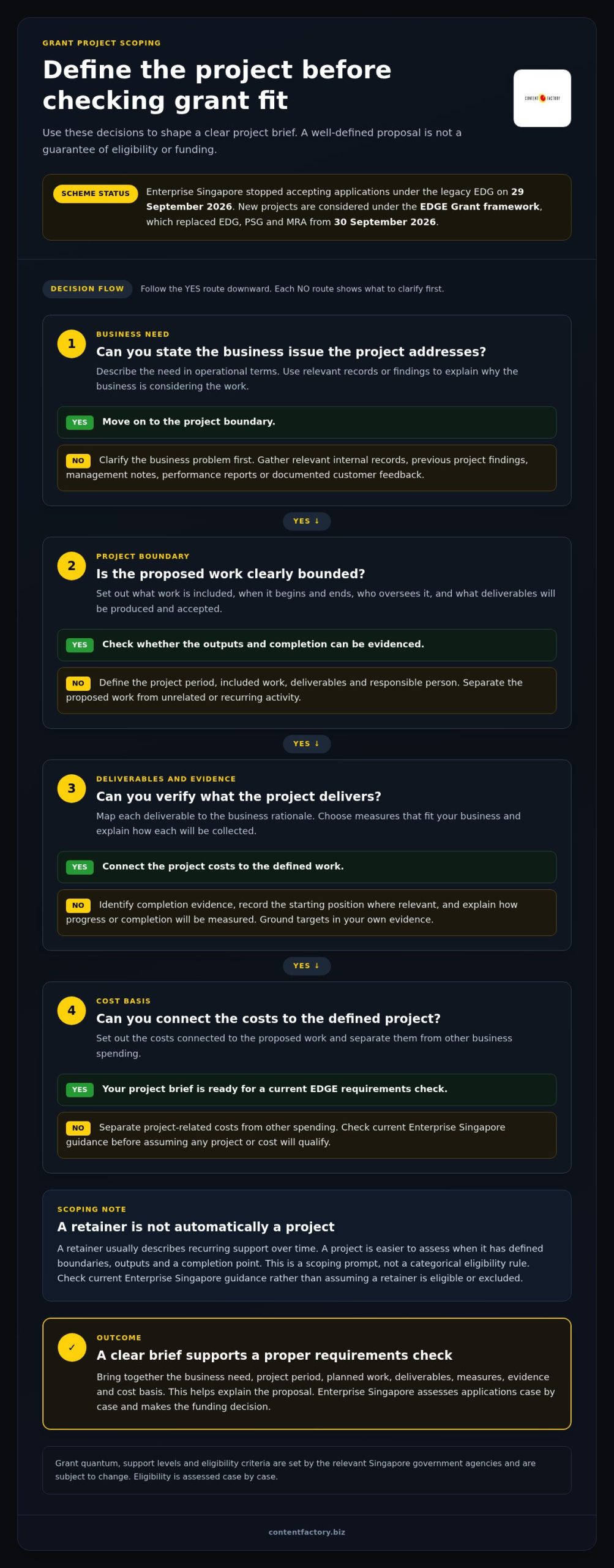
Before assessing grant fit, write down:
- The business need the proposed work addresses.
- The project period and the work included within it.
- The deliverables and how the business will verify completion.
- The costs connected to the defined work, separated from other business spending.
This framing helps you distinguish a proposed project from ongoing activity without overstating what the scheme will support. For help structuring the scope and application records, ContentFactory provides strategic grant advisory and financial modelling. Advisory can support preparation; Enterprise Singapore retains the decision on eligibility and funding.
How to Scope a Digital Marketing Project Before Applying for EDG
The legacy EDG is closed to new applications, so businesses planning a new project should assess it under the current EDGE Grant framework. The scoping discipline is still useful: using EDG grant for digital marketing was never just a matter of naming a marketing expense. A clear project brief connects a business need to defined work, outputs, measures and evidence. It also gives you a sound basis for checking the relevant current Enterprise Singapore requirements.
Turn a business problem into a defined project
Start with the business issue, stated in operational terms. For example, your records may show that your organisation has no consistent way to assess whether its digital marketing activity is reaching its intended business audience. That observation describes a problem; it does not promise that a funded project will produce more leads, revenue or conversions.
Next, set the project boundary. Specify what work is proposed, when it begins and ends, what deliverables will be produced, and who is responsible for overseeing and accepting them. Separate this defined work from unrelated or recurring activity, so the project does not become an open-ended list of marketing expenses.
Choose measures that show progress or completion and make sense for your business. These might include whether agreed deliverables are completed, whether a documented review process is in place, or whether the business can compare a relevant measure before and after the project. Record the starting position and explain how each measure will be collected. Targets should be grounded in your own evidence, not invented to make the proposal sound more compelling.
Build a clear project rationale and evidence base
Your rationale should show why the business is considering the project and how its planned outputs address the stated need. Collect information that already supports that explanation, such as relevant internal records, previous project findings, management notes, existing performance reports or documented customer feedback. Use only evidence that relates to the business problem and proposed scope.
Then map each deliverable to the rationale. If the project proposes a structured assessment, for instance, explain what business question it will answer and what documented output the organisation expects to receive. This is more useful than a broad objective such as “improve marketing”, because it lets a reviewer understand the proposed work without assuming a particular commercial result.
Keep a concise project brief with the problem, baseline, scope, outputs, measures, timing, responsibilities and evidence in one place. Check Enterprise Singapore’s current scheme instructions for applicable requirements. The Enterprise Development Grant Official Guidelines page relates to the legacy EDG; use it as background, not as confirmation of current EDGE requirements. For broader planning context, the EDG advisory guide for Singapore SMEs can help you organise the grant-planning questions to resolve.
If you need support turning a proposed project into a documented scope and evidence plan, you can discuss your grant preparation needs with ContentFactory. Advisory can help clarify the proposal and records; Enterprise Singapore makes the funding decision.
Compare EDG Project Preparation Options Without Assuming Approval
The right preparation route depends on the project’s clarity and your team’s capacity, not on a promise of approval. The legacy EDG is closed to new applications. If you’re using EDG grant for digital marketing as a planning reference, assess new projects against the current EDGE Grant requirements and Enterprise Singapore’s latest instructions.
Compare your options against four practical questions: Is the scope clear? Can someone in your organisation coordinate the work? Is the evidence ready? Who will keep records as the project progresses?
- Internal preparation: Your team develops the scope, gathers supporting information and manages the application. This can suit a clearly bounded project when someone has time and responsibility to coordinate it.
- Focused grant advisory: An adviser helps structure the project case, review cost assumptions and prepare application documentation. Your organisation still owns its project information, decisions and records.
- Broader project support: This may combine grant preparation with assistance planning project delivery and record-keeping. Consider it when internal capacity is limited or responsibilities across the project need clearer definition.
These are preparation choices, not indicators of whether Enterprise Singapore will approve an application. Support can improve the clarity and completeness of preparation, but it cannot influence agency decisions or guarantee an outcome.
When can an SME prepare the application internally?
Internal preparation may be workable when a named owner can coordinate the scope, obtain input from the people responsible for the project and keep the supporting information organised. The team should also be able to follow Enterprise Singapore’s current application instructions and distinguish project-specific costs and records from other business activity.
If information is missing or responsibilities are unclear, treat that as a preparation gap to resolve. It is not, by itself, evidence that an application will be rejected. Check current agency instructions directly before submission; scheme processes and requirements can change. For historical context, IMDA’s Productivity Solutions Grant for Digital Solutions page describes the former PSG route. It should not be taken as confirmation of current EDGE requirements.
What should grant advisory support cover?
Focused advisory can help turn a proposed project into a coherent scope, align the financial model with the planned work, and organise the application documentation. It can also help establish who will maintain project records, track deliverables and retain evidence of work completed. Those responsibilities matter after submission, not just during preparation.
Before deciding, identify the specific gap you need help with. If your team has a sound scope but needs support with costs and documentation, focused advisory may be sufficient. If the project plan and record-keeping responsibilities are also unsettled, broader support may be more appropriate. ContentFactory’s strategic grant advisory and financial modelling supports project preparation; Enterprise Singapore remains responsible for assessing applications. You can discuss your grant preparation needs to determine what support fits the work ahead.
Grant quantum, support levels and eligibility criteria are set by the relevant Singapore government agencies and are subject to change. Eligibility is assessed case by case.
Prepare the EDG Application and Plan for Project Compliance
The legacy EDG stopped accepting applications on 29 September 2026. For a new project, use Enterprise Singapore’s current EDGE Grant instructions, not an old EDG checklist. Before committing to activities or costs, verify the application timing and current requirements directly with Enterprise Singapore. A well-organised file is useful, but it does not establish eligibility or guarantee support.
What information should you organise before submission?
Build one consistent project file before entering details into the application. Bring together the project brief, business rationale, planned deliverables, cost information, responsibilities and evidence that supports the stated need. Use Enterprise Singapore’s current checklist to confirm the exact forms and supporting documents for your application. Don’t assume that a document used for an earlier EDG application still applies to EDGE.
Then check the information across every item. The project period, scope, costs and deliverables should tell the same story in the application and supporting materials. If an estimate or assumption changes, update the relevant records and explain the basis for the figure. Clear version control helps prevent different drafts from presenting conflicting project details.
Keep the preparation sequence practical:
- Confirm the current scheme instructions and application timing.
- Match the project brief and rationale to the proposed work.
- Reconcile cost information with the scope and supporting evidence.
- Assign an owner to review the final set for consistency.
This is particularly useful when you’re using EDG grant for digital marketing as a planning reference, because materials can span internal notes, supplier documents and cost assumptions. Treat the sequence as an internal control, not as a substitute for Enterprise Singapore’s requirements.
How should you manage records after approval?
If Enterprise Singapore approves a project, organise delivery records around the approved scope and current agency instructions. Retain relevant project and expenditure records, track completed work against planned deliverables, and make responsibilities clear before delivery starts. Ask the project owner to record what was completed, when, and which supporting evidence is retained.
Changes deserve careful handling. If delivery, costs or scope need to change, document the reason and check the applicable agency instructions before proceeding. Don’t assume a change is covered simply because it appears related to the original project. Keep claims information aligned with the approved project and the evidence of actual delivery.
A simple record structure can help: keep the approved project details, correspondence, delivery evidence and expenditure records together, with a clear owner for each. ContentFactory’s post-approval grant audit and compliance support focuses on compliance planning and project records. For help preparing an application file and planning those controls, Contact Us.
Grant quantum, support levels and eligibility criteria are set by the relevant Singapore government agencies and are subject to change. Eligibility is assessed case by case.
Get Practical EDG Advisory for a Digital Marketing Project
The legacy EDG stopped accepting applications on 29 September 2026. If you’re planning a new project, use Enterprise Singapore’s current EDGE Grant guidance rather than relying on older EDG material. The value of advisory is practical: it helps organise the project rationale, scope, costs, application documents and delivery records. Enterprise Singapore alone assesses applications and decides whether to provide support.
What does a structured advisory engagement help you organise?
A structured engagement connects the business need to the proposed project and the records that will support its delivery. It can help you clarify the project boundaries, map deliverables to the rationale, review financial assumptions and organise the application documentation. It can also establish who is responsible for preparing information, monitoring delivery and retaining relevant records if the project proceeds.
That preparation is useful only when it reflects your actual project. Advisory does not create eligibility, guarantee funding or influence Enterprise Singapore’s assessment. Your organisation remains responsible for the accuracy of information it provides and for following current agency requirements. The agency’s decision is separate from the quality of the support you receive.
ContentFactory provides strategic grant advisory, financial modelling, application documentation and post-approval compliance support. Mayuresh Godse is a Singapore Certified Management Consultant. The credential belongs to him as an individual, not to the firm. To understand the wider context for Singapore government grant consulting, distinguish historical EDG guidance from current scheme instructions before using any older planning resource.
What should you bring to a first discussion?
Bring a short description of the business problem, a draft outline of the proposed project and any available cost information. You don’t need a polished application to identify what needs work. A rough scope can help surface unclear deliverables, assumptions that need evidence and responsibilities that have not yet been assigned.
- Your project objective and the reason the business is considering the work.
- A draft scope, proposed outputs and an indicative timeline.
- Available cost details and the assumptions behind them.
- Questions about current Enterprise Singapore requirements or application timing.
Use the discussion to separate questions that advisory can help resolve from those that require the agency’s current guidance. For broader scheme information, consult Enterprise Singapore’s official materials directly; a guide to the former EDG should not be treated as confirmation of EDGE requirements.
ContentFactory can help organise project preparation and plan for post-approval records, without promising or influencing an agency decision. To discuss your project, Contact Us to Book a Strategic Consultation.
Grant quantum, support levels and eligibility criteria are set by the relevant Singapore government agencies and are subject to change. Eligibility is assessed case by case.
Set Your Next Step Around the Current Grant
Before you commit to a project, make one decision: is the scope clear enough for your team to explain, cost and track? If not, resolve the gaps first. Check Enterprise Singapore’s current scheme guidance, then use your project brief to identify what needs clarification. The phrase using EDG grant for digital marketing may still appear in searches, but legacy EDG references should not replace current requirements for a new application.
Grant preparation is about making an informed decision, not assuming an outcome. You can assess your readiness internally or seek structured support for the parts that need attention. Either way, keep the agency’s assessment separate from the work of preparing a sound project case and maintaining records.
If you’d like to discuss your project scope, financial assumptions or documentation needs, Contact Us to Book a Strategic Consultation. A clear next step can help you move forward with greater confidence, while keeping the funding decision where it belongs: with Enterprise Singapore.
Grant quantum, support levels and eligibility criteria are set by the relevant Singapore government agencies and are subject to change. Eligibility is assessed case by case.
Frequently Asked Questions
Can an EDG grant support a digital marketing project?
Not under the legacy EDG for new applications. Enterprise Singapore stopped accepting EDG applications on 29 September 2026. If you’re considering using EDG grant for digital marketing, assess a new project under the EDGE Grant, which replaced EDG, PSG and MRA from 30 September 2026. EDGE may support qualifying digital initiatives, but a project example does not confirm eligibility. Check current Enterprise Singapore guidance for the applicable requirements.
Is a regular marketing retainer eligible for EDG?
There’s no sound basis to assume that a retainer is automatically eligible or excluded. A recurring service arrangement may differ from a time-bound project with defined deliverables, but the distinction alone does not determine grant fit. Identify which work is proposed as a project, what outputs it will produce and how it differs from ongoing activity. Then check the current EDGE requirements with Enterprise Singapore.
How much EDG funding can a qualifying digital initiative receive?
For legacy EDG applications submitted before 29 September 2026, Enterprise Singapore’s support for eligible SMEs was up to 50% of qualifying costs. New projects fall under EDGE: eligible SMEs may receive up to 70% support, while eligible non-SMEs may receive up to 50%, depending on the activity. Some pre-approved digital marketing packages may receive up to 50% for eligible SMEs. These are not guaranteed rates.
What should I prepare before applying for EDG?
For a new application, prepare for the current EDGE process rather than relying on an old EDG checklist. Gather a concise project outline, the business rationale, planned outputs, cost assumptions and available evidence. Make sure the information is consistent across your materials, then follow Enterprise Singapore’s current checklist for exact forms and supporting documents. Keep a record of questions that need agency clarification before submission.
Can a business start the project before receiving an EDG decision?
Don’t assume that starting early will preserve eligibility for support. Enterprise Singapore’s current instructions determine application timing and how project commitments are treated. Confirm those points before signing agreements, incurring costs or beginning work. EDGE support is provided on a reimbursement basis: the company completes the project and pays the costs before submitting a claim. Reimbursement does not mean every project cost will qualify.
What happens if the project scope changes after EDG approval?
A change can affect how delivery aligns with the approved project, so don’t assume revised work or costs remain covered. Record what has changed and why, and check Enterprise Singapore’s current instructions for how to handle the proposed variation before proceeding. Keep the approved scope, relevant correspondence, delivery evidence and expenditure records together. The agency determines how changes affect support and claims.
Grant quantum, support levels and eligibility criteria are set by the relevant Singapore government agencies and are subject to change. Eligibility is assessed case by case.

Article by
Mayuresh Godse
Mayuresh Godse is a Singapore Certified Management Consultant and Business Strategist specializing in Sustainability, ESG, AI-driven Digital Transformation, and business growth. Based in Singapore, he writes about Sustainability, Digital Innovation, Business Strategy, and Content Marketing for global audiences.
Disclaimer
This article is provided by ContentFactory for general information only and is not legal, tax, accounting or financial advice. Regulations and government scheme criteria change; grant eligibility and quantum are set by the relevant Singapore agencies and assessed case by case, with no outcome guaranteed. Verify current requirements before acting.