

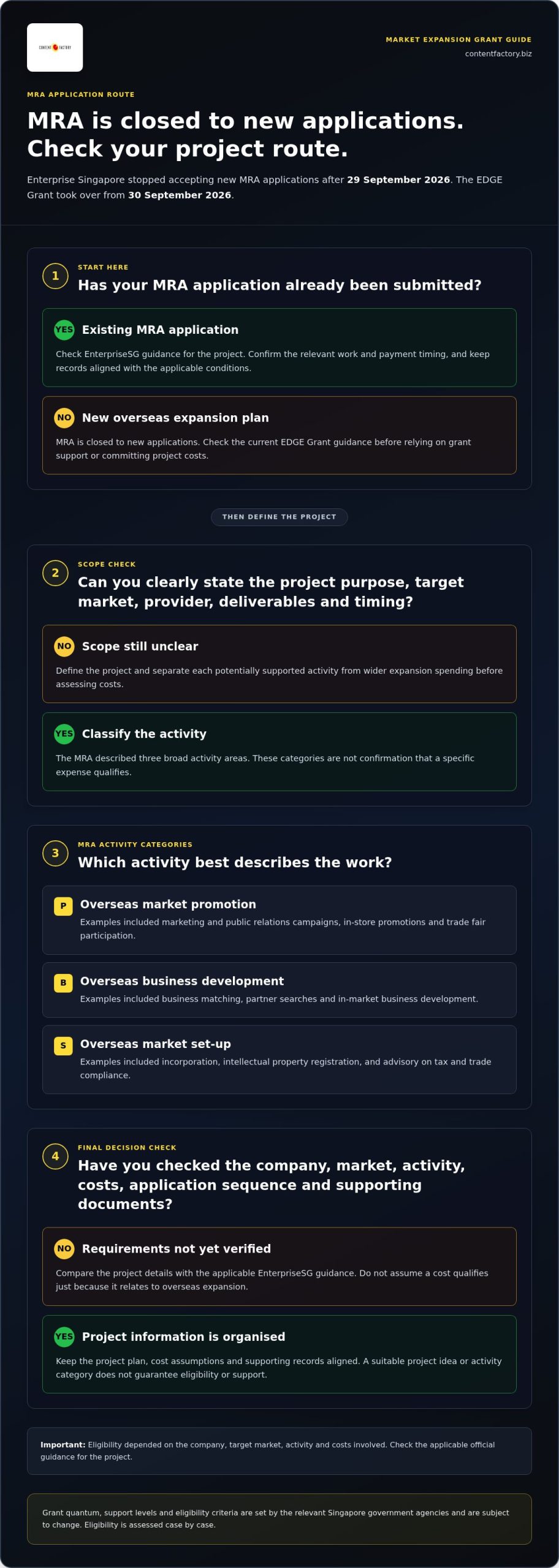
The MRA grant for market expansion is no longer open to new applications. Enterprise Singapore stopped accepting applications after 29 September 2026, with the EDGE Grant taking over from 30 September. If you’re planning overseas project costs now, first establish which scheme applies before making commitments.
That timing matters. The MRA supported eligible third-party costs across overseas market promotion, business development and market set-up, but fitting an activity into a category was only one part of assessing a project. Company and market eligibility, application timing and supporting documents also mattered. For projects already submitted under MRA, work and payment timing remain important to check against EnterpriseSG’s guidance.
This article explains the MRA’s purpose and broad activity categories, outlines the factors to verify when assessing project fit, and identifies the information that helps define a clear scope and prepare supporting documentation. It also puts the scheme’s closure in context, so you can distinguish MRA projects already in progress from plans that need to be considered under the current grant framework.
Grant quantum, support levels and eligibility criteria are set by the relevant Singapore government agencies and are subject to change. Eligibility is assessed case by case.
Key Takeaways
- The MRA grant for market expansion covered eligible overseas promotion, business development and market set-up activities, subject to Enterprise Singapore’s criteria.
- A suitable project idea alone doesn’t establish eligibility. Check your company and target market against the current official requirements.
- Before committing costs, clarify your project scope and verify the applicable scheme, application sequence and required documents with Enterprise Singapore.
- Keep project plans, cost assumptions and supporting records aligned so you can manage documentation and any post-approval compliance obligations.
- Structured financial modelling and grant documentation support can help you prepare a clearer application and maintain orderly project records.
What the MRA grant for market expansion is designed to support
The Market Readiness Assistance (MRA) Grant supported eligible Singapore businesses with certain costs for expanding into new overseas markets. Enterprise Singapore administered the programme. EnterpriseSG stopped accepting new MRA applications after 29 September 2026, and the EDGE Grant took over from 30 September 2026. If you’re planning a project now, check the current scheme guidance before relying on grant support.
Definition: The MRA Grant was an Enterprise Singapore programme that supported eligible business development, promotion and set-up activities in new overseas markets, subject to the scheme’s criteria.
For an official account of the programme and its requirements, consult Enterprise Singapore’s MRA Grant guidance. It is the reference for understanding MRA conditions and for distinguishing them from the requirements of a current funding scheme.
What the Market Readiness Assistance grant was for
The MRA grant for market expansion covered eligible costs across three broad areas: overseas business development, overseas market promotion and overseas market set-up. These categories were intended to support defined activities in a new overseas market, not expansion spending without limits.
Eligibility depended on the company, target market, activity and costs involved. Since the MRA is closed to new applications, use EnterpriseSG’s current guidance to understand requirements for existing MRA projects and the EDGE Grant for new plans. ContentFactory’s strategic grant advisory and financial modelling can help organise grant project assumptions and documentation.
What the MRA grant does not replace
A grant isn’t a substitute for a viable project with a defined scope, budget and delivery plan. An activity that appears to fit a broad category doesn’t automatically meet the scheme criteria or guarantee support.
Co-funding, where applicable, isn’t automatic reimbursement. It is subject to assessment and the relevant terms, and it doesn’t mean every overseas expansion cost is covered. Separate potentially eligible activities from wider project spending, then verify the applicable requirements before committing funds.
Grant quantum, support levels and eligibility criteria are set by the relevant Singapore government agencies and are subject to change. Eligibility is assessed case by case.
Which overseas expansion activities may fit the MRA grant
Enterprise Singapore grouped MRA support into three areas: overseas market promotion, overseas business development and overseas market set-up. These categories describe the programme’s broad scope, not a guarantee that a particular expense qualifies. Since EnterpriseSG stopped accepting new MRA applications after 29 September 2026, these categories are most relevant to understanding existing MRA projects; check current EnterpriseSG guidance for new plans under the EDGE Grant.
Promotion and business development activities
Promotion covered activities to raise awareness or promote a business in the target market. EnterpriseSG’s examples included marketing and public relations campaigns, in-store promotions and trade fair participation. Business development covered work such as business matching, partner searches and in-market business development. Treat these as examples of broad activity types, not confirmation that a specific supplier, expense or proposal is eligible.
To classify a planned project, define its purpose, target market, deliverables, provider and timing. For instance, distinguish the cost of participating in a trade fair from other costs associated with entering that market. A clear scope helps you see which activity category may be relevant and identify which details need checking. The Enterprise Singapore’s MRA Grant page is the authoritative reference for scheme-specific conditions and activity rules.
Overseas set-up costs and project boundaries
The set-up category covered activities such as incorporation, intellectual property registration and advisory on tax and trade compliance. For businesses seeking specialized trademark support when entering regional markets like Malaysia, check out Henry Goh & Co. These examples describe the programme’s broad scope. They aren’t legal or tax advice, nor do they establish that every related expense would qualify.
- Promotion: activities intended to promote the business in the overseas market.
- Business development: activities such as business matching or partner searches.
- Set-up: activities such as incorporation or intellectual property registration.
Keep potentially supported activity separate from general expansion spending. Build a project-level cost list, describe the purpose of each item and identify the deliverable it relates to. Then compare those details with the applicable EnterpriseSG guidance and any approval conditions for an existing MRA project. Don’t assume that a cost qualifies simply because it relates to overseas expansion.
For grant preparation and financial modelling, strategic grant advisory can help organise the project scope and supporting documentation. If you need help structuring those materials, discuss your grant preparation needs.
How to assess whether your company and project may qualify
A relevant overseas expansion idea does not, by itself, establish eligibility. Enterprise Singapore assessed the MRA Grant against both company-level criteria and project requirements. The distinction matters now: EnterpriseSG stopped accepting new MRA applications after 29 September 2026, so these checks are relevant to understanding existing MRA projects, not a basis for assuming a new project qualifies under the EDGE Grant.
Check company eligibility against current agency criteria
EnterpriseSG’s published MRA criteria included the following company and market checks. Treat them as MRA-specific, and verify the rules that apply to your project with the agency:
- Your business must be registered and operating in Singapore.
- At least 30% of local equity must be held by Singaporeans or Singapore Permanent Residents.
- Group annual sales turnover must not exceed S$100 million, or group employment size must not exceed 200 employees.
- The target country must meet EnterpriseSG’s “new market” definition: the company’s annual sales there must not have exceeded S$100,000 in any of the preceding three years.
EnterpriseSG also stated that a company previously supported for a market could re-apply if sales in that market remained below the stated threshold. But the MRA is closed to new applications, and eligibility under another scheme should not be inferred from these historical MRA criteria. SME status, a particular market choice or engaging a consultant does not establish eligibility on its own.
Test the project scope before committing
For an existing MRA project, or to assess a proposal against the scheme’s former requirements, document the target country, each activity, its deliverable, proposed cost and timing. Map each activity to an MRA category only where the agency’s guidance supports that classification. EnterpriseSG’s MRA Grant guidance is the reference point for scheme-specific criteria.
Then separate confirmed facts from assumptions. Record what your business can substantiate, such as its sales history in the target country, separately from forecasts or expectations. For each planned cost, note its purpose and supporting basis. This gives you a clearer project rationale and helps surface details that still need agency verification.
Before spending or starting work on any project already submitted under MRA, check its application status and applicable terms. EnterpriseSG’s guidance stated that applications had to be submitted before project work began or payments were made; retrospective applications were not permitted. For new plans, assess them against the current EDGE Grant guidance rather than relying on MRA criteria.
How to prepare an MRA grant application and manage compliance
Enterprise Singapore stopped accepting new MRA applications after 29 September 2026. The preparation steps below are therefore relevant to understanding past submissions and managing approved or ongoing MRA projects, not to starting a new application. For a new project, check EnterpriseSG’s current EDGE Grant application channel, sequence and document requirements before taking action.
For MRA projects, EnterpriseSG’s guidance required an application before project work began or payments were made. Retrospective applications were not permitted. Treat that timing as a scheme-specific condition, and use the current agency instructions for any new funding application.
Prepare a clear project scope and supporting documents
A well-defined scope connects the business need to the proposed activities and the outputs they are intended to produce. Set out the target market, project boundaries, planned activities, deliverables and cost assumptions. Keep the description consistent across the project rationale, quotations and other supporting records.
Checklist: Align your project scope, supporting evidence, cost assumptions and record-keeping before submission.
- Describe the business need and the specific activities in scope.
- Identify the intended deliverables and distinguish project costs from wider business spending.
- Organise quotations and cost assumptions in line with the applicable agency instructions.
- Check that dates, activity descriptions and figures agree across the documents.
This is a preparation framework, not an official document list. Requirements can differ by scheme and project. Verify the current application channel, submission sequence and required documents directly with EnterpriseSG before relying on any checklist.
Plan for post-approval records and grant claims
Approval isn’t the end of the compliance process. For an approved MRA project, follow the conditions in the approval and EnterpriseSG’s current instructions for project delivery, evidence, claims and any audit requirements. Keep records organised as the work proceeds, rather than trying to reconstruct the project after completion.
Record actual project activity and costs against the approved scope, and retain the supporting evidence required under the applicable terms. If a proposed change could affect the scope or costs, consult the agency’s instructions before treating it as part of the approved project. Don’t assume that a cost is claimable merely because it appears in an earlier plan.
Structured strategic grant advisory and financial modelling can help organise project assumptions and documentation. For support with grant preparation or compliance, Contact Us.
Grant quantum, support levels and eligibility criteria are set by the relevant Singapore government agencies and are subject to change. Eligibility is assessed case by case.
How ContentFactory supports MRA grant preparation and compliance
Grant support is not about promising an outcome. It is about making the project scope, financial assumptions and supporting records clear, consistent and aligned with the applicable agency requirements. Since Enterprise Singapore stopped accepting new MRA applications after 29 September 2026, new projects should be assessed against the current grant framework, while existing MRA projects must follow their approval conditions.
ContentFactory provides Singapore government grant consulting for businesses preparing grant documentation and managing post-approval compliance. Mayuresh Godse is a Singapore Certified Management Consultant with more than 25 years of consulting experience. That expertise supports structured preparation, not influence over EnterpriseSG or its assessment decisions.
From project idea to grant-ready documentation
A project idea needs to be translated into a defined scope before its funding assumptions can be assessed. ContentFactory’s grant advisory work helps organise the project rationale, activities, deliverables, cost assumptions and supporting materials so they tell a consistent story. For an MRA project, the relevant task may be reviewing documentation for an application already submitted or an approved project. For a new project, the applicable scheme and its current instructions must guide the preparation.
Financial modelling helps set out the project’s cost assumptions and funding requirements in a structured way. Documentation should support the scope rather than introduce conflicting descriptions or figures. ContentFactory’s strategic grant advisory and financial modelling connects these preparation tasks with the wider grant process. Its Singapore Government Grant Consulting work focuses on clear project definition and accurate records, not a promised approval.
Support after an application is approved
Once a grant is approved, the work shifts from preparation to delivery records and compliance. ContentFactory provides post-approval audit and compliance assistance to help organise documentation and track project activity against the approval terms and relevant agency instructions. This support does not replace the agency’s requirements or constitute an audit opinion.
Keep evidence and cost records as the project progresses. If a change to the scope or expenditure may affect the approved project, follow the agency’s process and instructions rather than assuming it is covered. Good record-keeping helps you account for what was delivered and supports the applicable claim or review process.
If you’re planning grant preparation or need support with post-approval compliance, book a 30-minute discovery call: Book a Strategic Consultation.
Grant quantum, support levels and eligibility criteria are set by the relevant Singapore government agencies and are subject to change. Eligibility is assessed case by case.
Build your next grant project on a clear foundation
The MRA grant for market expansion supported eligible activities across overseas promotion, business development and set-up, but a relevant activity alone never guaranteed funding. Enterprise Singapore closed MRA to new applications after 29 September 2026, so assess new projects against current EDGE Grant guidance and follow the terms that apply to existing MRA projects.
Before committing to project costs, define the scope, separate confirmed information from assumptions, and verify current scheme criteria, application instructions and supporting documents with EnterpriseSG. Keep records aligned with the approved scope and agency requirements throughout delivery.
ContentFactory supports grant preparation through strategic advisory, financial modelling, documentation and post-approval compliance assistance. Mayuresh Godse is a Singapore Certified Management Consultant with more than 25 years of consulting experience. This support helps bring structure to your preparation; it does not guarantee an agency decision.
For practical support with your grant project, Contact Us. With a clear scope and well-organised records, you can take your next steps with greater clarity.
Frequently Asked Questions
What is the MRA grant for market expansion?
The Market Readiness Assistance (MRA) Grant was an Enterprise Singapore programme supporting eligible Singapore businesses with overseas market promotion, business development and market set-up activities. It was intended for expansion into new overseas markets, subject to the scheme’s criteria. EnterpriseSG stopped accepting new MRA applications after 29 September 2026. From 30 September 2026, new plans should be checked against the current EDGE Grant guidance.
What costs can the MRA grant support?
The MRA covered eligible third-party costs within its supported categories, subject to Enterprise Singapore’s rules. Examples included promotion activities such as trade fair participation, business development services such as business matching, and set-up activities such as incorporation or intellectual property registration. These examples don’t mean every related expense qualified. The scheme is closed to new applications, so check EnterpriseSG guidance for existing MRA projects and current requirements for new funding.
How much can a business receive from the MRA grant?
Enterprise Singapore’s MRA support was capped at up to S$100,000 per company, per new overseas market, subject to eligibility and eligible costs. The cap was divided across overseas market promotion, business development and market set-up. The maximum was not an automatic award or reimbursement. EnterpriseSG stopped accepting new MRA applications after 29 September 2026, so businesses planning new projects should verify the applicable support under the current scheme.
Who may be eligible for the MRA grant?
EnterpriseSG’s MRA criteria included being registered and operating in Singapore, having at least 30% local equity held by Singaporeans or Singapore Permanent Residents, and meeting the group sales turnover or employment-size threshold. The target country also had to meet the agency’s definition of a new market. These are MRA criteria, not confirmation of eligibility for another scheme. MRA is closed to new applications; check current EDGE Grant rules separately.
Can a business apply for the MRA grant before starting its project?
Under EnterpriseSG’s MRA instructions, an application had to be submitted before project work began or payments were made. Retrospective applications weren’t permitted. However, EnterpriseSG stopped accepting new MRA applications after 29 September 2026. For an application already submitted, follow the applicable terms and agency instructions. For a new project, confirm the current EDGE Grant application process and timing requirements before starting work or making payments.
What happens if a project is approved for the MRA grant?
Approval means you need to deliver and document the project in line with the approval conditions and EnterpriseSG’s instructions. Keep records of project activities, deliverables and costs, and follow the applicable process for claims and any review requirements. Don’t assume that changes or additional costs are covered. Check the agency’s instructions if the project scope or expenditure changes, and retain supporting evidence as the work proceeds.
Can a consultant guarantee MRA grant approval?
No. A consultant cannot guarantee an agency’s grant decision or influence Enterprise Singapore’s assessment. Grant advisory can help you organise the project scope, financial assumptions and supporting documentation, and support compliance after approval. The agency assesses applications against its criteria. Be cautious of any claim that approval is certain. MRA is closed to new applications, so verify current scheme information before seeking support for a new project.
Grant quantum, support levels and eligibility criteria are set by the relevant Singapore government agencies and are subject to change. Eligibility is assessed case by case.

Article by
Mayuresh Godse
Mayuresh Godse is a Singapore Certified Management Consultant and Business Strategist specializing in Sustainability, ESG, AI-driven Digital Transformation, and business growth. Based in Singapore, he writes about Sustainability, Digital Innovation, Business Strategy, and Content Marketing for global audiences.
Disclaimer
This article is provided by ContentFactory for general information only and is not legal, tax, accounting or financial advice. Regulations and government scheme criteria change; grant eligibility and quantum are set by the relevant Singapore agencies and assessed case by case, with no outcome guaranteed. Verify current requirements before acting.