

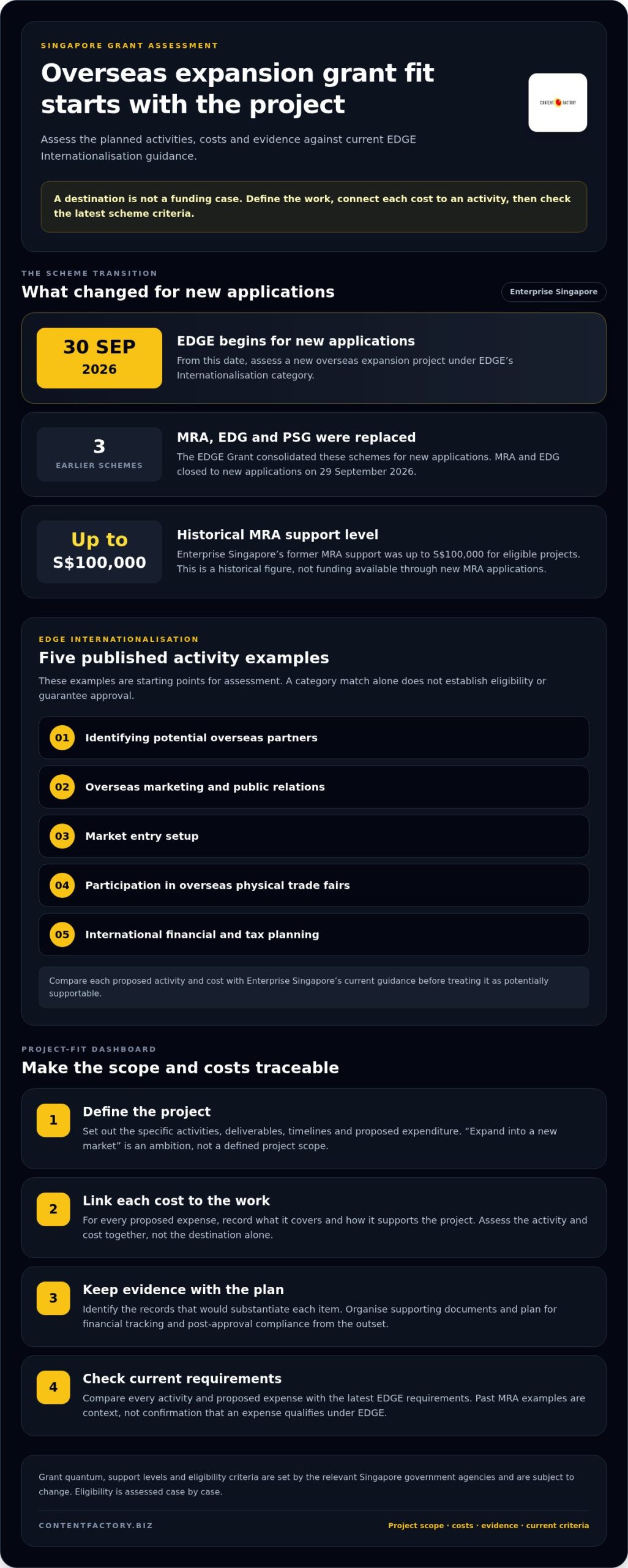
Expansion ambition alone does not determine whether a grant fits. The key question is whether your planned activities and costs align with the scheme’s current criteria. For new applications from 30 September 2026, assess the EDGE Grant’s Internationalisation category when considering Singapore government grants for overseas expansion. Enterprise Singapore has replaced MRA, EDG and PSG for new applications under this consolidated scheme.
A grant is not automatic funding. A strong expansion idea does not, by itself, establish eligibility. You need a defined project scope, costs linked to proposed activities and a clear record of the evidence behind your plan.
This guide explains how to assess potential fit under EDGE Internationalisation, compare eligible activities with planned expenditure and prepare a practical funding plan. It also covers what to organise before applying and how to plan for documentation, financial tracking and post-approval compliance from the outset.
Key Takeaways
- Assess a grant against your project’s specific activities and proposed costs, not the expansion ambition alone.
- For a new application, assess whether the project fits EDGE’s Internationalisation category and review Enterprise Singapore’s current guidance.
- Set out the project scope, cost assumptions and supporting records before preparing an application.
- Plan for clear documentation and post-approval compliance from the start.
Singapore government grants for overseas expansion: start with project costs
Before selecting a grant, write down what your business plans to deliver and the expenditure attached to each activity. An intention to enter a new country is not a defined funding case. Assess the work, its costs and the scheme criteria together.
This distinction matters in 2026. Enterprise Singapore’s EDGE Grant replaced MRA, EDG and PSG for new applications from 30 September 2026. The former MRA is no longer open to new applications. Its historical examples, including market research and local setup, explain the kinds of overseas expansion costs businesses considered under the earlier scheme. They do not confirm that an expense qualifies under EDGE.
What counts as an overseas expansion project for grant assessment?
A project is a defined set of activities, deliverables, timelines and costs. It is not simply a destination on a growth plan. “Expand into a new market” describes an ambition. A project scope should state the specific work your business proposes to undertake and the expenditure linked to it.
Under EDGE, Internationalisation is a business area for eligible activities. Enterprise Singapore’s published examples include identifying potential overseas partners, participating in overseas physical trade fairs and market entry setup. Compare each proposed activity and cost with the current scheme guidance before treating it as potentially supportable. A past MRA example is useful context, not a substitute for that assessment.
Why grant fit depends on the expense, not the destination
The destination explains where the project will take place. It does not establish whether the activities or costs meet a grant’s criteria. Two businesses targeting the same country may propose different work, budgets and deliverables. Each must assess its own project against the relevant guidance from Enterprise Singapore.
Grant fit means alignment between a defined project scope, its proposed expenses and the scheme’s current eligibility criteria. Apply this test before estimating funding or committing to an application. A relevant-sounding scheme does not establish that your business or every budget item is eligible, and no scheme guarantees approval.
For each proposed expense, record what it covers, how it supports the project and what evidence would substantiate it. Then compare the item with the latest EDGE requirements. This gives you a sound basis for deciding whether to assess the project further. Grant assessment and financial modelling can help connect the scope, expenses and funding assumptions without treating approval as assured.
Grant quantum, support levels and eligibility criteria are set by the relevant Singapore government agencies and are subject to change. Eligibility is assessed case by case.
How MRA and EDG may relate to overseas expansion projects
MRA and EDG are useful reference points when reviewing older grant guidance, but they are no longer open to new applications. Enterprise Singapore closed new applications for both schemes on 29 September 2026. From 30 September 2026, EDGE replaced MRA, EDG and PSG for new applications. For a new project, assess it against current EDGE requirements rather than relying on the previous schemes’ criteria.
The former schemes help explain how grant assessments distinguished overseas expansion work from capability or digital projects. MRA was directly associated with eligible overseas expansion expenses, while EDG related to qualifying capability and digital work. Applications submitted before the change and projects already under way may be subject to different rules. Check the project’s status and the applicable Enterprise Singapore guidance before relying on past support levels.
When to assess the Market Readiness Assistance grant
Under the former MRA, eligible overseas expansion, market research and local setup expenses were examples relevant to assessment. Enterprise Singapore’s MRA support was up to S$100,000 for eligible projects, subject to the scheme’s criteria. This is a historical support level, not funding available through new MRA applications.
MRA was not a blanket allowance for every internationalisation cost. The activity, expense and application had to meet the requirements that applied at the time. For a new application, assess the project against EDGE’s current Internationalisation guidance instead.
When EDG may be relevant to a project
The former EDG could be relevant to qualifying core capability or digital initiative components, rather than overseas expansion as a broad ambition. Enterprise Singapore’s former support was up to 50% for eligible core capability and digital projects, and up to 70% for qualifying sustainability projects, subject to eligibility. These are historical EDG support levels, not rates for new applications.
Keep distinct project components clear. Combining an expansion plan with a capability or digital project does not make every cost eligible. The former EDG’s focus on capability-building projects can help distinguish its historical purpose from the current assessment of a new application.
For a new overseas expansion application, assess whether the project and proposed expenditure fit EDGE’s Internationalisation category. Enterprise Singapore lists activities such as identifying potential overseas partners, overseas marketing and public relations, market entry setup, participation in overseas physical trade fairs, and international financial and tax planning. Check each activity against current guidance. A category match alone does not establish eligibility or guarantee approval.
Keep a record of the project activities, associated expenses and supporting documents, then compare each item with Enterprise Singapore’s latest requirements. ContentFactory provides grant assessment and financial modelling to help organise this work. Contact us to discuss your project.
Compare grant options against the project you plan to deliver
For new applications in 2026, compare your project with the EDGE Grant’s Internationalisation category. MRA and EDG help explain how earlier grant assessments distinguished overseas expansion work from capability or digital projects, but neither scheme is open for new applications. Enterprise Singapore’s current criteria, not a legacy scheme description or a consultant’s preference, determine whether a proposed project may fit.
Historically, MRA was the more direct reference point for eligible overseas expansion expenses. EDG addressed a different project purpose, such as qualifying core capability or digital work. If your plan contains both types of activity, assess them as distinct components. Do not assume that the overall expansion objective makes every cost eligible under one scheme.
A practical comparison without assuming eligibility
Use these four checks to organise your assessment. They help you compare project components without treating a possible fit as confirmation of eligibility.
- Project purpose: State what each component is intended to deliver. Is it an overseas expansion activity or a separate capability or digital initiative?
- Proposed costs: List each expense against the activity it supports. Avoid grouping unrelated items under a broad expansion budget.
- Scheme fit: Check current EDGE Internationalisation guidance for the proposed activity. Treat MRA and EDG descriptions as historical context only.
- Evidence required: Identify records that substantiate the scope, cost and delivery of each component. Then review the agency’s current documentation requirements.
This separation matters when a business plan includes several workstreams. Describe and assess a partner identification activity on its own terms. A distinct digital initiative needs its own scope and cost rationale. Do not assume a project can be divided across schemes or that costs can be claimed twice. Confirm the applicable conditions with Enterprise Singapore.
Questions to resolve before choosing a scheme
Before selecting a route, make sure you can describe the project outputs and proposed expenses clearly. Then confirm that current Enterprise Singapore requirements support assessing the chosen scheme. If you cannot connect a cost to a defined activity and supporting evidence, refine the project file before making funding assumptions.
For other named schemes, including PSG, CTC or CCP, do not infer overseas expansion support from the scheme name or a past project example. Assess them only where current agency guidance confirms a relevant fit for the specific project. The same discipline applies to any grant comparison: a destination or broad business objective does not establish eligibility.
Grant advisory and financial modelling can help organise project components, cost assumptions and supporting records against current criteria. That preparation supports a reasoned decision about whether to proceed, without implying an agency outcome. ContentFactory provides strategic grant advisory and financial modelling for this process. Contact us to book a Strategic Consultation.
Prepare a clear grant project scope and supporting records
A funding plan needs a project file that stands on its own. Set out what the business intends to deliver, who is responsible, the proposed costs and how the work will be evidenced. Assess potential support against Enterprise Singapore’s latest EDGE Grant requirements, while keeping the project rationale clear whether or not funding is approved.
Keep the business case separate from grant assumptions. The project should explain its purpose and expected outputs. Any estimate of grant support should remain conditional on current criteria and agency assessment. This separation makes it easier to revise funding assumptions without obscuring the project plan.
Build the project scope and financial model
Describe each activity in practical terms. Record its intended output, the responsible person or team, its proposed cost and its connection to the project objective. Avoid broad budget lines that combine unrelated work. The link between an activity and its cost should be easy to follow.
Use financial modelling to show how estimates were developed and which assumptions they depend on. Separate the full project budget from costs being assessed as potentially eligible. Do not present tentative estimates as confirmed costs or include unsupported forecasts.
Organise application evidence and compliance records
Create a record structure before submitting. Keep the project scope, cost workings, supporting material, internal approvals and later records of activity and expenditure organised together. These are practical categories, not a fixed document list. Enterprise Singapore’s current guidance determines the exact documents, submission process and any subsequent claim requirements.
Use consistent descriptions across the scope, budget and records so that changes can be tracked and explained. If the project is approved, maintain records of delivery and expenditure in line with the applicable conditions. Compliance planning belongs in the project workflow, not just at claim stage.
Before submitting, review the latest EDGE guidance and align your scope, assumptions and evidence with the requirements that apply. ContentFactory supports grant advisory, financial modelling and post-approval compliance planning. Contact us to apply this structure to your project.
Turn grant assessment into a compliant next step
Assess the project as it stands: define the scope, connect proposed costs to activities, and compare both with Enterprise Singapore’s current criteria. For new applications, use the EDGE Grant’s Internationalisation guidance rather than relying on former MRA or EDG requirements. A relevant category is a reason to assess fit, not proof of eligibility or a promise of approval.
This gives you a clearer basis for deciding whether to proceed. Keep the business case focused on the project’s purpose and expected outputs. Record grant-related assumptions separately, so a change in funding assumptions does not obscure the project rationale or cost structure.
What grant advisory can help you organise
Grant advisory can help you review potential scheme fit, organise the application logic and build a financial model that connects project scope, proposed expenses and funding assumptions. The aim is to make the basis for your assessment clear and documented. It cannot influence Enterprise Singapore’s assessment or guarantee an outcome.
If a project receives support, compliance planning continues beyond submission. Keep project records organised so activities, expenses and subsequent claims can be substantiated in line with the applicable conditions. The specific records and processes depend on current agency requirements. ContentFactory provides post-approval grant compliance support as part of this planning.
Mayuresh Godse is a Singapore Certified Management Consultant. ContentFactory’s strategic grant advisory and financial modelling connect project assessment with preparation and documentation, without implying any agency influence.
Make the next step a focused project discussion
Before a discussion, bring a draft project scope, a breakdown of proposed cost categories and a short list of unresolved eligibility questions. Note which activities are confirmed, which assumptions need checking and where you need current agency guidance. This gives the conversation a practical starting point.
For Singapore government grants for overseas expansion, the useful outcome is a grounded assessment of what to verify and prepare, not a prediction of approval. ContentFactory can help structure the grant assessment, financial model and compliance records around your project.
Grant quantum, support levels and eligibility criteria are set by the relevant Singapore government agencies and are subject to change. Eligibility is assessed case by case.
Set a clear decision point for your expansion plan
Before committing to a funding route, agree internally on what evidence would make the project ready to proceed. That could mean a settled scope, traceable cost assumptions and confirmation that the proposed activities can be assessed against current agency guidance. If those pieces are still changing, refine the plan before treating potential grant support as part of the funding decision.
This discipline gives your business a sound basis to move forward whether support is available or not. Keep the project’s commercial rationale intact, and treat any funding assumption as conditional on the relevant criteria and agency assessment. This is a practical way to approach Singapore government grants for overseas expansion without building the plan around an unconfirmed outcome.
ContentFactory can help you set out the project scope, cost assumptions and evidence needed for a grounded assessment.
Frequently Asked Questions
Which Singapore government grant is most relevant to overseas expansion?
For new applications, assess the EDGE Grant’s Internationalisation category. Enterprise Singapore introduced EDGE from 30 September 2026, replacing MRA, EDG and PSG for new applications. Fit depends on the activities and costs in your project, not simply the destination. Review Enterprise Singapore’s current guidance for the specific work you plan to undertake before deciding whether to develop an application.
Can the MRA grant support overseas market research and local setup?
Market research and local setup were examples of expenses assessed under the former MRA scheme, subject to eligibility and the applicable requirements. Enterprise Singapore closed new MRA applications on 29 September 2026. For a new application, use the current EDGE guidance instead. Existing MRA applications and ongoing projects are handled under the rules that apply to those cases.
How much MRA grant support can an eligible business receive?
Under the former scheme, Enterprise Singapore’s MRA provided up to S$100,000 for eligible projects, subject to the scheme’s requirements. This figure does not represent support available through new MRA applications, which closed on 29 September 2026. If your application was submitted before that date, refer to its applicable conditions and direct questions to Enterprise Singapore.
Can EDG support a project connected to overseas expansion?
Historically, EDG could relate to qualifying core capability or digital initiative components within a wider business plan, subject to eligibility. It was not a general overseas expansion grant, and Enterprise Singapore closed new EDG applications on 29 September 2026. For a new application, assess relevant activities under EDGE’s current Internationalisation criteria rather than assuming the former EDG rules still apply.
Does applying for a Singapore government grant guarantee approval?
No. Submitting an application does not guarantee approval, and a project’s apparent fit with a grant category is not confirmation of eligibility. Enterprise Singapore assesses applications against the requirements that apply to the scheme. Treat projected support as conditional, keep the business case viable on its own terms and avoid committing expenditure based on an assumed grant outcome.
What documents should a business prepare before a grant application?
Start with a working file containing a draft project scope, planned activities and outputs, a cost breakdown, and the assumptions behind each estimate. Add relevant supporting material, such as cost workings or quotations where available, and identify who will maintain project records. This is a preparation aid, not an official document checklist. Verify the documents and submission requirements in Enterprise Singapore’s current guidance.
What happens after a grant application is approved?
Follow the approval terms and the agency’s instructions for carrying out the project, recording expenditure and making any required claims. Keep records that connect project activities to costs incurred, and document material changes in line with the applicable conditions. Requirements vary by scheme and approval, so use the award documents and current agency guidance as the authority. Approval does not remove ongoing compliance responsibilities.
Discuss your project in a 30-minute discovery call. Book a Strategic Consultation

Article by
Mayuresh Godse
Mayuresh Godse is a Singapore Certified Management Consultant and Business Strategist specializing in Sustainability, ESG, AI-driven Digital Transformation, and business growth. Based in Singapore, he writes about Sustainability, Digital Innovation, Business Strategy, and Content Marketing for global audiences.
Disclaimer
This article is provided by ContentFactory for general information only and is not legal, tax, accounting or financial advice. Regulations and government scheme criteria change; grant eligibility and quantum are set by the relevant Singapore agencies and assessed case by case, with no outcome guaranteed. Verify current requirements before acting.